
The Architect’s Guide to Large Format Lenticular Printing

The most captivating surfaces in modern architecture don’t require a single pixel or a power outlet. While a massive digital display often feels intrusive or demanding of a visitor’s attention, a static wall can feel strangely lifeless in a high-traffic corporate lobby or retail flagship. You likely recognize this tension between the need for movement and the desire for architectural permanence, especially as over 83 percent of retail dollars continue to be spent in physical environments. Large format lenticular printing offers a sophisticated middle ground, transforming dormant surfaces into kinetic experiences that respond directly to the viewer’s stride.
Scaling this technology from a handheld postcard to a fifty-foot installation requires a shift in perspective and technical precision. This guide will help you bridge that gap. You’ll discover how to design for motion at an architectural scale, distinguish between depth and flip effects, and navigate the logistics of end-to-end fabrication. We’ll examine how these surfaces breathe life into environments, ensuring your next project moves with its audience rather than simply standing in their way.
Key Takeaways
- Learn how large format lenticular printing replaces static, lifeless walls with kinetic surfaces that respond to viewer movement without the need for digital hardware.
- Understand why viewing distance is the most critical variable when scaling 3D and motion effects for massive architectural installations.
- Compare the fluid motion of lenticular lenses with the sharp, geometric shifts of Agamographs to choose the right aesthetic for your space.
- Master the art of “thinking in layers” and discover how ambient lighting influences the clarity and impact of a large-scale visual experience.
- Move from a visionary concept to a realized installation by engaging a collaborative partner who manages the technical discipline of end-to-end fabrication.
What is Large Format Lenticular Printing?
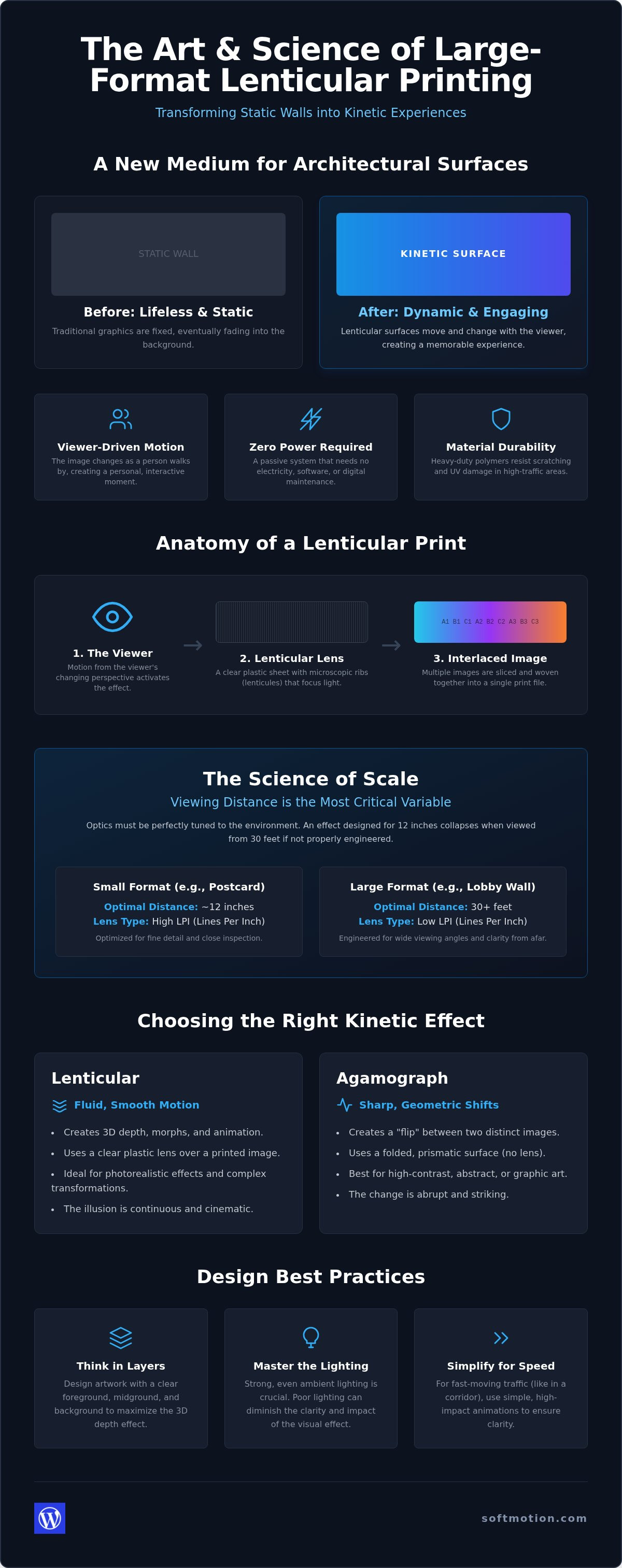
Think of a surface that breathes. Traditional graphics are static, fixed in a single moment that eventually fades into the background of a viewer’s awareness. Large format lenticular printing transforms these dormant surfaces into kinetic experiences through a specialized combination of interlaced imagery and a physical plastic lens. It’s a sophisticated medium that bridges the gap between traditional fine art and modern interactive technology. By using Lenticular printing technology, architects can turn a simple wall into a multi-dimensional narrative that evolves based on where a person stands.
Unlike digital signage, which often feels intrusive or demands attention through glowing pixels, lenticular installations are “passive-interactive.” They don’t require power, software, or maintenance. Instead, they rely on “viewer-driven motion.” The art changes only as the person walks by, creating a personal, intimate connection between the individual and the environment. This shift from a 2D image to a multi-dimensional surface allows for a unique storytelling opportunity within architectural spaces like corporate lobbies or retail flagships, where designers might also explore Ball pits to enhance the visitor experience for families.
The Anatomy of a Lenticular Print
The magic of large format lenticular printing lies in the precise alignment of the lens and the underlying artwork. Every piece begins as a series of images sliced into microscopic strips and “interlaced” into a single file. A clear, ribbed plastic lens is then laminated over this print. These ribs, or lenticules, act as magnifying glasses that isolate and project only one slice of the image at a time to the viewer’s eye as they move.
- LPI (Lines Per Inch): While small prints use high LPI for fine detail, large-scale projects often utilize a lower LPI. This allows for a wider viewing angle and better performance at the significant distances found in architectural environments. A thorough grasp of lenticular printing specifications — including how LPI interacts with viewing distance and lens geometry — is essential for achieving flawless results at architectural scale.
- Material Durability: For high-traffic areas, we prioritize heavy-duty polymers. These materials resist scratching and UV damage, ensuring the installation remains vibrant for years without the degradation seen in standard commercial printing.
Why Motion Matters in Modern Design
Humans are biologically wired to notice movement. In an era where screen fatigue is a genuine concern for designers, large-scale lenticular visuals provide a refreshing alternative. They define the rhythm of a physical space, encouraging visitors to slow down or change their pace to see the full transformation of the artwork. This kinetic engagement creates a lasting psychological impact, making a space feel alive without the cold, distracting glare of a monitor. It’s about creating a sense of wonder that feels integrated into the building’s soul rather than just being an electronic afterthought.
This human attraction to movement is why kinetic elements are increasingly popular not just in buildings, but also in event design. For those planning a corporate gala or brand activation, you might explore Per-Event Equipment Rental and Service Fees for luxury photo booth experiences that offer a similar sense of interactive wonder.
The Science of Scale: How Large Format Differs from Standard Prints
In the world of large format lenticular printing, size is more than a measurement; it’s a fundamental shift in optical physics. A handheld postcard is designed for a viewing distance of twelve inches, but an architectural mural might be viewed from thirty feet away. This change in proximity dictates every technical decision, from the thickness of the lens to the interlacing pattern of the underlying art. If the optics aren’t perfectly tuned to the environment, the intended 3D depth or motion effect collapses into a blurred, unintelligible mess.
Calculating the “sweet spot” is the first step in any large-scale installation. This is the precise distance where the viewer’s eyes receive the correct image slices to trigger a seamless transition. For a massive wall, we must account for the primary path of foot traffic. If visitors walk quickly through a corridor, the animation needs to be concise and high-impact. If they linger in a lobby, we can introduce more layers of complexity. Understanding the process for creating a lenticular print at this scale ensures that the visual illusion remains stable across the entire surface.
Viewing Distance and Lens Selection
The “viewing angle” is the specific arc within which the lenticular effect is visible; it determines how quickly a “flip” or motion occurs as you move. A billboard requires a narrow viewing angle to project a sharp image to cars passing at high speeds hundreds of feet away. Conversely, a lobby mural needs a wider angle to accommodate pedestrians walking just a few feet from the surface. The faster the viewer moves, the simpler the animation should be to maintain clarity. Designers planning 2026 installations will find that reviewing detailed lenticular printing specifications for large format sheets helps demystify the relationship between lens pitch, viewing angle, and optimal foot-traffic scenarios.
Tiling and Seamless Integration
Scaling to fifty-foot walls requires tiling multiple panels; this process demands surgical precision. Each panel must be interlaced so that the image strips align perfectly across physical seams. Even a fraction of a millimeter of misalignment will break the illusion. This is why we emphasize the importance of sub-structure preparation and custom mounting systems. These systems allow for micro-adjustments during installation, ensuring the entire wall functions as a single, cohesive lens.
Material choice also shifts at scale. Large sheets of plastic expand and contract with temperature changes, especially in outdoor environments or sun-drenched atriums. We select specific polymers that offer thermal stability to prevent the lens from warping or “walking” away from the print. This technical discipline is what separates a standard print from a permanent architectural feature. If you’re planning a complex installation, exploring our lenticular samples can help you visualize how these technical choices translate into physical impact.
Lenticular vs. Agamograph: Choosing the Right Kinetic Effect
Choosing the right kinetic medium depends entirely on the spatial choreography of your project. While large format lenticular printing uses a clear lens to create fluid transitions, the Agamograph offers a more architectural, geometric alternative. An Agamograph consists of a series of triangular prisms where two distinct images are applied to the opposing facets. This creates a sharp, binary shift as a viewer passes a corner or crosses a specific threshold. It’s an “abrupt” change that works beautifully for bold brand transformations or high-contrast messaging.
Lenticular technology provides a much smoother gradient of movement. Because the lens can handle multiple frames of animation, it allows for a gradual “reveal” that feels organic rather than mechanical. This makes it the preferred choice for complex storytelling or subtle environmental shifts. Recent research into 3D objects with lenticular lens surfaces shows how these effects can be integrated into varied geometries, further expanding the possibilities for architects who want to move beyond flat walls and into truly immersive, multi-dimensional installations.
The 3D Illusion: Creating Depth at Scale
Creating volume on a flat surface relies on “binocular parallax,” a process where each eye receives a slightly different image to simulate depth. In large format lenticular printing, this effect is most powerful in controlled environments like corporate lobbies or fine art galleries. 3D depth can be challenging in massive outdoor formats where the extreme viewing distances and unpredictable ambient sunlight can flatten the illusion. However, for interior spaces, 3D effects offer a sense of luxury and sophistication that standard graphics simply can’t match. It’s an ideal choice for lenticular art for museum exhibitions where the goal is to draw the viewer into a deep, layered world.
Motion and Flip Effects for Storytelling
Motion effects allow you to condense a narrative into a simple walk-by experience. You can choose between a “two-flip” effect, which switches between two distinct states, or a “multi-frame animation” that plays out like a short, looped film. This technique is particularly effective for retail storefronts or transit hubs where you only have a few seconds of the audience’s attention. For brands seeking to maximize this impact in advertising contexts, exploring kinetic advertising displays offers a deeper understanding of how lenticular motion can be engineered specifically for high-impact brand campaigns.
- Narrative Compression: Distill complex brand stories into three or four key visual stages.
- Hidden Information: Use specific viewing angles to reveal “easter eggs” or secondary messages that reward the curious visitor.
- Sequential Flow: Guide the eye across a long corridor by timing the animation to match the average walking speed of the crowd.
Whether you opt for the sharp transition of an Agamograph or the liquid motion of a lenticular lens, the goal is to create a dialogue between the architecture and the individual. By understanding these aesthetic differences, you can select the effect that best reinforces the rhythm and purpose of your space.
Designing for Large Format: Best Practices for Architects and Artists
Designing for large format lenticular printing requires a fundamental shift from traditional graphic design. You aren’t just creating a static image; you’re orchestrating a temporal sequence. Much like the user-centric approach taken by creative agencies such as Insight Multimedia in the digital space, we encourage architects to “think in layers” and “think in motion” from the very first sketch. For 3D effects, this means clearly separating your foreground, midground, and background elements to maximize the binocular parallax. For motion, it means understanding how colors and shapes will transition as the viewer moves. Bold shapes and high-contrast color palettes perform best at scale, as they maintain clarity even when viewed from across a busy terminal or lobby.
Lighting Considerations for Lenticular Walls
Light is the lifeblood of the lenticular lens. Without proper illumination, even the most sophisticated interlacing will fail to impress. Overhead lighting is a common pitfall; if light hits the lens at an extreme vertical angle, it can cause “ghosting,” where multiple frames appear simultaneously. We recommend positioning light sources to hit the wall at a more direct, perpendicular angle to ensure each “rib” of the lens projects only the intended image slice.
Choosing between reflective and backlit materials is equally vital. Reflective surfaces rely on ambient light, making them ideal for bright atriums. Backlit installations, however, offer a glowing, cinematic quality that excels in darker environments or as a centerpiece in a retail flagship. By controlling the light, you control the rhythm of the reveal, ensuring the kinetic effect remains sharp and purposeful throughout the day.
The Importance of Physical Samples
Digital proofs are deceptive. They can show you the “flip” on a screen, but they cannot simulate the physical sensation of walking past a massive installation. This is why physical prototyping is a non-negotiable step in successful large format lenticular printing. We utilize 1:1 scale “strip tests” to evaluate how the lens performs at the actual viewing distance of the final installation. These tests allow us to adjust the interlacing and color density before full production begins, eliminating risk and ensuring the final result matches your visionary concept.
Successful execution depends on a deep partnership between the designer and the large format lenticular manufacturer. We guide you through these technical nuances, transforming complex engineering challenges into a seamless creative journey. If you’re ready to see how your vision translates to a physical surface, contact us for a custom sample to experience the impact of our precision fabrication firsthand.
The Softmotion Approach: From Vision to Installation
Softmotion operates as a visionary guide for architects who want to push the boundaries of spatial design. We understand that large format lenticular printing is an investment in an environment’s identity. Since 1997, we’ve delivered over 1,000 projects, bridging the gap between imaginative concepts and the technical discipline required for full-scale execution. We don’t just provide a service; we offer a partnership that prioritizes clarity and craftsmanship at every stage of the journey. Before committing to a full installation, many decision-makers benefit from reviewing a detailed breakdown of large format lenticular printing cost to understand how material selection, fabrication quality, and project scale influence the overall investment.
Our process is designed to provide a sense of composure and ease. Complex projects, such as 50-foot lobby walls or international retail storefronts, require more than just technical skill. They demand rigorous lenticular installation project management to ensure that every panel aligns and every light source is optimized. This “human-first” approach has made us a trusted partner for Fortune-500 companies seeking to redefine their corporate environments through kinetic storytelling.
Custom Fabrication and Prototyping
Every installation is a bespoke creation. We don’t believe in one-size-fits-all solutions because every architectural site has unique lighting, foot traffic patterns, and structural requirements. Our fabrication process involves tailoring the specific lenticular or Agamograph effects to these environmental variables. We use high-precision, architecturally-durable materials that withstand the rigors of high-traffic spaces, ensuring the kinetic experience remains as vibrant on day 1,000 as it was on day one. This technical discipline allows us to realize potential in ordinary spaces that others might overlook.
Global Installation and Management
Executing a large-scale visual project across international borders requires meticulous logistical planning. Softmotion manages the entire lifecycle, from the initial sample and prototype to the final onsite assembly. We handle the complexities of transport and the precision of the physical hand-off, ensuring the architect’s vision is realized without compromise. It’s a controlled, professional process that removes the risk from complex artistic challenges. As we look toward the future of environmental design, we invite you to explore the potential of lenticular building facades, a new frontier where the building itself becomes a dynamic, moving canvas that breathes with its audience.
Bringing Movement to Permanent Spaces
Large format lenticular printing is more than a decorative choice; it’s a fundamental reimagining of how a building communicates with its visitors. By mastering the science of viewing distances and the art of layered design, you can transform a static wall into a kinetic narrative that breathes with every passing stride. This transition from the two-dimensional to the multi-dimensional ensures that your environment remains alive, engaging, and memorable long after the initial reveal.
Realizing such a complex vision requires more than just technical skill. It demands a partner with the discipline to manage every detail, from the first strip test to the final onsite assembly. Since 1997, we’ve delivered over 1,000 projects for Fortune-500 companies and visionary architects worldwide. We provide the security of end-to-end global installation services, ensuring your creative intent is never lost in translation. Start your visionary lenticular project with Softmotion and discover how our expertise can turn your next architectural surface into a deep, sensory experience. We look forward to guiding your vision toward its fullest potential.
Frequently Asked Questions
How large can a lenticular print actually be?
There is no functional limit to the size of an installation because we utilize a precision tiling process to combine multiple panels. While individual lens sheets typically reach up to 48 by 96 inches, our fabrication team aligns these panels with sub-millimeter accuracy to create seamless murals spanning fifty feet or more. This approach allows large format lenticular printing to scale alongside the most ambitious architectural designs without losing visual coherence or impact.
What is the best viewing distance for a large format lenticular wall?
The ideal viewing distance depends entirely on the lens pitch and the intended effect. For most architectural walls, a “sweet spot” between 10 and 30 feet ensures the transition remains sharp and the depth feels natural. We calculate this distance during the design phase to match the primary path of foot traffic in your lobby or retail space. Proper calibration prevents the visual blurring that occurs when a viewer is too close to the lens surface.
Can lenticular installations be used outdoors in extreme weather?
Lenticular installations are highly durable and can be engineered specifically for outdoor environments. We use UV-stabilized polymers and weather-resistant adhesives that withstand temperature fluctuations and direct sunlight. For projects in extreme climates, we select specific materials that account for thermal expansion and contraction. This ensures the lens doesn’t warp or delaminate, maintaining the kinetic effect through seasons of rain, wind, and significant heat.
How do I prepare my artwork for large format lenticular printing?
Successful artwork requires “thinking in layers” rather than flat compositions. You should provide high-resolution files with clearly defined foreground, midground, and background elements for 3D projects. For motion effects, we recommend using high-contrast colors and bold shapes that translate clearly through the lens ribs. Our team works collaboratively with your designers to refine these files, ensuring the large format lenticular printing process produces the most impactful visual transformation possible.
How long does a large-scale lenticular project typically take from design to installation?
A typical large-scale project moves from initial concept to final installation in approximately 8 to 12 weeks. This timeline accounts for the collaborative design phase, physical prototyping, precision fabrication, and global logistics. More complex installations involving custom mounting systems or international shipping may require additional lead time. We provide a methodical, well-paced schedule to ensure every technical milestone is met with the highest level of craftsmanship and care.
Is lenticular art more effective than digital screens for advertising?
Lenticular art offers a “passive-interactive” experience that many audiences find more engaging than digital screens. It doesn’t require electricity, software updates, or expensive hardware that can feel cold and distracting. Instead, the motion is driven by the viewer’s own movement, creating a personal connection that feels integrated into the architecture. It’s an elegant solution for spaces where you want to inspire wonder without the screen fatigue common in modern environments. Brands looking to apply this principle specifically to advertising campaigns can find a comprehensive framework in our guide to kinetic advertising displays and high-impact lenticular motion.
While lenticular surfaces excel in fixed locations, brands looking to take this level of visual scale onto the streets often turn to specialists like Mobile Outdoor Media, who provide large-scale mobile outdoor media solutions designed to capture attention in high-traffic urban environments.
What maintenance is required for a large format lenticular installation?
Maintenance for these installations is remarkably minimal compared to digital signage. The durable plastic surface can be cleaned with a soft microfiber cloth and a mild, non-abrasive detergent to remove dust or fingerprints. Because there are no electronic components to fail, the primary focus is simply keeping the lens clear of debris. This low-maintenance profile makes it an ideal choice for high-traffic corporate and retail environments where operational ease and longevity are priorities. For businesses in these sectors that also require high-quality, rapid-turnaround collateral, London City Print offers expert professional printing to complement your permanent architectural features.