
Fine Art Lenticular Prints: 2026 Curator’s Guide
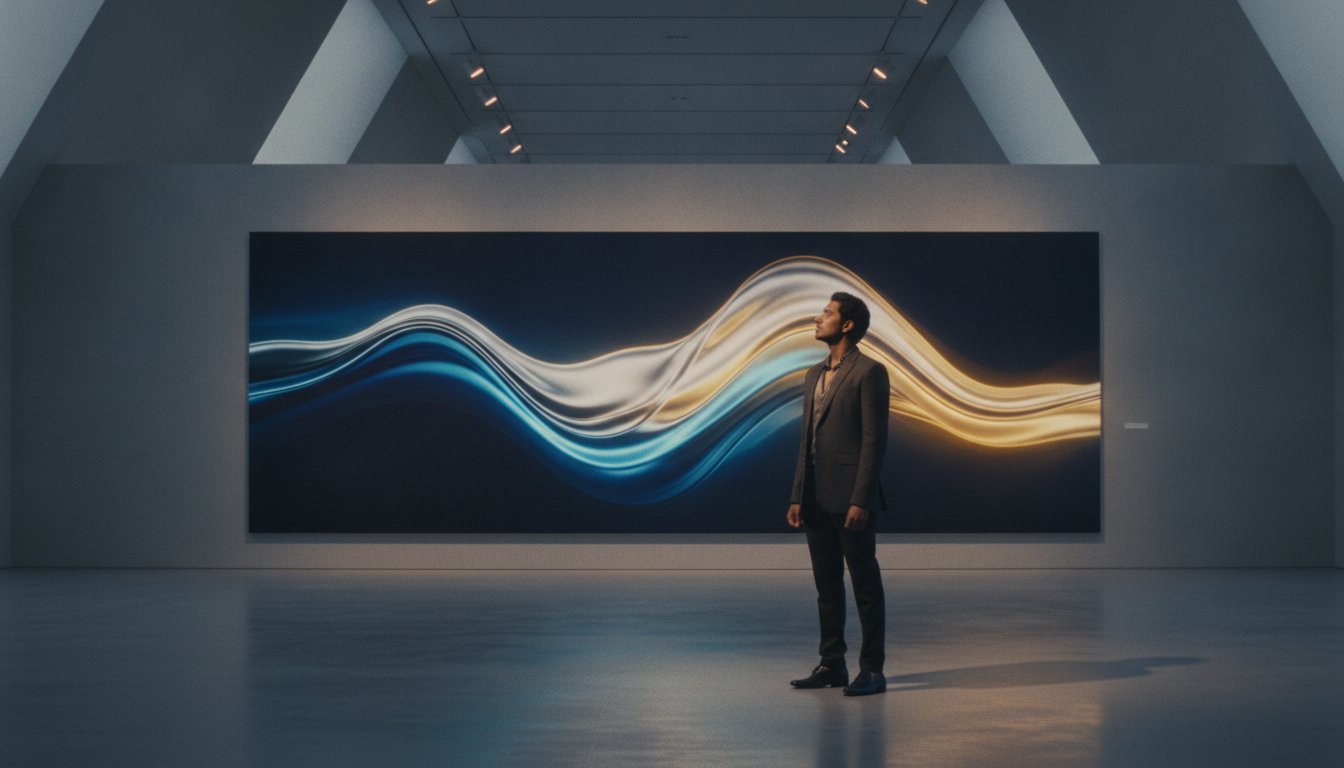
In an era defined by digital fatigue, the most profound movement in a gallery often requires no power source at all. Static walls no longer suffice for modern audiences who crave a sensory journey through space. You likely recognize the challenge of creating immersive experiences that don’t rely on fragile hardware or constant software updates. Integrating high-precision lenticular art for museum exhibitions offers a rare solution. It transforms a fixed surface into a fluid, motion-driven narrative that reacts to the visitor’s physical presence through optical transformation rather than pixels.
This 2026 curator’s guide clarifies how to elevate your institution’s offerings with durable, large-format prints that meet strict archival standards. We’ll address your most pressing concerns, from managing specific lighting angles to selecting manufacturers capable of true museum-grade fabrication. You’ll gain a clear roadmap for planning installations that withstand high-traffic environments while maintaining the aesthetic integrity of fine art. We will also examine the practical logistics of 2026 exhibition planning, where industry forecasts project a 4% to 5% increase in overall exhibit costs, ensuring your visionary projects remain both ambitious and pragmatically sound.
Key Takeaways
- Understand the critical distinctions of museum-grade fabrication, specifically the use of UV-stable lenses and archival inks for enduring quality.
- Contrast the lifecycle costs of analog movement against digital displays to find a more sustainable path for immersive storytelling.
- Learn to optimize spatial planning for lenticular art for museum exhibitions by mastering viewing angles and point-source lighting requirements.
- Discover how physical viewer movement triggers a unique “magic of discovery” that creates stronger memories than passive screen-based content.
- Navigate the path from vision to installation with a collaborative fabrication partner who prioritizes precision and project security.
The Evolution of Dynamic Imagery in Museum Spaces
The museum wall is no longer a silent witness to history. It’s becoming an active participant. For decades, curators relied on static graphics to convey information, but the modern visitor demands more than a passive viewing experience. They seek resonance. This shift has led to the rise of “analog interactive” art, where the viewer’s own movement dictates the narrative. Unlike digital screens that dictate a pace, Lenticular printing technology allows the story to unfold at the speed of a human step. It’s a transformation from a fixed image to a fluid dialogue.
In 2026, the psychology of engagement has moved toward physical participation. When a visitor walks past a display and witnesses a sudden shift in perspective or a hidden detail coming to light, their brain registers a moment of genuine discovery. This tactile motion encourages people to slow down. They linger. They move back and forth to test the limits of the illusion. Softmotion has spent decades perfecting this interaction, serving as a visionary guide for institutions that want to modernize their kinetic offerings through high-precision fabrication.
The Shift from Novelty to Fine Art
Lenticular effects were once relegated to the realm of commercial novelties. That era has ended. Today, high-precision lenticular art for museum exhibitions utilizes UV-stable lenses and archival pigment inks to create works that rival traditional media in longevity and depth. Curators now integrate these installations into permanent collections to illustrate complex transformations. Whether it’s the architectural evolution of a city or the subtle decay of an organic form, the medium provides a narrative depth that static frames lack. Softmotion has pioneered this transition since 1997, delivering over 1,000 projects that bridge the gap between industrial production and fine art sensibility.
Kinetic Engagement Without Digital Hardware
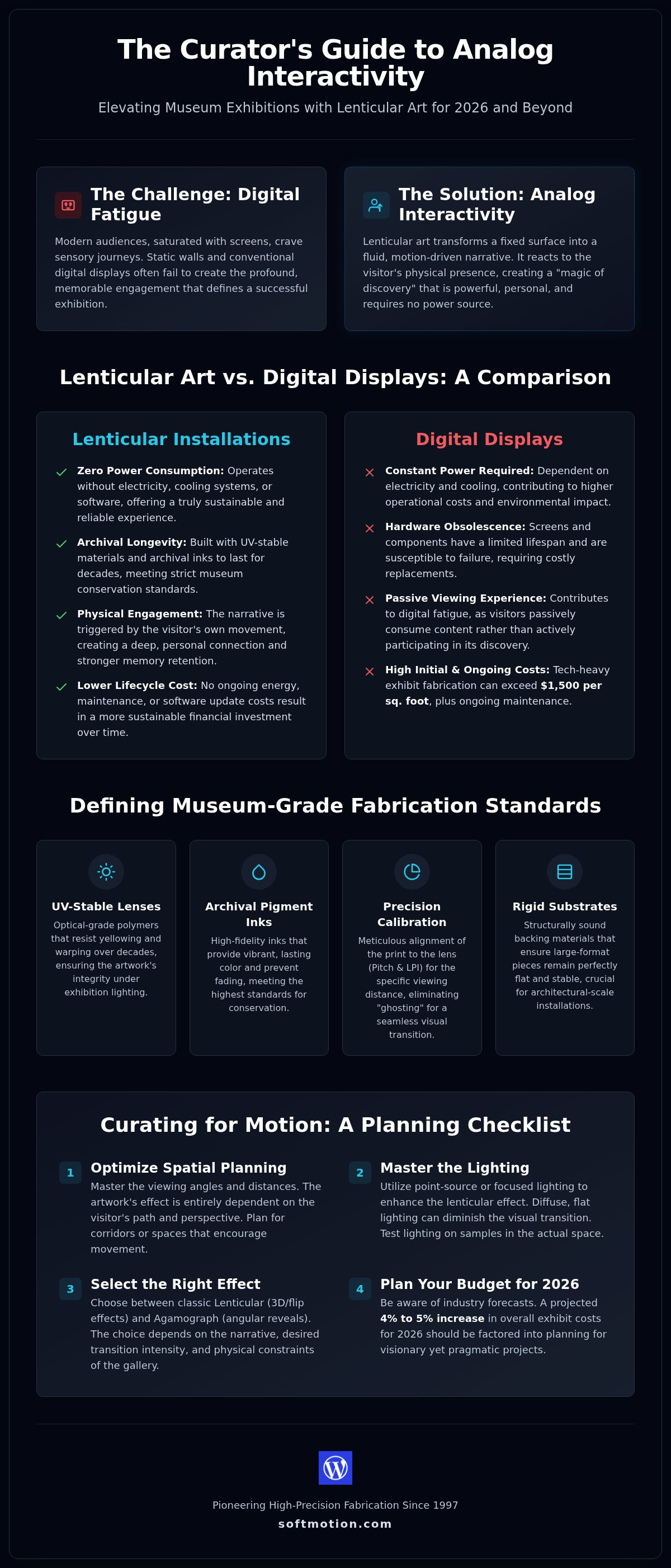
Digital fatigue is a documented reality. Visitors spend their days behind screens; they don’t want to stand before another one in a gallery. Lenticular installations provide a physical engagement that digital hardware cannot replicate. These displays require zero electricity, no cooling systems, and no software updates. They offer a human-first experience where the spatial transformation is triggered by the body, not a sensor. In an industry where fabrication for tech-heavy exhibits can reach over $1,500 per square foot, the reliability of a non-powered interactive element is a strategic asset. The same principle that makes lenticular so effective in gallery settings also drives the growing adoption of interactive lenticular tradeshow displays, where dwell time and audience engagement are equally critical. It’s about reclaiming the gallery as a space of discovery, where the magic is baked into the physical substrate itself.
Defining Museum-Grade Lenticular Fabrication Standards
Museum-grade lenticular art is the intersection of high-resolution interlacing and optical-grade polymers. While retail-level prints often rely on thin, flexible plastics and standard offset printing, installations destined for a gallery environment require a far more rigorous technical foundation. Achieving a seamless transition of imagery across a ten-foot wall is not merely a matter of scale; it’s a matter of structural integrity. True museum-grade fabrication utilizes rigid substrates and UV-stable lenses that resist warping or yellowing over decades of display. This level of precision ensures that lenticular art for museum exhibitions remains as crisp on day 1,000 as it was on day one.
The core of this precision lies in the “Pitch” and LPI (Lines Per Inch) of the lens. For small handheld items, a high LPI is standard. However, for large-scale architectural installations, a lower LPI with a thicker lens is often required to maintain visual clarity from a distance. If the pitch is not perfectly calibrated to the viewing distance, the image will “ghost,” causing the different narrative layers to bleed into one another. It’s a delicate balance of physics and art. To ensure your vision translates perfectly to the wall, you might consider requesting custom lenticular prototypes to test the effect in your specific environment.
Curators must also choose between classic lenticular effects and the Agamograph style. While lenticulars use a curved lens to create 3D or flip effects, an Agamograph uses a series of folded, angular surfaces to reveal different images as the viewer moves. Both techniques serve to transform static walls into motion-driven narratives, but the choice depends on the desired intensity of the transition and the physical constraints of the gallery corridor.
Optical Precision and Lens Selection
The choice of lens dictates the depth of the viewer’s experience. 3D-specific lenses are engineered with a narrower viewing angle to create deep-space illusions, while motion-oriented lenses favor a wider angle to allow for longer animation sequences. In high-traffic museum corridors, durability is paramount. These lenses must be scratch-resistant and occasionally treated with anti-reflective coatings to prevent overhead gallery lights from obscuring the image. The Smithsonian’s own documentation on lenticular prints in museum exhibits highlights how these graphics add pops of animation that engage visitors without the maintenance of a digital screen.
Archival Printing and Interlacing
Archival longevity is the benchmark of any fine-art acquisition. High-resolution interlacing requires specialized software that aligns the image data with the physical lens at a sub-pixel level. We utilize UV-cured pigment inks that bond directly to the substrate, ensuring the colors remain vibrant even under the intense lighting common in permanent exhibits. For the final presentation, back-mounting techniques like Diasec provide a contemporary, frameless finish that protects the print and enhances the optical clarity of the lens. This meticulous approach to lenticular art for museum exhibitions creates a result that rivals traditional fine art in both presence and permanence.
Lenticular Art vs. Digital Displays: The Case for Analog Interactivity
Digital displays are often the default choice for modern galleries. They offer bright, moving pixels and the promise of endless content. But they also carry a hidden burden of maintenance, hardware failure, and eventual obsolescence. Lenticular art for museum exhibitions provides a sophisticated alternative that replaces digital hardware with optical physics. It offers motion without the power cord. It provides depth without the glasses. Most importantly, it creates an enduring presence that a black, unpowered screen simply cannot match.
In 2026, curators are facing tighter logistical constraints. Freight and shipping costs have risen by 3% to 8% this year, while union labor for complex tech installations has increased by up to 6%. A digital display is a recurring expense that requires cooling, power, and software updates. In contrast, a lenticular installation is a one-time capital investment that remains vibrant for decades. When integrated into architectural lenticular installations, the medium transforms the very structure of the museum into a responsive environment that doesn’t rely on a grid.
There’s a specific “Magic of Discovery” when a visitor realizes they are the engine behind the motion. As they walk, the image shifts, reveals, or transforms. It’s not a looped video they’re watching; it’s a dialogue they’re having with the wall. Understanding the history of lenticular art helps us appreciate why this analog medium remains so relevant. It taps into a primal sense of wonder that digital animation often misses by removing the barrier of the screen. Architects and designers working across institutional and commercial environments can explore the broader implications of this choice by examining kinetic wall murals vs static murals to understand how dynamic surfaces outperform passive ones in long-term engagement.
Technical Reliability in Public Environments
Public museum spaces are demanding. They’re high-traffic, high-touch areas where digital hardware is vulnerable to both technical glitches and vandalism. Lenticular art is inherently robust. It has no fragile LCD layers to crack and no internal processors to overheat. Maintenance is limited to standard cleaning of the optical-grade polymer surface. Because these installations generate no heat, they’re significantly safer for climate-controlled archival environments where sensitive artifacts might be stored nearby.
The Viewer Experience: Active vs. Passive
Digital animation is a passive experience. The viewer stands still while the image moves. Lenticular art reverses this dynamic. It encourages “slow looking” and physical movement, as the perspective-shifting nature of the work requires the visitor to engage their body to see the full narrative. Utilizing large format lenticular printing allows curators to fill entire sightlines with these kinetic stories. This physical parallax creates a deeper cognitive imprint, ensuring the exhibition remains a memorable spatial journey rather than just another digital encounter.
Curating for Motion: Lighting and Spatial Planning
Spatial planning is the silent engine of a successful installation. Unlike traditional paintings that remain static regardless of the viewer’s position, lenticular art for museum exhibitions is a spatial commitment. It requires a precise intersection of light, distance, and movement to realize its full kinetic potential. Curators must transition from thinking about “wall space” to thinking about “viewing corridors.” Calculating the Critical Viewing Angle is a non-negotiable step in this process. This angle determines exactly when the image transitions from one narrative state to the next, ensuring the motion feels intentional rather than accidental.
The “Sweet Spot” is the ideal distance where the lens pitch perfectly aligns with the human eye. For large-scale pieces, this distance might be several meters, requiring wide corridors that allow for unhindered movement. If a piece is positioned in a cramped alcove, the viewer may never reach the angle necessary to trigger the transformation. Managing traffic flow is equally vital. Positioning the art parallel to the primary path of travel ensures that every visitor experiences the motion naturally as they walk past, rather than forcing them to hunt for the effect.
Lighting the Motion: Avoiding the Blur
Lighting is the most common point of failure in kinetic installations. Point-source lighting, such as high-quality LED or Halogen, is essential for optical clarity. Diffuse, ambient light is the enemy of the lens; it scatters across the lenticular ridges and creates a muddy, ghosted image. To achieve a crisp transition, the light must be directional and positioned to minimize glare. We recommend placing fixtures at a 45-degree angle to the wall, which highlights the refraction without reflecting directly into the visitor’s eyes. In darker gallery environments, integrated lighting solutions can be built into the frame to ensure the “analog interactivity” remains vibrant regardless of the room’s secondary light sources.
Spatial Choreography for Curators
Designing the “reveal” is an act of choreography. Curators should consider the pace of the average walker to determine how many frames of animation a piece can comfortably support. If the transition happens too quickly, the narrative feels frantic. If it happens too slowly, the visitor may miss it entirely. Consider these technical factors during your planning phase:
- Height and Tilt: Adjust the installation height to account for varied viewer heights and ADA accessibility. A slight forward tilt can often improve the viewing experience for seated visitors.
- Substrate Preparation: Large-format lenticulars are significantly heavier than standard prints. Ensure the wall substrate is reinforced to handle the weight of rigid optical polymers and archival mounting.
- Environmental Control: Maintain consistent humidity to prevent the substrate from expanding or contracting, which can subtly shift the lens alignment.
Precision in the planning phase eliminates the risk of a flat experience. To ensure your spatial layout is optimized for maximum impact, you can collaborate with our technical team to review your gallery floor plans and lighting schematics before fabrication begins.
Softmotion: Custom Fine Art Fabrication from Concept to Installation
Realizing a kinetic vision at an architectural scale requires more than a standard printing partner. It demands a fabricator who balances artistic intuition with industrial precision. Softmotion serves as a visionary guide for curators and artists, transforming complex digital narratives into physical realities that command attention. Since 1997, we’ve refined a collaborative process that has successfully delivered over 1,000 projects globally. Our focus remains on the specific technical and aesthetic rigors of lenticular art for museum exhibitions, ensuring that every installation meets the highest standards of the fine art world.
The Prototyping and Sampling Phase
Curatorial approval often hinges on the tangible. A digital rendering can suggest motion, but it cannot replicate the physical experience of light hitting a lens. We prioritize a risk-free approach through exhaustive sampling. Small-scale physical proofs allow your team to evaluate different kinetic effects, such as 3D depth or complex animation flips, directly within the gallery space. This phase is critical for refining the interlaced file, ensuring that the final, large-format output maintains absolute clarity without the visual interference of ghosting or blur. For a deeper understanding of how creative vision and optical engineering intersect during this process, exploring the principles behind designing lenticular fine art can help your team align aesthetic goals with technical constraints before fabrication begins. Institutions planning large-scale works can also benefit from reviewing our architect’s guide to custom lenticular prototypes at scale, which details how physical prototyping serves as a definitive technical document that bridges the gap between digital concept and real-world installation.
Logistics and Professional Installation
The journey from the fabrication floor to the gallery wall is a delicate one. Large-format lenticular panels are rigid, substantial, and require specialized handling to protect their optical integrity. Our end-to-end service model includes:
- Custom Crating and Shipping: Every project is secured in bespoke, museum-grade crates designed for global transport and long-term protection.
- Specialized Installation Teams: We provide expert assembly for architectural-scale works, ensuring every panel is perfectly aligned to the critical viewing angles established during the planning phase.
- Maintenance and Preservation: Our teams provide clear protocols for the long-term care of optical polymers, ensuring the surface remains pristine even in high-traffic public areas.
We manage the technical complexity so you can focus on the curatorial narrative. By overseeing the process from the initial concept to the final on-site assembly, we ensure that the finished work is not just a display, but a durable piece of heritage. This methodical approach guarantees that your institution receives a high-end result that is both visually arresting and technically sound.
The Future of Kinetic Storytelling in Museum Spaces
The transition from static graphics to immersive, motion-driven narratives isn’t just an aesthetic trend; it’s a fundamental shift in how we engage with history and art. You’ve seen how the right technical foundation, from UV-stable lenses to point-source lighting, ensures that these kinetic works endure for generations. By choosing analog interactivity over digital screens, you create a human-first experience that rewards physical movement and curiosity. High-precision lenticular art for museum exhibitions offers a rare combination of visual magic and industrial reliability, allowing your institution to tell complex stories without the burden of technical downtime.
Softmotion stands ready to bridge the gap between your imaginative concept and a flawless gallery installation. We’ve served as a visionary guide for curators since 1997, delivering over 1,000 projects globally with a specialization in large-format museum installations. Our end-to-end project management ensures that every detail, from initial sampling to final crating, is handled with the precision your institution demands. Begin your custom fine art fabrication journey with Softmotion today. Let’s transform your walls into a living dialogue that captivates every visitor who walks through your doors.
Frequently Asked Questions
What is the maximum size for a museum-grade lenticular print?
Single sheets typically reach 48 by 96 inches, but we create massive installations through precision tiling. By aligning multiple panels with sub-millimeter accuracy, we can cover entire gallery walls or even building facades. This modular approach ensures that the kinetic effect remains seamless across vast architectural surfaces. For curators, this means the only real limit is the physical dimension of the gallery space itself.
How long do lenticular art prints last in a public museum environment?
Museum-grade prints are designed to last for decades when displayed under standard gallery conditions. By utilizing archival pigment inks and UV-resistant optical polymers, these works resist the yellowing and fading common in retail-grade plastics. While longevity depends on specific light exposure, high-quality lenticular art for museum exhibitions is built to maintain its structural and visual integrity for 20 to 50 years.
Can lenticular art be used for outdoor museum installations?
Yes, we fabricate specific architectural-grade installations designed for outdoor environments. These require specialized UV-stable acrylics or polycarbonate lenses and weather-sealed mounting systems to withstand temperature fluctuations and moisture. Outdoor pieces often use a coarser lens pitch to maintain the kinetic effect even when viewed from a significant distance across a sculpture garden or a museum plaza.
What is the best lighting setup for a large-scale lenticular wall?
High-CRI LED or halogen track lighting is the preferred choice for illuminating large installations. These fixtures provide the sharp, directional beams necessary to prevent image ghosting across the lens ridges. Unlike standard fluorescent tubes that scatter light and flatten the kinetic effect, focused tracks allow you to isolate the refraction. This setup ensures that the colors remain vibrant and the motion transitions stay crisp for every visitor.
How do curators choose between 3D depth and flip animation effects?
The choice depends on the specific narrative goals of your exhibition. 3D depth effects are ideal for creating spatial immersion and a sense of “looking into” a window. Flip animations or zoom effects work better for storytelling, such as showing a “before and after” transformation. Curators often use small-scale samples to test which effect resonates most powerfully with the intended traffic flow.
What is the difference between an agamograph and a lenticular print?
While both create kinetic experiences, lenticular prints use a specialized lens to hold multiple frames of animation. An agamograph relies on a folded, geometric substrate to reveal only two or three distinct images. Lenticular technology provides a much smoother transition and allows for complex motion or 3D depth. This makes it the superior choice for curators who want to depict fluid transformations or deep spatial illusions.
Is lenticular art considered an archival medium for permanent collections?
Modern high-precision prints meet the rigorous standards for permanent museum collections. By moving away from commercial dyes and using UV-cured pigment inks, the industry has achieved a level of lightfastness that rivals traditional photography. When paired with rigid, non-warping substrates, these pieces are classified as conservation-sensitive materials. This ensures they are suitable for long-term acquisition and display within a controlled gallery environment.
How does Softmotion handle the project management of large installations?
Our approach centers on a “Visionary Guide” partnership that supports curators from the initial concept to the final reveal. We manage the technical complexities of interlacing and fabrication, allowing your team to focus on the narrative. With a portfolio of over 1,000 global projects, we handle the logistics of crating and international shipping. This comprehensive management ensures that lenticular art for museum exhibitions is delivered with the professional reliability expected by major institutions.