
High-End Lenticular Art vs. Digital Signage: Why Analog Kinetic Art Wins in 2026
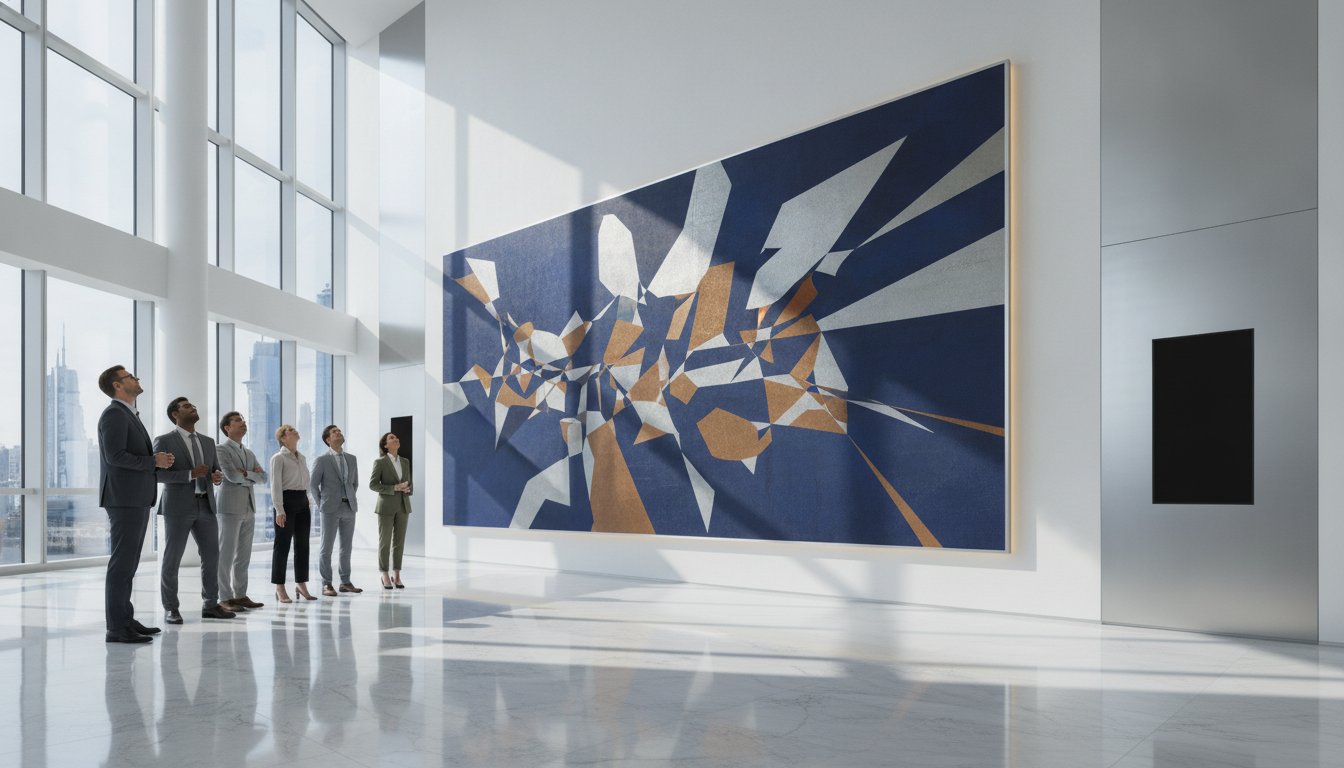
What if the most arresting visual in your architectural space didn’t require a single power cable or a glowing LED panel? In an era where every surface competes for attention, the debate of lenticular art vs digital signage has shifted toward a more organic, human-centered solution. You’ve likely noticed that viewers are increasingly tuning out the flicker of commercial monitors. This digital fatigue is real. While a standard digital sign player and its cooling fans can consume between 200 and 300 watts of power constantly, high-end kinetic art remains silent, sustainable, and strikingly effective.
We understand the desire for a medium that feels like a permanent part of the environment rather than a temporary broadcast. This article reveals why high-end lenticular installations are surpassing digital screens in 2026 through superior sustainability and deeper viewer engagement. We’ll examine how these fabrications transform static walls into multi-dimensional experiences driven entirely by the observer’s own movement. From the elimination of monthly software fees to the creation of a sophisticated, interactive atmosphere, you’ll discover why the most visionary brands are choosing to move beyond the screen.
Key Takeaways
- Understand why the human brain is hardwired to notice physical kinetic motion over programmed pixels, providing a refreshing alternative to the noise of digital fatigue.
- Compare the technical mechanics of lenticular art vs digital signage, focusing on how high-precision lenses provide infinite visual fluidity without the limitations of pixel pitch.
- Explore the operational benefits of zero-energy installations that function without power cables or software fees while offering a lifespan that far exceeds digital hardware.
- Learn how to transform static environments into multi-dimensional experiences by integrating kinetic art into the architectural skin of lobbies and retail spaces.
- Appreciate the rigorous engineering behind high-end fabrication, shifting the focus from simple prints to sophisticated optical installations designed for global impact.
Beyond the Screen: Navigating the Era of Digital Fatigue
Screens have reached a saturation point. In 2026, the flicker of a monitor is no longer a novelty; it’s a distraction. This environment has birthed a psychological defense mechanism known as “banner blindness.” Viewers subconsciously filter out digital content, treating expensive 4K displays as mere wallpaper. This is where the debate of lenticular art vs digital signage becomes critical for architects and brand managers. High-end lenticular art doesn’t shout for attention. It invites it through a subtle, sophisticated presence that digital hardware cannot replicate. This human-first approach prioritizes the person in the space over the hardware on the wall.
The Crisis of Screen Satiation in 2026
The glow of a screen often clashes with the intended ambiance of a luxury space. While digital signage pushes content at a passive audience, lenticular installations pull the viewer in. Light pollution from large LED walls can degrade the organic feel of a corporate lobby or a high-end retail environment. This “glow factor” creates a sterile atmosphere that many modern designers are actively avoiding. Lenticular printing technology offers a sophisticated alternative. It utilizes ambient light rather than emitting its own, ensuring the art integrates seamlessly into the skin of the building. It respects the spatial design while providing a dynamic focal point that feels permanent and intentional.
The Psychology of Kinetic Engagement
Our brains are evolutionarily hardwired to prioritize physical motion. A programmed pixel changing color is a simulated event, but the parallax effect of a lenticular piece is a physical reality. When a viewer walks past an installation, they are the catalyst for change. This reward-based interaction creates a deeper sense of curiosity. By simply moving their bodies, viewers “unlock” different layers of the image. It’s a form of analog interactivity that feels like a luxury differentiator. Choosing between lenticular art vs digital signage often comes down to the quality of the engagement. Research into kinetic advertising displays shows that this physical engagement leads to significantly longer dwell times compared to flat video loops. It transforms a generic corridor into a memorable journey, rewarding the viewer for their presence and movement.
The Science of Motion: Analog Kinetic Art vs. Programmed Pixels
The fundamental difference in the debate of lenticular art vs digital signage lies in how light reaches the eye. Digital displays rely on a grid of light-emitting diodes, where motion is a programmed sequence of refreshing pixels. In contrast, high-end lenticular art uses optical physics to create movement. It’s a mechanical transformation. As you move, the precision-engineered lenses redirect light from different slices of the underlying image. This creates a sense of infinite fluidity. There’s no refresh rate to stutter and no blue light to contribute to the growing problem of digital fatigue that defines our modern workspace.
Resolution and Depth: The Lenticular Advantage
Resolution in digital signage is often limited by pixel pitch, which is the distance between the center of two pixels. even a high-end 1.5mm LED wall can appear grainy when viewed up close in a corporate lobby. High-precision large format lenticular printing operates on a different scale. We measure quality in dots per inch (DPI). While a screen offers a fixed resolution, a fabricated lenticular piece can achieve thousands of DPI, resulting in a crispness that feels tangible. This density allows for true 3D depth. High-end production techniques eliminate the ghosting or blurred transitions often associated with lower-quality prints, ensuring every perspective is razor-sharp. If you’re curious about the tactile quality of these materials, you can order a lenticular sample to see the difference firsthand.
Viewing Angles and Environmental Integration
Digital screens struggle in bright environments. Direct sunlight often washes out LED panels, forcing them to run at maximum brightness, which increases heat and energy consumption. Lenticular art thrives in these conditions. Because it uses ambient light, the colors remain vibrant and the motion stays clear regardless of the time of day. The viewing experience is also more inclusive. While digital screens lose color accuracy at extreme angles, engineered lenses maintain their integrity across a wide viewing cone. This allows for the agamograph effect, where two or more distinct messages occupy the same physical space. One person sees a brand message while another, standing just a few feet away, sees a serene landscape. It’s a spatial transformation that turns a static wall into a multi-message storytelling device.
Debunking the ‘Low-Tech’ Stigma: The Complexity of Large-Format Lenticular
High-end lenticular art is often unfairly dismissed as a relic of the nineties. It isn’t a simple 3D postcard; it is a sophisticated marriage of optical physics and precision engineering. When evaluating lenticular art vs digital signage, the complexity of the medium shifts from electrical circuits to optical geometry. While screens are a primary cause of Digital Eye Strain, analog kinetic installations provide a high-impact visual experience that remains gentle on the human eye. This fabrication process requires a level of technical discipline that far exceeds standard commercial printing, turning a static surface into a dynamic experience through purely physical means.
The Precision Engineering Behind the Lens
The foundation of any successful architectural piece is the selection of the correct LPI, or lenses per inch. This choice is dictated by the specific viewing distance of the environment. A corporate lobby requires a different lens density than a massive transit hub. Material science also plays a vital role. We utilize UV-stable acrylics rather than standard plastics to ensure the installation remains clear and vibrant for decades. High-end lenticular art is a precision-engineered optical system designed to manipulate light through physical geometry. It requires a collaborative approach between architects and fabricators to ensure the final result integrates perfectly into the building’s skin.
From Digital Files to Physical Motion
The transition from a static design to a moving installation begins with interlacing. This is a high-stakes digital-to-physical conversion where multiple images are sliced into microscopically thin strips and aligned with the lens array. Precision is everything. Even a fraction of a millimeter of misalignment can ruin the effect. Prototyping and sampling are critical phases in this journey, allowing us to test the visual impact before full-scale fabrication begins. In high-end production, we distinguish between two primary effects:
- Flip effects: A clean transition between two or more distinct images as the viewer moves, perfect for multi-message storytelling.
- 3D depth: The creation of a multi-perspective environment that feels like a window into another dimension without the need for glasses.
Achieving these results on an architectural scale requires custom software and a mastery of the fabrication process. It’s a meticulous craft that turns a static wall into a living, breathing part of the space. By focusing on the relationship between the viewer and the environment, we create a sense of wonder that programmed pixels simply cannot match.
Operational Reality: Comparing Longevity, Maintenance, and Sustainability
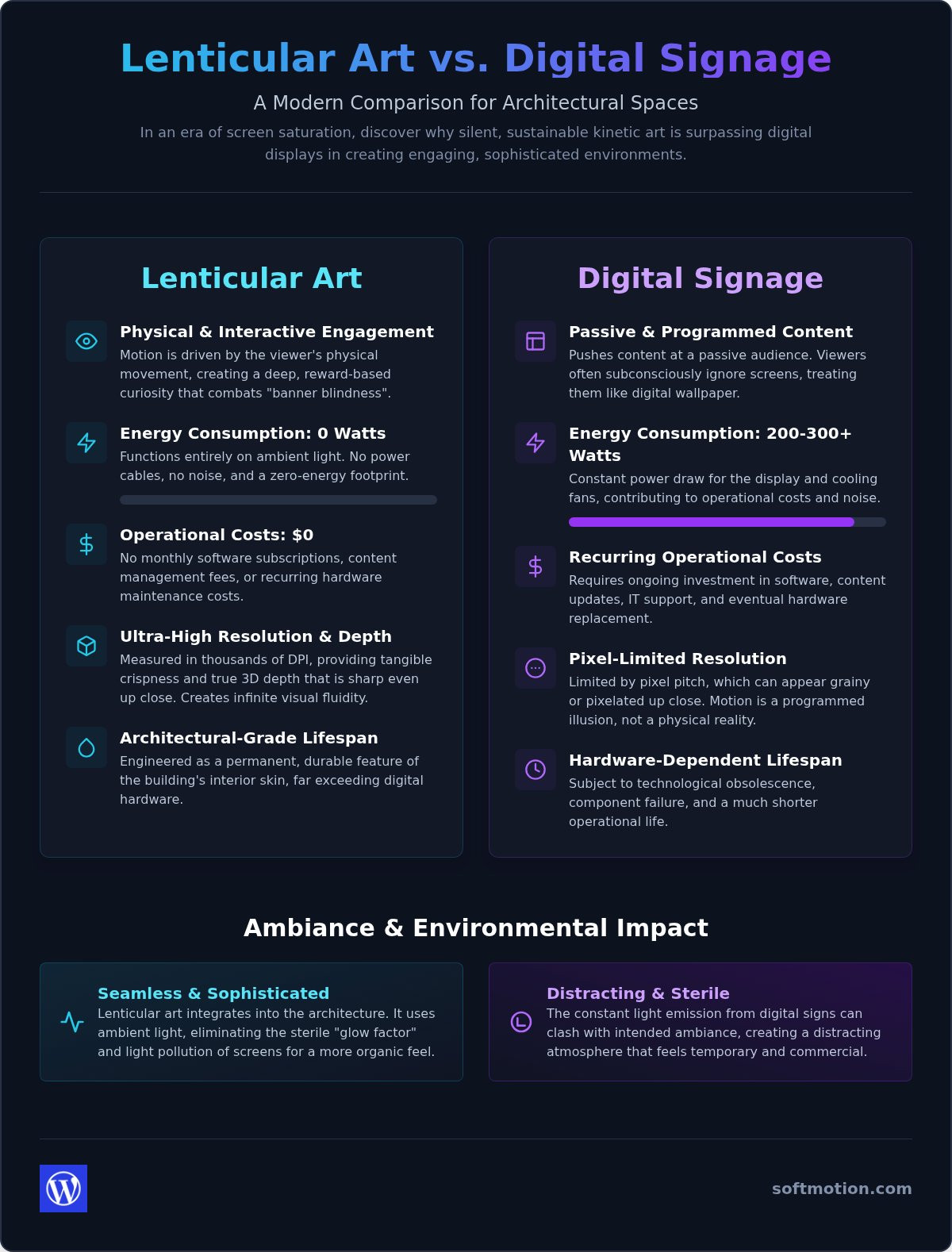
The choice between lenticular art vs digital signage often centers on the initial visual impact, but the true differentiator reveals itself over time. Digital hardware is fundamentally transient. Most commercial LED walls face a functional lifespan of just five to seven years before dead pixels, color degradation, or hardware failure demand a total replacement. In contrast, a high-end lenticular installation is a legacy asset. These pieces are fabricated to last for decades, maintaining their optical clarity and kinetic energy without the inevitable decay of electronic components. It’s the difference between a temporary gadget and a permanent architectural feature.
The Hidden Costs of Digital Signage
Digital signage is never truly “off.” It requires a constant flow of electricity to power the screen, the media player, and the necessary cooling fans. A single player and its associated fans can consume between 200 and 300 watts of power around the clock. Beyond energy, the maintenance profile is demanding. You’re looking at recurring costs for software subscriptions, media player replacements, and the inevitable troubleshooting of connectivity issues. A “Blue Screen of Death” in a high-traffic lobby is more than a technical glitch; it’s a brand failure. A physical kinetic installation offers total reliability. It doesn’t crash, it doesn’t require software patches, and it never presents a blank black screen to your guests. It is a “set it and forget it” solution that honors the space it occupies. For luxury retailers weighing these ongoing operational burdens, a detailed comparison of lenticular vs digital signage for retail environments reveals just how significant these hidden costs become over time.
Sustainability and the Zero-Power Revolution
Sustainability is no longer a corporate suggestion; it’s a requirement for modern architecture. Lenticular art represents a zero-power revolution in spatial design. Because it relies entirely on ambient light and viewer movement to create motion, it has a negligible carbon footprint after the initial fabrication. This makes it an ideal candidate for LEED certifications and other sustainable building standards. Unlike digital screens that contribute to light pollution, these installations comply with “dark sky” initiatives, respecting the natural environment and the circadian rhythms of the people within the space. Modern architectural-grade materials are also increasingly focused on recyclability, ensuring your design is as responsible as it is beautiful. If you’re ready to move beyond the high-maintenance cycle of digital screens, you can explore our architectural lenticular installations to find a permanent, sustainable solution for your environment.
Strategic Selection: When Lenticular Architecture is the Superior Investment
Deciding between lenticular art vs digital signage isn’t just about comparing hardware; it’s about understanding the rhythm of your environment. While digital screens serve a purpose for real-time data or rapidly changing menus, architectural lenticular installations excel in spaces where the medium must become part of the building’s soul. Transit hubs, corporate headquarters, and luxury retail flagships are the ideal theaters for this technology. In these high-traffic pedestrian areas, the viewer’s natural movement provides the “energy” for the visual change, creating a surprise and delight factor that feels discovered rather than broadcasted. Nowhere is this more evident than in underground stations and commuter corridors, where lenticular art for public transit stations transforms routine journeys into cinematic, multi-dimensional experiences without a single power cable.
Before committing to a visual strategy, decision-makers should evaluate their specific spatial needs through a focused lens. If your audience is in constant motion, a kinetic installation will often outperform a screen that requires a static viewer to wait for a video loop to finish. Consider this strategic checklist for your next project:
- Movement Dynamics: Does the audience flow past the wall? Kinetic art rewards this movement, whereas digital screens often require viewers to stop.
- Maintenance Threshold: Do you have the resources for 24/7 technical support, or do you need a permanent architectural asset?
- Aesthetic Integration: Should the visual feel like a piece of the architecture or an external monitor?
- Content Cycle: Does the message need to change every hour, or is it a seasonal or permanent brand statement?
Architectural Integration and Kinetic Facades
We see the most profound impact when the art is integrated directly into the skin of the environment. High-end lenticular building facades transform static surfaces into storytelling canvases that change as people walk, drive, or commute past. This is “stealth technology” at its finest. It doesn’t look like a commercial TV; it looks like a living texture. In transit environments, this serves a dual purpose of wayfinding and engagement, turning a mundane corridor into a multi-dimensional journey. It respects the architect’s vision by maintaining the material integrity of the wall while adding a layer of sophisticated motion without the clutter of power cables.
The Future of Offline Interaction
As we move further into 2026, the luxury market is shifting toward “quiet tech” and unplugged experiences. There’s a growing premium on visuals that don’t demand a connection to a cloud or a power grid. This movement toward analog kinetic art reflects a desire for authenticity and permanence in an increasingly ephemeral digital world. By choosing a medium that honors human movement and spatial design, you create an environment that feels both visionary and grounded. If you’re ready to transform your space with a high-precision, multi-dimensional installation, the next step is a partnership built on technical discipline and creative vision. Collaborate with Softmotion for your next large-scale installation and discover how we can reimagine your environment together.
Reimagining the Future of Spatial Design
The choice between lenticular art vs digital signage represents a decision between temporary flicker and permanent impact. We’ve seen how analog kinetic installations solve the modern crisis of digital fatigue by rewarding human movement with infinite visual fluidity. Unlike screens that face rapid obsolescence and constant energy costs, high-end lenticular fabrication offers a sustainable, zero-power alternative that integrates into the very skin of a building. It’s a transition from passive consumption to active engagement.
Since 1997, Softmotion has remained a pioneer in high-precision lenticular technology, delivering over 1,000 projects worldwide. Our master fabricators understand that architectural excellence requires a marriage of optical physics and disciplined craftsmanship. Whether you’re designing a corporate lobby or a massive transit hub, our team is ready to serve as your collaborative partner. Bring your vision to life with Softmotion’s master fabricators and transform your environment into a living masterpiece. We look forward to realizing the hidden potential of your next space together.
Frequently Asked Questions
Is high-end lenticular art production more expensive than digital signage?
While the upfront fabrication costs of a high-end installation may be higher than entry-level screens, the total cost of ownership is often significantly lower. Digital signage involves recurring software fees, high electricity consumption, and hardware replacements every five to seven years. Lenticular installations are a one-time capital investment with a lifespan measured in decades. This makes the long-term value of lenticular art vs digital signage highly competitive for large-scale architectural and advertising projects. Luxury brands in particular have found that evaluating lenticular vs digital signage for retail storefronts and flagships reveals a compelling case for kinetic art as the more cost-effective long-term investment.
How do you maintain a large-scale lenticular wall installation?
Maintenance is remarkably simple and follows a “set it and forget it” profile. Unlike digital displays that require constant software updates and hardware cooling, these physical installations only need occasional cleaning with a soft, non-abrasive cloth and a mild soap solution. There aren’t any pixels to burn out, media players to replace, or complex wiring systems to troubleshoot. This reliability ensures the art remains vibrant and functional without the need for ongoing technical support.
Can lenticular art be used outdoors on building facades?
Yes, architectural-grade lenticular technology is specifically engineered for challenging outdoor environments. We utilize UV-stable acrylics and specialized fabrication techniques that resist weathering and color fading over time. These kinetic facades integrate into the skin of a building, offering a dynamic visual experience that thrives in direct sunlight. Because they don’t rely on backlighting, they avoid the wash-out effect that often plagues outdoor digital screens in bright or high-glare conditions.
What is the maximum size for a large-format lenticular print?
There’s virtually no limit to the size of a lenticular installation because we produce them in modular panels. While individual sheets have physical manufacturing constraints, our master fabricators seamlessly tile panels together to cover entire architectural walls or building facades. This modular approach allows for massive, high-impact displays that maintain perfect optical alignment across hundreds of square feet. Each project is custom-engineered to fit the specific dimensions and aesthetic requirements of your unique environment.
How many ‘frames’ or images can be used in a lenticular flip effect?
High-end production typically utilizes between two and five distinct images for a clean “flip” effect. While it’s technically possible to include more, adding too many frames can lead to “ghosting” or blurred transitions. By focusing on a precise number of high-resolution images, we ensure that each message is razor-sharp and clearly defined as the viewer moves. This creates a more sophisticated result for luxury retail and corporate branding that feels both intentional and premium.
Does lenticular art require specific lighting to be effective?
These installations thrive in well-lit environments, particularly those with a single primary light source. While they utilize ambient light rather than internal power, the strategic placement of spotlights can enhance the depth and clarity of the kinetic effect. It’s best to avoid flat, diffused lighting that hits the lens from every direction simultaneously. Our team works closely with architects to optimize lighting conditions, ensuring the multi-dimensional transition stays crisp and impactful throughout the day.
What is the difference between an agamograph and a lenticular print?
An agamograph is a traditional form of kinetic art that uses a zigzag or pleated surface to show different images from two angles. Lenticular technology is the modern, high-precision evolution of this concept. Instead of a bulky physical fold, it uses a thin array of optical lenses to achieve the same result with much higher resolution and fluidity. Lenticular prints allow for more frames, 3D depth, and a much smoother transition between images.
How long does the fabrication and installation process typically take?
The timeline varies based on the scale and complexity of the project, but most high-end fabrications take between eight and twelve weeks. This includes the initial consultation, interlacing of digital files, prototyping, and the final production of modular panels. Large-scale architectural installations might require additional time for site preparation and collaborative engineering with your construction team. We prioritize a methodical, risk-free process to ensure the final result meets our rigorous quality and alignment standards.