
Engaging Commuters with Transit Hub Visual Installations: The Case for Lenticular Art (2026)

The most effective way to captivate a modern commuter isn’t a high-definition digital screen, but a static wall that only comes to life when they move. In the dusty, vibrating environments of underground hubs, digital displays often succumb to technical failure, leading to “visual blindness” among passengers weary of flickering pixels. Integrating lenticular art for public transit stations offers a sophisticated alternative, turning a routine walk down a corridor into a cinematic, multi-dimensional journey. It’s a spatial transformation that leverages the passenger’s own momentum to create motion without a single power cable or maintenance crew.
You’ve likely felt the frustration of managing hardware that constantly struggles against heat and strict safety codes. We understand that transit environments deserve better than the expensive cycle of digital repair and static advertising fatigue. This article reveals how large-scale lenticular installations provide a lasting “wow” factor that’s both sustainable and compliant with 2026 standards, including the newly reintroduced STAR Act. We’ll explore how these analog masterpieces foster station pride, enhance safety through intentional place-making, and utilize durable materials like PETG to ensure your creative vision remains vibrant for decades.
Key Takeaways
- Learn how analog kinetic technology creates motion-driven environments that captivate moving audiences without the energy costs or maintenance burdens of digital screens.
- Discover the specific design principles behind lenticular art for public transit stations that turn routine commutes into engaging, multi-dimensional experiences.
- Understand the engineering requirements for underground installations, focusing on fire safety ratings and material durability in high-vibration transit zones.
- Identify the strategic advantages of integrating kinetic art early in the architectural planning phase to ensure both aesthetic impact and regulatory compliance.
- Gain a clear roadmap for a collaborative journey that transitions from an inspiring vision to a concrete, high-precision architectural reality.
The Evolution of Transit Hub Visual Installations
Transit hub visual installations have transcended their origins as simple decorative murals. They’ve evolved into site-specific kinetic experiences designed to interact with the unique tempo of a moving audience. In the past, a station mural was a static background, often ignored by the hurried commuter. Today, we reimagine these surfaces as dynamic environments where the artwork changes alongside the passenger. This shift reflects a deeper understanding of urban movement. By integrating lenticular art for public transit stations, architects can bridge the gap between traditional static art and the high-maintenance complexity of digital media. Lenticular printing technology provides this bridge, offering the illusion of motion and depth without a single circuit or power source. It captures the eye precisely because it respects the viewer’s pace, rewarding their movement with a shifting visual narrative.
The Psychology of the Commuter Journey
Passenger flow isn’t just a logistics challenge; it’s a sensory one. Transit corridors are often characterized by high-stress “tunnel vision” where commuters become blind to their surroundings. Kinetic art breaks this monotony by introducing a variable visual stimulus that requires no conscious effort to engage with. As a person walks, the image evolves. This provides a rhythmic mental reset that lowers cortisol levels and increases a sense of security. Wayfinding art is a visual landmark that intuitively guides passengers through complex transit networks while reducing the cognitive load of traditional signage. These installations transform a utilitarian corridor into a space that feels intentional, which directly influences how passengers perceive their journey and treat the physical environment.
Place-Making in Urban Infrastructure
Urban planners often struggle with “non-places,” those sterile transition zones that lack identity or cultural resonance. Strategic public art transforms these voids into recognizable landmarks. The ROI of such investments is measurable in increased ridership and heightened community pride. For instance, the Los Angeles County Metro Art Program allocates a minimum of 0.5% of construction costs to public art. This recognizes its power to define a city’s character and improve the passenger experience. With the April 2026 reintroduction of the Saving Transit Art Resources (STAR) Act, federal funding is once again positioned to support these vital cultural assets. Iconic installations prove that when art is integrated into the architecture, it creates a legacy that passengers don’t just pass through, but remember.
Lenticular Technology: The Kinetic Advantage for Stations
The brilliance of lenticular art for public transit stations lies in its ability to generate complex, fluid motion from an entirely passive surface. While digital screens require a constant stream of electricity and cooling, large format lenticular printing achieves high-impact animation through the precise marriage of interlaced imagery and optical lenses. It is a form of analog kinetic art that doesn’t just sit on a wall; it interacts with the physical movement of the crowd. This technology transforms a static corridor into a living environment, where the artwork’s state is directly tied to the viewer’s position. It’s a reliable, elegant solution for high-traffic zones where technical downtime isn’t an option.
Transit environments offer a unique canvas because the audience is almost always in motion. We utilize this viewer-in-motion dynamic to create “parallax storytelling,” a technique where different layers of a narrative reveal themselves as a commuter walks or rides past. As the viewing angle shifts, the lenses isolate specific portions of the printed image, creating a seamless transition between frames. This results in a cinematic experience that feels personalized to the individual’s pace. National Academies of Sciences has been documenting the use of art in public transit, noting that such interactive elements are vital for reducing the perceived wait times and stress of daily travel. If you’re curious about how these physics apply to your specific site, you can order a custom sample kit to see the motion in person.
Lenticular vs. Digital Signage: The 2026 Perspective
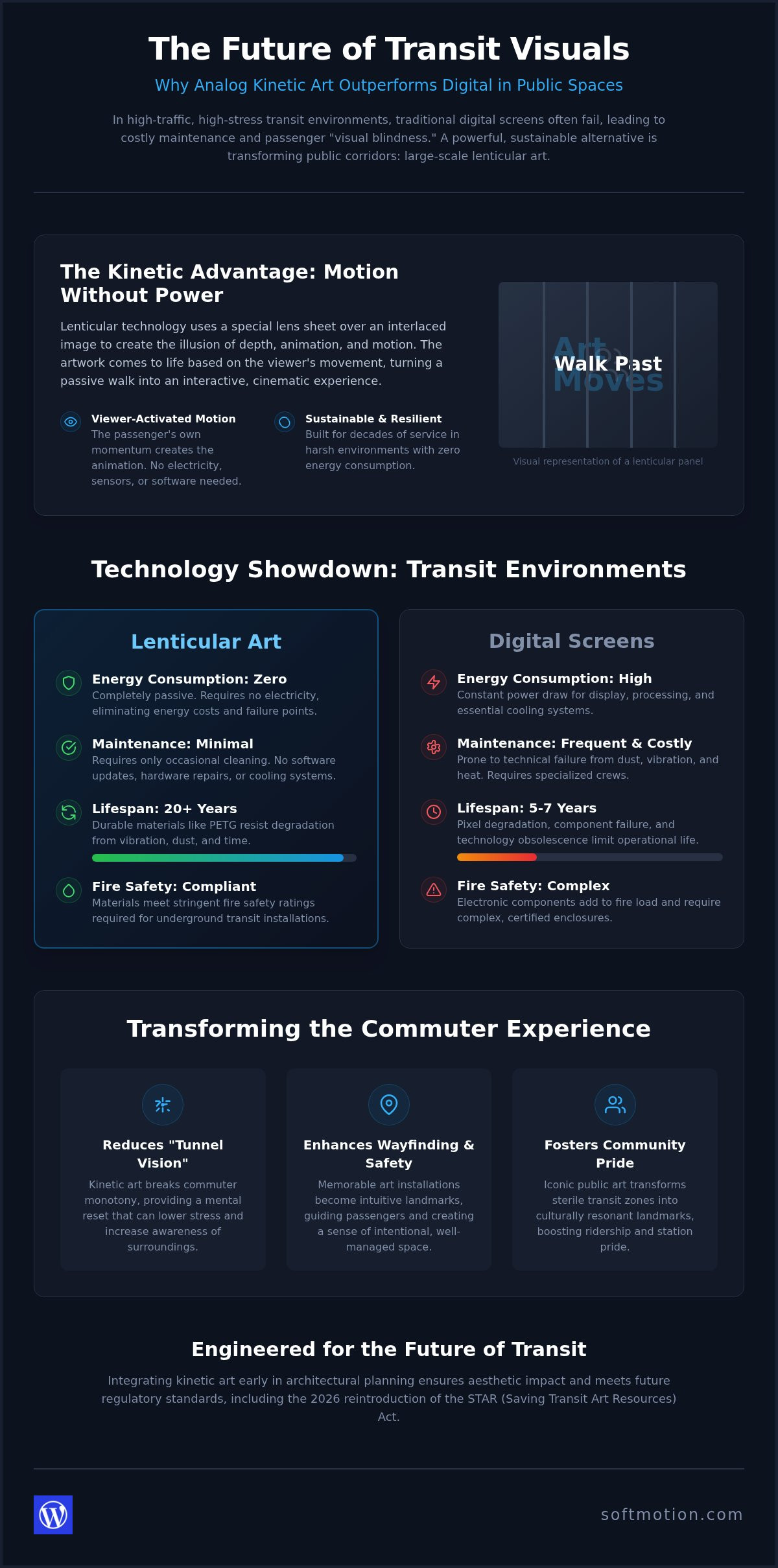
In the harsh conditions of underground stations, digital hardware often fails due to fine brake dust, constant vibration, and heat. Lenticular installations offer a sophisticated alternative with significantly lower lifecycle costs and zero energy consumption. Beyond the practicalities, analog art feels more human and less intrusive than the aggressive glow of LEDs. For a deeper look at these trade-offs, our analysis of Lenticular vs. Digital Signage for Retail explains why high-end environments are increasingly moving away from screens in favor of tactile, motion-driven art.
Large-Scale Motion Graphics for Public Corridors
Engineering these installations requires a deep understanding of “lens pitch” and viewing distance. In narrow corridors, we use lenses with a wide viewing angle to ensure the 3D depth or animation is visible even from a few feet away. Conversely, for art viewed from a moving train, the design must account for higher speeds, requiring broader transitions to prevent visual “ghosting.” By tailoring the technical specs to the passenger’s velocity, we ensure the spatial transformation is both clear and captivating, even in the most challenging underground passages. Architects seeking a broader technical foundation for these principles will find our guide to kinetic wall panels and dynamic surfaces an essential reference for understanding how perspective-shifting technologies can be applied across a range of architectural contexts.
Case Study: Maximizing Engagement in High-Traffic Hubs
Integrating lenticular art for public transit stations requires a shift from viewing art as an after-thought to seeing it as a core architectural component. We’ve observed that when a static wall is replaced by architectural lenticular installations, the physical flow of the station changes. Commuters don’t just pass by; they pause, shift their weight to trigger a visual ‘flip,’ and often capture the moment on their phones. This ‘social media effect’ turns a subterranean corridor into a digital destination, amplifying the reach of the transit authority’s investment far beyond the station walls. By leveraging the viewer’s own motion, we transform a passive walk into an active, shared experience that defines the station’s identity.
The Design and Prototyping Phase
The journey from a creative concept to a large-scale reality begins with rigorous prototyping. We believe that clarity is found in the physical sample, not just the digital render. During the design phase, we work closely with artists to translate two-dimensional illustrations into multi-dimensional motion. This involves testing specific lens pitches under subterranean lighting to ensure that colors remain vibrant and the ‘flip’ transition is crisp. By using high-precision printing techniques, we eliminate the visual ‘ghosting’ that often plagues lower-quality attempts. This collaborative process ensures the final result meets the exacting standards of both the artist and the transit board, providing a risk-free path to a high-impact installation.
Measuring Commuter Engagement
Success in transit art is measured by its impact on the passenger’s internal clock. Engaging visual environments can significantly reduce perceived wait times; when commuters are captivated by a shifting narrative on a platform wall, the three-minute wait for a train feels shorter. Transit authorities report that these installations improve the overall atmosphere of the station, fostering a sense of safety and community pride. It’s a pragmatic approach to place-making where the ROI is found in a more satisfied, loyal ridership. By choosing lenticular art for public transit stations, agencies provide a durable, interactive landmark that remains fresh for every passenger, every day.
Engineering for Durability: Safety and Longevity Standards
High-vibration transit environments require more than just aesthetic appeal; they demand absolute structural integrity. Lenticular art for public transit stations must withstand constant acoustic pressure, significant temperature fluctuations, and the abrasive nature of metallic brake dust. Unlike fragile digital screens that can fail due to fine particulate ingress or paper-based murals that degrade in humid tunnels, our installations utilize rigid, high-impact polymers. These materials maintain their optical clarity under the most punishing subterranean conditions. Maintenance is remarkably straightforward, requiring only periodic cleaning with non-abrasive, pH-neutral solutions. This eliminates the need for specialized technical teams or the constant volunteer restoration efforts often associated with less durable public art forms. By engineering for the environment first, we ensure your spatial transformation remains a permanent cultural asset rather than a recurring maintenance liability.
Meeting Transit Authority Safety Codes
Fire safety and smoke toxicity are the most critical technical hurdles for any underground installation. We address these concerns by utilizing specialized lens materials that meet rigorous ASTM E84 Class A and NFPA 130 standards for flame spread and smoke development. To ensure longevity in high-traffic public spaces, we integrate specialized anti-graffiti coatings that allow for the rapid removal of spray paint or permanent markers without clouding the precision-engineered lenticular lens. We primarily utilize high-impact PETG and specialized acrylics to ensure the panels remain resilient against cracking and stay securely bonded in high-vibration zones. This technical discipline ensures that your artistic vision doesn’t just look spectacular on opening day, but remains safe and vibrant for the millions of passengers who will encounter it over the next several decades.
Installation and Project Management Logistics
The complexity of a high-traffic hub requires a surgical approach to physical execution. We work as a collaborative partner with transit boards to coordinate night-time installations during track maintenance windows, ensuring zero disruption to daily passenger flow. For large-format panels on curved station walls, we design custom structural mounting systems that account for masonry irregularities while maintaining the precise viewing angle required for the kinetic effect. Effective lenticular installation project management is the vital link that connects architectural intent with physical reality. It is a methodical, purposeful process that mitigates risk at every stage, from the initial site survey to the final panel alignment. If you are ready to explore the technical requirements and durability standards for your next station upgrade, connect with our project team to begin the journey.
The Future of Transit Art: A Collaborative Vision
The future of urban mobility depends on creating spaces that feel alive, yet remain fundamentally sustainable. As we look toward the next decade of infrastructure development, the trend is moving away from energy-intensive digital noise and toward permanent, analog kinetic experiences. Softmotion steps into this space as a “Visionary Guide,” helping transit boards and architects reimagine how lenticular art for public transit stations can be woven into the very fabric of a city. We don’t just provide prints; we provide a technical discipline that realizes the hidden potential of transit hubs. By integrating these installations during the initial architectural planning phase, we ensure that art isn’t an additive layer, but a structural identity that defines the passenger’s journey from the moment they approach the station.
Integrating Motion into Architectural Facades
The visual narrative shouldn’t begin at the turnstile. By extending the kinetic experience to the station’s exterior through lenticular building facades, architects can create a seamless transition from the street to the platform. These large-scale installations interact with shifting natural light and the movement of pedestrians outside, providing a preview of the station’s internal character. This external application uses the same precision-engineered principles discussed in previous sections, ensuring that the building itself becomes a landmark. It’s about creating a cohesive, multi-dimensional environment that rewards curiosity at every turn, regardless of whether the viewer is standing still or rushing to catch a train.
Partnering for End-to-End Execution
Realizing a vision of this scale requires a partner that understands the delicate balance between fine art and technical production. Softmotion manages the entire collaborative journey, from the initial concept and design phase to the final assembly and on-site coordination. We act as a single-source partner, which minimizes risk and ensures that the high-precision printing standards we’re known for are maintained throughout the project. This end-to-end approach allows architects to focus on their grander vision while we handle the complexities of lens pitch, viewing angles, and subterranean logistics.
If you’re ready to transform a high-traffic hub into a dynamic, motion-driven environment, the first step is experiencing the technology firsthand. We invite transit planners and architectural firms to start their journey by requesting custom lenticular samples. Seeing the fluid transition and depth of a physical prototype provides the clarity needed to move from “what is possible” to “how it is achieved.” Let’s work together to build transit hubs that don’t just move people, but move the spirit of the city.
Reimagining the Kinetic Potential of Urban Hubs
The transition from static infrastructure to dynamic, motion-driven environments is no longer a futuristic concept; it’s a pragmatic necessity for modern urban design. We’ve explored how lenticular art for public transit stations offers a maintenance-free alternative to digital screens, providing a cinematic experience that respects both the passenger’s pace and the transit authority’s budget. By prioritizing high-precision printing and rigorous safety standards, these installations turn utilitarian corridors into enduring cultural landmarks that foster community pride and improve passenger safety. It’s a spatial transformation that rewards movement and turns a routine commute into an active visual journey.
With over 1,000 projects delivered since 1997, our team provides the expert architectural project management and custom high-precision prototyping needed to realize your most ambitious visions. We invite you to partner with Softmotion for your next transit hub installation and discover how a collaborative journey can transform a two-dimensional surface into a multi-dimensional narrative. Let’s work together to create a visual legacy that captivates every commuter who passes through your station. Your vision deserves the technical discipline of a seasoned leader and the creative spark of a visionary guide.
Frequently Asked Questions
What is lenticular art and how does it work in transit stations?
Lenticular art is a high-precision printing method that uses specialized lenses to reveal different images as the viewer’s position changes. In transit stations, we align the lens orientation with the direction of passenger flow. As commuters walk past the installation, the shifting perspective triggers a fluid animation or 3D depth effect. This creates a kinetic experience that is powered entirely by human movement, making the art feel alive and responsive to the individual’s pace.
Is lenticular art fire-safe for use in underground subway tunnels?
Yes, our installations utilize materials specifically engineered to meet strict subterranean safety codes. We prioritize the use of high-impact polymers like PETG and specialized acrylics that carry ASTM E84 Class A or NFPA 130 fire ratings. These materials are tested for low flame spread and minimal smoke toxicity. This technical discipline ensures that your art for public transit stations remains compliant with transit authority regulations while providing a vibrant, multi-dimensional visual experience.
How does lenticular art compare to digital signage in terms of maintenance?
Lenticular installations offer a significant maintenance advantage because they are entirely analog and passive. Unlike digital signage, they don’t require power supplies, media players, or cooling systems that often fail in dusty, high-vibration environments. There are no pixels to burn out and no software updates to manage. This results in a much lower total cost of ownership, as the primary maintenance task is simple periodic cleaning rather than technical hardware repair.
Can lenticular art be cleaned easily in high-traffic public spaces?
Cleaning lenticular surfaces is a straightforward process that doesn’t require specialized technical skills. The rigid polymer lenses are resilient and can be wiped down with non-abrasive, pH-neutral cleaners to remove dust and grime. For transit environments, we often integrate anti-graffiti coatings that allow for the safe removal of spray paint without damaging the optical clarity of the lens. This ensures the installation remains a pristine cultural landmark despite the heavy use of public spaces.
Does lenticular art require electricity to create motion effects?
No, lenticular technology creates the illusion of motion without any electrical power or electronic components. The kinetic effect is purely optical, triggered by the viewer’s changing perspective as they walk or ride past the installation. This sustainable approach eliminates energy consumption and removes the risk of technical downtime. It’s an elegant solution for architects seeking to integrate motion into a space while maintaining a commitment to long-term environmental and operational efficiency.
How long does a large-scale lenticular installation typically last?
When properly engineered and installed, a large-scale lenticular project is designed to last for decades. We use UV-stable inks and high-impact polymers that resist yellowing and degradation even in high-traffic corridors. The absence of moving parts or electronic components means there is very little that can break over time. This longevity makes lenticular art for public transit stations a permanent asset that continues to captivate new generations of commuters with the same clarity as opening day.
Can lenticular art be installed on curved walls or irregular surfaces?
Yes, our architectural installations can be adapted to follow the contours of curved station walls or irregular architectural features. While the lenticular lens itself is rigid, we design custom mounting systems that maintain the precise viewing angles required for the motion effect. This allows the art to wrap around corridors or conform to the unique geometry of a transit hub. We manage this complexity through meticulous site surveys and custom structural engineering to ensure a seamless fit.
What is the typical lead time for a custom transit hub art project?
Lead times for transit projects are determined by the scale and complexity of the architectural integration. The process begins with a collaborative design phase and custom prototyping to ensure the kinetic effect meets your vision. Once the final specifications are approved, fabrication and assembly are scheduled to align with your project timeline. We work as a dedicated partner to coordinate with transit schedules, ensuring a controlled, professional process that meets all construction milestones and safety requirements.