
Lenticular vs. Digital Signage for Retail: Why Luxury Brands Choose Kinetic Art in 2026

The most expensive digital screen in your window might be the very thing driving your most discerning customers away. In an era where every surface competes for attention through a backlit glow, the luxury market is rediscovering the power of the physical. You’ve likely noticed that high-end consumers are retreating from digital saturation, seeking instead the tactile and the authentic. When comparing lenticular vs digital signage for retail, the choice isn’t just about pixels versus print; it’s about the difference between a broadcast and an experience.
We understand the pressure to innovate while maintaining the prestige of a heritage brand. This article provides a comprehensive comparison of high-end lenticular installations versus digital screens to help you create unforgettable, low-maintenance window displays. We’ll examine the hidden costs of LED maintenance, the environmental impact of 24/7 power consumption, and how kinetic art transforms a static storefront into a living, breathing narrative. By the end, you’ll see why the future of luxury retail isn’t found in a power outlet, but in the sophisticated dance of light and motion.
Key Takeaways
- Reclaim consumer attention by understanding why global luxury leaders are moving away from digital saturation toward tactile, kinetic experiences.
- Evaluate the technical performance of lenticular vs digital signage for retail, focusing on high-impact 3D depth and superior visibility in direct sunlight.
- Master the art of pedestrian flow by learning how to calibrate “flip” speeds that synchronize naturally with shopper movement.
- Secure brand prestige with visual installations that require zero electricity and no technical maintenance, ensuring your display never experiences a “black-screen” failure.
- Discover the essential role of precision prototyping in bridging the gap between a creative vision and a flawless, large-scale architectural installation.
Lenticular vs. Digital Signage for Retail: The 2026 Landscape
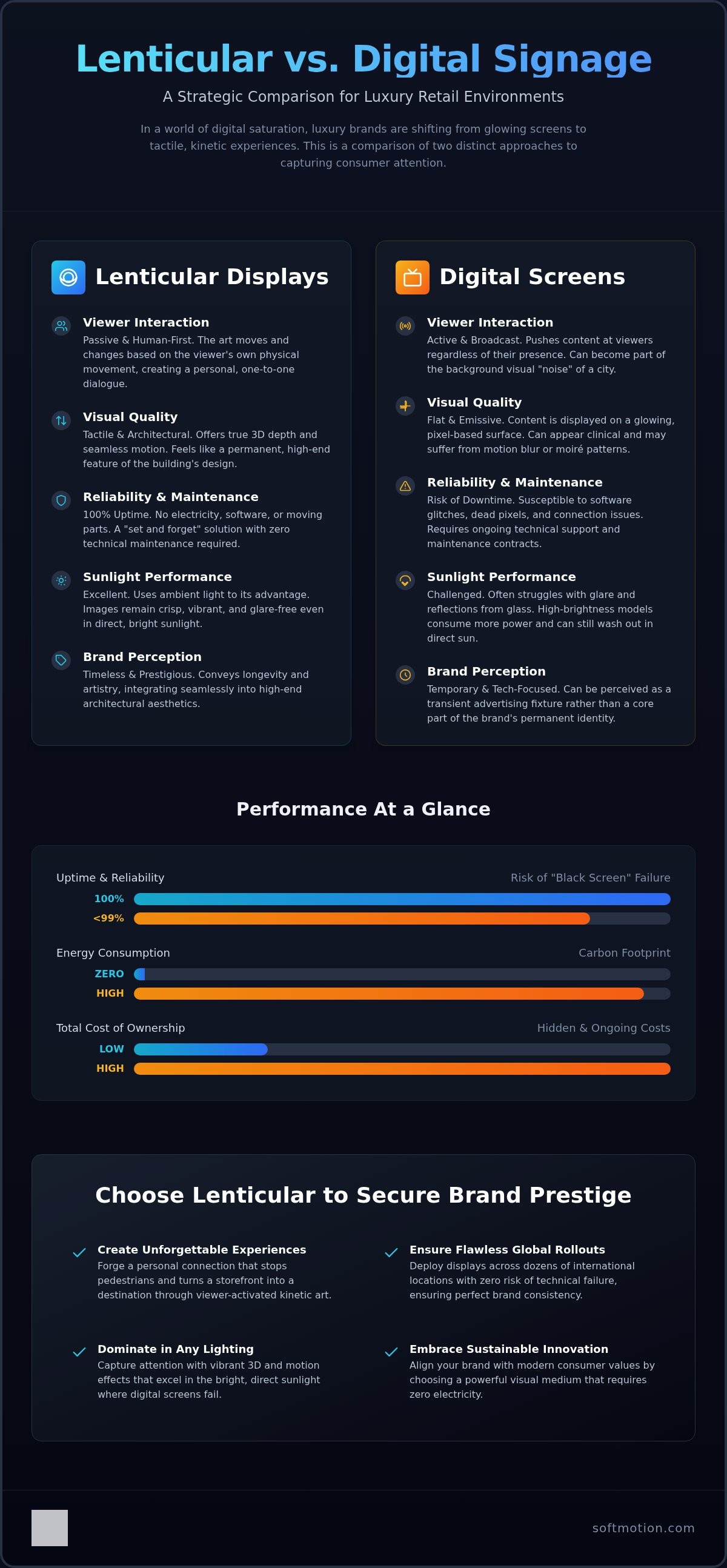
The retail environment in 2026 is undergoing a quiet but profound revolution. For over a decade, “dynamic” was synonymous with “digital,” but that narrow definition is shifting as luxury brands seek more authentic ways to engage. Digital signage relies on active interactivity; it pushes content at a viewer through a powered screen. Lenticular installations, however, utilize passive interactivity. The motion isn’t generated by a processor or a refresh rate but by the viewer’s own physical movement. This creates a deeply personal, human-first connection. As shoppers walk past, the image evolves in direct response to their pace. It’s a dialogue between the architecture and the individual, rather than a one-way broadcast.
When evaluating lenticular vs digital signage for retail, the psychological impact of this viewer-triggered motion cannot be overstated. A digital screen moves whether someone is watching or not, often becoming part of the background noise of a busy street. Lenticular art rewards the observer. It demands a physical presence to reveal its secrets, creating a “stop-and-stare” moment that feels earned. This kinetic resonance is why visionary creative directors are moving toward lenticular art vs digital signage to reclaim consumer attention in saturated urban centers.
The Rise of the “Non-Digital” High-End Experience
Luxury consumers are increasingly fatigued by the pervasive, artificial glow of high-definition screens. In flagship boutiques, “blue light” environments can feel clinical and cold. High-end retail thrives on texture, depth, and the sense of the handmade. Unlike the flat, glowing pixels of an LCD, Lenticular printing technology offers a tactile, architectural quality. It transforms a static surface into a multi-dimensional feature that feels like a permanent part of the building’s soul. By positioning kinetic art as an architectural element rather than a temporary tech fixture, brands communicate a sense of longevity and timelessness that digital hardware simply cannot replicate.
Reliability and the Cost of Downtime
The hidden costs of digital signage often emerge long after the initial installation. Software glitches, dead pixels, and complex wiring require constant vigilance and expensive maintenance contracts. A single “System Error” message in a flagship window can shatter a brand’s prestige in seconds. Lenticular displays offer a “set and forget” advantage for global retail rollouts. They provide 100% uptime because they don’t require electricity, media players, or internet connectivity. This reliability ensures that your lenticular vs digital signage for retail strategy remains flawless from the moment of installation, offering a risk-free way to maintain brand standards across dozens of international locations without the need for on-site technical support.
Sustainability also plays a pivotal role in this landscape. A large LED wall consumes significant energy and generates heat that often necessitates additional air conditioning. Kinetic lenticular art is an electricity-free motion experience. It allows brands to reduce their carbon footprint while maintaining a traffic-stopping presence, aligning the storefront with the environmental values of the modern luxury consumer. The same principle extends well beyond retail; lenticular art for public transit stations demonstrates how this zero-power kinetic approach captivates high-footfall audiences in demanding environments where digital screens routinely fail.
Comparing Performance: When to Choose Lenticular over Digital
Performance in a retail environment is often measured by a display’s ability to command attention without overwhelming the space. While digital screens rely on sheer luminous power to compete with ambient light, high-end lenticular installations use physics to their advantage. When analyzing lenticular vs digital signage for retail, the most immediate differentiator is how each medium handles its environment. Digital displays, even those rated for high-brightness storefronts, often struggle with glass reflections and direct sunlight. In contrast, large scale 3D wall art utilizes the existing light. The precision-engineered lenses refract and amplify ambient light, ensuring the “flip” or “3D depth” remains crisp and vibrant regardless of the sun’s position.
The viewing experience also differs fundamentally in its technical execution. Digital signage is bound by refresh rates and pixel pitch, which can lead to visible moiré patterns or motion blur when viewed up close. Lenticular motion is analog and infinite. There are no pixels to discern and no refresh cycles to sync. The transition from one image to the next is as smooth as the viewer’s own movement, providing a seamless visual flow that feels more like a living sculpture than a broadcast. This architectural permanence is backed by an impressive lifespan; while digital hardware typically requires replacement or significant repair within three to five years, a well-fabricated lenticular installation remains a pristine brand asset for a decade or more.
The Interactivity Factor: User-Driven vs. Loop-Driven
Digital signage operates on a closed loop. It plays its content regardless of who is watching or where they stand. This can often feel repetitive or intrusive in a luxury setting. The “magic” of a lenticular surface lies in its inherent responsiveness to the shopper’s gait. The image doesn’t just move; it moves for the viewer. As a customer walks past a window, the artwork evolves in direct correlation to their pace and angle. This creates a deeply personal connection between the individual and the storefront. It transforms a passive observer into an active participant, making the brand experience feel bespoke rather than mass-produced.
Technical Scalability in Retail Environments
Scaling digital visuals often introduces significant technical friction. Large-format LED walls require heavy structural support, complex cooling systems to manage heat, and visible seams that can disrupt a high-end aesthetic. Transitioning to large format lenticular printing removes these barriers. These installations are remarkably lightweight and can be integrated directly into curved walls or intricate retail millwork. For architects working within heritage buildings, lenticular art is frequently the preferred choice. It avoids the invasive electrical overhauls and heavy permitting often required for high-draw digital hardware. Architects seeking a deeper understanding of how these perspective-shifting surfaces integrate across diverse building typologies will find valuable technical guidance in this comprehensive overview of kinetic wall panels and dynamic surfaces for architectural design. If you’re looking to see how these textures integrate into your design, you might explore our architectural lenticular samples to experience the material quality firsthand.
Luxury Retail Case Studies: Kinetic Art in Action
The transition from a static display to a kinetic one marks the difference between a storefront and a destination. In the high-stakes world of luxury, the medium is as much a part of the message as the product itself. When choosing lenticular vs digital signage for retail, global brands often prioritize the “analog soul” of kinetic art to preserve the prestige of their physical spaces. This choice manifests in diverse ways across different sectors, each utilizing the unique properties of light and motion to tell a deeper brand story.
Fashion flagships use these installations to breathe life into their seasonal collections. By layering multiple frames of a model in motion, designers create a “walking” mannequin effect. As a pedestrian passes the window, the garment appears to sway and flow, mimicking a runway experience without the flickering distraction of a screen. In the high jewelry sector, the focus shifts to microscopic precision. Here, 3D depth effects reveal the intricate facets of a gemstone or the movement of a watch caliber. Unlike a digital display that can wash out fine details with backlighting, lenticular surfaces use ambient light to create a sense of genuine physical volume.
Automotive showrooms and luxury cosmetic brands also leverage these visual shifts. A static corridor in a showroom can be transformed into a high-speed track where vehicles appear to accelerate alongside the visitor. Cosmetics brands utilize the “Flip” effect to visualize product transformations, showing a “before and after” state that changes based on the viewer’s perspective. This interaction is intuitive and immediate, requiring no touchscreens or sensors to function. The same movement-triggered storytelling that captivates shoppers in a boutique corridor is equally powerful in high-footfall transit environments, where lenticular art for public transit stations transforms routine commuter journeys into cinematic, multi-dimensional experiences.
The Flagship Window as a Kinetic Masterpiece
A flagship window is more than a display; it’s a 40-foot narrative. High-end lenticular advertising displays consistently drive higher dwell times than static posters because they provoke curiosity. When shoppers realize the image is responding to their movement, they stop, backtrack, and engage. This street-level curiosity translates directly into increased foot traffic. By turning a massive facade into a moving story, brands create a landmark that people remember long after they’ve walked away.
In-Store Point of Sale: High-End Accents
The kinetic experience shouldn’t end at the entrance. In luxury boutiques, smaller lenticular elements act as sophisticated guides, leading customers through the curated space. These “micro-motion” accents are particularly effective for high-end product launches. They provide a subtle visual pulse that draws the eye toward a specific display or the register without the aggressive glare of a digital tablet. This creates a cohesive visual language that begins at the exterior window and continues through every touchpoint of the customer journey, ensuring the brand’s prestige remains uninterrupted.
Strategic Implementation for Luxury Storefronts
Successful implementation of kinetic art in a retail environment requires a shift from broadcast thinking to spatial engineering. While digital screens are often treated as an afterthought or a “plug-and-play” addition, the efficacy of lenticular vs digital signage for retail depends on how well the installation respects the physical rhythm of the street. To achieve a high-impact result, creative directors must analyze pedestrian flow with mathematical precision. The “flip” speed of the artwork should synchronize with the average walking pace of your demographic. If the transition is too rapid, the image becomes a frantic blur; if it’s too slow, the shopper has passed the window before the narrative reveals itself.
Lighting design plays an equally critical role in the success of lenticular building facades. Unlike digital screens that fight against the sun, these installations thrive on it. For daytime impact, the lens must be positioned to capture and refract ambient light without creating blinding hotspots. For nighttime presence, top-down grazing light or integrated backlighting can maintain the kinetic effect long after sunset. Material choice is the final pillar of this strategy. UV-resistant acrylic offers the optical clarity required for fine-art color matching, while high-durability polycarbonate is the preferred choice for high-traffic areas where structural resilience is paramount.
Calculating Viewing Zones and Sweet Spots
The geometry of the sidewalk dictates the technical specs of the lens. In narrow urban corridors like London’s Bond Street, the viewing distance is short, requiring a high-density lens pitch (LPI) for crisp transitions. Conversely, wide plazas or flagship stores with deep setbacks allow for a coarser lens that maximizes the “drive-by” impact for passing traffic. We help teams identify these “sweet spots” early in the design phase, ensuring the 3D depth and animation effects are optimized for the specific footprint of the storefront. This level of calibration ensures that the lenticular vs digital signage for retail debate is settled by superior visual performance.
Seamless Architectural Integration
Integrating kinetic surfaces into a modern facade requires more than just a mounting bracket. It demands a collaborative approach with retail architects to ensure that lenticular wall cladding sits flush with the building’s skin. Specialized mounting systems allow for large-scale panels to be installed with minimal seams, maintaining the illusion of a single, continuous moving surface. Beyond aesthetics, these installations must meet rigorous fire-code compliance and structural integrity standards for public spaces. If you’re ready to move from a static concept to a functional architectural feature, contact Softmotion to discuss your custom fabrication needs and ensure your vision is realized with technical excellence.
The Softmotion Collaborative Process: From Concept to Installation
Realizing a high-end kinetic installation is a journey from imagination to physical reality. It requires more than a fabricator; it demands a partner who understands the nuances of luxury and the technical discipline required to achieve it. We act as a Visionary Guide for architects and creative directors, helping them see the hidden potential in static storefronts. While the choice between lenticular vs digital signage for retail often begins with aesthetic preference, the success of the project is defined by the quality of the collaboration. We bridge the gap between a bold creative concept and a flawless architectural execution.
Our process is methodical and purposeful. We don’t just print images; we orchestrate light and movement. By partnering with creative teams from day one, we ensure the technical specifications of the lens align perfectly with the artistic intent. This collaborative spirit transforms a standard retail fit-out into a bespoke sensory experience that reflects the prestige of the brand. Precision is our baseline. Reliability is our promise.
Bespoke Design and Interlacing
The technical heart of every project lies in the interlacing process. We develop custom interlaced files that are mathematically tailored to your specific store dimensions and pedestrian viewing distances. This isn’t a one-size-fits-all approach. For luxury brands, color accuracy is non-negotiable. We utilize precision prototyping and provide high-fidelity lenticular samples to test flip transitions under real-world lighting conditions. This iterative refinement ensures that brand colors remain “luxury-accurate” and that the motion effect is smooth, sophisticated, and free of ghosting.
End-to-End Installation Support
Global luxury brands require a consistent visual identity across every flagship worldwide. We manage the complexities of global fabrication and logistics, delivering bespoke installations to any major city with white-glove care. Our team provides on-site oversight for large-format architectural projects, coordinating directly with general contractors and retail fit-out teams. We ensure that every panel is aligned with sub-millimeter precision, as even a slight deviation can disrupt the kinetic illusion. This end-to-end support extends to ongoing brand rollouts and seasonal refreshes. While digital installations often require a revolving door of technicians and software patches, our kinetic wall panels offer a controlled, professional process that results in a permanent, maintenance-free masterpiece.
The final result is a motion effect that matches the artistic vision perfectly. It’s a risk-free transition from the two-dimensional to the multi-dimensional, ensuring your storefront remains a traffic-stopping landmark for years to come.
The Future of Luxury Storefronts is Kinetic
The retail landscape of 2026 demands more than just brightness; it requires a return to sensory resonance and architectural integrity. Choosing between lenticular vs digital signage for retail isn’t merely a technical decision. It’s a commitment to how your brand is perceived in the physical world. By prioritizing passive interactivity over screen-based loops, luxury retailers eliminate the risks of technical failure while fostering a deeper, more personal connection with every passerby.
Softmotion brings over 25 years of large-scale lenticular expertise to your creative team. Trusted by Fortune-500 luxury brands and world-class architects, we provide comprehensive global installation and project management to ensure your vision is executed with absolute precision. It’s time to move beyond the glow of the screen and embrace the timeless allure of kinetic art.
Transform your luxury retail space with Softmotion’s kinetic installations and reclaim the art of the first impression. Your storefront has the potential to be a living landmark. Let’s realize that potential together.
Frequently Asked Questions
What is the main advantage of lenticular over digital signage for luxury retail?
The primary advantage of lenticular over digital signage is its ability to create a human-first kinetic experience without the intrusion of blue light or screen fatigue. While digital displays push content at a viewer, lenticular art relies on the shopper’s own movement to reveal its narrative. This creates a sense of discovery and architectural permanence that digital hardware, which often feels like a temporary addition, simply cannot match in a luxury environment.
Can lenticular window displays withstand direct sunlight without fading?
High-end lenticular installations are specifically engineered to thrive in storefront windows. We utilize UV-resistant acrylic and high-durability polycarbonate materials that protect the underlying graphics from solar degradation. Unlike LCD screens that suffer from glare or LED walls that can overheat in direct sunlight, lenticular lenses use ambient light to enhance their vibrancy. This makes them an ideal choice for south-facing flagships where digital screen visibility often fails.
How do I choose the right effect (3D vs. Flip) for my retail window?
Choosing the right effect depends on your brand’s specific storytelling goals and the viewing distance of the sidewalk. 3D depth is exceptional for high jewelry and watches because it reveals the physical volume and facets of a product. The “Flip” effect is better for fashion or cosmetics, where you want to show a dramatic transformation or a walking motion. We help you calibrate these effects during the prototyping phase to ensure maximum impact.
Do lenticular displays require special lighting to achieve the motion effect?
Lenticular displays don’t require specialized “smart” lighting, but they do benefit from purposeful directional illumination. To achieve the most fluid motion effect, we recommend top-down grazing light that allows the lenses to refract light across the interlaced image. During daylight hours, the installation uses natural light to power the experience. This electricity-free motion is a key differentiator when evaluating lenticular vs digital signage for retail for sustainable luxury storefronts.
What is the maximum size for a custom lenticular retail installation?
There is virtually no limit to the scale of a custom lenticular installation. While individual panels have manufacturing maximums, our specialized tiling and mounting systems allow us to cover entire building facades. We have successfully delivered projects ranging from small point-of-sale accents to 40-foot exterior brand stories. This scalability ensures that your kinetic art can match the architectural ambition of any flagship location, regardless of the physical footprint.
How long does the design and fabrication process take for a luxury rollout?
For a bespoke luxury rollout, the design and fabrication process typically spans 8 to 12 weeks. This timeline includes the critical precision prototyping phase where we provide physical samples for color matching and transition testing. Because we manage the process from concept to global installation, we ensure that every milestone is met with the technical discipline required for Fortune-500 standards. This methodical pace guarantees a risk-free execution for complex retail environments.
Is lenticular signage more sustainable than using LED or LCD screens?
Lenticular signage is significantly more sustainable than digital alternatives. It consumes zero electricity throughout its lifespan and produces no heat, which helps reduce the cooling load on retail interiors. Additionally, these installations avoid the environmental burden of e-waste, such as circuit boards and rare-earth metals found in screens. By choosing lenticular vs digital signage for retail, brands align their visual identity with a commitment to long-term environmental responsibility.
How does the cost of a high-end lenticular installation compare to digital signage?
When comparing costs, it’s essential to look at the total cost of ownership over a three to five year period. While the upfront investment for high-end lenticular can be similar to professional-grade LED, the ongoing expenses are drastically lower. Lenticular art requires no electricity, no software subscriptions, and zero technical maintenance. This “set and forget” reliability makes it a more pragmatic and cost-effective solution for brands seeking a traffic-stopping display without hidden operational fees.