
Kinetic Wall Murals vs Static Murals: The Architect’s 2026 Guide to Dynamic Spaces
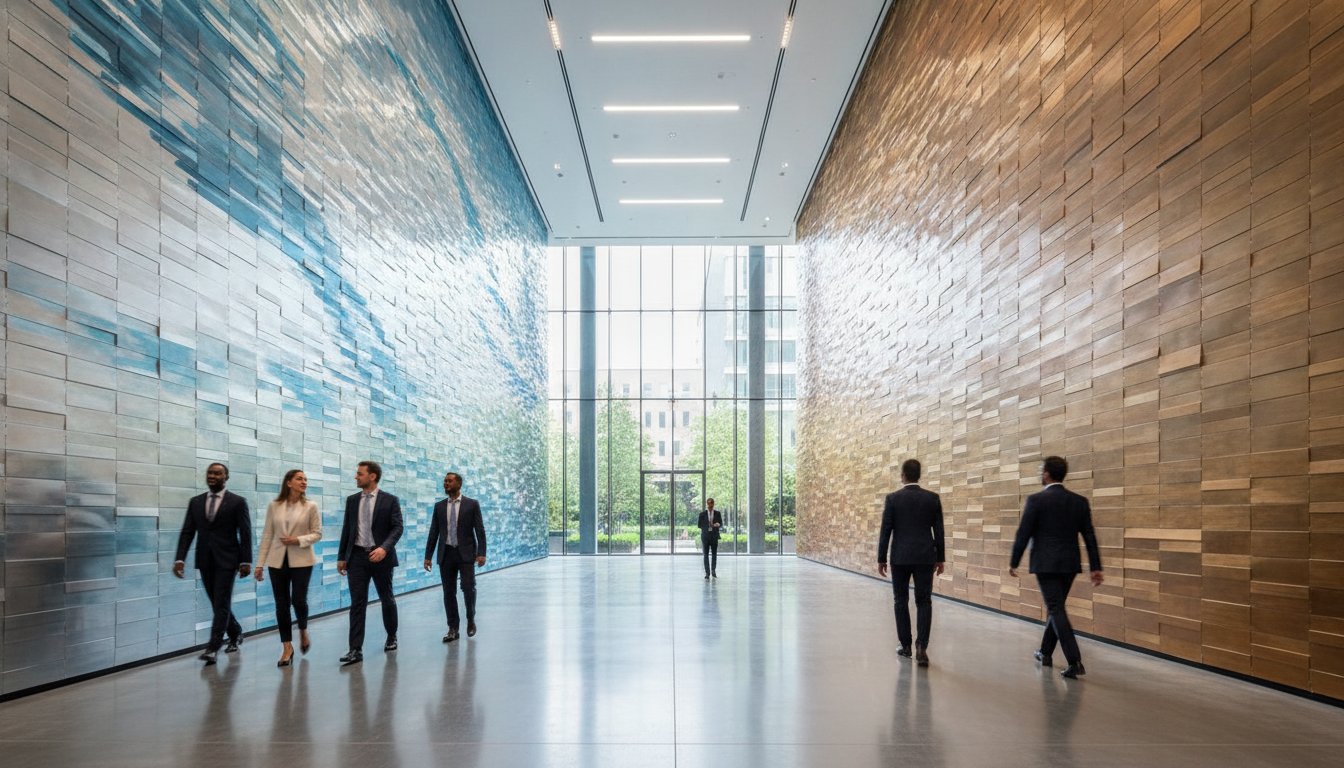
If a mural stands in a high-traffic lobby but no one stops to look at it, does it actually exist as a design element? Most architects understand the frustration of seeing a carefully curated piece of art fade into the background noise of a busy corporate or retail environment. You design for impact, yet traditional static surfaces often lose their power the moment the initial novelty wears off. When weighing the benefits of kinetic wall murals vs static murals, the decision often comes down to how long you want your space to remain relevant and engaging to its inhabitants.
It’s time to rethink the potential of the vertical plane. This guide explores how lenticular technology allows you to move beyond the limitations of passive surfaces, offering the vibrant energy of motion without the failure risks or maintenance costs of digital hardware. You’ll discover how to transform ordinary walls into immersive, multi-dimensional experiences that respond to the viewer’s movement. We’ll examine the technical advantages of lenticular fabrication, compare the lifecycle costs of dynamic installations, and show you how to create a lasting “wow factor” through a collaborative, risk-free process.
Key Takeaways
- Understand the fundamental shift from passive, fixed imagery to perspective-shifted art that evolves as the viewer moves through a space.
- Evaluate the trade-offs of kinetic wall murals vs static murals to determine which medium best serves your project’s long-term engagement goals.
- Discover why lenticular installations offer a low-risk alternative to digital screens by providing dynamic motion without power requirements or technical failure points.
- Learn how to leverage increased “dwell time” in retail and corporate environments by turning static walls into interactive, sensory landmarks.
- Explore the importance of technical prototyping in large-scale architectural projects to ensure your vision translates perfectly from concept to permanent installation.
Beyond the Painted Surface: Defining Kinetic and Static Wall Murals
The architectural landscape of 2026 demands more than just aesthetic coverage; it requires engagement. When we examine the choice between kinetic wall murals vs static murals, we’re really choosing between a passive backdrop and an active dialogue. A static mural is defined by its permanence. It relies on fixed composition, pigment, and light to convey a single moment in time. While these works can be breathtaking, they’re inherently limited to a solitary perspective. They represent the anchor of traditional design, reliable but ultimately unmoving.
In contrast, a kinetic mural introduces the element of time. These installations incorporate movement, whether through physical mechanical parts, environmental triggers, or the viewer’s own changing vantage point. This shift from the two-dimensional to the multi-dimensional is what separates a decorative surface from an immersive experience. As experiential design becomes the standard for corporate and retail environments, movement is no longer an optional flourish. It’s a necessary tool for brand storytelling that sticks.
The Limitations of Traditional Static Murals
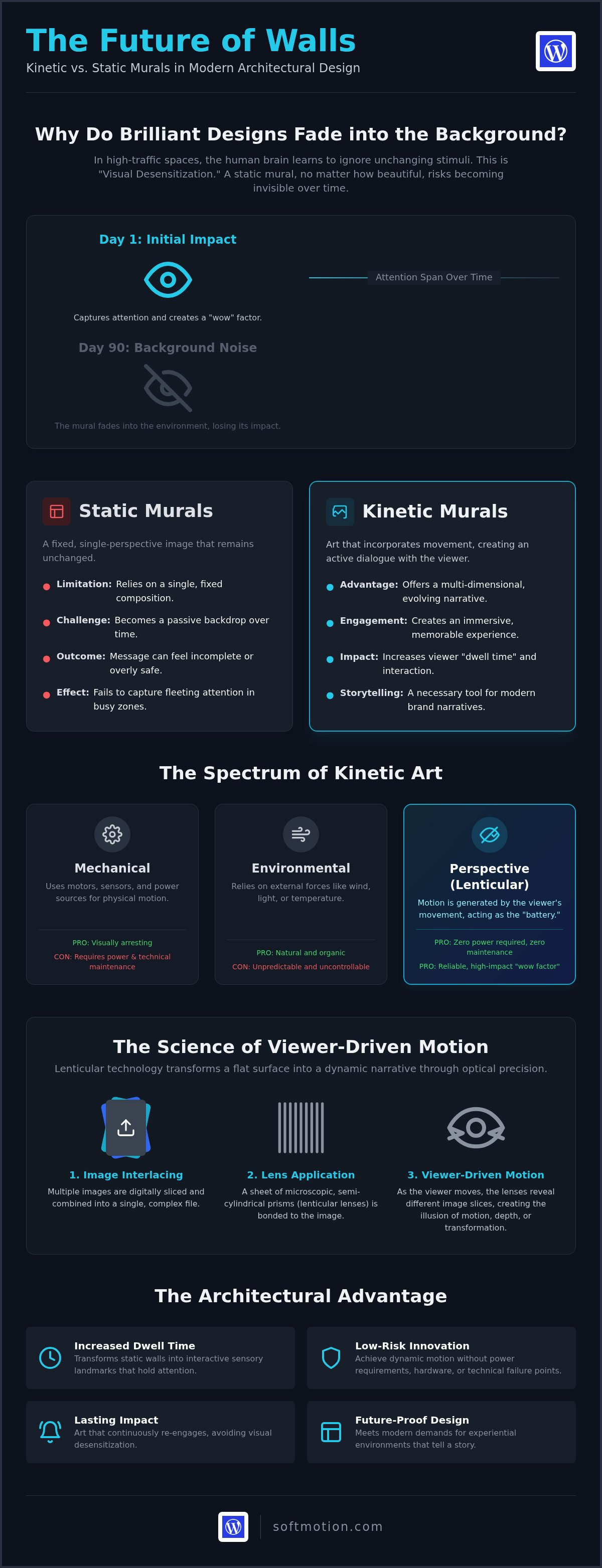
The human brain is wired to prioritize change. Once a static image becomes a permanent fixture in a lobby or hallway, a process called visual desensitization begins. Over time, the most vibrant mural effectively becomes “invisible” background noise as the mind filters out unchanging environmental data. This poses a significant challenge for modern spaces. If your narrative is complex or multi-faceted, forcing it into a single, unmoving frame often results in a message that feels incomplete or overly safe. In high-traffic zones, a mural that doesn’t evolve often fails to capture the fleeting attention of a professional audience.
The Three Categories of Kinetic Art
Movement in architectural art generally falls into three distinct methodologies. Each offers a different level of complexity and maintenance for the long-term life of the building.
- Mechanical Kinetic: These pieces utilize motors, sensors, or internal power sources to create physical motion. While visually arresting, they often require ongoing technical maintenance and dedicated power infrastructure.
- Environmental Kinetic: This category relies on external forces like wind currents, light shifts, or temperature changes. Shimmer walls are a common example; however, their unpredictability can sometimes clash with a highly controlled brand environment.
- Perspective Kinetic: This is where lenticular technology shines. These installations “move” as the viewer walks past them. The physical movement of the person acts as the battery for the art. It creates a sophisticated, multi-stage narrative that is entirely analog, meaning it requires zero power while providing a high-impact, reliable “wow factor.”
By understanding these distinctions, architects can move beyond the limits of the painted surface. Designing spaces that truly live requires a transition from seeing walls as boundaries to seeing them as opportunities for transformation.
The Science of Viewer-Driven Motion: How Lenticular Murals Work
The magic of a dynamic environment often lies in its subtlety. While we’ve discussed the conceptual shift of kinetic wall murals vs static murals, the actual transformation occurs through the precise manipulation of light. At the heart of this process is the lenticular lens; a series of microscopic prisms that act as a sophisticated gatekeeper for the viewer’s eye. These lenses don’t just sit on the surface. They curate the visual data, directing specific slivers of imagery to the left or right eye depending on where a person stands.
This is where the viewer becomes the “battery.” Unlike digital screens that consume electricity to force motion, lenticular art remains dormant until a person moves. As a visitor walks past the wall, their changing perspective reveals different segments of the underlying image. It’s a dance between human motion and optical precision. A seasoned large format lenticular manufacturer uses this principle to scale tiny optical effects into building-sized narratives. By mastering the Parallax Effect, we can create the illusion of deep, receding 3D space on a perfectly flat architectural surface.
From Interlaced Images to Fluid Motion
Creating this motion requires a rigorous technical process known as interlacing. We take multiple frames of an animation or various perspective shots and slice them into microscopic strips. These strips are merged into a single master file, then perfectly aligned beneath the lenticular lens. The angle of the lens determines which “frame” you see. This allows for the creation of large scale 3D wall art that feels tangible and deep, rather than just a flat graphic. Understanding how to prepare artwork for lenticular printing is essential at this stage, as the precision of your source files directly determines the sharpness and fluidity of the final motion effect. When weighing kinetic wall murals vs static murals, the depth of the narrative often dictates the technology.
Lenticular vs. Agamographs: Choosing Your Motion Style
Architects often encounter Agamographs; the “pleated” or accordion-style walls that reveal two different images. While effective for simple transitions, they lack the fluidity of modern technology. Lenticular is the superior choice for high-end architectural lenticular installations because it supports dozens of frames. This allows for smooth, cinematic animation or extreme 3D depth that an Agamograph simply cannot replicate. For artists and designers seeking to master this medium, designing lenticular fine art requires balancing high-level creative intuition with the rigid physics of optical lenses. If you’re looking to see how these textures feel in person, reviewing lenticular samples can help clarify the right motion style for your project.
Performance Comparison: Engagement, Maintenance, and Longevity
Performance isn’t just about the first impression; it’s about the thousandth. When evaluating kinetic wall murals vs static murals, architects must look beyond the initial visual pop to the long-term operational reality. Digital screens often promise the ultimate dynamic experience, yet they bring a relentless cycle of software updates, pixel failures, and significant energy costs. A high-end lenticular installation provides the same sense of wonder with none of the technical overhead. It replaces fragile electrical components with durable optical physics. This shift ensures a lifespan of up to 20 years, far outlasting the typical 5-year replacement cycle of commercial digital displays.
Engagement and Audience Interaction
Movement triggers a primary visual instinct that static images simply cannot reach. We call this the “Double-Take” factor. While traditional murals eventually settle into the architecture as background noise, kinetic surfaces remain a destination. They demand attention because they respond to the viewer’s presence. In the competitive environment of 2026, spaces are often judged by their social resonance. A wall that evolves as you walk past invites people to record and share the experience. You’re no longer just providing art; you’re designing a participatory event that naturally increases dwell time in retail and corporate environments.
Durability in High-Traffic Environments
Durability defines the success of any installation in transit hubs or luxury flagships. These spaces are demanding, requiring materials that withstand physical contact and environmental stress. Modern lenticular materials are engineered for this rigour, offering exceptional UV resistance and color fastness. This ensures the work remains as vivid in its tenth year as it was on day one. While a static mural might require a costly refresh or repainting every few years to combat fading, a well-designed kinetic piece remains timeless. Most importantly, these installations achieve this impact with zero energy consumption. Architects can deliver high-impact motion while meeting strict sustainability goals, proving that dynamic doesn’t have to mean high-maintenance.
Strategic Application: Matching Mural Types to Architectural Environments
Selecting the right medium requires an understanding of the environment’s pulse. In corporate lobbies, kinetic murals serve as a visual shorthand for innovation and brand evolution. They signal that a company is forward-thinking and responsive to change. Static murals, while dignified, often suggest a fixed history or a traditional stance. For retail and luxury flagships, creating “Dynamic Retail Environments” is about stopping power. It’s the difference between a storefront that people walk past and one that draws them inside through a subtle, magnetic shift in perspective. When you weigh the impact of kinetic wall murals vs static murals, the kinetic option consistently wins in spaces where capturing and holding attention is a business necessity.
Transit hubs present a unique challenge of scale and momentum. In these high-volume zones, the art must communicate with a moving audience that rarely stops. The motion of the crowd itself becomes the catalyst for the visual narrative, creating a synchronized experience. In contrast, fine art galleries utilize fine art lenticular prints to invite slow, deliberate contemplation. The technology allows artists to hide and reveal layers of meaning, rewarding the viewer for their physical presence and curiosity. This versatility makes lenticular art an ideal choice for architects who need to balance large-scale impact with intimate engagement.
Designing for Scale and Distance
The technical execution of a mural depends heavily on the “pitch” of the lenticular lens. This refers to the density of the micro-prisms per inch. A mural designed for a narrow hallway requires a high-pitch lens for sharp, close-up viewing. Conversely, a grand atrium demands a lower-pitch lens that can project its motion effects across dozens of feet. When we manage large-scale commuter movement in public spaces, we calculate these sightlines with precision. We ensure the motion feels fluid and intentional from every possible angle of approach, whether someone is rushing to a train or standing still on an escalator.
Atmospheric Integration: Light and Space
Success lies in how the art integrates with its surroundings. Ambient light is the lifeblood of the perspective-shift effect. We often collaborate with lighting designers to ensure the surface is illuminated in a way that maximizes the “flip” or 3D depth. By integrating these installations directly into architectural cladding, we achieve a seamless, built-in look that feels like part of the building’s DNA rather than an decorative afterthought. This holistic approach ensures that the art doesn’t just sit on the wall; it transforms the entire spatial experience. Ready to see how these dynamics work in your specific project? You can request lenticular samples to experience the material’s transformative quality firsthand.
Designing the Future: The Softmotion Approach to Large Scale 3D Wall Art
Realizing a complex spatial vision requires more than high-quality printing; it demands a disciplined technical process. When deciding between kinetic wall murals vs static murals, the ultimate success of the installation hinges on the transition from conceptual art to structural reality. Softmotion acts as your Visionary Guide throughout this journey. Since 1997, we’ve delivered over 1,000 projects for Fortune-500 clients and public institutions, bridging the gap between imaginative design and technical discipline. Our experience ensures that the bold innovation you envision is grounded in professional reliability and artistic craftsmanship.
Custom prototyping is the cornerstone of our approach. For large-scale architectural success, we don’t simply scale up a digital file. We create physical samples that allow you to verify viewing angles, lighting interactions, and the fluidity of motion in the actual environment. This collaborative process eliminates risk, ensuring the final result resonates with the intended emotional impact. By moving from 2D concepts to multi-dimensional prototypes, we provide clarity and confidence before the first panel is ever fabricated. It’s a methodical path from what is possible to how it’s achieved. A critical part of this process is understanding how to prepare artwork for lenticular printing, so that your source files are optimized for the unique physics of the lens before fabrication begins.
Precision Fabrication and Project Management
The complexity of large-format work necessitates expert lenticular installation project management. We handle the entire lifecycle of the project, from initial sampling to on-site assembly. Navigating the logistics of large-format shipping and the intricacies of structural mounting requires a seasoned eye. Our quality control standards ensure perfect alignment across multiple panels, which is critical for maintaining the illusion of movement across a vast surface. We manage these technical nuances so you can focus on the broader architectural vision, knowing the execution is in capable hands.
Your Invitation to Motion
Transforming a space from static to dynamic is a journey of discovery. We invite you to experience the difference between kinetic wall murals vs static murals firsthand. It’s one thing to read about motion, but it’s another to walk past a surface and see it come to life. By requesting custom lenticular samples, you can feel the texture and observe the perspective shift in your own light. This is the first step toward creating a landmark environment that captures the imagination and leaves a lasting resonance. Transform your environment with a Softmotion kinetic installation today.
Elevating the Architectural Narrative
The decision between kinetic wall murals vs static murals ultimately defines how a space communicates with its inhabitants. While static art offers a reliable anchor, kinetic installations invite a living dialogue that evolves with every step. You’ve seen how lenticular technology bypasses the fragility of digital screens, offering high-impact motion through pure optical physics. This approach ensures your design remains a vibrant destination rather than fading into the background. It’s about choosing a medium that rewards curiosity and honors the viewer’s presence.
As pioneers in large-format lenticular since 1997, Softmotion has delivered over 1,000 successful installations worldwide. We specialize in end-to-end custom fabrication for Fortune-500 brands, acting as a collaborative partner to realize your most ambitious visions. Our process is designed to be risk-free and methodical, ensuring that the final result carries the emotional resonance your project deserves. Begin your journey from static to dynamic with Softmotion. We look forward to helping you transform your next environment into a multi-dimensional landmark.
Frequently Asked Questions
What is the main difference between a kinetic mural and a static mural?
The main difference is how the art interacts with time and the viewer. A static mural is a fixed, unchanging image that relies on composition for impact. A kinetic mural incorporates motion, whether through physical movement or optical shifts. When evaluating kinetic wall murals vs static murals, consider that kinetic installations transform passive surfaces into active experiences. They respond to the environment, ensuring the artwork remains engaging long after the initial viewing.
Do lenticular kinetic murals require electricity or special lighting?
Lenticular kinetic murals require zero electricity because the viewer’s physical movement provides the necessary energy for the motion effect. The transition between images is purely analog, driven by the way micro-lenses redirect ambient light to the eye. While dedicated power isn’t needed, strategic lighting can significantly enhance the Parallax Effect. We often work with architects to ensure the light levels maximize the depth and clarity of the multi-dimensional narrative.
How long do large-scale 3D wall art installations typically last?
Large-scale 3D wall art installations are engineered for permanence and typically last up to 20 years in interior environments. These optical surfaces are far more durable than digital screens, which often require replacement within five years due to technical obsolescence. By using UV-stable materials and high-grade polymers, we ensure the kinetic effects and color vibrancy remain intact for decades. This longevity makes them a highly reliable choice for landmarks and corporate headquarters.
Can kinetic murals be installed outdoors on building facades?
Yes, kinetic murals can be installed on building facades provided they are engineered with exterior-grade materials. We produce specialized architectural installations that are specifically treated for UV resistance, thermal expansion, and moisture protection. These dynamic skins allow a building to evolve visually throughout the day as sunlight shifts and pedestrians move past. It’s a powerful way to create a responsive architectural landmark that stands up to the rigors of the outdoor environment.
Are kinetic murals more expensive than traditional hand-painted murals?
Kinetic murals involve a higher initial investment than traditional hand-painted works because of the specialized optical materials and precision fabrication required. However, the long-term ROI is often superior. When analyzing kinetic wall murals vs static murals, the kinetic option provides significantly higher engagement and social resonance. Because they don’t fade or require repainting like static murals, the lifecycle costs are reduced, making them a pragmatic choice for high-value retail and corporate spaces.
What kind of maintenance does a lenticular wall mural require?
Maintenance for a lenticular wall mural is remarkably minimal and mirrors the care required for architectural glass. Since the installation has no motors, sensors, or electronic components, there are no technical parts to fail or software to update. You simply need to keep the surface free of dust and debris using a soft, non-abrasive cloth. This zero-maintenance profile is a primary reason why architects choose this technology for high-traffic transit hubs and lobbies.
Is it possible to create a kinetic mural that shows more than two images?
It is entirely possible to create kinetic murals that display far more than just two images. While basic accordion-style walls are limited, our advanced interlacing process allows for smooth animations consisting of dozens of individual frames. This technology enables us to create fluid motion, cinematic transitions, and extreme 3D depth. Architects can use this capability to communicate complex brand stories or create sophisticated artistic sequences that unfold gradually as the viewer traverses the space.
How do I choose between a mechanical kinetic mural and a lenticular one?
Choosing between these options depends on your goals for maintenance and technical complexity. Mechanical murals provide physical motion but require power infrastructure and regular servicing to prevent mechanical failure. Lenticular murals offer the same dynamic energy through viewer-driven motion, providing a risk-free, analog solution. For most architectural projects, the lenticular approach is preferred because it delivers a consistent “wow factor” without the noise, energy consumption, or repair costs associated with motorized art.