
Designing Lenticular Fine Art: Merging Optical Precision with Artistic Vision

The most compelling art doesn’t just sit on a wall; it interacts with the air around it. As public spaces see a significant shift away from the fatigue of digital screens toward permanent, analog kinetic works, the demand for tactile, moving experiences has never been higher. You know that a truly great piece should evolve as the viewer moves, yet the technical hurdles of ghosting and complex file preparation often feel like a barrier to entry. Designing lenticular fine art requires a delicate balance between high-level creative intuition and the rigid physics of optical lenses.
We understand the hesitation that comes with large-format production. It’s a journey from a flickering screen to a physical masterpiece that must command a room. This article provides a clear roadmap to help you master this medium with confidence. You’ll learn how to select the right effects for your specific environment and how to prepare files that translate perfectly from your studio to the gallery floor. We’ll explore the transition from the two-dimensional to the multi-dimensional, ensuring your vision remains crisp and emotionally resonant in any physical space.
Key Takeaways
- Understand how to transition from static imagery to dynamic narratives where the viewer’s physical movement completes the artistic experience.
- Learn the essential principles of designing lenticular fine art by matching kinetic effects, such as flips or complex animations, to the specific viewing path of your audience.
- Discover technical strategies to eliminate “ghosting” and master the precise interlacing math required for high-resolution, large-format production.
- Gain clarity on how viewing distance and ambient lighting dictate the selection of lens pitch (LPI) for seamless architectural-scale installations.
- Establish a reliable production workflow by utilizing physical lenticular samples to verify digital concepts before committing to full-scale fabrication.
The Intersection of Optical Physics and Artistic Vision
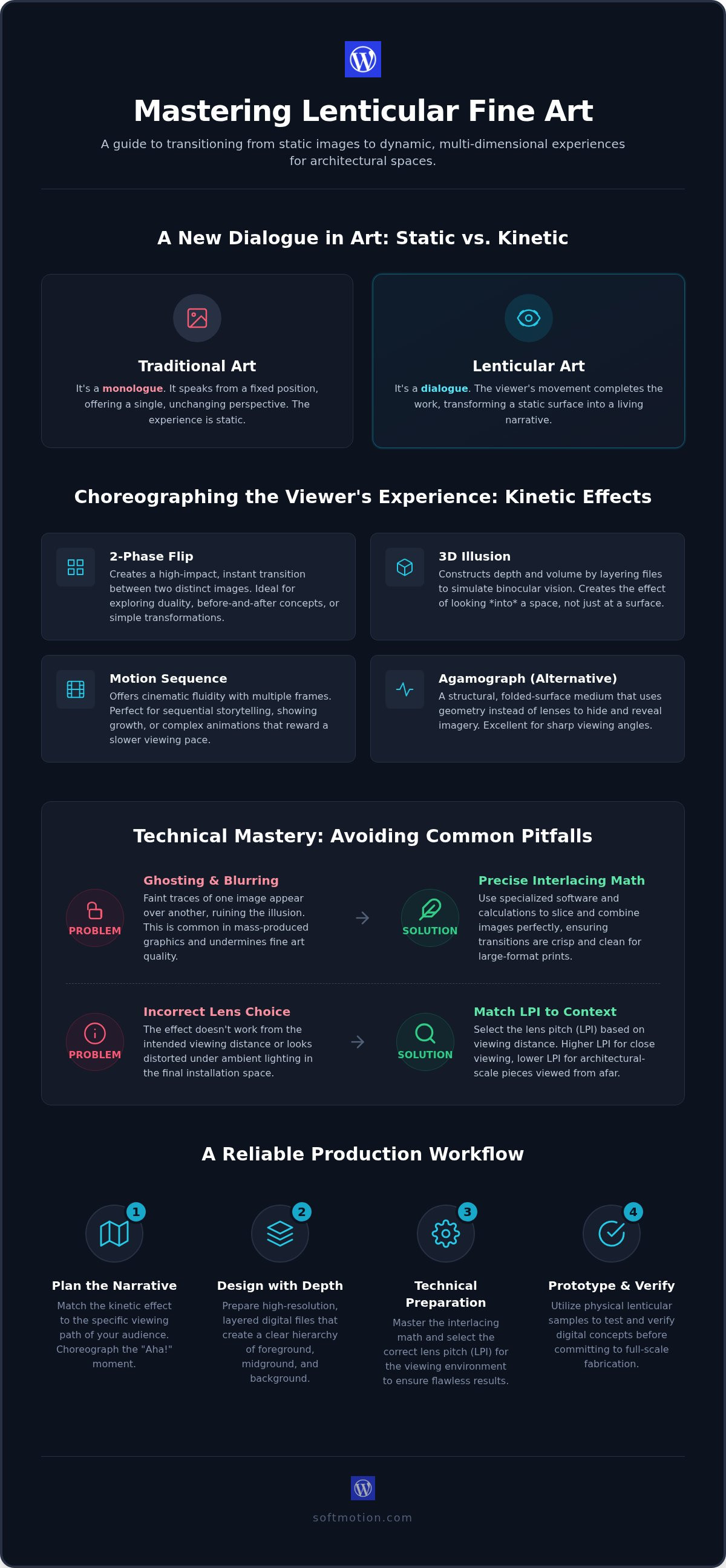
Traditional art is a monologue. It speaks to the viewer from a fixed position, offering a single, unchanging perspective. Lenticular fine art is a dialogue. It requires the viewer’s physical presence and movement to reveal its true form. When you’re designing lenticular fine art, you’re creating a medium where the observer’s perspective completes the work. The art remains incomplete until someone walks past it, triggering a transformation that turns a static surface into a living narrative.
Static printing has inherent limitations. It captures a moment but loses the dimension of time. Kinetic surfaces reimagine this relationship by using a sophisticated array of lenses to slice and layer multiple images into a single plane. Lenticular printing technology acts as the gateway between two-dimensional digital files and multi-dimensional physical experiences. The lens doesn’t just show an image; it directs the gaze, isolating specific visual data based on the viewer’s angle. This allows for “Sequential Storytelling,” a tool that lets artists layer chronological events or emotional shifts within a single frame.
Why Fine Art Demands Large-Format Precision
Scale changes the stakes. In a quiet gallery or a vast corporate lobby, a piece must command the environment without losing its technical integrity. Standard commercial printing often prioritizes speed, but fine art requires a level of depth and clarity that resists the “blur” common in mass-produced graphics. Designing lenticular fine art at an architectural scale requires specialized interlacing math to ensure every transition is crisp. For those looking to bridge the gap between digital concept and museum-quality physical results, our Fine Art Lenticular Prints: 2026 Curator’s Guide provides a deeper look into these professional standards.
The Artist as Choreographer: Designing for the Gaze
In this medium, movement is as much a design element as color or composition. You aren’t just an illustrator; you’re a choreographer. You’re mapping out how a viewer will walk through a space and deciding exactly when the “Aha!” moment should occur. That instant when the image shifts is where the emotional resonance lives. It’s a moment of discovery that creates a lasting bond between the audience and the environment. As your Visionary Guide, we focus on balancing your boldest creative impulses with the pragmatic constraints of optical physics. We help you see the hidden potential in your files, ensuring the final installation feels both inspired and technically flawless.
Designing for Movement: Planning Your Kinetic Narrative
Movement is the primary medium in kinetic design. When you’re designing lenticular fine art, you aren’t just selecting images; you’re choreographing time. The success of a piece depends on matching the visual effect to the physical path a viewer takes. A ‘2-Phase Flip’ creates a high-impact transition between two distinct states, making it ideal for pieces that explore duality or transformation. In contrast, complex animations offer a cinematic fluidity that rewards a slower, more deliberate pace. Understanding the nuances of creating 3D lenticular art ensures that these transitions feel intentional rather than accidental.
For installations where the viewer approaches from a sharp angle, an Agamograph, a structural, folded-surface alternative to the lenticular lens, might provide the necessary physical presence. While lenses rely on optical refraction, Agamographs use geometry to hide and reveal imagery. Both methods transform a static wall into a living surface. If you’re unsure which path fits your vision, our team can help you review lenticular samples to see how these effects behave in person.
The 3D Illusion: Constructing Depth and Volume
True depth in fine art isn’t about looking at a picture; it’s about looking into a space. By layering digital files to simulate binocular vision, we create “volume without boundaries” that can make a corporate lobby feel like an infinite vista. Achieving this requires a strict hierarchy of foreground, midground, and background elements. Each layer must be carefully spaced to avoid visual strain while maintaining the illusion of physical mass. For a deeper look at the technical requirements for these installations, explore our guide on Large Scale 3D Wall Art.
Motion Sequences: Capturing Time in a Single Surface
Fluidity is the hallmark of a sophisticated motion sequence. While commercial graphics might use dozens of frames, fine art often benefits from restraint. Too many frames can lead to a “muddy” transition where images overlap in a ghost-like blur. We focus on finding the “sweet spot,” which is the exact number of frames needed to convey motion without sacrificing clarity. Whether you’re designing a subtle morph or a sharp reveal, the goal is to use motion to pull the viewer deeper into the narrative, revealing hidden layers that a static print simply cannot hold. This refined approach is particularly effective when working with intimate source material; for example, a profesjonalna sesja buduarowa (professional boudoir session) can be translated into a kinetic narrative where subtle shifts in pose and expression are revealed through the lens.
Digital perfection often shatters when it meets the physical world. While your monitor displays millions of colors with absolute clarity, a lenticular lens introduces physical variables like light refraction and viewing angles. Mastering the technical side of designing lenticular fine art means anticipating these shifts before the first drop of ink hits the substrate. It’s about moving from a “what I see is what I get” mindset to a “what the lens allows” philosophy. We act as your technical partner, ensuring that your creative intent survives the transition from pixels to plastic.
One of the most persistent hurdles is the “Ghosting” challenge. Ghosting is the unintended bleeding of one image into another due to high contrast. Imagine a dark silhouette on a stark white background. As the viewer moves, the dark ink lingers in the white space of the next frame, creating a distracting smudge. To solve this, we often recommend using textured backgrounds or mid-tone gradients that “absorb” the ghosting, maintaining the integrity of the narrative without sacrificing the art’s emotional impact.
Color theory also takes on a new dimension under a lens. CMYK values can shift slightly as light passes through the lens ribs, and dark colors may appear more saturated than they do on a backlit screen. Typography requires similar care. High-impact text should be bold and typically sans-serif to remain legible during a transition. Thin lines or delicate serifs tend to break up or disappear entirely as the lens slices the image, which can ruin the polished finish of a museum-quality piece.
Managing Contrast and Background Textures
Solid white backgrounds are the enemy of clean lenticular flips. They offer no place for the previous frame’s light to hide. Instead of flat colors, we suggest using organic textures, patterns, or complex imagery to mask technical artifacts. This approach doesn’t just solve a technical problem; it enhances the “fine art” feel by adding a layer of sophistication that feels intentional. It’s a transformation that turns a technical constraint into a creative asset.
File Preparation and Interlacing Basics
Interlacing is the complex math that slices your images and arranges them to match the lens frequency. This process is highly sensitive to the “Pitch,” which is the exact number of lenses per inch. Working with an experienced Large Format Lenticular Manufacturer is essential to get this right. They ensure your bleed requirements match the specific effect. For instance, 3D depth requires horizontal bleed, while motion sequences often need extra space on all sides to account for the physical registration of the lens during fabrication. For a comprehensive walkthrough of these technical requirements, our guide on how to prepare artwork for lenticular printing covers the full spectrum of file preparation best practices.
Context and Scale: Designing for Architectural Environments
Environment dictates the soul of the work. When you’re designing lenticular fine art for an architectural scale, the room itself becomes a collaborator. A piece in a quiet corporate lobby invites an intimate, slow-paced interaction. Conversely, a transit hub installation must speak to a crowd in motion, often from a distance of thirty feet or more. This shift in scale requires a fundamental change in how we select the lens and calculate the visual “sweet spot.” We guide you through these spatial challenges, ensuring your vision remains clear regardless of the room’s dimensions.
Lighting is the silent partner in every installation. Ambient light in a glass-walled atrium behaves differently than the focused spotlights of a gallery. Directional light can catch the ribs of the lens, creating glare or unwanted shadows that break the illusion. We work to align the orientation of the lens with the primary light source and the expected path of the viewer. This technical foresight ensures that the transition from 2D wall art to Kinetic Architecture remains seamless and impactful.
Viewing Distance and the ‘Sweet Spot’
The potency of a lenticular effect depends on the Lenses Per Inch (LPI). For close-range viewing, a high LPI provides the resolution needed for intricate details. As the distance increases, we shift to a lower LPI with thicker lenses to maintain the depth and motion visibility. In long corridors, we often design for “sideways” motion, where the image evolves as the viewer walks parallel to the wall. Calculating these “dead zones” and “sweet spots” is a pragmatic science that ensures the art remains vibrant from every corner of the room. It’s about choreographing a narrative that feels consistent even as the audience moves through the space.
Materiality and Durability for Public Spaces
Public installations demand a level of resilience that studio work does not. We select UV-resistant materials and specialized substrates to ensure architectural longevity, whether the work is destined for an indoor lobby or an outdoor facade. The physical environment dictates the fabrication method, from scratch-resistant coatings to moisture-sealed edges. Our approach to high-traffic environments is rooted in decades of experience; we’ve delivered over 1,000 projects since 1997. We build for emotional impact while ensuring the work can withstand the rigors of a busy metropolitan space. If you’re planning a large-scale project, explore our architectural lenticular installations to see how we transform public environments through technical mastery.
The Collaborative Journey: From Prototype to Installation
Designing lenticular fine art is a journey that moves from the abstract to the architectural. It isn’t a simple transaction where you upload a file and receive a generic print. Instead, it’s a meticulous partnership between artistic vision and technical fabrication. We act as your Visionary Guide, bridging the gap between your digital concept and a physical installation that commands attention. This involves troubleshooting artistic files for production, identifying potential ghosting issues, and optimizing file layering before the first lens is even selected. This collaborative approach ensures that every nuance of your work is preserved, providing a risk-free path for high-stakes corporate and gallery commissions where failure isn’t an option. For organizations seeking a maintenance-free alternative to motorized sculptures or digital screens, our guide to kinetic art for corporate headquarters explores how lenticular installations serve as permanent architectural features that reflect core brand values.
Prototyping: The Bridge Between Concept and Reality
Prototyping is the bridge between concept and reality. We believe that lenticular samples are non-negotiable for large-scale fine art projects. They allow you to test color accuracy and motion timing in the actual environment where the work will live. Prototyping is the only way to verify the physical ‘depth’ of a 3D file before full-scale printing. By seeing a small-scale version of the final piece, you can adjust the speed of a morph or the intensity of a flip. This feedback loop between the artist and our production team ensures that technical artifacts are resolved early. It transforms the creative process into a controlled, predictable evolution that maintains the integrity of your original vision.
On-Site Installation and Final Alignment
The final stage is as much about engineering as it is about art. Managing the logistics of Lenticular Installation Project Management requires a deep understanding of structural alignment and environmental factors. Mounting large-format sheets demands extreme precision. Even a fraction of a millimeter of misalignment can disrupt the motion experience for the viewer. We prioritize verticality and registration to ensure the transition is seamless from every angle. Our “human-first” commitment means we don’t just deliver a crate; we ensure the final result resonates with the audience as intended. Since 1997, we’ve delivered over 1,000 projects to Fortune-500 companies and renowned artists, proving that technical discipline is the essential foundation for artistic freedom.
Transforming Vision into Kinetic Reality
Designing lenticular fine art is more than a technical exercise; it’s the creation of a sensory experience that lives and breathes with its audience. We’ve explored how the intersection of optical physics and artistic vision allows for narratives that static surfaces simply can’t hold. From the precision of large-format interlacing to the strategic planning of viewing distances in architectural spaces, every detail serves a single purpose: to turn a passive observer into an active participant. It’s a journey from the two-dimensional to the multi-dimensional, where your creativity is the primary engine of motion.
Success in this medium requires a partner who understands both the creative spark and the rigid constraints of production. With over 25 years of specialized experience and a portfolio that includes global deliveries for Fortune-500 brands, Softmotion provides the expert-led project management needed to navigate every stage from initial concept to final installation. We don’t just print; we collaborate to ensure your work achieves its maximum emotional resonance. Bring your vision to life with Softmotion’s custom lenticular design and fabrication services. Let’s build something extraordinary together.
Frequently Asked Questions
What is the best file resolution for designing lenticular fine art?
The standard resolution for high-quality output is 300 DPI at full physical size. However, when you’re designing lenticular fine art for large-format installations, the resolution must be precisely calculated based on the lens pitch or LPI. We recommend working in a CMYK color space and avoiding extremely thin lines that might disappear during the interlacing process. This technical precision ensures your final print maintains its museum-quality clarity and impact.
How do I prevent ‘ghosting’ in my lenticular motion prints?
You can prevent ghosting by avoiding high-contrast transitions, such as placing dark silhouettes against a stark white background. Ghosting occurs when the previous image’s light bleeds into the current viewing angle. We suggest using textured backgrounds or mid-tone gradients to absorb this visual overlap. These creative workarounds act as a buffer, hiding technical artifacts while enhancing the overall aesthetic and emotional resonance of your multi-dimensional narrative.
Can I use photography and digital illustration in the same lenticular piece?
Yes, you can seamlessly blend photography and digital illustration in a single work. This hybrid approach is frequently used in designing lenticular fine art to create surreal or deeply layered narratives. If you want to incorporate professional portraits into your custom art projects, Beautiful Capture Photography can assist; find out more about their specialized on-location sessions. The key is ensuring that both elements share consistent lighting and perspective to maintain the illusion of a single, cohesive environment. We help you align these disparate digital assets so they translate perfectly through the physical lens during fabrication.
A lenticular flip switches between two or more distinct images as the viewer moves, which is ideal for showing transformation or duality. A 3D effect uses a series of slightly offset frames to simulate binocular depth, creating the illusion of volume within a single scene. While flips are about change over time, 3D effects focus on spatial immersion. You can even combine both techniques for a truly complex, multi-dimensional experience.
How does viewing distance affect the design of a large-format lenticular wall?
Viewing distance determines the Lenses Per Inch (LPI) required for the installation. If the audience is thirty feet away in a busy transit hub, we use a lower LPI with a thicker lens to ensure the motion remains visible. For intimate corporate lobbies, a higher LPI provides the fine detail needed for close-up inspection. We calculate the “sweet spot” based on your room’s dimensions to ensure the kinetic effect is potent and clear.
Are lenticular fine art prints durable enough for high-traffic corporate lobbies?
Our fine art prints are engineered specifically for the rigors of public and corporate environments. We use UV-resistant plastics and specialized substrates that resist scratching and fading over time. Whether it’s a bustling atrium or a high-traffic corridor, the materials are selected for their architectural longevity. Since 1997, we’ve delivered over 1,000 projects that continue to maintain their kinetic impact and structural integrity years after their initial installation.
What is an Agamograph and how does it differ from a lenticular lens?
An Agamograph is a structural artwork that uses a zigzag, folded surface to hide and reveal images based on the viewer’s position. It relies on physical geometry rather than the optical refraction of a lenticular lens. While lenticular prints offer fluid motion and 3D depth, Agamographs provide a more tactile, sculptural presence. Both methods transform a static wall into a kinetic narrative, but the choice depends on the specific lighting of your space.
How do I get started with a custom lenticular commission at Softmotion?
The process begins by sharing your digital concept or artistic vision with our production team. We act as your Visionary Guide, reviewing your files for technical feasibility and suggesting the best lens for your specific environment. The journey typically involves creating small-scale lenticular samples to verify the motion and color before full-scale fabrication. This collaborative, human-first approach ensures a risk-free execution for high-stakes commissions, leading you from initial prototype to a flawless installation.