
Kinetic Art Guide for Corporate Identity 2026
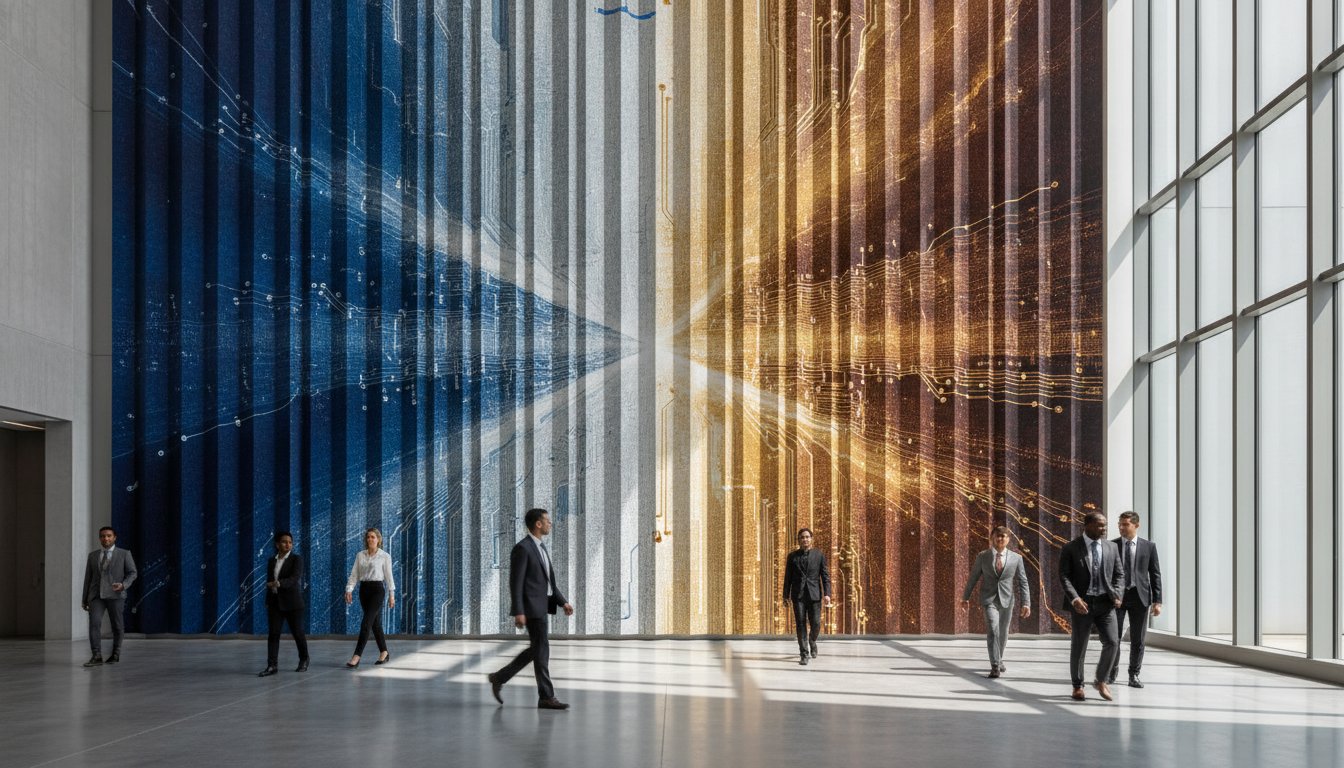
In 2026, the most sophisticated kinetic art for corporate headquarters isn’t powered by complex motors or expensive software, but by the simple movement of the people walking through your lobby. It’s a shift from the mechanical to the experiential. You’ve likely noticed that traditional static art often feels outdated for an innovative company, yet the constant upkeep and inevitable mechanical failure of motorized sculptures can become a significant burden. Digital screens frequently miss the mark too, feeling sterile or distracting in a space meant to project professional warmth and stability.
This guide explores how dynamic lenticular installations provide a high-impact, maintenance-free alternative to traditional kinetic art. You’ll discover a collaborative design process that ensures your installation isn’t just a decoration, but a permanent architectural feature reflecting your core values. We’ll examine the transition from two-dimensional surfaces to multi-dimensional experiences, showing you how to achieve a “wow-factor” that feels both visionary and grounded. From initial prototypes to full-scale architectural cladding, we’ll walk through the path to creating a landmark that moves in perfect harmony with your team and your visitors.
Key Takeaways
- Modern corporate identities require motion to signal innovation; learn how to transition from static canvases to dynamic, motion-driven environments.
- Architectural lenticular installations offer a silent, maintenance-free alternative for kinetic art for corporate headquarters that avoids the mechanical failure of motorized sculptures.
- Strategic placement in high-traffic lobbies and boardrooms creates a signature first impression while symbolizing diverse perspectives during critical negotiations.
- Explore the technical differences between 3D depth and true motion to select the visual impact that aligns with your specific brand values.
- Navigate a risk-free creative journey from the first conceptual sketch to a physical prototype for seamless architectural integration.
Beyond the Static Canvas: The Evolution of Kinetic Art for Corporate Headquarters
In the corporate environment of 2026, art has transcended the frame. It no longer sits passively on a wall; it interacts, evolves, and breathes. While the historical definition of Kinetic art often focused on mechanical parts and motorized components, the modern landscape prioritizes the relationship between the installation and the observer. Today, kinetic art for corporate headquarters is defined by engagement. It’s a visual dialogue where the movement of a visitor triggers a transformation in the artwork itself. This shift represents a move away from static monuments toward living expressions of a brand’s energy.
Static art often fails to meet the innovation mandates of modern HQ design. A fixed painting or a silent sculpture can feel like a relic of the past, especially for tech-forward companies that pride themselves on agility. When a space feels frozen, the brand can feel stagnant. By contrast, viewer-driven motion creates a sense of momentum. High-end lenticular art for corporate spaces bridges the gap between traditional fine art and permanent architectural features. It provides the “wow-factor” of a moving installation without the noise, heat, or mechanical vulnerability of motorized systems.
The Psychology of Motion in Professional Environments
Lobbies are often high-stress environments where first impressions are formed in seconds. Dynamic visuals serve a dual purpose: they reduce visitor anxiety by providing a calming focal point and increase engagement by rewarding curiosity. As a visitor walks past a lenticular installation, the image shifts, revealing new colors, depths, or patterns. This “discovery effect” keeps viewers interested longer than a static image ever could. Apparent motion is the visual phenomenon where movement is perceived without mechanical aid. By leveraging this effect, companies can create a sense of life within their walls that feels organic rather than artificial.
Why 2026 is the Year of the ‘Living’ Wall
We’re seeing a decisive shift from decorative art to immersive architectural storytelling. In an increasingly digital world, there’s a growing demand for analog interaction. People are fatigued by screens; they crave tactile, physical experiences that don’t feel cold or distracting. Kinetic art for corporate headquarters reflects a brand’s forward-thinking nature by showing, rather than just telling, its story of growth and change. These installations function as “living” walls that adapt to the perspective of every employee and client, symbolizing a company that values diverse viewpoints and constant evolution.
- Engagement: Art that moves with the viewer creates a personal connection.
- Reliability: Analog kinetic art offers the visual impact of motion without the maintenance of motors.
- Storytelling: Shifting visuals allow for multi-layered brand narratives within a single space.
Motion Without Motors: Lenticular vs. Mechanical Kinetic Art
Traditional kinetic art relies on a complex choreography of gears, motors, and electrical housing. While Tate’s definition of kinetic art encompasses any work that contains movement, the execution of that movement varies wildly in a corporate setting. Mechanical installations are often celebrated as feats of engineering, yet they introduce significant failure points. In contrast, lenticular technology offers a “passive interaction” model. Here, the art remains physically still, while the precision-engineered lenses create the illusion of motion as the viewer walks past. It’s a human-first approach to kinetic art for corporate headquarters that prioritizes the sensory experience over the machinery.
Silence is a luxury in modern architecture. Mechanical sculptures inevitably produce hums, clicks, or whirs that can disrupt the focus-heavy atmosphere of a professional lobby or executive suite. Lenticular installations are entirely silent. They leverage the durability of high-grade polycarbonate and stainless steel, materials perfected through decades of large format lenticular printing. These surfaces are built to withstand high-traffic environments, resisting the wear and tear that typically plagues moving parts. It’s a transition from fragile robotics to resilient, architectural-grade storytelling.
Maintenance and Longevity Comparison
Mechanical systems are high-maintenance assets. They require periodic lubrication, motor replacements, and specialized technicians who understand the specific robotics involved. If a single gear fails, the “wow-factor” becomes an eyesore of static metal. Lenticular installations require no such specialized care. You can maintain them using standard architectural glass cleaning protocols. Because there are no moving parts to fail, the long-term ROI is significantly higher for facility managers who need permanent, risk-free solutions. You might consider requesting lenticular samples to see how these resilient materials perform in person.
Architectural Integration and Weight Constraints
Integrating a motorized sculpture into a building often requires structural reinforcement and up to three feet of mechanical clearance for gears and housings. This limits where the art can live. Lenticular cladding is remarkably thin, typically requiring only 1/4 inch of depth. It integrates easily into existing load-bearing walls without the need for heavy-duty mounting brackets. For designers seeking “limitless” scale, lenticular sheets can be seamlessly tiled to cover entire elevator banks or expansive corridors. This allows for a massive visual impact that remains light enough for standard drywall or glass partitions.
Strategic Applications: Elevating Lobbies, Boardrooms, and Transition Spaces
Strategic placement transforms a building from a static structure into a narrative journey. In the context of kinetic art for corporate headquarters, the location of an installation dictates its tempo and its purpose. It’s not enough to simply hang a piece of art; you must curate the experience based on how people move through the space. While section two highlighted the technical resilience of lenticular systems, this section focuses on the spatial intelligence required to deploy them effectively. From high-traffic entryways to quiet rooms of deliberation, motion-driven art serves as a functional tool for brand expression. To further enhance your physical location’s impact, you can discover BrandLume to ensure your headquarters is easily found by clients and talent alike.
The lobby is where your brand’s story begins. It should offer a signature first impression that communicates depth and momentum the moment a visitor steps inside. We design for the “walk-through” experience, ensuring the visual evolves as a person moves from the front door toward the reception desk. This avoids the “advertorial” feel of traditional signage. Instead, we use abstract motion to evoke brand feelings. For instance, a 50-foot installation we recently delivered for a global firm changes color from deep navy to a vibrant teal as commuters walk by, mirroring the company’s fluid approach to global markets. It’s a subtle yet powerful way to signal innovation without saying a word.
Boardrooms require a more measured approach. Here, we utilize subtle, perspective-shifting art to symbolize the importance of seeing different points of view during high-stakes negotiations. The art doesn’t distract; it grounds the room in a philosophy of multi-dimensional thinking. Transition corridors, often the most overlooked areas of an HQ, offer the perfect canvas for “motion murals.” These long, potentially monotonous hallways become interactive galleries that reward movement. You can explore how these dynamic surfaces compare to traditional options in our guide to kinetic wall murals vs static murals.
Enhancing Employee Wellness through Visual Stimulation
Modern office design in 2026 prioritizes the human experience. Kinetic installations contribute to employee wellness by providing “soft fascination,” a type of visual stimulation that reduces workplace stress by allowing the mind to wander without effort. When placed in breakrooms or social hubs, dynamic art encourages spontaneous interaction and conversation among team members. There’s a direct connection between architectural beauty and talent retention. High-performers want to work in environments that feel as innovative as the projects they tackle. By integrating kinetic art for corporate headquarters, you’re investing in a workspace that feels alive, responsive, and deeply respectful of the people within it.
- Lobbies: Establish brand momentum and sophistication immediately.
- Boardrooms: Foster a culture of diverse perspectives through shifting visuals.
- Corridors: Turn utilitarian paths into engaging, motion-driven experiences.
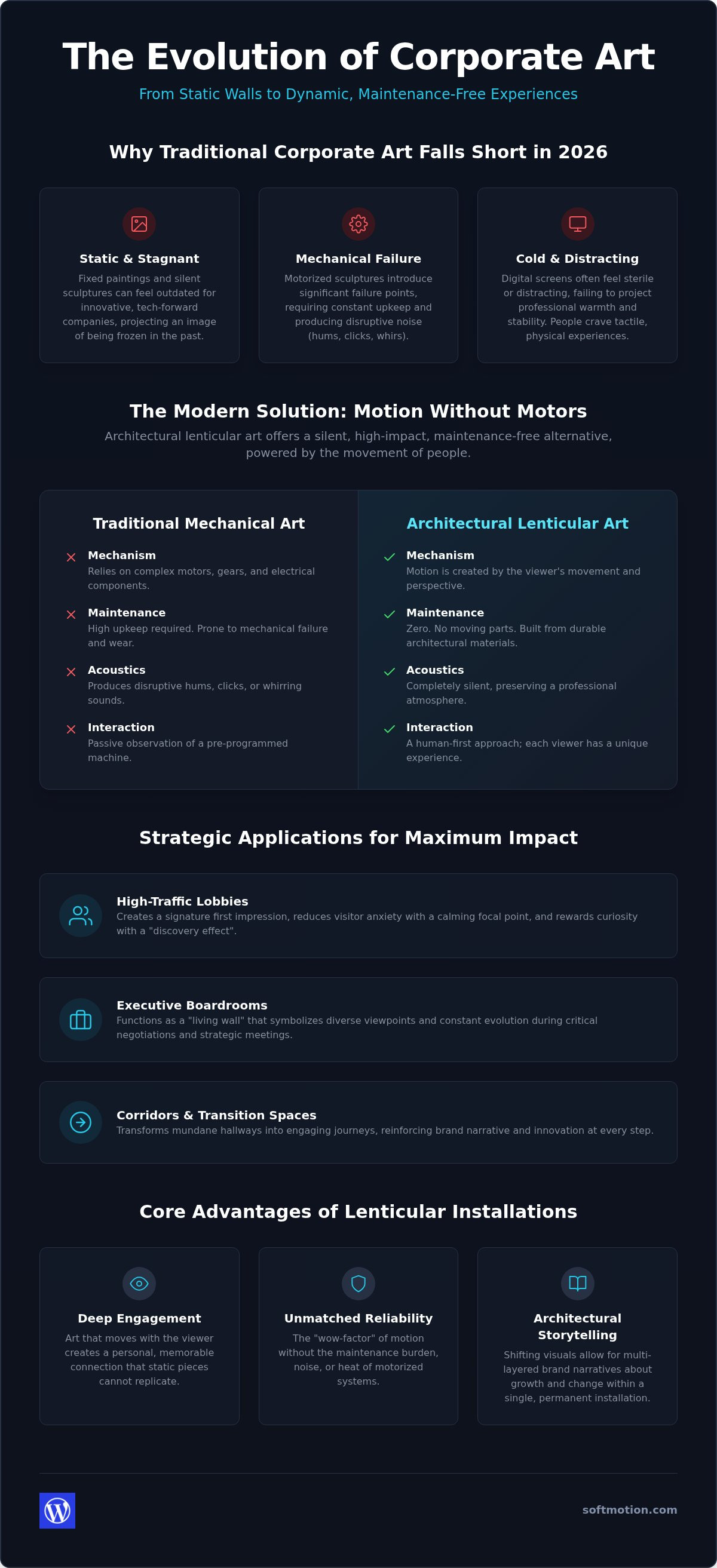
Impactful Themes and Effects for Corporate Spaces
A static wall is a silent surface; a lenticular installation is a conversation. Selecting the right visual effect is where the visionary concept meets technical reality. For kinetic art for corporate headquarters, you aren’t merely choosing an image; you’re choosing a behavior. The choice between 3D Depth, a two-phase Flip, or True Motion dictates how your brand’s energy is felt by everyone who enters the building. While tech firms often favor abstract patterns that symbolize connectivity, financial institutions may prefer representational art that uses shifting gradients to bridge the gap between tradition and innovation.
Achieving this level of sophistication requires more than just a creative brief. It demands an uncompromising commitment to optical precision. The specialized process of designing lenticular fine art ensures that every angle is accounted for and every transition is seamless. This precision prevents the artwork from feeling like a transient novelty, instead positioning it as a permanent architectural feature that maintains its clarity for decades. To find the right fit for your brand, you can explore our architectural lenticular installations to see these effects in action.
The ‘Flip’ Effect: Communicating Transformation
The Flip effect is a powerful narrative tool. It utilizes a two-phase transition where one image replaces another as the viewer walks past. This is an ideal choice for companies that want to represent transformation, such as “Input and Output” or a “Before and After” scenario. To ensure the highest visual quality, we focus on high-contrast imagery to avoid ghosting, a phenomenon where the previous image remains visible during the transition. We’ve seen this successfully implemented in global headquarters where a brand logo transforms into a mission statement, creating a rhythmic, interactive moment that stays with the visitor.
3D Depth and Spatial Expansion
Spatial expansion is a common challenge in modern urban HQs. 3D lenticular effects create a “window” into a deeper space, giving the illusion that a lobby extends back several feet without any structural changes to the wall. This effect makes small lobbies feel exponentially larger and more inviting. Lighting plays a critical role here; specific overhead angles can dramatically enhance the perceived depth of the installation. By manipulating these variables, we turn a flat surface into a multi-dimensional experience that rewards the viewer’s movement with a sense of wonder and discovery.
From Vision to Installation: Partnering with Softmotion for Custom Projects
Realizing a visionary installation is a journey from the abstract to the concrete. It requires technical discipline. Softmotion acts as your Visionary Guide, bridging the gap between an architect’s first sketch and the final architectural cladding that defines a building’s identity. While the previous sections explored the “why” and “where” of kinetic art for corporate headquarters, this final phase focuses on the “how.” We transform imaginative concepts into high-precision reality through a process that emphasizes security, clarity, and collaborative craftsmanship.
The Softmotion Collaborative Journey
Our process is methodical and purposeful. It begins with discovery and conceptual alignment, where we ensure the artistic vision harmonizes perfectly with your corporate brand values. We don’t believe in guesswork. During the second phase, we move into technical sampling. This involves creating a 1:1 physical slice of the final installation. Seeing a physical sample is non-negotiable for large-scale commissions because it allows stakeholders to experience the motion and depth in their specific lighting conditions before full-scale production begins. Finally, we move into large-scale fabrication using proprietary techniques developed over decades.
A successful execution depends on the quality of the foundation. Understanding how to prepare artwork for lenticular printing is essential for ensuring that the final result matches the initial vision without optical distortion. We work closely with your creative teams to refine these files, ensuring that every transition is crisp and every layer of depth is intentional. This meticulous preparation is what allows us to deliver kinetic art for corporate headquarters that feels like a seamless part of the architecture rather than an afterthought.
Global Execution and Local Support
Since 1997, Softmotion has delivered over 1,000 projects worldwide. This extensive portfolio speaks to our ability to manage the logistical complexities of large-format architectural installations. We handle everything from high-precision printing to the final on-site assembly, ensuring a risk-free experience for our partners. Whether we’re cladding an entire elevator bank or installing a signature piece in a flagship lobby, our end-to-end management style provides the professional reliability that Fortune-500 companies expect.
Your headquarters is more than just a place of business. It’s a physical manifestation of your company’s momentum. By choosing a motion-driven installation, you’re turning a static environment into a dynamic landmark that inspires employees and captivates visitors. We’re here to guide that transformation, ensuring that your vision is realized with the artistic sensibility and technical excellence it deserves.
Transforming Your Corporate Environment into a Living Narrative
The transition from a static office to a dynamic headquarters is a move toward a more human and responsive architecture. By choosing viewer-driven motion over mechanical complexity, you ensure that your investment remains a vibrant, maintenance-free asset for years to come. We’ve explored how kinetic art for corporate headquarters can redefine a lobby, symbolize diverse perspectives in a boardroom, and turn simple corridors into engaging journeys. It’s about more than just decoration; it’s about creating a landmark that breathes with your team and reflects your brand’s momentum.
As a trusted partner to Fortune-500 companies with over 1,000 projects delivered since 1997, Softmotion provides the technical precision and artistic vision needed for architectural-grade durability. Our collaborative process ensures a risk-free journey from the initial sketch to the final assembly. Bring your corporate space to life with a custom Softmotion installation and discover the untapped potential hidden within your walls. The future of your workspace is in motion, and we’re ready to help you lead the way.
Frequently Asked Questions
What is the difference between lenticular art and digital screens for a lobby?
Lenticular art is an analog, passive experience that relies on the viewer’s physical movement rather than electricity or backlighting. Unlike digital screens, which can feel cold or distracting in a professional lobby, lenticular installations offer a tactile, architectural quality that doesn’t emit light or heat. They are permanent features that harmonize with the building’s materials. This makes them a sophisticated choice for kinetic art for corporate headquarters where a calm, focused atmosphere is prioritized.
How long does a large-scale kinetic art installation take to produce?
The timeline for a custom architectural installation typically ranges from twelve to eighteen months. This duration accounts for the visionary collaborative journey, including conceptual alignment, technical prototyping, and final large-scale fabrication. While smaller fine art prints have shorter lead times, large-scale cladding requires meticulous engineering and coordination with architects. We prioritize a controlled, professional process to ensure the final landmark meets our high standards for craftsmanship and durability without feeling rushed or frantic.
Can lenticular art be installed on curved walls or around corners?
Yes, our architectural lenticular installations can be designed to accommodate curved surfaces and complex spatial geometries. While the lenticular sheets themselves are rigid, we use specialized mounting systems and precise tiling techniques to follow the contours of a building’s interior. This allows for a seamless visual experience that wraps around corners or follows the sweep of a grand staircase. It transforms challenging architectural constraints into opportunities for immersive, motion-driven storytelling that engages viewers from every possible angle.
Is kinetic art for corporate headquarters a good investment for ESG goals?
Lenticular installations are an excellent choice for sustainability-focused corporate environments because they require zero electricity to operate. Unlike motorized sculptures or digital displays, this form of kinetic art for corporate headquarters provides motion through passive physics. It has a significantly lower carbon footprint over its lifecycle. The use of durable, architectural-grade materials like polycarbonate also ensures a lifespan of decades, reducing the need for replacements and minimizing waste in your long-term facility management strategy.
Does lenticular art require special lighting to achieve the motion effect?
While the effect is driven by the viewer’s movement, high-quality lighting is essential to maximize the clarity and depth of the installation. We generally recommend focused, overhead lighting that minimizes glare on the polycarbonate surface. During the prototyping phase, we create 1:1 samples to test how your specific lobby or boardroom lighting interacts with the lenses. This collaborative testing ensures that the visual impact remains consistent throughout the day, regardless of shifts in natural or artificial light.
What is the maximum size for a lenticular wall installation?
There is virtually no limit to the scale of a lenticular installation because we use a precision tiling method. Individual large-format sheets are seamlessly aligned to cover expansive surfaces, from ten-foot feature walls to hundred-foot transition corridors. Our experience with over 1,000 projects delivered since 1997 has allowed us to perfect the art of architectural integration at any scale. We manage the logistical complexities of these large-format murals to ensure the motion remains fluid across the entire surface.
How do I maintain and clean a large-format lenticular mural?
Maintenance is remarkably simple because there are no moving parts to fail or motors to lubricate. You can clean these installations using standard architectural glass protocols and non-abrasive microfiber cloths. The high-grade polycarbonate is designed for durability in high-traffic corporate environments, resisting the wear and tear that often plagues mechanical art. This low-maintenance profile ensures that your investment continues to look pristine and professional without the need for specialized technicians or expensive, ongoing service contracts.
Can our own brand assets be converted into kinetic lenticular art?
We frequently collaborate with corporate creative teams to transform existing brand assets into dynamic installations. Whether it’s a logo, a mission statement, or abstract brand patterns, we guide you through the process of preparing artwork for lenticular printing. We reimagine your two-dimensional assets as multi-dimensional experiences, using effects like 3D depth or two-phase flips to communicate your company’s story. This partnership ensures that the final artwork feels deeply rooted in your unique corporate identity and visionary goals.
For organizations looking to extend their brand identity beyond architectural features, Logotrade offers a wide range of high-quality corporate gifts; learn more about their selection of branded business solutions.