
The Evolution of Large Scale Lenticular Fabrication: A 2026 Technology Guide

What if a physical wall could move with its audience without a single motor or digital screen? For years, architects and designers have looked at static surfaces as missed opportunities for engagement. You’ve likely envisioned a space that breathes and shifts as people walk through it, but the technical hurdles of lenticular printing technology often feel like a barrier. The fear of “ghosting” at scale or the complexity of calculating LPI for vast viewing distances can turn a visionary concept into a logistical headache. Finding a partner capable of executing massive, high-end installations shouldn’t be the hardest part of your creative process.
This 2026 guide transforms that uncertainty into a clear, actionable roadmap for your next project. We’ll explore how modern fabrication turns cold, architectural materials into dynamic experiences that respond to human movement. You’ll gain a deep understanding of the optical physics required for large-scale success and a technical framework for choosing the right materials. From the initial prototype to the final installation, we’re here to ensure your transition from a two-dimensional plan to a multi-dimensional landmark is seamless and risk-free. Let’s look at how kinetic art is redefining public spaces in the modern era.
Key Takeaways
- Learn how modern lenticular printing technology transforms static surfaces into kinetic, motion-driven experiences that respond to human movement.
- Master the relationship between LPI and viewing distance to ensure crisp visuals across vast public spaces.
- Discover why rigid-mounted structural panels are the standard for high-end corporate and luxury retail environments.
- Use the “Less is More” design framework to manage color contrast and eliminate image ghosting at scale.
- Understand how an end-to-end fabrication process provides the security needed to realize multi-dimensional visions.
Understanding Modern Lenticular Printing Technology
Static surfaces have long been the silent backdrop of our cities, but the modern era demands more. What was once a 20th-century novelty found on cereal boxes and postcards has undergone a profound transformation. By 2026, lenticular printing technology has matured into a high-stakes architectural medium. It offers a way to breathe life into corporate lobbies and public plazas without the sterile glow of a digital screen. While digital signage often feels like an intrusion, physical motion art feels like an invitation. It relies on the viewer’s own pace to reveal its secrets, creating a private dialogue between the individual and the architecture.
The Physics of the Illusion: How Lenticules Work
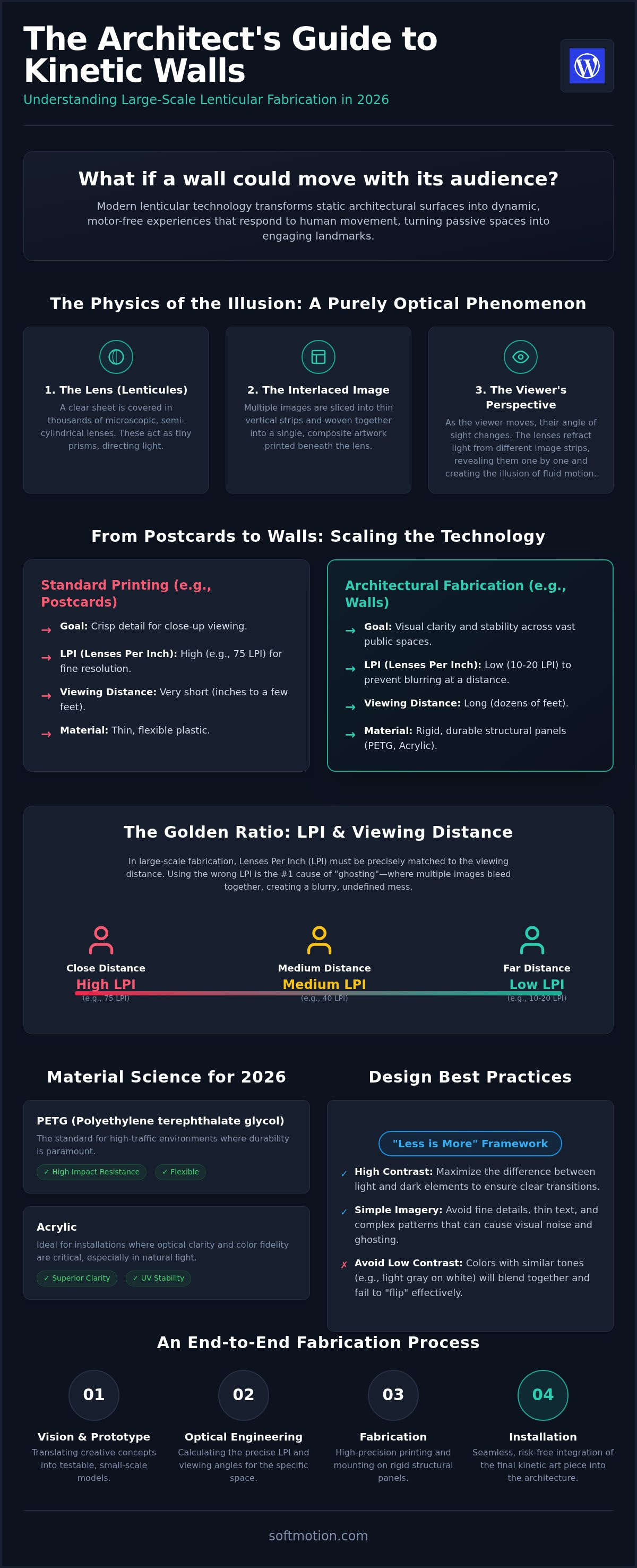
The magic of this medium lies in the marriage of light and geometry. A lenticular sheet consists of a series of clear, semi-cylindrical lenses known as lenticules. These lenses act as tiny prisms. They refract light coming from the “interlaced” image beneath them, which is a composite of multiple frames sliced into microscopic strips. As a person walks past the installation, their changing perspective allows the eye to see different slices of the underlying artwork. This creates the sensation of fluid motion or deep three-dimensionality. It’s a purely optical phenomenon, requiring no power source other than the ambient light in the room and the movement of the audience.
From Postcards to Walls: Scaling the Technology
Scaling this effect from a handheld card to a twenty-foot wall isn’t a matter of simple enlargement. It’s a complete reimagining of optical physics. Standard printing techniques often fail at this scale because the viewing distance dictates the entire geometry of the lens. If the lenticules are too fine, the image disappears into a blur from across a room; if they’re too coarse, the transition feels jarring. Success requires a meticulous calculation of the Viewing Angle and Lenticules Per Inch (LPI) to ensure the visual “flip” happens at the exact moment a pedestrian passes by. Large scale lenticular fabrication is a precision-engineered optical system that harmonizes high-resolution imagery with the specific dimensions of a physical space.
This shift from two-dimensional to multi-dimensional changes how people feel. It triggers a psychological response of wonder and curiosity. When a wall shifts from a vibrant landscape to a corporate manifesto as you walk, you don’t just see the message; you experience it. This engagement is why global brands are moving away from flat graphics toward immersive, kinetic surfaces that respect the viewer’s presence. It turns a transit corridor into a gallery and a lobby into a landmark.
The Technical Specs of Large Scale Lenticular Fabrication
Precision is the bridge between a creative vision and a successful installation. While standard lenticular printing technology relies on high-resolution density, architectural applications demand a different set of rules entirely. You aren’t just printing an image; you’re engineering an optical experience that must remain stable over dozens of feet. The relationship between the thickness of the lens and the perceived depth of the image is a delicate balance. A thicker lens can create a more dramatic 3D effect, but it also increases the weight and complexity of the structural mounting system.
LPI and Viewing Distance: The Golden Ratio
In the world of large-scale fabrication, less is often more. Lenticules Per Inch (LPI) determines how many individual lenses exist in a single inch of material. For a handheld postcard, 75 LPI provides crisp, minute detail. However, in a transit hub or corporate lobby, a lower LPI, often between 10 and 20, is essential for visual clarity. Lower LPI allows for a broader lens geometry that maintains image integrity at significant distances. If the LPI is too high for the space, the viewer experiences “ghosting,” where multiple frames bleed into one another simultaneously. Choosing the right LPI involves a technical trade-off: a narrower viewing angle provides sharper transitions, while a wider angle allows the motion to be seen by a larger crowd at once.
Material Science in 2026 Installations
Choosing the right substrate is a decision about longevity as much as aesthetics. PETG is often favored for its flexibility and impact resistance, making it ideal for high-traffic corridors where durability is paramount. Conversely, Acrylic offers superior clarity and UV stability, which is vital for installations exposed to direct natural light. For those diving into the fine details of material science, reviewing the Technical specs for lenticular sheets can help clarify which material fits your environment’s fire rating and structural needs. Outdoor kinetic installations require even more specialized care, utilizing weather-resistant coatings to prevent delamination over time. For designers who wish to integrate these kinetic surfaces with other premium glazing, you can visit FGD Glass Solutions to explore high-end decorative glass options that complement modern architectural designs.
Light management remains the final hurdle for any large-scale project. In bright, glass-walled lobbies, glare can easily shatter the illusion of motion. We utilize specific matte finishes and diffusion layers to ensure the artwork remains vibrant and visible from every intended angle. It’s this level of technical discipline that transforms a simple wall into a landmark. If you’re planning a complex project, partnering with an expert who understands these nuances ensures a risk-free and collaborative approach to your creative challenges.
Standard Printing vs. Architectural Lenticular Fabrication
Standard printing is a transaction; architectural fabrication is a partnership. In the high-stakes environments of luxury retail and corporate headquarters, off-the-shelf lenticular solutions often fall short of the mark. These generic products are typically designed for small-scale novelty, lacking the structural integrity and optical precision required for massive surfaces. When a project scales to cover an entire wall, the differences between a simple print and a precision-engineered panel become undeniable. We don’t just provide an image. We deliver a permanent architectural element that integrates seamlessly into the building’s soul.
The core distinction lies in the mounting method. Many standard providers offer adhesive-backed prints that are prone to peeling, bubbling, or warping in fluctuating lobby temperatures. Conversely, rigid-mounted structural panels provide a stable, long-term solution. This stability is essential for maintaining precision alignment across multiple panels. Without it, you’ll encounter “banding” or “ghosting,” where the visual transition appears jagged rather than fluid. Custom fabrication also opens the door to advanced artistic techniques, such as Agamographs, which use specific geometric folds to create distinct visual shifts from opposing viewing angles.
Comparison of Fabrication Methods
Choosing the right printing method is a strategic decision that affects both clarity and budget. Lithographic printing is excellent for high-volume, small-format runs, yet it often lacks the versatility needed for custom architectural panels. High-resolution flatbed digital printing has become the 2026 standard for large-scale work. It allows for direct-to-lens printing, which eliminates the adhesive layer and provides a much sharper visual experience. For a comprehensive breakdown of how these methods influence your project’s financial planning, refer to the 2026 Buyer Guide for Lenticular Printing Cost.
The Role of Custom Prototyping
Visionary projects require a risk-free path to realization. We believe full-scale samples are non-negotiable for large-format architectural lenticular installations. Prototyping allows us to test specific light conditions and pedestrian flow in your actual space before final production begins. Does the morning sun wash out the colors? Is the “flip” happening too fast for the typical walking pace? Softmotion’s prototyping process answers these questions early, ensuring the final result is as technically sound as it is visually inspiring. This meticulous attention to detail is why we’ve successfully delivered over 1,000 projects globally, transforming static environments into immersive, motion-driven landmarks.
Designing for Motion: Best Practices and Common Pitfalls
Movement is a language of its own. When you design for large-scale surfaces, you aren’t just creating a picture; you’re directing a performance. Many designers fall into the trap of over-complicating the narrative with complex, multi-frame animations. While modern lenticular printing technology can support several frames, the “Less is More” rule remains the gold standard for architectural impact. A clean, two-frame flip often delivers a more punchy and memorable experience than a cluttered sequence. It allows the viewer to fully absorb each state of the artwork as they move through the space.
Success depends on understanding the “Walk-By.” Most architectural installations are viewed by people in motion, which means the orientation of the lenticules is a critical decision. Vertical lenticules are the standard for pedestrian corridors because they trigger the visual shift as the viewer moves horizontally past the wall. If you choose horizontal lenticules, the effect only changes if the viewer moves up or down, which is rarely the case in a standard lobby. Aligning the technology with the natural flow of human traffic is what transforms a static corridor into a living environment. Understanding the nuanced differences between lenticular 3D vs flip effect is essential to making the right choice for your specific space and audience flow.
Color and Contrast Management
Where some see “ghosting” as an inevitable flaw, we treat it as a manageable design variable. Ghosting occurs when a remnant of the previous image remains visible during a transition. You can mitigate this by avoiding extreme contrast “jumps,” such as a dark black image flipping to a bright white one. Instead, utilize gradients and textures to mask technical transitions and create a sense of fluid continuity. Professional color theory application ensures that value levels remain consistent across frames, which effectively prevents visual “banding” in large scale motion graphics. This balanced approach reduces visual fatigue and keeps the audience engaged for longer periods.
Spatial Planning for Lenticular Walls
Strategic placement is the final piece of the puzzle. An installation’s impact is tied directly to how it sits within the existing interior architecture. We recommend aligning the primary focal point of the artwork with the average viewer’s eye-level to ensure the most dramatic 3D or flip effect. Lighting also plays a pivotal role; poorly placed spotlights can create harsh reflections that wash out the interlaced imagery. For those looking to see how these elements harmonize in the real world, exploring lenticular wall installations provides a deeper look at successful architectural integration. If you’re ready to elevate your space with a custom installation, contact Softmotion today to start your collaborative design journey.
The Softmotion Approach: From Vision to Installation
Expertise is the difference between a project that works and one that inspires. Since 1997, Softmotion has delivered over 1,000 projects globally, positioning us as a seasoned leader in the field of large-scale lenticular printing technology. We don’t see ourselves as a distant vendor. Instead, we act as a collaborative partner for architects, artists, and global brands who need technical discipline to match their creative ambition. This human-first approach ensures that every multi-dimensional vision is realized with a sense of security and professional ease. What begins as a static blueprint is reimagined through our lens, evolving into a living, breathing part of the built environment.
The Fabrication and Installation Journey
Converting a static surface into a dynamic artwork requires more than just high-end equipment. It demands a methodical, end-to-end process that guides you from the initial concept to the final assembly. While others might simply ship a roll of print, we manage the entire logistics of installing large-format panels in complex, high-traffic environments. This journey is purposeful and well-paced. We handle the technical heavy lifting, from the first prototype to the final structural mounting. On-site precision is our final hallmark. We ensure every lens is perfectly aligned with the intended viewer flow, guaranteeing that the kinetic effect is crisp and impactful from the very first step.
Transforming Environments with Kinetic Art
Our work transforms ordinary lobbies, trade shows, and transit hubs into memorable sensory experiences. For Fortune-500 companies, these installations serve as durable, physical landmarks that resonate far more deeply than digital screens. We’ve seen how a well-executed kinetic wall can change the entire energy of a corporate headquarters, turning a passing glance into a moment of genuine wonder. This transition from the two-dimensional to the multi-dimensional isn’t just an aesthetic choice; it’s a strategic investment in viewer engagement. It’s about seeing the hidden potential in ordinary walls and having the discipline to bring it to life. To see how these principles come to life across diverse industries, you can explore Softmotion’s portfolio of architectural lenticular installations and discover the potential hidden within your own environment.
Transform Your Space into a Living Landmark
The transition from a static wall to a kinetic experience is a journey of precision and partnership. You now understand that mastering lenticular printing technology at an architectural scale requires a deep harmony between optical physics and material science. By prioritizing lower LPI for vast distances and embracing a “less is more” design philosophy, you can eliminate technical risks like ghosting and banding. These aren’t just decorative prints; they’re structural installations that redefine how people interact with their environment.
With over 1,000 projects delivered globally, our team brings specialized architectural expertise to every collaboration. We provide the technical discipline and end-to-end management needed to turn visionary concepts into permanent, motion-driven landmarks. Whether you’re designing a corporate lobby or a global transit hub, you deserve a partner who understands the transition from the two-dimensional to the multi-dimensional. We’re here to ensure your creative process is seamless, risk-free, and inspiring.
Partner with Softmotion for your next large-scale lenticular project and let’s bring your most ambitious visions to life. The hidden potential of your environment is waiting to be revealed.
Frequently Asked Questions
What is the difference between 3D lenticular and flip lenticular effects?
3D effects create an illusion of depth by using multiple frames that mimic how each eye sees an object from slightly different angles. Flip effects use two or three distinct images that change as the viewer moves past the installation. While 3D focuses on spatial volume, flips prioritize narrative transformation. For a deeper exploration of how to choose between these approaches for your 2026 project, our guide on lenticular 3D vs flip effect for visual installations breaks down the technical and aesthetic nuances of each. Modern lenticular printing technology allows us to combine these techniques for more complex, immersive experiences in architectural settings.
How large can a single lenticular panel be fabricated?
Standard fabrication typically produces individual panels up to 48 by 96 inches. However, our architectural installations often cover entire building facades or lobby walls through a meticulous tiling process. We align the lenticular patterns across multiple panels with sub-millimeter precision. This ensures the motion remains fluid and the seams stay invisible, allowing for kinetic artworks that span dozens of feet without interruption.
What causes “ghosting” in lenticular prints and how can it be prevented?
Ghosting occurs when light refracts through the lens and catches a glimpse of the “hidden” frame, causing a faint double image. This is often triggered by extreme color contrast or incorrect LPI settings for the viewing distance. We prevent this through advanced color theory and custom prototyping. By balancing image values and testing full-scale samples, we ensure every visual transition is crisp and intentional.
Can lenticular technology be used for outdoor architectural facades?
Yes, lenticular technology is highly effective for outdoor environments when specified with the correct materials. We utilize UV-stable acrylics and specialized weather-resistant coatings to protect the imagery from sun damage and moisture. These installations provide a sustainable alternative to digital screens. They don’t require power and won’t contribute to light pollution, making them ideal for urban planning and public art initiatives.
What is the typical lifespan of a large scale lenticular installation?
Indoor installations typically maintain their visual integrity for over ten years when kept in controlled environments. For outdoor projects, the lifespan generally ranges from five to seven years depending on local climate conditions and UV exposure levels. Because these systems are physical rather than electronic, they don’t suffer from pixel burnout or software obsolescence. A simple cleaning schedule is usually all that’s required to preserve their impact.
How do I choose the correct LPI for my large format project?
Choosing the correct LPI is a critical step in lenticular printing technology; it’s determined primarily by the average distance of your audience. If viewers are standing fifty feet away in a transit hub, a lower LPI like 10 or 15 provides the necessary clarity and viewing angle. For high-traffic corridors where people are within arm’s reach, a higher LPI ensures the image doesn’t appear pixelated or jarring.
Is lenticular printing more cost-effective than digital signage for large walls?
Lenticular installations offer significant long-term savings because they require zero electricity and have no electronic components to replace. While the initial custom fabrication is a precision-led investment, the absence of monthly power bills and 24/7 technical monitoring makes it a pragmatic choice for many corporate spaces. It provides a high-end, artistic aesthetic that digital hardware often struggles to replicate without feeling cold or overly commercial.
What kind of maintenance do architectural lenticular panels require?
Maintenance is minimal and largely mirrors the care needed for standard architectural glass or acrylic. You’ll only need to wipe the surface with non-abrasive cleaners and soft cloths to remove dust or fingerprints. There are no cooling fans to clean, no bulbs to change, and no software updates to manage. This low-maintenance profile ensures that your kinetic installation remains a beautiful, hassle-free asset for the building’s management team.