
Lenticular 3D vs Flip Effect: Choosing the Right Motion for 2026 Visual Installations
What if the most impactful element of your next architectural installation isn’t the image itself, but the way it breathes as a viewer moves? In the high-stakes world of large-scale advertising and fine art, the distinction between a subtle shift and a dramatic transformation is everything. You’ve likely felt the pressure to innovate without crossing into the territory of the gimmicky or the low-quality. It’s a delicate balance to strike. Selecting between a lenticular 3d vs flip effect is the pivotal decision that defines how your audience experiences a space.
We’ll help you navigate this choice by breaking down the technical and aesthetic nuances of spatial depth versus narrative transitions. You’ll discover how parallax creates an immersive 3D world and why image sequencing is the superior tool for storytelling. This guide provides a clear framework for specifying custom agamograph production for your 2026 visual installations. We’re moving beyond the two-dimensional to create environments that truly engage. You’ll gain the confidence to specify large-format motion that feels both visionary and grounded in technical precision.
Key Takeaways
- Learn to distinguish between binocular parallax and image sequencing to select the visual motion that best aligns with your project’s emotional goals.
- Identify the technical requirements for each effect, from high-density interlacing for depth to ghosting prevention in multi-image transitions.
- Apply a strategic framework to decide between a lenticular 3d vs flip effect based on your specific environment and audience movement.
- Explore custom agamograph production as a geometric, lens-free alternative for large-scale architectural surfaces that require a distinct aesthetic.
- Discover how collaborative prototyping mitigates technical risk and ensures the final installation achieves the desired impact at scale.
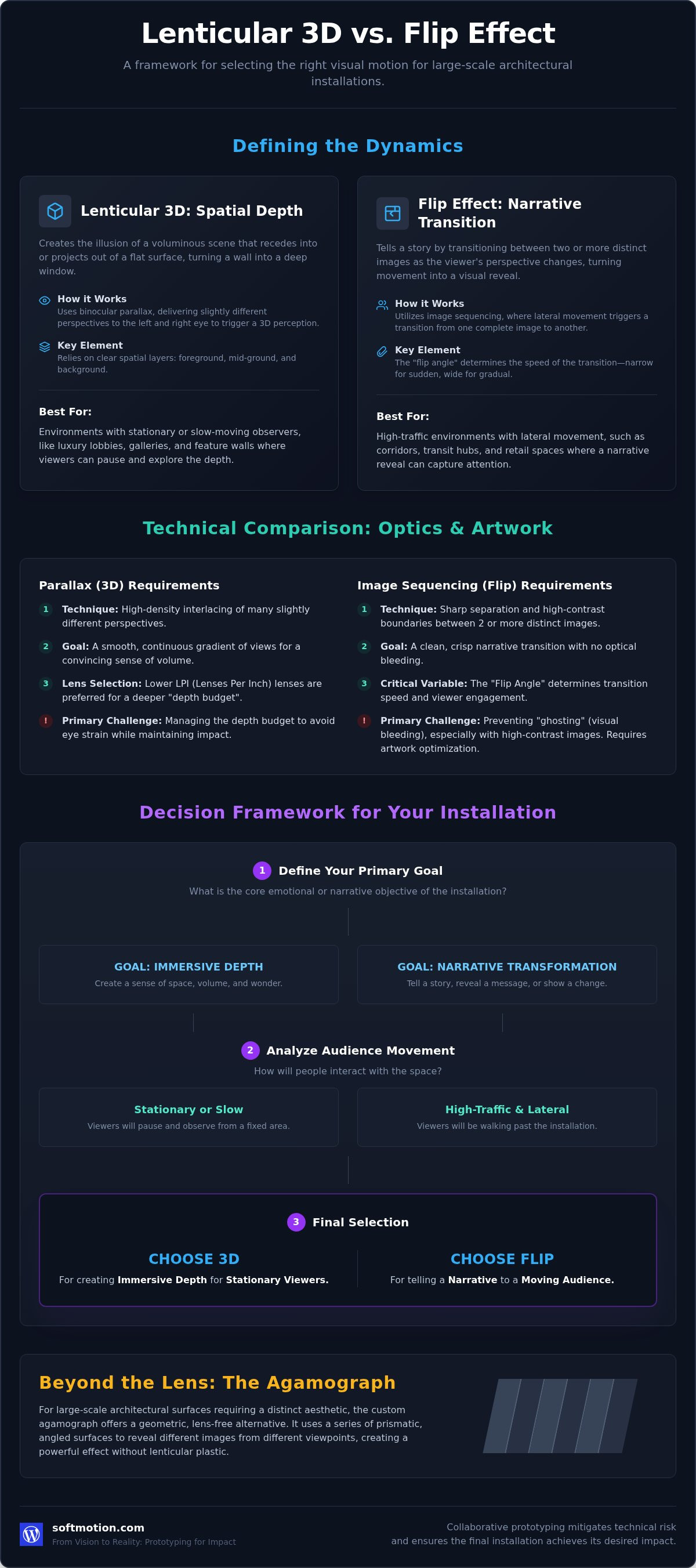
Defining the Dynamics: What is Lenticular 3D vs. Flip Effect?
Static walls often feel like boundaries. Through the lens of modern design, we transform these boundaries into gateways. Understanding the lenticular 3d vs flip effect allows designers to choose between spatial volume and narrative movement. Both effects rely on a precision-engineered lenticular lens. This lens acts as an optical gatekeeper, segmenting light and directing specific slices of an image to the viewer’s eyes based on their position. In 2026, these effects are being reimagined for large-format architectural installations, moving beyond simple novelties to become integral parts of a building’s identity.
The Mechanics of 3D Depth
Lenticular 3D is an exercise in stereoscopy. By delivering slightly different perspectives to the left and right eye simultaneously, we trigger binocular parallax. The brain assembles these views into a singular, voluminous scene that appears to recede into or project out of the wall. It’s a sophisticated illusion that turns a flat surface into a deep window.
- Spatial Layers: Effective 3D requires a clear hierarchy of foreground, mid-ground, and background to guide the eye.
- The Depth Budget: At a large scale, we must carefully manage the “depth budget.” If the perceived volume is too aggressive, it can cause eye strain; if it’s too shallow, the effect feels flat.
- Viewer Behavior: 3D is most impactful for stationary or slow-moving observers. It invites a person to pause and explore the hidden dimensions of a luxury lobby or a curated gallery.
The Logic of the Flip Transition
While 3D creates space, the flip effect creates time. It utilizes the viewer’s change in perspective to transition between two or more distinct images. This is the logic of image sequencing, where movement becomes the catalyst for a visual reveal. It doesn’t just show an image; it tells a story through transformation.
The “flip angle” is the critical technical variable here. It determines how quickly the transition occurs. A narrow angle creates a sharp, sudden change that grabs attention, while a wider angle allows for a more gradual evolution. We can design a simple A/B flip or a complex multi-phase animation that unfolds as a viewer walks the length of a corridor. This makes flip effects the preferred choice for high-traffic environments like transit hubs. Because the change is triggered by natural lateral movement, it captures the attention of busy commuters without requiring them to stop.
Technical Comparison: Parallax vs. Image Sequencing
Choosing between a lenticular 3d vs flip effect is a decision rooted in the hard science of optics. Each effect demands a specific approach to how data is structured behind the lens. For a 3D installation to succeed, it requires a high-density “interlacing” of many slightly different perspectives. This creates the smooth, continuous gradient of views necessary for a convincing sense of volume. A flip effect, however, thrives on separation. It requires sharp, high-contrast boundaries between images to prevent the optical bleeding that can ruin a narrative transition.
Lenticular Technology and Lens Selection
The evolution of lenticular printing technology has fundamentally changed how we specify materials for architectural projects. Lens LPI (Lenses Per Inch) selection is the primary lever for controlling visual impact. For deep 3D depth, a lower LPI lens is typically the preferred choice. These lenses provide the physical thickness required to project light across a wider range of angles, creating a more expansive “depth budget.”
Viewing distance plays a critical role in this selection. A lens that works for a handheld card will fail on a 20-foot wall. We meticulously match the lens geometry to the intended viewing path of the audience. Following strict lenticular printing specifications ensures that the installation remains clear and vibrant, even when viewed from extreme angles or under challenging ambient light conditions.
The Ghosting Challenge in Flip Effects
Ghosting is the unintended presence of one image within another. It occurs when the lens fails to completely isolate the interlaced strips of the “hidden” frame. High-contrast image pairs, such as a dark silhouette against a bright sky, are particularly susceptible to this visual “bleeding.” To mitigate this, we employ sophisticated artwork optimization techniques. By adjusting the color density and strategically softening the transitions within the file, we ensure each frame remains crisp and distinct.
Precision is our baseline. In large-format manufacturing, even a microscopic shift in alignment can cause a project to fail. We manage this risk through a rigorous fabrication process that prioritizes stability. If you’re uncertain which technical path suits your vision, examining physical lenticular samples is the most reliable way to verify clarity and effect stability before final production begins.
Lenticular 3D vs. Flip: Decision Framework for 2026 Installations
Selecting between a lenticular 3d vs flip effect isn’t merely a technical preference; it’s a strategic architectural decision. We must look at the environment through the eyes of the viewer. Is the goal to stop them in their tracks or to reward their movement? 3D depth provides a visceral “wow factor” that invites lingering, while the flip effect excels at narrative transitions that unfold as someone passes by. In 2026, the most successful installations are those that respect the viewer’s journey, aligning the visual motion with the natural flow of the space.
When to Specify 3D Depth
3D is the language of spatial immersion. It works best in environments where the audience is stationary or moving slowly, allowing their eyes to adjust to the perceived volume. In a corporate lobby, a 3D installation acts as a tactile layer of the brand’s identity. It creates a sense of infinite space within confined interiors, making it an invaluable tool for urban architecture where footprint is limited. We’ve seen this impact firsthand when integrating 3D elements into lenticular building facades, where the depth adds a sculptural quality to the structure that changes with the daylight.
When to Specify Flip Effects
If your project is about transformation, choose the flip. This effect is the engine of storytelling in high-traffic areas. It’s the perfect medium for “Before and After” branding or dual-message advertising. In long corridors or transit hubs, the viewer’s natural stride becomes the catalyst for the visual change. This ensures that a high-impact advertising display remains dynamic and engaging without needing a single watt of electricity. The flip effect turns a passive walk into an active discovery.
Environmental factors play a decisive role in the final clarity of the motion. Lighting is the silent partner in any installation. High ceilings and directional lighting can shift the optimal viewing angle, potentially causing reflections that obscure the lens. We analyze these variables during the design phase to ensure the transition or depth remains clear from every intended vantage point. Whether it’s a luxury retail window or a sprawling airport terminal, the choice between 3D and flip must be grounded in the physical realities of the site.
Beyond the Lens: Custom Agamograph Production
While the lenticular 3d vs flip effect relies on the precision of a plastic lens, there is a geometric alternative that offers a more physical, architectural presence. The agamograph replaces the lens with a “V-fold” or accordion-style structure. This method doesn’t use optical refraction to change the image; it uses the physical angle of the surface itself. It’s a shift from the digital precision of a lens to the structural craftsmanship of kinetic art. Static planes become sculptural dialogues through the clever use of geometry.
Choosing custom agamograph production over lenticular printing is often a matter of scale and viewing environment. Deciding between a lenticular 3d vs flip effect often leads designers to consider if a lens-free alternative might better serve a large-scale project. Agamographs handle extreme viewing angles with remarkable clarity. Because there is no lens material to catch glare or cause distortion at sharp perspectives, the transition between images remains crisp. This makes them a superior choice for massive murals in wide corridors or open plazas where viewers approach from nearly parallel angles.
The Art of the Agamograph Wall
Architects frequently favor agamographs for their structural weight. The folded surface adds a tactile dimension to a wall, turning a flat plane into a sculptural element. This physical presence allows for a distinct “two-way” narrative. A viewer approaching from the left sees one complete image, while a viewer from the right discovers an entirely different story. For public-facing installations, we utilize durable materials like aluminum or high-grade composites to ensure the artwork survives the rigors of high-traffic environments while maintaining its visual integrity.
Integrating Agamographs into Interior Design
In modern office environments, kinetic wall art serves as a tool for spatial transformation. An agamograph can shift the energy of a room as people move through it, creating a sense of momentum and discovery. The synergy between these installations and ambient lighting is profound. As light hits the folds, it creates natural shadows and highlights that enhance the depth of the artwork. To ensure success at this scale, our process emphasizes meticulous prototyping. We align every fold with mathematical precision to prevent the narrative from breaking. If your project requires this level of structural impact, you can explore our options for custom agamograph wall art to see how geometry can redefine your space.
From Vision to Reality: The Softmotion Prototyping Process
Transforming a bold concept into a tangible installation requires more than just technical skill. It demands a partnership. At Softmotion, we understand that the choice between a lenticular 3d vs flip effect is only the beginning of the journey. Executing large format lenticular printing at an architectural scale is a complex endeavor that shouldn’t be left to chance. We move beyond the flat constraints of 2D design files to create multi-dimensional experiences that respond to human movement. Our end-to-end approach ensures that every detail, from the initial technical specifications to the final site installation, is managed with meticulous care.
The transition from a digital file to a physical wall graphic involves a series of calculated steps. We bridge the gap between creative ambition and technical reality by providing a clear roadmap for fabrication. Since 1997, we’ve delivered over 1,000 projects globally, refining a process that prioritizes both artistic impact and structural reliability. This experience allows us to anticipate challenges before they reach the construction site, making the journey from vision to reality both predictable and inspiring.
The Importance of Physical Samples
Digital mockups are inherently limited. They can’t replicate the physical sensation of depth or the crispness of a narrative flip. This is why custom lenticular prototypes are essential for mitigating project risk. Reviewing physical samples allows us to test how color shifts and viewing angles interact with the specific lighting of your site. As your visionary guide, we use these prototypes to refine your creative intent. We ensure the final result resonates exactly as you imagined. It’s a pragmatic, risk-free path from the abstract to the monumental.
Planning Your 2026 Installation
Success in 2026 requires early integration. Large-scale projects involve specific timelines and coordination between architects, interior designers, and advertisers. We recommend beginning the collaborative design phase as early as possible to align the visual motion with the building’s structural requirements. This proactive approach ensures a seamless integration into the environment. We handle the technical heavy lifting, allowing you to focus on the creative narrative. When you’re ready to transcend the ordinary, partner with Softmotion for your next immersive installation to bring your multi-dimensional vision to life.
Shaping the Future of Kinetic Environments
The transition from a static surface to a living environment is a profound shift in modern design. Selecting between a lenticular 3d vs flip effect is the first step in defining how your audience will interact with your space. While 3D depth offers an immersive sense of volume for slow-moving viewers, the flip effect provides the narrative energy needed for high-traffic transit hubs. Both require a meticulous approach to technical specifications and environmental lighting to ensure the final installation remains crisp and impactful.
Since 1997, Softmotion has served as a visionary guide for architects and Fortune-500 advertisers, delivering over 1,000 global projects that bridge the gap between creative ambition and technical reality. Our expertise in architectural fine art ensures your project is grounded in both craftsmanship and professional reliability. We’re ready to help you navigate the complexities of large-scale motion with a risk-free, collaborative process. Begin Your Immersive Project with Softmotion and transform your next environment into a multi-dimensional masterpiece. Your vision is the catalyst; we provide the precision to realize it.
Frequently Asked Questions
Can I combine 3D and Flip effects in a single lenticular print?
Yes, you can combine these effects through a process known as hybrid interlacing. This technique allows for a 3D background with a flip effect overlaying it. It requires precise file preparation to ensure the depth doesn’t interfere with the clarity of the image transition. We often suggest this for luxury branding where you want both spatial volume and a narrative reveal in a single installation.
What is the maximum size for a large-format lenticular installation in 2026?
There’s no true maximum size because we utilize a seamless tiling method for massive architectural surfaces. While individual lenticular sheets have standard manufacturing limits, we’ve delivered installations that span entire building lobbies. By aligning multiple panels with microscopic precision, we create a continuous visual experience that feels like a single, gargantuan piece of art. Your vision defines the scale.
How does lighting affect the visibility of 3D and Flip effects?
Ambient lighting plays a decisive role in the final clarity of your installation. Strong, directional spotlights can cause glare on the lens surface, while soft, diffused light typically enhances the depth and transition. We analyze the light levels of your specific site during the prototyping phase to ensure the lenticular 3d vs flip effect remains vibrant and legible from every intended angle.
Are lenticular wall installations durable enough for high-traffic public areas?
Modern lenticular materials are engineered for the rigors of public spaces. We utilize high-impact PETG and acrylic lenses that are both UV-stable and scratch-resistant. These materials ensure that large-scale graphics in transit hubs or retail centers maintain their optical clarity for years. It’s a durable solution that combines the elegance of fine art with the resilience required for high-traffic environments.
How do I prepare digital files for custom agamograph production?
Preparing files for custom agamograph production requires two high-resolution images of identical dimensions. You provide the creative vision, and we manage the complex geometric slicing and alignment required for the V-fold structure. It’s important to avoid placing critical text near the center folds to ensure legibility. We guide you through this technical preparation to ensure a flawless physical transformation of your space.
What is the difference between a “vertical” and “horizontal” lenticular flip?
The difference lies in the orientation of the lens and the expected movement of the viewer. A horizontal flip occurs as a person walks past the installation from left to right. A vertical flip is triggered by changing the viewing height, such as on an escalator. Choosing the right orientation is vital for ensuring the motion feels natural and purposeful within the specific architectural context.
How much does a large-scale architectural lenticular project typically cost?
Every large-scale project is a custom endeavor with pricing that reflects its unique scale, material choice, and technical complexity. Factors such as the total square footage and the specific lens LPI required will influence the final investment. We provide tailored quotes after a thorough consultation to ensure the budget aligns with your vision. This approach guarantees a risk-free path toward a high-end, professional result.
Can lenticular effects be used on curved surfaces or building facades?
Lenticular effects can indeed be adapted for curved surfaces and building facades. For gentle curves, we utilize flexible lens materials that conform to the substrate. For more aggressive architectural angles, we employ a faceted tiling approach that maintains the integrity of the lenticular 3d vs flip effect. This allows us to activate non-traditional surfaces, turning complex geometry into a canvas for multi-dimensional storytelling.