
The Art of Custom Lenticular Design: Transforming Spaces with Kinetic Motion
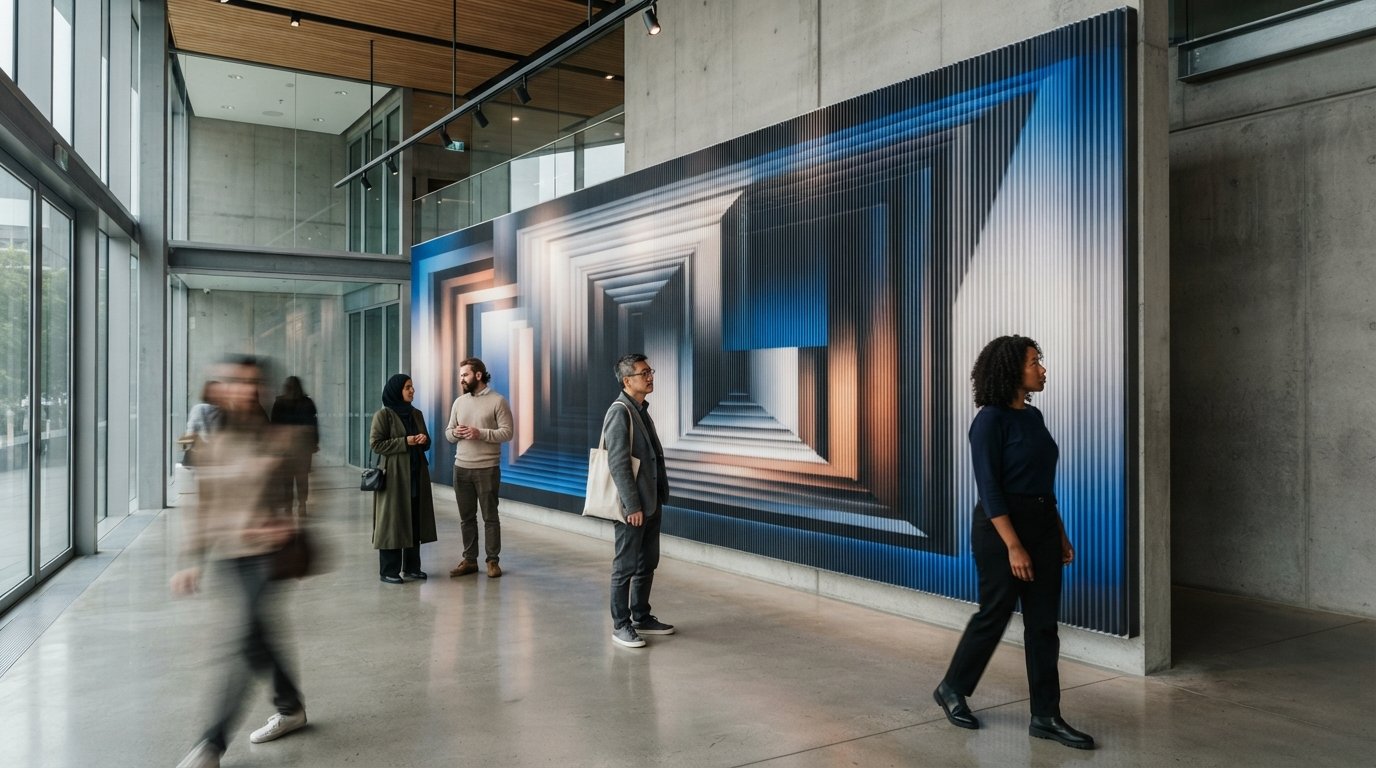
What if a structural wall could animate, shift, and reveal hidden dimensions as you walk past it, entirely without digital screens, wiring, or power cords? Through custom lenticular design, static spaces evolve from passive boundaries into responsive, kinetic experiences that engage human perspective directly. Environmental studies show that this tangible optical movement can lift visual engagement by up to 40% compared to traditional flat print.
Yet, if you’ve hesitated to specify the medium for major architectural features or fine-art commissions, you aren’t alone. Bridging the gap between handheld novelty cards and grand installations brings real technical friction. Worries about blurry ghosting, complex file interlacing requirements, and choosing the right lens pitch for specific pedestrian viewing distances often stall ambitious concepts before they begin.
You can master these optical engineering and artistic principles to elevate your environments with absolute confidence. Ahead, we’ll demystify lens geometries, frame sequencing, and precision fabrication standards, giving you the practical roadmap needed to execute flawless kinetic installations from initial prototype to final reveal.
Key Takeaways
- Understand how custom lenticular design transforms static walls into responsive kinetic narratives, delivering immersive motion without digital hardware.
- Learn how to match specific optical dynamics, from clean multi-phase flips to deep stereoscopic 3D, to your room’s natural pedestrian traffic patterns.
- Demystify digital file preparation, resolution thresholds, and sub-pixel interlacing techniques that eliminate blur and visual ghosting.
- Identify the ideal lens pitch, structural materials, and ambient lighting conditions needed to preserve crisp visual impact across any viewing distance.
- Discover how physical optical sampling and dedicated large-scale fabrication safeguard your vision from initial concept through final architectural assembly.
What Is Custom Lenticular Design and How Does It Transform Spaces?
Static surfaces ask viewers to stand still. Architecture, however, is experienced through movement. Through custom lenticular design, interior surfaces shed their passive boundaries and become reactive physical environments that respond to human presence. Lenticular optical mechanics function by bonding an array of microscopic cylindrical lenses to an interlaced image base, refracting segmented visual data across deliberate viewing angles to generate motion or stereoscopic parallax without electronic power. In modern kinetic interior architecture and contemporary galleries, this tangible interaction transforms ordinary corridors and public atriums into responsive artistic journeys.
The Physics of Physical Interactivity Without Screens
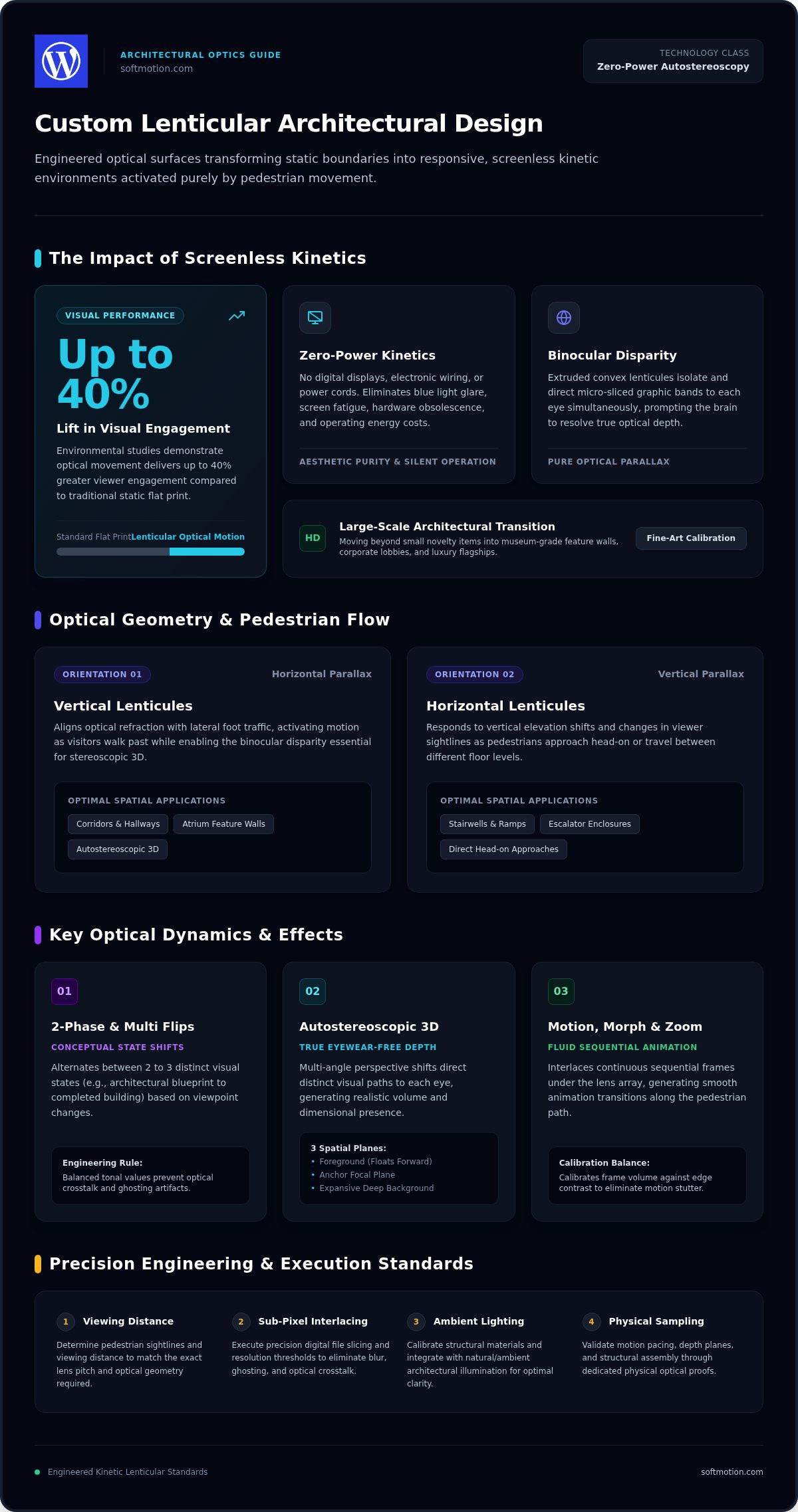
The magic relies on pure optical physics rather than software or digital displays. When an observer moves, extruded convex lenticules isolate and direct distinct, micro-sliced graphic bands to each eye simultaneously. Grounded in the optical principles of lenticular printing, this binocular disparity guides the brain into perceiving organic spatial depth and seamless motion sequences. Unlike electronic monitors, which emit harsh blue light and risk hardware obsolescence, lenticular surfaces integrate harmoniously with ambient lighting. They offer an aesthetic purity that digital signage cannot match: silent, zero-power kinetic movement that sparks personal exploration instead of screen fatigue.
Moving Beyond Novelty to Architectural Expression
For decades, commercial culture encountered lenticular technology primarily as small promotional novelties, flickering postcards, or trading cards. Today, refined large-format fabrication has elevated the medium into museum-grade spatial art. When expanded across grand feature walls, kinetic shifts alter the sensory atmosphere of a room. The visual narrative unfolds in direct choreography with pedestrian foot traffic, making the space feel alive. In prestigious cultural venues, specifying bespoke fine art lenticular prints redefines how visitors engage with curated environments, proving that custom lenticular design belongs among the highest tiers of structural and artistic finishes.
Key Optical Effects: Choosing the Right Visual Dynamic
Every architectural environment possesses its own rhythm of foot traffic. Successful custom lenticular design begins by studying that kinetic pathway and pairing it with the correct optical geometry. Lens orientation determines how the eye encounters the image. Vertical lenticules align with lateral movement, creating distinct shifts as visitors walk through corridors, while also enabling the binocular disparity needed for autostereoscopic 3D. Horizontal lenticules respond to vertical changes in viewpoint, making them ideal for stairwells, escalators, or spaces where observers approach head-on.
Two-Phase and Multi-Phase Flips
Flip effects alternate between two or three distinct visual states as the viewing angle changes. They deliver bold conceptual shifts, such as an architectural blueprint transforming into a completed structure. Precision matters here. Extreme contrasts, such as dark typography against pure white backgrounds, risk optical crosstalk or distracting ghosting. Balancing background tonal values and calibrating sub-pixel interlacing ensures clean, definitive cutoffs across corporate feature walls.
Stereoscopic 3D Depth Without Eyewear
Autostereoscopic 3D separates flat visual assets into tangible spatial planes: a foreground that floats forward, an anchor focal plane, and an expansive background. Rendering multi-angle perspective shifts from digital 3D camera tracks directs separate sightlines to each eye, allowing the brain to resolve true spatial volume. In corporate lobbies and luxury flagships, custom lenticular design creates an arresting dimensional presence that commands sustained engagement.
Continuous Motion, Morphing, and Zoom Sequences
Cinematic animations, morphs, and scaling zooms interlace a succession of sequential frames beneath the lens array. Rather than an abrupt flip, the visual transitions continuously along a pedestrian path. Optical engineering requires balancing frame volume against image sharpness. Squeezing too many frames under a narrow lenticule reduces edge contrast, while too few can cause stuttered motion. When calibrating complex movement, reviewing physical optical samples with Softmotion ensures your frame pacing aligns perfectly with pedestrian walking speeds before final production.
The Custom Lenticular Design and Engineering Process
Flawless spatial animation demands an exacting marriage of digital creative direction and physical optical physics. Transforming an artistic concept into a responsive spatial feature requires a disciplined, four-phase workflow:
- Phase 1: Storyboard and Motion Mapping. Choreographing the visual progression to align with observer approach angles and movement speeds.
- Phase 2: Layer Separation and Depth Profiling. Structuring multi-planar visual elements and establishing key focal baselines.
- Phase 3: Algorithmic Interlacing and Optical Calibration. Slicing source files into microscopic data bands matched precisely to the chosen lens pitch.
- Phase 4: Physical Optical Prototyping. Fabricating real-world test sections to verify lens clarity, color density, and lighting behavior prior to full production.
Artwork Preparation, Layering, and Interlacing
Precision begins in the digital file structure. Artwork must be built with generous lateral bleeds and organized into discrete visual planes to support clean perspective slicing. Algorithmic interlacing divides each graphic sequence into sub-pixel strips, aligning them underneath individual lens ridges. For high-resolution UV flatbed production, files must render between 300 and 1,200+ DPI. Dedicated software calculations compensate for thermal substrate expansion during the UV curing cycle, preserving microscopic registration across every line.
Pitch Testing and Optical Calibration
Never rely on nominal lens ratings. An extruded lens labeled as 20 or 40 LPI fluctuates slightly due to manufacturing variances, ambient workshop temperatures, and specific viewing distances. A 40 LPI sheet might actually read at 39.94 LPI under true optical evaluation. Technicians must conduct rigorous physical pitch tests across minute decimal increments to discover the exact optical match. Reviewing dedicated custom lenticular prototypes confirms clean image cutoffs and eliminates ghosting risks before committing to extensive installations.
Large-Format Material Selection and Lens Frequencies
Scale dictates material engineering. Handheld novelties use high-frequency lenses, but architectural features require rugged, coarse-gauge profiles. Long-range viewing in open atriums calls for 10 to 20 LPI lenses, while interior feature walls viewed from 2 to 6 meters standardly employ 20 to 30 LPI structures. Commercial installations also demand heavy-duty polymers like PETG or PMMA acrylic rather than PVC to satisfy strict smoke-toxicity and fire classifications. Reviewing the technical requirements in large format lenticular printing ensures your custom lenticular design retains dimensional stability across wide architectural expanses.
Spatial Integration: Designing for Pedestrian Flow and Lighting
A masterpiece of optical engineering will fail if the surrounding room works against it. Custom lenticular design requires an environmental mindset that accounts for ambient lux levels, pedestrian approach angles, and physical boundaries. Single extruded sheets generally max out around 4 ft × 8 ft or 4 ft × 10 ft. Creating vast feature walls means tiling multiple panels together seamlessly. Sub-millimeter mechanical registration across panel joints prevents broken optical ridges, ensuring the moving visual flows continuously across expansive architectural surfaces.
Viewing Distances, Speed, and Human Ergonomics
Movement profiles determine optical pacing. In rapid transit corridors where commuters stride briskly past, subtle multi-frame animations can blur into visual noise. These fast-flow settings benefit from high-contrast, two-phase flips that resolve clearly within a split-second glance. Conversely, intimate gallery alcoves or corporate lounges permit detailed micro-animations and deep stereoscopic layers because viewers have the leisure to slow down and explore the piece from multiple vantage points.
Mounting height demands equal precision. Aligning the focal baseline with the standard human sightline (roughly 57 to 60 inches from finished floor) maintains optical clarity across varying viewer heights. In wider corridors, broad viewing angles accommodate peripheral observation, while narrow hallways require tighter optical angles to trigger transitions quickly as pedestrians walk parallel to the wall.
Illumination Strategies and Surface Reflection Control
Because lenticules are curved optical cylinders made of clear resin, direct downlighting can create distracting specular reflections across the face of the panel. Proper illumination preserves color depth and dynamic contrast:
- Diffused Angled Lighting: Position wash fixtures at balanced 45-degree angles to illuminate graphic layers evenly while deflecting glare away from viewer sightlines.
- High-CRI LED Fixtures: Use directional light sources with a 90+ Color Rendering Index to reveal true tonal gradations beneath the lens ridges.
- Integrated Rear Illumination: In low-light hospitality lounges or dim retail alcoves, combining thin-gauge lenses with uniform edge-lit diffusers maintains vibrant optical transitions without relying on ceiling fixtures.
Planning these architectural nuances early eliminates expensive installation revisions down the line. Collaborate with Softmotion’s architectural installation specialists to evaluate your space’s pedestrian sightlines, structural framing, and lighting plans before finalizing your build.
Selecting an End-to-End Custom Lenticular Fabrication Partner
Commercial printers excel at high-volume paper runs, but architectural-scale optics require specialized spatial engineering. Executing custom lenticular design across public interiors or cultural galleries demands an integrated specialist capable of managing the entire continuum from optical physics to structural installation. Without deep technical oversight, even the most striking concepts risk visual distortion, delamination, or misaligned framing.
Key Criteria for Commissioning Architectural Lenticulars
Direct-to-lens flatbed UV printing represents the essential industry standard. Traditional fabrication mounted photographic paper to clear lenses using optical adhesives, an approach vulnerable to humidity delamination, bubbling, and edge separation over time. Direct printing cures resilient UV inks straight onto the reverse facet of the lens substrate, backed with a durable opaque flood layer.
Equally critical is the fabricator’s capacity to handle structural engineering and multi-panel registration. Large spatial features require split panels manufactured to sub-millimeter tolerances so lenticular ridges align perfectly across seams. Look for dedicated partners offering in-house project management who understand load-bearing mounts, ambient lighting calibration, and rigorous on-site installation protocols.
Collaborating with Softmotion: Visionary Optical Craftsmanship
Since 1997, Softmotion has served as a trusted fabrication leader for large-format motion installations, delivering over 1,000 projects worldwide. Architects, fine artists, and Fortune-500 institutions rely on our studio to bridge artistic ambition with uncompromising optical discipline. We don’t view ourselves as a hands-off manufacturing vendor. Instead, we guide your project as a collaborative partner through every milestone:
- Physical Optical Sampling: Producing tactile proof segments to evaluate viewing angles, color depth, and frame pacing in your actual project lighting.
- High-Precision UV Fabrication: Direct-to-substrate flatbed printing using high-grade, fire-rated polymers tailored to architectural building codes.
- Turnkey Site Coordination: Providing seamless structural framing guidance, multi-panel seam alignment, and on-site assembly support.
Elevating a space with responsive physical motion should be an inspiring, risk-free creative journey. When you are ready to turn static surfaces into dynamic living environments, Collaborate with Softmotion on custom lenticular design to realize your vision with absolute technical precision.
Bringing Kinetic Movement to Your Next Architectural Canvas
Static walls don’t have to remain silent. When engineered with intention, custom lenticular design transforms ordinary corridors and public atriums into responsive narrative journeys that unfold with every human step. By matching optical lens pitch to pedestrian flow, managing ambient illumination, and verifying registration through physical sampling, you eliminate distortion and replace cold digital displays with pure, screenless motion.
Executing large-scale kinetic features requires a partner with uncompromising optical discipline. Since 1997, Softmotion has delivered over 1,000 installations globally, earning the trust of visionary architects, fine artists, and Fortune-500 institutions. With turnkey project management spanning initial optical sampling to final on-site structural assembly, our team eliminates risk while realizing your creative vision. Ready to redefine how visitors experience your environment? Collaborate with Softmotion on custom lenticular design to bring your next architectural space to life.
Frequently Asked Questions
What is the difference between custom lenticular design and standard 3D printing?
Standard 3D printing is an additive manufacturing process that produces tangible, three-dimensional physical objects out of polymers or resins. Custom lenticular design, by contrast, is an optical print engineering discipline. It combines an array of extruded cylindrical lenses with micro-interlaced visual graphics, creating perceived stereoscopic depth or kinetic animation on flat surfaces. Instead of producing static objects, lenticular methods turn walls and panels into dynamic, responsive visual narratives without glasses or power cords.
How do I choose the correct lens LPI for my custom installation?
Lens selection depends directly on the intended pedestrian viewing distance. Coarse, thick-gauge profiles between 10 and 20 LPI work best for expansive atriums and public spaces where viewers stand 3 to 15 meters away. Intermediate 20 to 30 LPI lenses are standard for corporate feature walls observed from 2 to 6 meters. Finer 40 LPI lenses are calibrated for close pedestrian interactions within 1 to 3 meters, delivering sharp detail up close.
Can custom lenticular art be installed on curved walls or outdoor facades?
Yes, though both applications require specialized mechanical engineering. Flexible substrates like PETG can adapt to gentle architectural curves, but aggressive radiuses distort lens focal lengths, disrupting image alignment. Exterior installations demand UV-stabilized acrylic or PETG lenses, weather-sealed perimeter edges, and engineered expansion gaps within the framing. These accommodations prevent thermal warping and moisture intrusion, ensuring your custom lenticular design withstands direct exposure to outdoor elements.
How should digital files be prepared for custom lenticular printing?
Prepare digital artwork as multi-layered master files, separating visual elements onto discrete foreground, focal, and background planes with generous lateral bleeds. Renders should maintain resolutions between 300 and 1,200+ DPI. Rather than attempting manual interlacing, provide layered source assets to your fabrication specialist. They’ll use dedicated software to slice the imagery into micro-bands, calibrating the file precisely to the printing press’s optical pitch test.
What causes ghosting in lenticular prints and how is it prevented?
Ghosting happens when traces of one frame remain visible while viewing another, producing distracting double images. This optical crosstalk usually stems from extreme contrast discrepancies, such as solid black lettering against pure white fields, or misaligned interlacing. Fabricators prevent ghosting by harmonizing tonal values between frame transitions, running empirical pitch calibrations rather than relying on nominal lens numbers, and validating output through physical proof samples before full fabrication.
Is direct-to-lens printing better than mounting prints to lenticular sheets?
Direct-to-lens flatbed UV printing is the superior method for architectural installations. Traditional fabrication mounted photographic paper to clear lenses using optical adhesive films, leaving panels vulnerable to bubbling, delamination, and humidity degradation over time. Direct UV printing cures durable inks straight onto the reverse facet of the lens, finished with a heavy opaque white backing. This creates a permanent, moisture-resistant bond with exceptional registration stability across changing interior climates.
How do viewing distances affect whether an image should flip vertically or horizontally?
Orientation is dictated by pedestrian flow relative to the viewing plane. Vertical lenticules align ridges perpendicular to eye level, enabling true stereoscopic 3D depth and allowing pedestrians to trigger kinetic flips as they walk horizontally past the wall. Horizontal lenticules eliminate lateral binocular disparity entirely, making them ideal for vertical movement transitions, such as staircases and escalators, or displays where viewers approach straight on and shift their vantage point vertically.