
Mastering the Lenticular Zoom Effect: A Guide to Dynamic Large-Scale Visuals
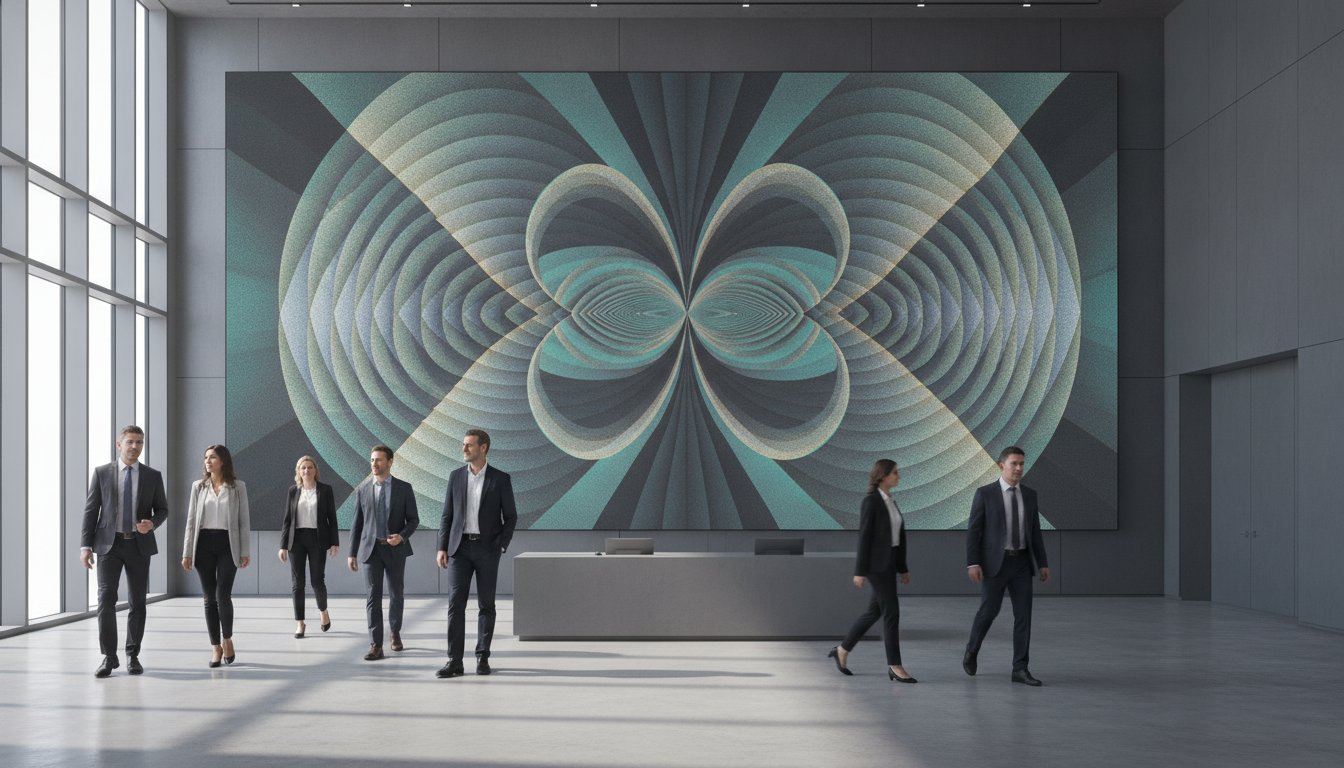
In a world saturated with digital noise, the most captivating movement is often the one that doesn’t require a power outlet or a glowing screen. A static wall shouldn’t just sit there. It should breathe, expand, and draw the viewer into a deeper narrative. The lenticular zoom effect offers exactly this transformation, turning a flat architectural surface into a rhythmic, three-dimensional experience that responds to the viewer’s own pace.
You already know that traditional signage often fails to hold attention in bustling lobbies or high-end retail environments. There’s a common fear that motion graphics can feel promotional or “cheap” when translated to physical materials, yet the demand for a “wow” factor has never been higher. This guide changes that perception. You’ll discover how to master the technical nuances of scaling motion for large-format environments, ensuring your vision maintains its artistic integrity. We’ll explore the transition from simple 2D graphics to sophisticated spatial installations and provide a roadmap for finding a fabrication partner who can bring these complex designs to life with professional precision.
Key Takeaways
- Learn how the lenticular zoom effect creates a sense of three-dimensional expansion on static surfaces, inviting viewers to engage with architectural spaces in a rhythmic, immersive way.
- Discover the technical requirements for large-format fabrication, where precision alignment and high-resolution interlacing are critical for maintaining visual clarity at scale.
- Differentiate between multi-frame zoom and traditional two-frame flips to select the kinetic effect that best suits your project’s spatial constraints and viewing distances.
- Identify essential design principles, such as background consistency and color contrast, to ensure your motion-driven art remains grounded and impactful.
- Move from abstract vision to concrete execution by understanding the collaborative milestones required for a successful, high-end large-scale installation.
What is the Lenticular Zoom Effect in Large-Scale Design?
The lenticular zoom effect is a kinetic phenomenon where a static image appears to physically scale toward or away from the viewer as they move past it. It’s a departure from the frozen nature of traditional graphics. Instead of a single, unyielding perspective, the surface becomes elastic. This “leaping out” sensation creates an immediate emotional response, tricking the brain into perceiving a three-dimensional expansion within a two-dimensional plane. While once relegated to small promotional novelties, this technique has matured into a sophisticated tool for high-end architectural and advertising environments. In the frantic atmosphere of a transit hub or the hushed prestige of a corporate lobby, the zoom effect demands attention by rewarding curiosity with movement.
The Core Mechanics of Visual Expansion
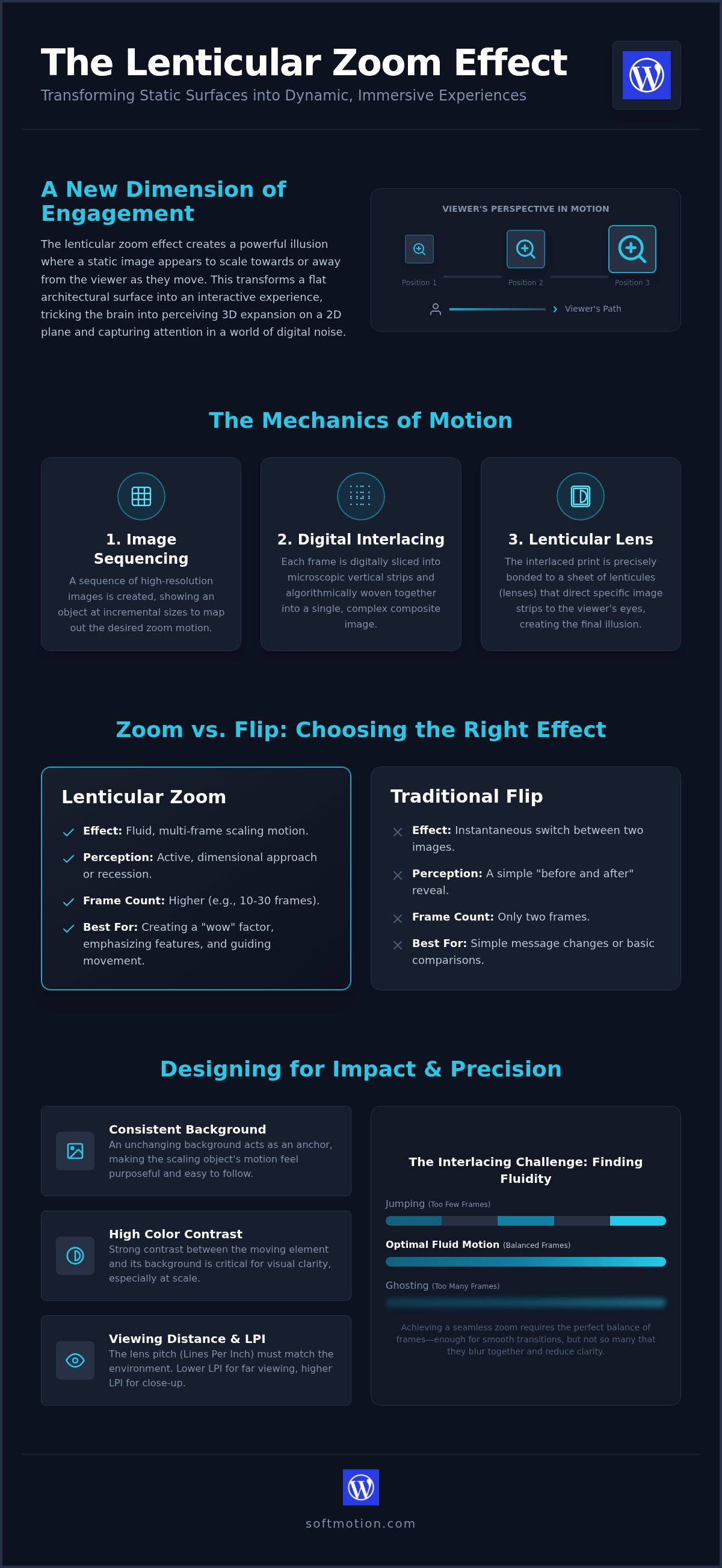
Achieving a seamless scale requires a meticulous orchestration of multiple frames. Unlike a simple flip, the zoom effect utilizes a sequence of images that grow or shrink in incremental stages. These frames are processed through Lenticular printing technology, where they’re sliced into microscopic strips and aligned under a specialized lens. A common background is essential. It acts as an anchor that grounds the scaling object, making the motion feel purposeful rather than chaotic. This structure transforms the viewer from a passive observer into an active participant. Their physical stride dictates the pace of the animation, creating a personal, tactile connection with the environment.
Zoom vs. Traditional 3D Depth
It’s easy to confuse zoom with standard 3D depth, but the two serve different narrative functions. Traditional 3D relies on parallax to create a sense of layers receding into the distance. It’s a window into a space. Zoom, however, is about active motion. It’s an invitation. While 3D depth is impressive, the lenticular zoom effect offers a higher degree of perceived interactivity without the need for digital hardware or power sources. Designers should prioritize scaling motion when the goal is to emphasize a specific product feature or create a sense of approach. It’s the difference between looking at a landscape and feeling an object move toward you. This distinction is vital for architects who want to create spaces that feel alive and responsive to human presence.
The Mechanics of Motion: How Zoom is Fabricated at Scale
Fabricating motion at an architectural scale is a disciplined exercise in precision. When an image spans several meters, the margin for error disappears. Every pixel must align perfectly with the lenticular lens to ensure the illusion remains stable and convincing. This process moves beyond standard printing, requiring a deep understanding of how light interacts with physical materials to create the lenticular zoom effect. It’s a technical challenge that transforms a visionary concept into a tangible, durable reality.
Interlacing for Seamless Scaling
The foundation of the zoom effect lies in interlacing. Digital frames are sliced into microscopic vertical strips and meticulously arranged behind the lens to produce the lenticular zoom effect. For a zoom to feel fluid, the transition between these frames must be imperceptible. If the frame count is too low, the viewer experiences “jumping,” where the motion feels stuttered. Conversely, adding too many frames can lead to “ghosting,” where multiple images appear simultaneously and muddy the visual clarity. Achieving the right balance requires high-resolution source imagery and a fabrication process that maintains absolute registration across the entire surface.
Large Format Lenticular Sheets and Hardware
Selecting the correct material is the next critical step. In architectural environments, the choice of lens pitch, or lines per inch (LPI), is dictated by the intended viewing distance. A lower LPI is often preferred for long-range impact in transit hubs, while a higher LPI provides the detail necessary for intimate retail corridors. Durability is equally vital. Public installations require materials that can withstand high traffic without losing their optical properties. For a deeper dive into these technical specifications, you can explore The Architect’s Guide to Large Format Lenticular Printing. This level of detail ensures that the final installation is as resilient as it is beautiful.
Success at this scale is never accidental. It’s the result of rigorous prototyping and sampling. Before full-scale production begins, creating a physical sample allows designers to verify the speed of the zoom and the clarity of the colors under specific site lighting. This phase eliminates risk, providing the security needed to move forward with confidence. If you’re ready to see how these mechanics translate to your specific environment, reviewing our lenticular samples is the most practical first step toward realizing your vision.
Zoom vs. Flip: Choosing the Right Kinetic Effect for Your Space
Selecting the right kinetic language for a physical environment requires more than technical knowledge; it demands an understanding of the viewer’s psychological journey. While both flips and zooms generate movement from static surfaces, they speak different emotional languages. A flip is a tool of surprise. It presents a binary choice, a sudden transformation that forces the brain to reconcile two distinct states. In contrast, the lenticular zoom effect is an exercise in immersion. It doesn’t switch; it evolves. By simulating a linear approach, it draws the viewer into the frame, creating a sense of physical proximity that feels both natural and cinematic.
Spatial requirements often dictate this choice. Zoom effects thrive in environments where the viewer has a long, unobstructed approach, such as an airport terminal or a grand corporate atrium. The scaling motion needs physical distance to unfold its narrative. Flips, however, excel in high-velocity areas where the viewer’s angle of observation changes rapidly. In these tight corridors, a quick transition ensures the message is delivered in a single, high-impact beat. For those seeking even greater complexity, hybrid effects can combine a zoom with a subtle color shift or a secondary flip, though this requires a master’s touch to avoid visual clutter.
When to Use the Zoom Effect
The lenticular zoom effect is most powerful when the goal is to celebrate a single, iconic subject. In high-end retail, it can make a hero product “leap” from the wall, creating an irresistible focal point that stops foot traffic. It’s also an effective architectural tool for directing focus. By placing a zoom installation at the end of a long hallway, you create a sense of ‘entry’ or ‘arrival,’ using the perceived motion to guide the viewer toward a specific destination. It’s a rhythmic, graceful way to animate a space without the frantic energy of digital screens.
When to Opt for a Kinetic Flip
Choose a flip when the story requires a clear “before and after” or when you need to communicate two distinct messages in a single footprint. This is particularly effective for dual-brand partnerships or for showing the internal mechanics of a complex machine. Because flips rely on a sharp change in perspective, they work best in spaces where viewers pass by quickly and close to the surface. For a comprehensive look at how these transitions can be optimized for commercial impact, see our guide on Kinetic Advertising Displays: A Guide to High-Impact Lenticular Motion. This strategic choice ensures your installation resonates with the specific rhythm of the room.
Designing for Impact: Best Practices for Large-Format Zoom
High-impact design requires a delicate balance between artistic vision and technical constraint. To maximize the lenticular zoom effect, every element must serve the illusion of movement. Background consistency is non-negotiable. If the background shifts along with the hero object, the eye loses its reference point, and the scaling sensation collapses into visual noise. Visual anchoring is the practice of maintaining a static reference point within a kinetic composition to provide the eye with a sense of scale and stability. By keeping the surrounding environment steady, you allow the central subject to truly “breathe” and expand toward the viewer.
Contrast is the engine of perception. Bold color transitions and sharp edges help the brain distinguish the scaling object from its surroundings, enhancing the sense of approach. Lighting also plays a silent but pivotal role. Large-scale lenticular walls require diffused, even illumination. Harsh point sources or spotlights can create glare on the lens surface, which can “kill” the effect in certain spots. Instead, aim for a broad wash of light that allows the entire panel to perform consistently from every angle. This ensures the motion remains fluid as the viewer moves through the space.
Every installation has a “sweet spot.” This is the ideal distance where the lens pitch and the interlaced imagery align perfectly for the viewer’s eye. Calculating this requires understanding the physical constraints of the environment. In a narrow retail corridor, the effect needs to trigger quickly. In a vast corporate lobby, the zoom can be more gradual and expansive. Finding this balance is what separates a mere graphic from a truly immersive experience.
Composition and Visual Hierarchy
Focus on a single “hero” object to lead the narrative. Attempting to scale multiple complex elements simultaneously often leads to a cluttered, confusing experience that diminishes the work’s emotional resonance. When producing these hero assets, working with a specialist like The Photography Co can help capture the high-resolution detail necessary for a convincing zoom effect. Effective use of negative space is your best tool for clarity. It provides the visual “room” necessary for the hero object to grow without overlapping other critical design elements, maintaining a clean and sophisticated aesthetic even at a massive scale.
Quality begins in the file structure. High-resolution source imagery is essential, as any pixelation will be magnified by the lenticular lens. Layers must be meticulously organized to facilitate the interlacing process, keeping the scaling object separate from the anchor background. Engaging with an experienced large format lenticular manufacturer early in the design phase ensures that these technical requirements are met before production begins. If you’re ready to explore these technical nuances for your next project, our team can provide expert guidance on architectural lenticular installations.
The Softmotion Approach: Transforming Environments with Dynamic Depth
Softmotion sees architectural surfaces not as boundaries, but as canvases for motion. Since 1997, we’ve delivered over 1,000 projects, helping architects and developers move beyond the constraints of the two-dimensional plane. The lenticular zoom effect is a cornerstone of this vision. It allows us to inject life into corporate lobbies and retail flagships, creating a spatial narrative that evolves with every footstep. We’ve partnered with Fortune-500 clients to realize hidden potential in their physical assets. These collaborations aren’t just about printing; they’re about spatial transformation. By working closely with design teams from the earliest stages, we ensure the kinetic art is integrated into the architectural fabric rather than treated as an afterthought.
End-to-End Fabrication Excellence
Excellence at this scale requires a departure from “off-the-shelf” thinking. Every environment has unique lighting, viewing angles, and traffic patterns. We prioritize custom lenticular design, developing bespoke prototypes that allow you to see the lenticular zoom effect in situ before full-scale production. This managed approach offers a sense of security, backed by professional lenticular installation project management. Our process ensures that the final result is not only visually stunning but also built for the rigors of high-traffic public spaces. We handle the technical complexity so you can focus on the creative vision.
Redefining the Viewer Experience
Motion-driven displays fundamentally change how people interact with a room. Kinetic elements significantly increase dwell time and brand recall compared to static graphics. The experience shifts from passive viewing to active exploration. Instead of walking past a wall, visitors walk with it. They pause. They double back. They engage. This level of immersion creates a lasting emotional resonance that digital screens often fail to achieve. It’s a human-first approach to technology that rewards curiosity with movement. Realizing these complex visions requires a partner who balances artistic sensibility with technical discipline. We invite you to begin your next collaborative journey with us. Together, we can transform your static surfaces into multi-dimensional experiences that define the modern architectural landscape.
Reimagining the Static Wall: Your Vision in Motion
The transition from a static surface to a multi-dimensional narrative is more than a technical upgrade. It’s a fundamental shift in how people experience a physical environment. By mastering the lenticular zoom effect, you move beyond the limitations of traditional graphics and invite viewers into a rhythmic, immersive dialogue with the architecture itself. Success at this scale requires a rare blend of artistic vision and absolute fabrication precision, ensuring every frame aligns to create a seamless sense of approach and expansion.
With over 1,000 successful projects delivered since 1997, Softmotion specializes in the complex logistics of large-format architectural art. We provide a secure, collaborative journey from initial sampling through to final assembly, ensuring your creative intent remains uncompromised. Our comprehensive project management takes the risk out of innovation, allowing you to focus on the impact your vision will have on its audience. It’s time to see the hidden potential in your walls and bring them to life with a partner who understands the nuances of spatial motion.
Transform your space with a custom Softmotion installation and redefine what’s possible in your next environment.
Frequently Asked Questions
What is the difference between a lenticular zoom and a flip effect?
A flip effect is a binary transition between two distinct images, designed for sudden impact. The lenticular zoom effect utilizes a sequence of multi-frame images to simulate linear movement toward or away from the viewer. This creates a sense of rhythmic expansion rather than a sharp change. While flips work well for dual messaging, zooms offer a cinematic, immersive experience that rewards the viewer’s physical movement through a space.
Can the lenticular zoom effect be used on outdoor building facades?
Outdoor installations are possible when utilizing UV-stable and weather-resistant lenticular materials. These large-scale facades require careful consideration of sun angles and ambient light to maintain the clarity of the motion. Because outdoor environments offer vast viewing distances, we often select a coarser lens pitch to ensure the effect remains visible from across a plaza or street. This turns a static building exterior into a landmark, motion-driven experience.
What is the maximum size for a lenticular zoom installation?
There is no theoretical limit to the size of an installation because we utilize a precision tiling method. While individual lenticular sheets have physical manufacturing limits, we seamlessly align multiple panels to cover entire lobby walls or expansive transit corridors. Our experience with over 1,000 projects since 1997 has allowed us to refine these alignment techniques, ensuring that the motion remains fluid and continuous across massive architectural surfaces.
Do I need special lighting for a lenticular zoom wall to work?
Diffused, even lighting is essential for a lenticular wall to perform at its best. You don’t need proprietary hardware, but you should avoid harsh spotlights that create glare or “hotspots” on the lens surface. Glare can disrupt the viewer’s ability to see the underlying interlaced imagery. A broad, soft wash of light across the panel ensures the zoom effect remains consistent and vibrant as people move past the installation.
How many frames are typically used to create a smooth zoom animation?
A smooth zoom animation typically requires between 12 and 24 frames, depending on the specific lens pitch and the complexity of the art. Using too few frames causes the motion to “jump,” while too many can lead to visual blurring or ghosting. We find the ideal balance during the prototyping phase. This ensures the scaling sensation feels fluid and natural, providing a high-end finish that matches the architectural environment.
Is the zoom effect effective for text-heavy advertising displays?
The zoom effect is most successful when focused on a single hero object or brand icon rather than dense blocks of text. Small typography often suffers from ghosting during a zoom animation, which can make the message difficult to read. We recommend keeping text static on a common background while allowing the central visual element to scale. This hierarchy ensures the lenticular zoom effect captures attention without sacrificing the clarity of your core message.
How do I choose the right viewing distance for a large-format zoom mural?
Choosing the right distance depends on the relationship between the lens pitch and the physical layout of your space. In narrow corridors, we use a higher LPI lens that triggers the motion quickly at close range. For grand atriums or transit hubs, a lower LPI lens allows the effect to resolve from much further away. We calculate these technical specs during the design phase to align with the viewer’s natural path.
What file formats are required for custom lenticular design and production?
We require high-resolution, layered files, typically in PSD or TIFF format, to begin the interlacing process. Each element of the zoom, including the hero object and the static background, should be on a separate layer with its transparency preserved. This organization allows our design team to meticulously slice and arrange the imagery behind the lens. Providing clean, high-fidelity source files is the first step toward achieving professional fabrication excellence.
To ensure your source files meet these rigorous technical standards, you can explore Project-based media authoring and post-production fees and partner with experts who specialize in professional asset creation and video sequences.