
Lenticular Wall Installations: The Architect’s Guide to Kinetic Environments
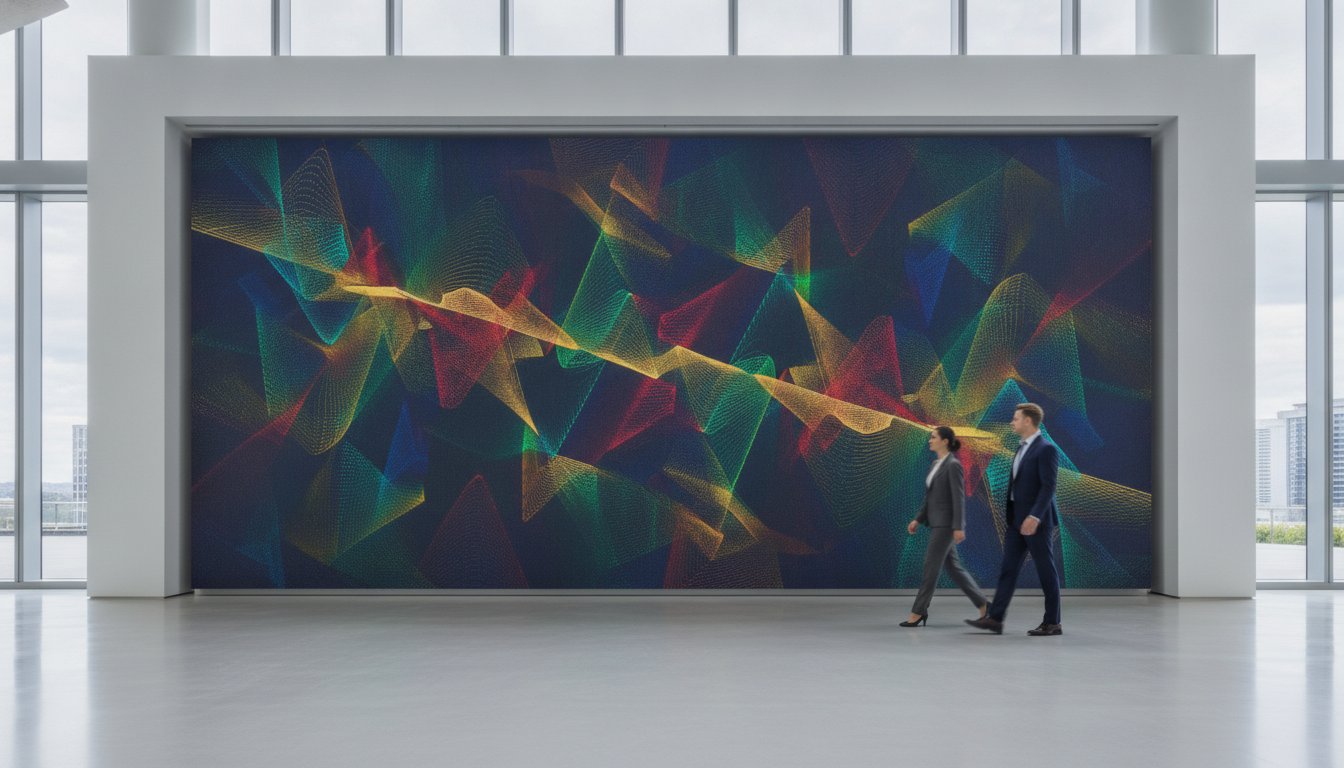
What if the most captivating feature in your next premium environment required no power source, no software updates, and zero ongoing maintenance? In high-end architectural design, the choice often feels limited to the uninspired silence of static surfaces or the distracting, high-maintenance flicker of digital screens. You deserve a medium that breathes with the room. By mastering lenticular wall installations, you can transform passive architectural boundaries into kinetic interfaces that synchronize visual narratives with human movement. This is the transition from the two-dimensional to the multi-dimensional, where a wall becomes a living part of the spatial experience.
We understand the hesitation that comes with large-scale technical projects. You need more than just a vendor; you need a partner who bridges the gap between fine art and rigorous technical production. This guide will show you how to achieve a seamless, low-maintenance kinetic installation that increases dwell time and deepens engagement. We’ll move from the broad vision of spatial transformation to the concrete logic of a risk-free fabrication process, ensuring your next project isn’t just seen, it’s experienced. Discover how to turn your vision into a reliable, high-impact reality that commands attention without saying a word.
Key Takeaways
- Shift from passive architectural surfaces to active, motion-driven environments that respond naturally to the movement of the observer.
- Master the critical technical variables, such as viewing distance and lens geometry, that define the success of large-scale lenticular wall installations.
- Identify specific strategic applications for corporate and retail spaces that maximize emotional resonance and significantly increase audience dwell time.
- Navigate the complexities of the fabrication process by prioritizing physical samples and precise digital interlacing to eliminate technical risk before production.
- Partner with a seasoned visionary guide to ensure a seamless transition from abstract architectural concepts to high-performance, low-maintenance kinetic art.
Beyond Static Surfaces: The Evolution of Kinetic Wall Installations
Traditional walls are silent boundaries. They define the limits of a room but rarely participate in the life of the space. Lenticular wall installations reimagine these static planes as multi-dimensional architectural surfaces that refuse to stay still. While a conventional mural or graphic remains fixed regardless of where you stand, kinetic art evolves based on your position. It responds. It breathes. As people move through a corridor or transition through a lobby, the surface shifts to reveal new colors, patterns, or narratives. This evolution reflects a significant shift in modern architecture toward experiential surfaces that prioritize human movement over static observation.
At its core, this medium utilizes Lenticular printing technology to interlace multiple images behind a specialized lens. This creates a physical dialogue between the architecture and the observer. For projects requiring a different geometric rhythm, architects often turn to the Agamograph. This high-impact alternative uses folded or triangular structures to create sharp, distinct image transitions that command attention from every angle. Whether using a smooth lens or a structured fold, these installations turn a passive walk into an active discovery.
Why Architects are Moving Away from Digital Screens
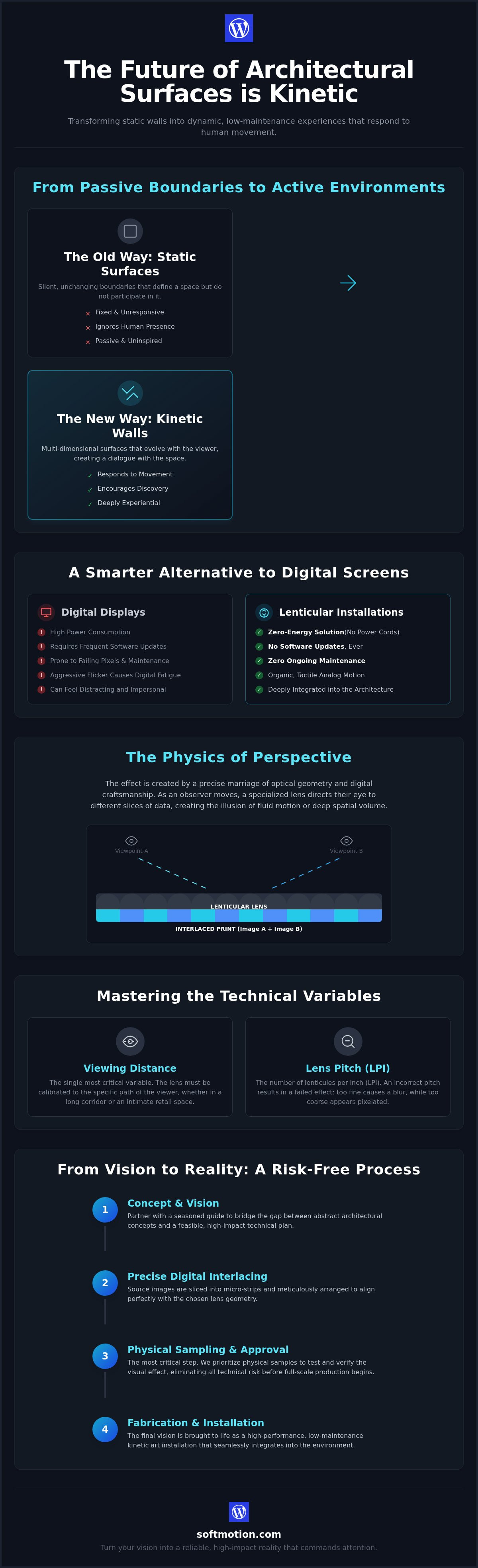
Digital fatigue is a growing concern in premium environments. In corporate lobbies and high-traffic transit hubs, the aggressive flicker of LED screens can feel distracting or even exhausting. Digital displays also come with a heavy operational burden. They require constant power, frequent software updates, and the inevitable maintenance of failing pixels. Lenticular technology offers a sophisticated, low-maintenance alternative. It provides fluid motion without a single cord. It’s a zero-energy solution that relies entirely on the physics of light and the natural movement of the viewer. There is an undeniable magic in analog motion that digital displays simply cannot replicate; it feels organic, tactile, and deeply integrated into the building’s soul.
The Psychology of Perspective-Shifting Art
Humans are biologically wired to notice change. When a wall seems to recognize a viewer’s presence by shifting its appearance, it creates an immediate emotional resonance. This isn’t just a visual trick; it’s a sensory experience that rewards curiosity. These installations naturally encourage people to slow their pace or even backtrack to witness the full transition. This behavior significantly increases dwell time, making the space feel more memorable and intentional. Kinetic engagement is the primary ROI for these installations, as it transforms a simple transit zone into a meaningful destination that people remember long after they leave.
The Physics of Perspective: How Large-Scale Lenticular Technology Works
The magic of lenticular wall installations begins with a precise marriage of optical geometry and digital craftsmanship. A lenticular lens is essentially a sheet of high-grade plastic featuring a series of semi-cylindrical ridges, known as lenticules. These ridges act as magnifying windows. Beneath them lies a high-resolution image that has been “interlaced,” a process where multiple graphics are sliced into micro-strips and arranged to align perfectly with the lens geometry. As an observer moves, the lens directs the eye to different slices of data, creating the illusion of fluid motion or deep spatial volume. Precision is the foundation of this experience; even a fractional misalignment can shatter the illusion.
In large-format architectural design, viewing distance is the most critical variable. The “pitch” of the lens, or the number of lenticules per inch, must be calibrated to the specific path of the viewer. If the lens is too fine for a long corridor, the effect disappears into a blur. If it’s too coarse for a close-up retail environment, the image appears pixelated. Architects must also navigate the choice between a “flip” effect, which transforms one image into another, and a “3D depth” effect, which uses stereoscopic offsets to push the visual plane beyond the physical wall. A masterful example of this spatial storytelling is Diller Scofidio + Renfro’s Travelogues at JFK Airport, where the installation uses perspective to engage travelers in a narrative that evolves with every step.
Technical failure often manifests as “ghosting,” where remnants of a previous image bleed into the current view. This visual interference is typically caused by poor contrast management or imprecise fabrication. High-precision production prevents this by utilizing advanced interlacing algorithms and rigorous alignment checks. For architects looking to test these variables in a real-world setting, reviewing physical lenticular samples is the most reliable way to ensure the final installation meets the intended aesthetic standard.
Lenticular vs. Agamograph: Choosing the Right Effect
While traditional lenticular lenses use micro-optics for fluid motion, Agamographs utilize large-scale pleated or triangular surfaces to create sharp, binary transitions. These “accordion” walls are ideal for high-contrast storytelling where the architect wants two completely different scenes to exist on the same surface. Architects should choose Agamographs for bold, two-way shifts and reserve traditional lenticular technology for cinematic motion, complex 3D depth, or projects requiring a smooth, low-profile surface. Both styles serve to turn a static boundary into an active participant in the room’s atmosphere.
Material Science in Large-Format Fabrication
Durability is non-negotiable in public and premium spaces. Large-scale installations utilize UV-stable plastics that resist yellowing over time, ensuring the visual clarity remains intact for years. Beyond aesthetics, compliance is paramount. Softmotion prioritizes the use of fire-rated materials that meet strict safety codes for public installations. Every panel is fabricated with sub-millimeter accuracy to ensure that color consistency and lens alignment remain perfect across massive, multi-panel surfaces. This grounded, technical discipline allows the visionary potential of the art to shine without the risk of material failure. Architects seeking detailed specification guidance will find a comprehensive resource in this overview of lenticular wall cladding for transformative kinetic surfaces.
Strategic Applications: Tailoring Motion for Diverse Environments
Every architectural space possesses a unique heartbeat, and designing successful lenticular wall installations requires a deep understanding of the choreography within that room. The intent behind the surface defines the technical specifications of the lens. In luxury retail, for example, the goal is often a “stop-and-stare” effect. By placing a high-contrast kinetic display in a storefront, brands can arrest the attention of passersby, turning a casual stroll into a focused interaction with the brand. This motion is organic and personal; it is a private performance triggered entirely by the shopper’s own pace. This creates a sense of discovery that static imagery simply cannot provide.
For fine art applications, the priority shifts toward archival permanence and extreme visual precision. These are not merely graphics; they are legacy investments. Artists use these multi-dimensional surfaces to explore the transition from the two-dimensional to the three-dimensional, requiring a level of clarity that only a master fabricator can deliver. Since 1997, Softmotion has refined this process, delivering over 1,000 projects that balance these high-level artistic demands with the technical durability required for public display. Whether it is a gallery piece or a large-scale installation, the impact relies on the seamless execution of the visual shift. Designers seeking a comprehensive overview of how these principles apply across different room types will find valuable context in this guide to integrating kinetic wall art installations into modern interiors.
Corporate Lobbies and Office Branding
Corporate environments often struggle with static branding that feels dated within a few years of installation. Lenticular walls solve this by allowing a single surface to showcase a company’s past, present, and future simultaneously. As visitors move toward a reception desk, they might see a timeline of innovation unfold or a brand logo transform into a mission statement. These systems integrate effortlessly into existing architectural cladding, appearing as a natural part of the building’s skin. Kinetic branding serves as a sophisticated tool to foster employee pride and leave visitors with a lasting sense of awe.
To complement these artistic features with traditional elements like dimensional lobby signs or ADA-compliant displays, you can visit Signarama for a wide range of custom commercial signage solutions.
Public Transit and High-Traffic Hubs
In transit hubs, the viewer’s speed dictates the “frame rate” of the motion. A commuter rushing at a brisk pace experiences a different visual transition than someone standing on a slow-moving escalator. Designing for commuter speed requires a visionary guide who understands how to time these shifts to prevent visual noise or confusion. Beyond aesthetics, these installations play a vital role in spatial orientation. They can use subtle color shifts to guide people toward specific gates or exits. By engaging thousands of daily commuters with non-digital motion, architects create a rhythmic, calming environment that reduces the stress of travel while remaining entirely maintenance-free.
Navigating the Complexity: A Framework for Lenticular Project Management
Realizing a large-scale kinetic environment is a journey that begins long before the first panel is printed. Managing lenticular wall installations requires a disciplined framework that bridges the gap between digital creativity and physical reality. The heart of this process is the interlacing phase, where digital art is mathematically decomposed and reassembled to match the lens pitch exactly. This isn’t a standard print job; it’s a technical translation that ensures the motion feels fluid rather than jarring. A seasoned partner oversees this complexity, ensuring that the transition from a screen-based concept to a tangible architectural element is both predictable and precise.
Logistics and lighting are the final, critical hurdles. For multi-panel installations, global shipping and on-site assembly must be handled with extreme care to prevent the slightest misalignment at the seams. Lighting acts as the engine for the kinetic effect. Proper illumination reveals the depth and color, while poorly placed fixtures can create glare that obscures the lens or shadows that break the interlaced narrative. By addressing these variables during the planning phase, the installation remains a source of wonder rather than a technical liability.
Step 1: Environmental Analysis and Viewing Angles
The success of the work depends on the “sweet spot,” the specific location where the visual transition is most impactful. We analyze the traffic flow to determine the orientation of the lens. Vertical lenticules are standard for corridors where people walk past side-to-side, while horizontal lenses are better suited for spaces with vertical movement, such as escalators or stairs. We also identify potential obstructions, ensuring that columns or furniture don’t sever the viewer’s connection with the kinetic surface.
Step 2: Prototyping and Technical Validation
In a field where precision is everything, seeing a physical sample is non-negotiable. Small-scale prototypes allow us to test “flip” speeds and color shifts under the actual lighting conditions of the site. This phase is about technical validation; we ensure that panel seams are virtually invisible and that the lens alignment is perfect across the entire surface. Softmotion’s approach to risk-free creative exploration ensures that every variable is mastered before full production begins.
To begin your own journey toward a kinetic environment, you can request a set of lenticular samples to experience the clarity and precision of our fabrication process firsthand.
Realizing the Vision: Custom Fabrication with Softmotion
Architecture is an act of faith. It is the transformation of an abstract vision into a physical landmark that defines how people interact with their surroundings. For over 25 years, Softmotion has served as the visionary guide for world-class architects and Fortune-500 corporations seeking to push the boundaries of spatial experience. We don’t just fabricate displays; we engineer kinetic environments that respond to the rhythm of human movement. Our end-to-end service model is built on a foundation of professional reliability, providing total clarity from the initial design consultation through to the final on-site installation. By acting as a collaborative partner rather than a distant vendor, we ensure that the technical complexity of lenticular wall installations never overshadows the primary artistic intent.
A Legacy of Innovation Since 1997
Experience is the ultimate form of technical security. Since our founding in 1997, we’ve successfully delivered more than 1,000 projects across the globe, ranging from archival-quality fine art prints to massive architectural cladding for high-profile headquarters. This deep history allows our team to anticipate challenges before they ever reach the site, ensuring that every lens alignment and color shift is executed with surgical precision. Our commitment to human-first collaboration means we prioritize your creative goals, providing the technical discipline needed to realize even the most ambitious concepts. We specialize in turning the hidden potential of a static surface into a multi-dimensional narrative that captures the imagination. This legacy of craftsmanship ensures that your project is not only beautiful but also durable and compliant with all architectural standards.
Global Reach and Local Execution
The logistics of a global installation can be as complex as the art itself. Softmotion manages the entire journey, ensuring that your vision is realized with consistent quality regardless of the project’s geographic location. We understand that a world-class design firm needs a partner who can navigate the intricacies of international shipping and local assembly with quiet confidence. This global authority is balanced by a pragmatic, hands-on approach to the final details of lighting and panel integration. We take the stress out of the creative process, allowing you to focus on the high-level vision while we handle the technical execution. Every project we touch becomes a testament to the power of partnership, blending fine art sensibility with grounded corporate dependability. It’s time to move beyond the limitations of static design and embrace the future of kinetic architecture.
Collaborate with Softmotion on your next kinetic installation
Transforming the Future of Spatial Design
Architecture is no longer just about the structure; it’s about the conversation the space has with its occupants. By integrating lenticular wall installations, you move beyond the limitations of static materials and digital fatigue. You create an environment that rewards movement and celebrates the unique perspective of every visitor. Success in this specialized field requires a bridge between imaginative concept and technical reality. This is where the transition from a simple wall to a living interface truly begins.
Since 1997, Softmotion has specialized in large-format lenticular technology, delivering over 1,000 projects to Fortune-500 brands and world-class architects across the globe. We provide the technical discipline and creative security needed to turn complex visions into reliable architectural art. Whether you’re designing a high-traffic transit hub or a luxury corporate lobby, our team ensures every panel is a masterpiece of precision and impact. It’s time to bring your most ambitious ideas into the physical world with confidence.
Start your custom lenticular project with Softmotion’s visionary team and redefine what’s possible for your next environment. Your vision deserves a partner who can realize its full potential.
Frequently Asked Questions
What is the maximum size for a lenticular wall installation?
Large-scale installations are virtually limitless because we utilize a modular paneling system. Each panel is engineered to align with sub-millimeter precision, allowing us to cover massive architectural cladding or entire lobby walls. While individual lens sheets have manufacturing limits, our fabrication process ensures that seams are nearly invisible to the observer. This allows for a continuous, immersive experience across any spatial dimension.
Can lenticular walls be installed outdoors or in high-humidity areas?
We offer specialized solutions for challenging environments by utilizing UV-stable plastics and moisture-resistant substrates. These materials prevent yellowing and warping in high-humidity areas or direct sunlight. We recommend a strategic consultation to verify the specific environmental stressors of your site before production begins. This ensures the long-term durability and visual clarity of the work in any climate.
How do I choose between a 3D depth effect and a 2-image flip effect?
Choosing between effects depends on the desired emotional resonance of the space. A 3D depth effect creates a sense of spatial volume that pushes the visual plane back, while a 2-image flip is superior for sharp, narrative storytelling. If your goal is kinetic branding that reveals a logo or message as people walk past, the flip effect is often the most impactful choice.
What kind of lighting is required for a lenticular wall to look its best?
Directional lighting is the engine that drives the visual shift in lenticular wall installations. We recommend overhead spotlights or wall-washers that provide consistent, focused illumination without creating excessive glare. Avoiding multiple conflicting light sources is essential to prevent ghosting and ensure the interlaced narrative remains crisp and clear. Proper lighting turns a static surface into a living, responsive experience.
How much maintenance do these kinetic installations require compared to digital screens?
These analog installations require significantly less maintenance than digital screens because they have no power requirements or software dependencies. Unlike LED walls that suffer from dead pixels or hardware failure, a lenticular surface only requires standard cleaning with non-abrasive materials. It’s a set-and-forget solution that remains vibrant for decades. This reliability makes them ideal for high-traffic environments where technical failure isn’t an option.
Can I use my own artwork for a custom lenticular project?
We encourage architects to provide their own high-resolution digital art for the project. Our team acts as your visionary guide, taking your raw files and managing the complex interlacing process to ensure the kinetic result matches your original intent. We provide physical samples to validate how your colors and transitions will behave under the lens before we move into full-scale production.
What is the typical lead time from design to final installation?
A typical project timeline ranges from 8 to 12 weeks from the initial design approval to final on-site delivery. This schedule includes a critical phase for prototyping and technical validation to ensure the final result meets our rigorous quality standards. Larger or more complex global installations may require additional time for logistics and custom material sourcing. We prioritize a controlled, professional pace to ensure excellence.
How does viewing distance affect the choice of lenticular lens pitch?
The pitch of the lens must be perfectly calibrated to the viewer’s distance to maintain the illusion of motion. For close-up retail displays, we use a fine pitch for high detail, while long-range lenticular wall installations in transit hubs require a much coarser lens. If the pitch is mismatched to the distance, the kinetic effect can blur or lose its rhythmic clarity. We calculate these variables during the initial environmental analysis.