
Integrating Kinetic Wall Art Installations into Modern Interiors: A Designer’s Guide

What if the most captivating movement in a room didn’t come from a motor or a screen, but from the viewer themselves? Many designers face the frustration of static walls in high-traffic areas; they often feel uninspiring and lack the energy required for modern spaces. While digital signage offers movement, it frequently becomes a distraction or a burden of constant content updates. Mechanical kinetic art presents its own risks, as intricate parts are prone to breaking down over time. It’s time to rethink the wall as a responsive, multi-dimensional surface.
By integrating kinetic wall art installations that rely on perspective rather than power, you can transform a quiet lobby into a living experience. This approach provides a sophisticated, maintenance-free solution that engages viewers through their own motion. In this guide, you’ll learn the difference between mechanical and perspective-driven art, ensuring your vision meets both aesthetic goals and practical requirements like ADA compliance. We’ll explore how to source custom, large-scale installations that breathe life into interiors without the complexity of traditional machinery.
Key Takeaways
- Learn how kinetic wall art installations transcend static decor. They become experiential architecture that responds directly to a viewer’s physical presence.
- Understand the technical advantages of perspective-driven lenticular art. This medium offers dynamic motion without the maintenance risks associated with motors or digital hardware.
- Evaluate kinetic art options through a professional framework. Focus on durability and visual impact when selecting pieces for high-traffic commercial environments.
- Master the critical design principles of sightlines and lighting. These elements are essential for maximizing the resonance and clarity of multi-dimensional installations.
- Navigate the custom fabrication journey with confidence. Use prototyping and physical samples to bridge the gap between an imaginative concept and a flawless final result.
What Are Kinetic Wall Art Installations?
Kinetic wall art installations represent a departure from the traditional, static gallery wall. At its core, this medium incorporates physical or perceived motion to create a living dialogue between the artwork and its environment. It is no longer just about filling a void on a surface. Instead, we are seeing a profound shift from simple decor to experiential architecture, where the art defines the rhythm and energy of a space—a philosophy often mirrored in high-end environments like the Kartell Singapore Flagship Store by Lifestorey. By introducing movement, designers can transform a passive lobby or a sterile corridor into a sensory experience that invites interaction and curiosity. This transition from the two-dimensional to the multi-dimensional allows a wall to become a responsive element of the building itself.
The Evolution of Movement in Art
The history of Kinetic art stretches back to the early 20th century, evolving from delicate mobiles that danced in the wind to the massive, immersive installations of the modern era. This evolution reflects our growing desire for environments that tell a story rather than just providing a backdrop. When movement is integrated into a wall, a static corridor becomes a narrative journey. This isn’t just an aesthetic choice; it’s rooted in human psychology. Dynamic visuals naturally increase viewer dwell time. The human brain is wired to track and interpret motion, making these installations a powerful tool for engagement in public or corporate settings where capturing attention is paramount.
Mechanical vs. Perspective-Driven Kinetic Art
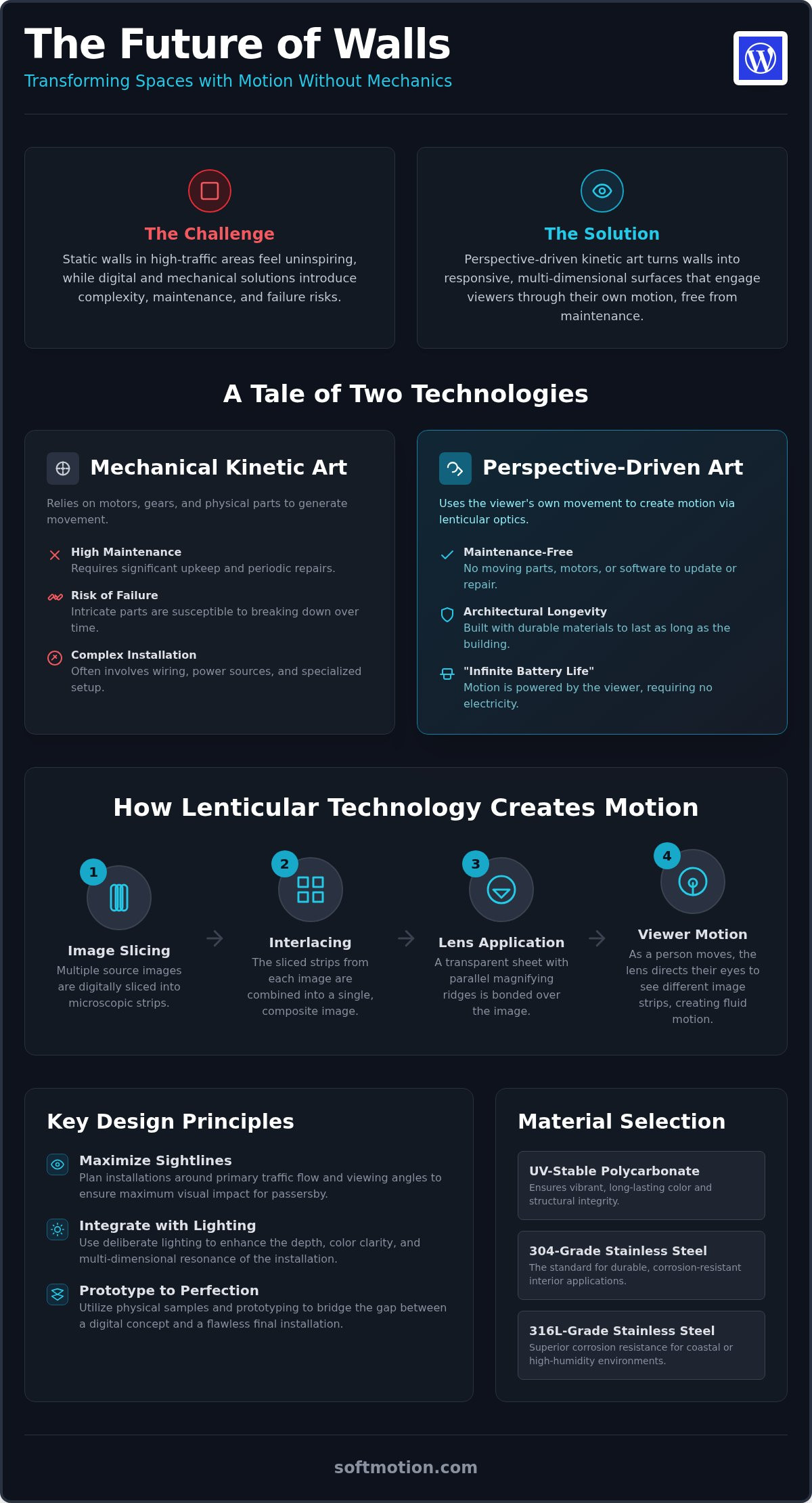
When selecting the right solution for a project, it’s essential to distinguish between mechanical and perspective-driven art. Mechanical installations rely on motors, gears, and intricate physical parts to generate movement. While visually impressive, they often require significant upkeep and are susceptible to mechanical failure over time. In contrast, perspective-driven art uses the viewer’s own movement to unlock hidden dimensions. This is the “viewer-as-the-motor” concept. As a person walks past, the image shifts, evolves, and transforms through the science of lenticular lenses. This approach is rapidly becoming the standard for high-traffic architectural environments. It offers the same emotional resonance as motorized pieces but maintains the reliability of a static surface. For designers seeking kinetic wall art installations that are both bold and pragmatic, perspective-driven art provides a maintenance-free path to visual transformation.
The Lenticular Advantage: Motion Without Motors
Mechanical kinetic art often feels like a ticking clock. While gears and motors provide a literal sense of movement, they introduce a layer of technical fragility that many commercial environments can’t afford. Perspective-driven art offers a transformation. By utilizing large-format lenticular technology, kinetic wall art installations achieve fluid, captivating motion without a single moving part. It’s a shift from active machinery to passive intelligence. This medium relies on the viewer’s movement to animate the surface, creating what we call “infinite battery life.” There are no wires to hide, no software to update, and no mechanical components to grease or repair. It is a permanent, reliable solution for spaces that demand high-impact visuals without the burden of ongoing maintenance.
The reliability of this medium stands in stark contrast to digital signage. Screens are prone to pixel death, backlight failure, and distracting content glitches. In contrast, lenticular installations are built for architectural longevity. This involves selecting high-grade materials like UV-stable polycarbonate or premium metals. For example, when integrating art into demanding environments, choosing the right substrate is critical. While 304-grade stainless steel is suitable for most interior applications, 316L-grade stainless steel is often preferred for its superior corrosion resistance, particularly in coastal or high-humidity settings. This level of material precision ensures the art remains as vibrant and structurally sound as the day it was installed. To see the clarity and depth of these materials firsthand, exploring professional lenticular samples can help bridge the gap between a design concept and its physical reality.
How Lenticular Technology Creates Motion
The magic of lenticular motion lies in the lens. A lenticular lens is a sheet of transparent plastic consisting of hundreds of tiny, parallel magnifying ridges. We take multiple images, slice them into microscopic strips, and interlace them together in a precise sequence. When this interlaced image is bonded to the lens, each ridge acts as a window, showing only one “slice” at a time based on the viewer’s angle. As you walk past the wall, the lens reveals different slices in rapid succession. This creates a seamless “flip” between images or a smooth, cinematic motion effect. It is a sophisticated dance of geometry and light that adheres to the classic Kinetic art definition while removing the complexity of hardware.
Why Architects Prefer Non-Mechanical Kinetic Art
Modern architecture prioritizes efficiency and sustainability. Architects increasingly favor non-mechanical kinetic wall art installations because they integrate effortlessly into existing wall cladding systems. There is no need for electrical retrofitting or dedicated power circuits. This passive approach aligns with green building standards, as the art consumes zero energy throughout its entire lifecycle. Beyond the practicalities, there is a human element. Perspective-driven art creates a personal, interactive experience. The motion is directly tied to the viewer’s pace, making the art feel responsive and alive. It transforms a static surface into a multi-dimensional narrative that respects the architectural integrity of the space while providing an unforgettable visual anchor. For a deeper technical understanding of how these passive-kinetic surfaces are specified and integrated, the architect’s guide to lenticular wall cladding offers a comprehensive framework for navigating large-scale panel integration.
Comparing Kinetic Art Options for Commercial Spaces
Selecting the right medium for kinetic wall art installations requires a balance between creative ambition and operational pragmatism. While high-tech robotic blooms or motorized sculptures offer a certain “wow” factor, they are often impractical for 24/7 corporate or transit environments. These “one-off” museum pieces require specialized technicians and frequent downtime. In contrast, perspective-driven art provides a reliable alternative that delivers consistent visual impact without the mechanical risk. It’s a shift from art that moves on its own to art that moves with the viewer, ensuring the experience is always personal and never repetitive.
Maintenance and Longevity Analysis
The hidden costs of motorized art often surprise facility managers. Beyond the initial investment, you must account for specialized repair contracts, electricity consumption, and the inevitable noise of aging gears. Lenticular installations bypass these issues entirely. Because they are static surfaces that rely on the viewer’s movement, they retain their integrity for decades. Cleaning is as simple as wiping down a standard architectural panel; this makes them ideal for public-facing walls where durability is non-negotiable. For outdoor or coastal applications, using 316L stainless steel ensures the frame resists salt air. Research indicates that while 316L is priced 25-40% higher than standard 304 stainless steel, the investment is essential for long-term structural health in harsh environments.
Impact on Brand and Atmosphere
Motion is a powerful reflection of a brand’s innovative identity. In retail and hospitality, creating “Instagrammable” moments is a key driver for foot traffic. However, there’s a delicate balance between engagement and distraction. In a busy workspace, active motion, like flashing screens or whirring parts, can become a nuisance. Passive motion, triggered only when someone walks by, respects the focus of the room while still offering a sense of discovery. Exploring Kinetic Art reveals how these interactive elements can deepen the connection between a person and the architecture they inhabit. By turning the viewer into the motor, the installation remains dynamic and fresh without ever needing a reboot.
Investing in custom lenticular design offers a superior ROI for large-scale projects. It eliminates the need for complex content management systems and ongoing power costs. You aren’t just buying a display; you’re commissioning a permanent architectural asset. It’s an investment in a risk-free, collaborative process that ensures the final result resonates with the audience for years to come. This approach allows a brand to project confidence and visionary leadership through a medium that is as technically disciplined as it is creatively bold.
Designing for Impact: Best Practices for Interior Integration
Successful kinetic wall art installations require more than artistic vision; they demand a rigorous spatial strategy. Designing for impact means moving beyond the surface of the wall to consider the entire volume of the room. This involves managing natural light through custom solutions like Luxe Drapery and Shades to prevent glare from obscuring the installation’s motion. This process begins by selecting the appropriate motion type to suit the environment’s specific energy. A “flip” effect, which alternates between two distinct images, works beautifully for brand storytelling or before-and-after reveals. In contrast, “zoom” effects add a sense of three-dimensional depth, while “fluid motion” creates an organic, cinematic flow that rewards slower movement. Each choice must align with the intended emotional resonance of the space.
Optimizing Sightlines and Movement Paths
The effectiveness of perspective-driven art depends entirely on the viewer’s path. Designers must calculate the “viewing cone,” the specific angle at which the kinetic effect is most pronounced. In high-velocity transit hubs like airports or train stations, the motion must be calibrated to match a brisk pedestrian pace. If the transition is too slow, the effect is lost; if it’s too fast, the image becomes a blur. Lobby environments offer a different challenge. Here, the art must engage viewers from multiple vantage points, such as the initial entrance and the wait time at an elevator bank. By mapping these movement paths early, you ensure the installation remains a focal point rather than a background element.
The Role of Lighting in Kinetic Installations
Lighting is the silent partner of any kinetic display. For lenticular installations, even illumination is non-negotiable. Hot spots or uneven shadows can break the illusion of movement and diminish the clarity of the interlaced images. Designers should prioritize diffused, high-CRI lighting that washes the surface consistently. Glare is another critical factor. Because large-format lenses have a specific sheen, positioning light sources to avoid direct reflection into the viewer’s eyes is essential. While mechanical art might benefit from dramatic accent lighting to emphasize physical shadows, perspective-driven art thrives on clarity and light uniformity. To ensure your lighting plan aligns with the medium’s technical requirements, you can consult with our design team for a detailed project review.
Early architectural planning is the best way to mitigate technical risks. This includes verifying structural support for large-scale panels and ensuring compliance with the Americans with Disabilities Act (ADA). As of 2026, wall-mounted objects in commercial circulation paths cannot protrude more than 4 inches if they are positioned between 27 and 80 inches above the floor. Use this checklist for your next project:
- Analyze pedestrian flow to determine the primary viewing axis.
- Select a motion type (flip, zoom, or fluid) that matches the room’s dwell time.
- Coordinate with electrical teams to ensure even, glare-free lighting coverage.
- Verify that the installation depth meets local protrusion and safety codes.
- Request physical samples to test color shifts under site-specific lighting.
From Vision to Reality: The Custom Fabrication Journey
Bringing kinetic wall art installations to life is a journey that bridges the gap between pure artistic imagination and rigorous technical production. It’s a collaborative process that requires a partner who understands both the aesthetic soul of the project and the structural demands of the environment. Since 1997, we’ve refined a methodology that transforms a broad concept into a concrete, multi-dimensional reality. This journey isn’t just about printing; it’s about guiding architects and designers through the complexities of spatial transformation. By positioning ourselves as a visionary guide, we ensure the final result remains as impactful in the physical space as it was in the initial renderings.
The Importance of Prototyping and Sampling
Seeing a physical sample is the most critical step in managing client expectations for large-scale lenticular projects. Digital renderings, while helpful, cannot fully capture the shimmer, depth, or specific timing of motion-driven art. Prototyping allows us to test motion effects and color accuracy under the exact lighting conditions of the site. This technical discipline reduces project risk significantly. It provides a tangible proof of concept that stakeholders can touch and experience before full-scale production begins. These lenticular samples serve as a bridge, ensuring clarity and alignment between the creative vision and the final architectural asset.
End-to-End Project Management
Executing a large-scale installation requires meticulous coordination across multiple disciplines. Our team manages the logistical complexities of worldwide delivery and on-site assembly, ensuring a seamless transition from a static wall to a dynamic experience. For teams navigating the full scope of these complexities, following a structured approach to lenticular installation project management ensures every phase—from site audit to final assembly—is executed with precision. We coordinate directly with the project’s key players:
- Architects and interior designers to finalize spatial integration.
- General contractors to ensure structural readiness and mounting safety.
- Lighting consultants to optimize the visual impact of the installation.
- Local installers to manage the final assembly and finishing.
With over 1,000 projects delivered globally, we’ve developed the expertise to handle diverse challenges, from seismic mounting requirements to complex wall cladding systems. This end-to-end approach ensures that every detail, from the first interlaced pixel to the final protective finish, is executed with professional reliability. We don’t just deliver art; we deliver a controlled, reliable process that results in a flawless addition to your building’s narrative.
The transition from the two-dimensional to the multi-dimensional is a bold move for any interior. It requires a partner who brings both creative innovation and pragmatic discipline to the table. By choosing a path that prioritizes perspective over power, you create a lasting legacy of engagement that respects the architecture and inspires the audience. This collaborative journey ensures that your vision doesn’t just sit on a wall; it lives within the space, responding to every person who walks by.
Elevating the Architectural Narrative
True innovation in interior design happens when a static surface becomes a responsive, living experience. Throughout this guide, we’ve explored how perspective-driven kinetic wall art installations offer a sophisticated, maintenance-free alternative to motorized displays or distracting digital screens. By prioritizing the viewer’s movement as the catalyst for change, you ensure your space remains dynamic without the fragility of mechanical parts. It’s a shift from merely decorating a room to defining its energy through experiential architecture that respects both form and function.
Softmotion has been at the forefront of this visual transformation since 1997. With over 1,000 successful installations delivered globally, our team provides the technical discipline and end-to-end project management required by Fortune-500 clients and world-class architects alike. We invite you to transform your space with a custom Softmotion installation. Let’s collaborate to bridge the gap between your boldest creative vision and a flawless, multi-dimensional reality. Your walls have the potential to do more than stand still; it’s time to let them move.
Frequently Asked Questions
Do kinetic wall art installations require an electrical connection?
Most perspective-driven kinetic wall art installations do not require any electrical connection or power source. Because the motion is triggered by the viewer’s movement relative to the surface, the piece remains dynamic without wires or batteries. This passive technology makes them significantly easier to integrate into existing architecture than motorized sculptures or digital screens. It’s a sustainable, maintenance-free solution that eliminates the need for electrical retrofitting or ongoing energy consumption.
Can lenticular art be used on curved walls or irregular surfaces?
Lenticular panels can be adapted for curved surfaces, provided the radius allows for proper lens alignment. While the material itself is rigid, we can engineer custom mounting systems to follow architectural contours with precision. It’s essential to maintain consistent sightlines to ensure the kinetic effect remains clear across the entire irregular surface. We work closely with designers to determine the feasibility of complex geometries during the initial prototyping phase.
What is the maximum size for a kinetic wall installation?
There is no functional maximum size for these installations. While individual panels have physical limits based on the printing press, we utilize a precise tiling method to create seamless, large-scale murals that can span entire lobby walls. We’ve successfully delivered immersive installations for world-class architects that cover hundreds of square feet. This modular approach allows for unlimited creative scale while ensuring the structural integrity of each individual component.
How do I clean and maintain a large-format lenticular wall?
Maintaining a large-format lenticular wall is straightforward and requires no specialized technical knowledge or equipment. You can clean the UV-stable surface using a soft, lint-free cloth and a mild soap solution to remove dust or fingerprints. Unlike mechanical art, there are no gears to oil or software to update. This ensures the installation retains its visual impact with minimal effort, even in high-traffic commercial environments where durability is a priority.
What is the typical lead time for a custom kinetic art project?
A custom project typically requires a lead time of 8 to 12 weeks from the finalization of the design to delivery. This window accounts for the collaborative prototyping phase, interlacing adjustments, and high-precision fabrication. Complex architectural integrations or exceptionally large-scale projects may require additional time for logistical coordination and on-site assembly. We provide a detailed project timeline early in the process to ensure alignment with your construction schedule.
Is kinetic art suitable for outdoor environments?
Yes, lenticular art is suitable for outdoor environments when specified with weather-resistant materials. For these applications, we utilize UV-stable substrates and corrosion-resistant framing, such as 316L stainless steel for coastal areas. These robust materials ensure the kinetic wall art installations withstand environmental stressors like salt air and temperature fluctuations while maintaining their clarity. Choosing the right grade of metal is a critical step in ensuring the installation’s longevity in public spaces.
How does the cost of lenticular art compare to digital signage?
While the initial investment in custom lenticular art can be comparable to high-end digital signage, the total cost of ownership is significantly lower. You avoid ongoing expenses such as electricity, content management subscriptions, and hardware repairs. Over a five-year period, the maintenance-free nature of perspective-driven art often makes it the more pragmatic financial choice for commercial interiors. It provides a permanent architectural asset that doesn’t suffer from pixel failure or software obsolescence.
Can I use my own artwork for a custom kinetic installation?
We frequently collaborate with designers and artists to convert their original concepts into multi-dimensional installations. Our team handles the technical interlacing process required to split your artwork into the layers needed for the kinetic effect. This partnership ensures your specific brand identity or artistic vision is preserved while being reimagined through the lens of motion. We provide physical samples during the journey to ensure the color accuracy and motion effects meet your expectations.