
Lenticular Tradeshow Booth Design Ideas: A 2026 Guide to Kinetic Exhibits

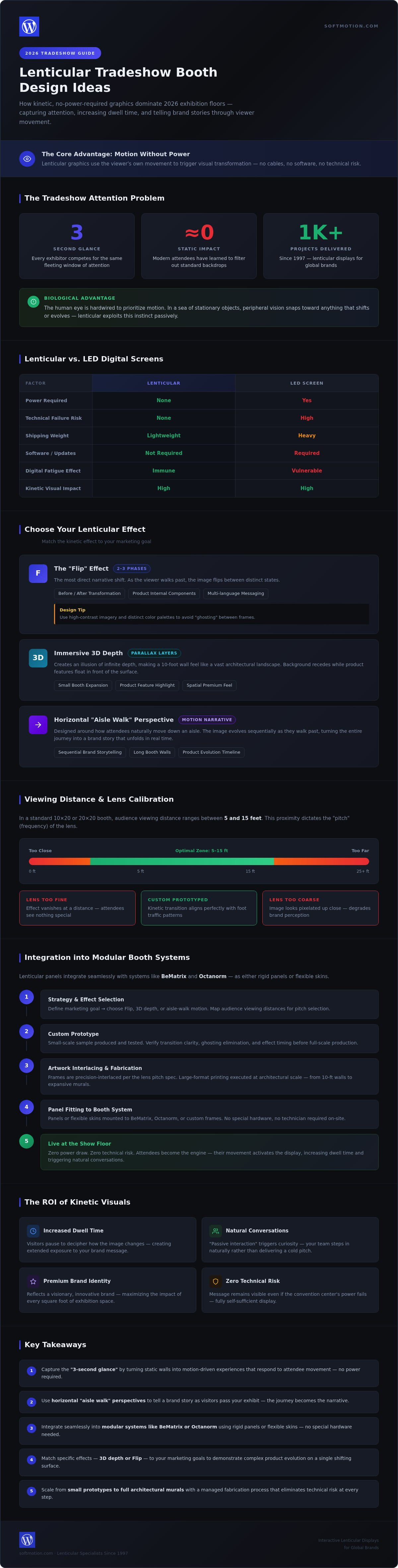
The most captivating interactive technology at your next tradeshow won’t require a single power outlet or a technician on standby. In a crowded hall where every exhibitor fights for a fleeting second of attention, the standard digital screen has become white noise. We’ve all felt the frustration of investing in expensive hardware only to have it fail or, worse, be ignored by a distracted crowd. You need a solution that is both visually arresting and fundamentally reliable. By exploring innovative lenticular tradeshow booth design ideas, you can transform static walls into living narratives that respond to the physical movement of your audience.
This 2026 guide reveals how to achieve high-impact kinetic exhibits that bridge the gap between fine art and technical production. You’ll discover how to utilize passive interactivity to increase dwell time and illustrate complex product evolutions with a single, shifting surface. We’ll walk through the transition from small-scale samples to expansive architectural installations, ensuring your brand stands out as a visionary leader on the floor. It’s time to move beyond the limitations of the two-dimensional and embrace a display strategy that’s as dynamic as the products you build.
Key Takeaways
- Capture the “3-second glance” by turning static walls into motion-driven experiences that respond to attendee movement without requiring power or digital hardware.
- Discover innovative lenticular tradeshow booth design ideas that leverage horizontal “aisle walk” perspectives to tell a brand story as visitors pass your exhibit.
- Learn how to integrate high-end lenticular graphics seamlessly into modular booth systems like BeMatrix or Octanorm using rigid panels or flexible skins.
- Match specific kinetic effects, such as 3D depth or “Before/After” flips, to your marketing goals to effectively demonstrate complex product evolution.
- Scale your vision from initial prototypes to full-scale architectural murals with a managed fabrication process that eliminates technical risk.
Beyond Static: Why Lenticular Graphics Dominate 2026 Tradeshow Floors
Tradeshow floors are sensory battlegrounds. Every exhibitor competes for the same “3-second glance,” yet most rely on static backdrops that the modern attendee has learned to filter out. This is where lenticular tradeshow booth design ideas offer a distinct competitive advantage. Unlike standard commercial printing, lenticular technology leverages the viewer’s own movement to trigger a visual transformation. It’s a non-digital interactive medium that demands attention without requiring a single cable, power outlet, or software update.
The human eye is biologically hardwired to prioritize motion. In a sea of stationary objects, our peripheral vision snaps toward anything that shifts or evolves. While many brands attempt to capture this through LED screens, they often face technical failures, high power costs, and significant shipping weights. Lenticular graphics provide the same kinetic impact with none of the digital risk. They’re durable, lightweight, and entirely self-sufficient, ensuring your message remains visible even if the convention center’s power fails. By choosing these analog interactive tools, you eliminate the hardware vulnerabilities that often plague high-tech exhibits.
The Rise of Experiential Offline Interaction
As we move through 2026, the trend toward tactile and perspective-shifting visuals continues to grow. Digital fatigue is a reality. Attendees are weary of staring at screens; they crave experiences that feel grounded, authentic, and surprising. Lenticular printing is a specialized medium that converts static surfaces into dynamic artworks, inviting the viewer to engage physically with the space. By simply walking past a wall, the attendee becomes the catalyst for the change they see. This creates a sense of wonder that a pre-recorded video loop simply can’t replicate, turning a passive observer into an active participant in your brand’s story. Brands seeking to deepen this impact are increasingly turning to lenticular graphics for experiential marketing that transform entire environments into motion-driven narratives.
The ROI of Kinetic Visuals
While visual impact is a powerful driver of engagement, many successful exhibitors pair these displays with high-end activities to deepen attendee connection. For those planning corporate events or looking for a unique interactive draw, a premium mobile experience from Inbound Golf can serve as an excellent complement to a motion-driven booth.
Engagement isn’t just a metric. It’s the foundation of lead generation. Motion graphics naturally increase booth dwell time as visitors pause to decipher how the image is changing. This “passive interaction” triggers curiosity, allowing your team to step in with a natural conversation rather than a cold pitch. Softmotion acts as your visionary guide in this process, managing the technical risk of large-format fabrication. Since 1997, we’ve delivered over 1,000 projects, specializing in interactive lenticular tradeshow displays for global brands. Implementing these lenticular tradeshow booth design ideas ensures your booth reflects a premium, innovative identity while maximizing the impact of every square foot of your exhibition space.
Selecting Lenticular Effects Based on Attendee Behavior
Effective lenticular tradeshow booth design ideas begin with a deep understanding of the optical lens. The lenticular sheet isn’t just a protective layer; it’s the engine that drives the entire visual experience. In a standard 10×20 or 20×20 booth, your audience’s viewing distance typically ranges between 5 and 15 feet. This proximity dictates the “pitch” or frequency of the lens. If the lens is too fine, the effect vanishes at a distance. If it’s too coarse, the image looks pixelated up close. Custom prototyping is essential to ensure the kinetic transition aligns perfectly with the foot traffic patterns of the aisle, allowing the artwork to breathe and evolve at the right pace.
The “Flip” Effect for Comparison and Storytelling
The “Flip” is the most direct way to communicate a narrative shift. By utilizing 2-phase or 3-phase flips, you can show a product’s internal components, a dramatic “Before vs. After” transformation, or even alternate between different languages for a global audience. To avoid “ghosting,” where elements of one frame bleed into another, we recommend using high-contrast imagery and distinct color palettes. This ensures each phase remains crisp and authoritative as the attendee walks by. It’s a pragmatic way to deliver multiple marketing messages without cluttering your physical space with redundant signage.
Immersive 3D Depth and Spatial Expansion
Small booth footprints often feel restrictive and shallow. You can use large format lenticular printing to create an illusion of infinite depth, making a 10-foot wall feel like a vast architectural landscape. By layering graphics with varying degrees of parallax, the background appears to recede while key product features float in front of the surface. This spatial expansion doesn’t just look impressive; it psychologically invites the attendee to step closer and explore the environment. It’s a sophisticated method for making a modest exhibit feel like a premium, expansive brand world.
Fluid Motion and Zoom for High Impact
Fluid motion simulates the experience of video by interlacing dozens of frames into a single surface. As a visitor walks past, they see smooth, cinematic movement that requires no electricity. Fluid motion captures peripheral vision from across the aisle by creating a shimmer of activity that the human brain is naturally programmed to investigate. You can also employ “Zoom” effects to highlight specific product features, making them appear to grow in size as a visitor approaches. This creates a personal, responsive interaction that rewards the attendee for their curiosity. To find the right balance for your next exhibit, you can explore our portfolio of interactive lenticular tradeshow displays to see how these effects perform in high-traffic environments.
The Design Logic of Motion-Driven Backdrops
Designing for motion requires a fundamental shift in perspective. Unlike traditional graphics that wait for a visitor to stand still, effective lenticular tradeshow booth design ideas prioritize the attendee’s horizontal path through the aisle. You aren’t just creating a picture; you’re choreographing a visual sequence. This “Aisle Walk” perspective ensures that the transformation occurs naturally as the viewer moves, preventing the message from feeling stuttered or confusing. By mapping out the journey from the moment they enter the hall to the moment they stand directly in front of your exhibit, you can ensure your brand story unfolds with cinematic precision. Understanding the broader evolution of kinetic tradeshow exhibits in 2026 can help you align your motion-driven backdrop strategy with the most impactful material-driven design trends shaping the industry.
Color and contrast play a vital role in this choreography. Convention centers are notorious for harsh, inconsistent lighting that can wash out subtle gradients. We recommend utilizing bold palettes and high-contrast transitions to maintain visual clarity. Typography, in particular, requires surgical care. If a brand name shifts too rapidly or occupies the same optical space as a complex background, it risks becoming unreadable. You should position critical information in a stable “sweet spot,” typically at eye level, where the lens’s focal point is most consistent for a viewer standing 8 to 12 feet away.
Optimizing for Convention Center Lighting
Lighting is the variable that most often undermines a display’s impact. Overhead halogen arrays and modern LED spotlights can create intense glare on glossy surfaces, obscuring the lenticular effect. When designing kinetic advertising displays, we often suggest matte or semi-gloss finishes to diffuse light and preserve the integrity of the motion. The viewing angle of a lenticular lens dictates the engagement zone, defining exactly where a visitor must stand to experience the full transformation without visual interference.
Interlacing and Resolution Requirements
Standard print rules for DPI don’t apply to large-scale lenticular projects. Because the image is sliced into hundreds of microscopic strips and interlaced behind a lens, the file preparation requires a level of precision that exceeds standard commercial printing. Collaborating with Softmotion’s design team early in the process ensures that your high-resolution assets are optimized for the specific frequency of the lens being used. This technical discipline is what prevents “ghosting” and ensures that the final 40-foot mural looks as crisp as a handheld sample. Our role as your visionary guide is to manage these complex technical requirements, allowing you to focus on the creative impact of your lenticular tradeshow booth design ideas.
Step-by-Step Integration into Modular Booth Systems
Transforming a conceptual vision into a physical structure requires more than just high-resolution files. It demands a pragmatic understanding of modular hardware. When executing lenticular tradeshow booth design ideas, you must first choose between rigid panels and flexible lenticular skins. Rigid panels provide a premium, architectural finish that feels permanent and substantial, whereas flexible options prioritize portability for global shipping. Most modern exhibits rely on standard frames like BeMatrix, Octanorm, or AGAM. We ensure our fabrications integrate seamlessly with these systems, accounting for the additional weight of large-format lenses and providing the necessary structural support for expansive murals.
Precise execution is non-negotiable when managing multi-panel walls. If the vertical alignment of the lens is off by even a fraction of a millimeter, the kinetic effect breaks across the join. We solve this through meticulous fabrication and clear installation guides, ensuring that your 40-foot backdrop behaves as a single, cohesive artwork rather than a series of disconnected segments. This technical discipline eliminates the risk of visual “stutter” on the show floor.
Mounting and Installation Techniques
Speed is the currency of the tradeshow floor. Magnetic mounting systems allow for rapid installation and quick-change graphics, making them ideal for brands with rotating messaging. While silicone edge graphics (SEG) are ubiquitous for fabric, lenticular material often performs better with magnetic strips or recessed rigid inserts that maintain the necessary tension. Perfect vertical alignment is the secret to preserving the motion effect. We provide the guidance needed to ensure every panel is seated correctly, ensuring that the transition remains fluid as attendees pass by.
Backlighting Lenticular for Maximum Glow
Illumination can elevate a kinetic display from impressive to unforgettable. By using a “Duratrans” approach, we create backlit motion graphics that pierce through the dim environment of a convention hall. This technique requires specific lightbox depth, typically at least 4 to 6 inches, to avoid “hot spots” where LED diodes become visible behind the lens. Backlighting doesn’t just increase visibility; it dramatically enhances the 3D depth effect by providing a secondary layer of luminous contrast. This creates a glow that draws attendees from the far end of the hall toward your exhibit. To ensure your vision is realized with technical precision, you can partner with Softmotion for your next exhibit.
Scaling Your Vision with Custom Lenticular Fabrication
The transition from a bold concept to a 40-foot mural requires more than just ambition; it demands a partner who can navigate the technical intricacies of light and motion. What begins as a small desktop sample must be reimagined for the grand scale of a convention hall without losing its optical integrity. By exploring these lenticular tradeshow booth design ideas through a structured fabrication process, you eliminate the guesswork that often leads to costly on-site errors. Our role as your visionary guide is to ensure that the final installation is as flawless as the initial prototype, regardless of the project’s physical dimensions.
Risk mitigation is the cornerstone of our approach. Since 1997, we’ve delivered over 1,000 projects, providing the technical discipline required to scale complex visuals for Fortune-500 environments. We understand that the logistics of global shipping and on-site assembly are just as critical as the printing itself. Every panel is engineered for durability, ensuring the high-end finish remains intact from the crate to the booth wall. This seasoned expertise allows you to push creative boundaries with the confidence that the technical execution is fully managed.
The Collaborative Design Journey
The process is methodical and purposeful. It begins with an initial consultation where we define the strategic ‘why’ behind the motion, ensuring that every kinetic shift serves a specific marketing goal. For organizations looking to align their physical presence with a broader commitment to sustainability, you can visit The Ethical Agency to discover how impact-driven design can elevate your brand narrative. We then move into sampling and prototyping, a vital stage where you can test the 3D depth or flip effects in your own environment before full-scale production begins. The journey concludes with final fabrication, where high-precision printing meets meticulous lens lamination. This guided experience ensures that the transition from a two-dimensional file to a multi-dimensional exhibit is seamless and stress-free.
Transforming architectural booth elements into storytelling devices creates a lasting resonance with your audience. We’ve seen brands use these techniques to turn standard reception counters into interactive discovery points and backwalls into vast, shifting landscapes. These immersive kinetic art installations represent the future of spatial design, where the environment itself becomes a medium for communication. By integrating lenticular tradeshow booth design ideas into your long-term exhibit strategy, you position your brand as a bold innovator that values both craftsmanship and attendee experience. To explore how these effects can be tailored to your specific brand narrative, you can contact Softmotion to start your custom tradeshow prototype.
Elevate Your Presence with Kinetic Artistry
The 2026 tradeshow environment demands a departure from the conventional. By embracing lenticular tradeshow booth design ideas, you transform passive surfaces into responsive narratives that follow the attendee’s gaze. You’ve learned how specific kinetic effects solve spatial challenges and why technical precision in lighting and mounting is essential for a flawless result. It’s about moving beyond the limitations of static prints to create a sensory experience that lingers long after the show floor closes.
Since 1997, Softmotion has served as a trusted partner for Fortune-500 corporations, delivering over 1,000 successful projects. We manage the entire lifecycle through our end-to-end project management, providing the technical discipline required for large-scale success. Ready to see the transformation for yourself? Request a custom lenticular sample for your next tradeshow and begin your journey toward a more dynamic exhibition. Your brand’s evolution into the multi-dimensional starts with a single, purposeful step.
Frequently Asked Questions
What is the best lenticular effect for a 10×20 tradeshow booth?
The most effective lenticular tradeshow booth design ideas for a 10×20 space often involve 3D depth or 2-phase flips. Because booth depth is limited, a 3D effect creates the illusion of a vast architectural landscape, making the exhibit feel more expansive. Alternatively, a 2-phase flip allows you to double your messaging on a single wall, showing a product’s internal components as visitors walk past. Both options maximize the limited footprint without requiring digital hardware.
How does convention center lighting affect the lenticular motion?
Harsh overhead halogen or LED spotlights can create glare that obscures the motion effect. To mitigate this, we recommend using matte or semi-gloss finishes to diffuse light. Positioning your graphics away from direct vertical down-lights ensures the viewing angle remains clear. Since the lens relies on light refraction, a well-lit environment is beneficial, provided the light is diffused rather than focused into intense hot spots that wash out the imagery.
Can lenticular graphics be installed on modular booth frames like BeMatrix?
Yes, lenticular graphics are fully compatible with modular systems like BeMatrix, Octanorm, and AGAM. We fabricate panels to fit specific frame dimensions, using magnetic strips or recessed rigid inserts for secure mounting. It’s important to account for the thickness of the lens, which typically ranges from 2mm to 4mm. Our technical team works with your booth drawings to ensure every panel aligns perfectly with the underlying aluminum structure for a seamless look.
Is lenticular printing more cost-effective than LED video walls?
Lenticular displays are significantly more cost-effective than LED video walls when considering the total cost of ownership. They require no power, no specialized technical staff for setup, and no expensive hardware rentals. Additionally, shipping costs are lower because the panels are lighter and more durable than fragile digital components. You achieve a similar kinetic impact and wow factor without the ongoing operational expenses and technical risks associated with digital signage.
How do you ship large format lenticular panels without damage?
We ship large format panels in custom-built, reinforced crates designed to prevent bending or surface scratching. Each panel is interleaved with protective foam or plastic sheeting to safeguard the lens during transit. For multi-panel murals, we provide a detailed packing list and assembly guide to ensure the pieces arrive in the correct order. Our logistics process is engineered to handle the demands of global shipping, ensuring your graphics arrive show-ready and undamaged.
What is the required file resolution for a large lenticular backdrop?
Standard high-resolution files at 300 DPI are a good starting point, but the final resolution depends on the specific lens pitch used. Large-scale installations often require specialized file preparation to account for the interlacing process. We recommend providing layered PSD files or high-bitrate TIFFs. Our design team manages the technical conversion, ensuring your assets are optimized for the viewing distance and the physical frequency of the lenticular sheet for maximum clarity.
How long does the custom lenticular fabrication process take?
The custom fabrication of innovative lenticular tradeshow booth design ideas typically takes between three to six weeks depending on the scale and complexity of the project. This timeline includes initial consultations, physical prototyping, and final high-precision printing. For expansive 40-foot murals, we recommend starting the collaborative journey early to allow for thorough testing. Our end-to-end management ensures that every stage, from the first sample to the final lamination, is completed with professional reliability.
Can lenticular graphics be reused for multiple tradeshows?
Yes, lenticular graphics are exceptionally durable and designed for multiple uses across different show cycles. The acrylic or PETG lenses are scratch-resistant and maintain their optical clarity over time. Unlike fabric graphics that can fray or fade, these panels retain their high-end finish and kinetic impact for years if stored correctly. This longevity makes them a sustainable investment for brands that maintain a consistent exhibition schedule throughout the year.