
Lenticular Printing for Museums: Dynamic Storytelling
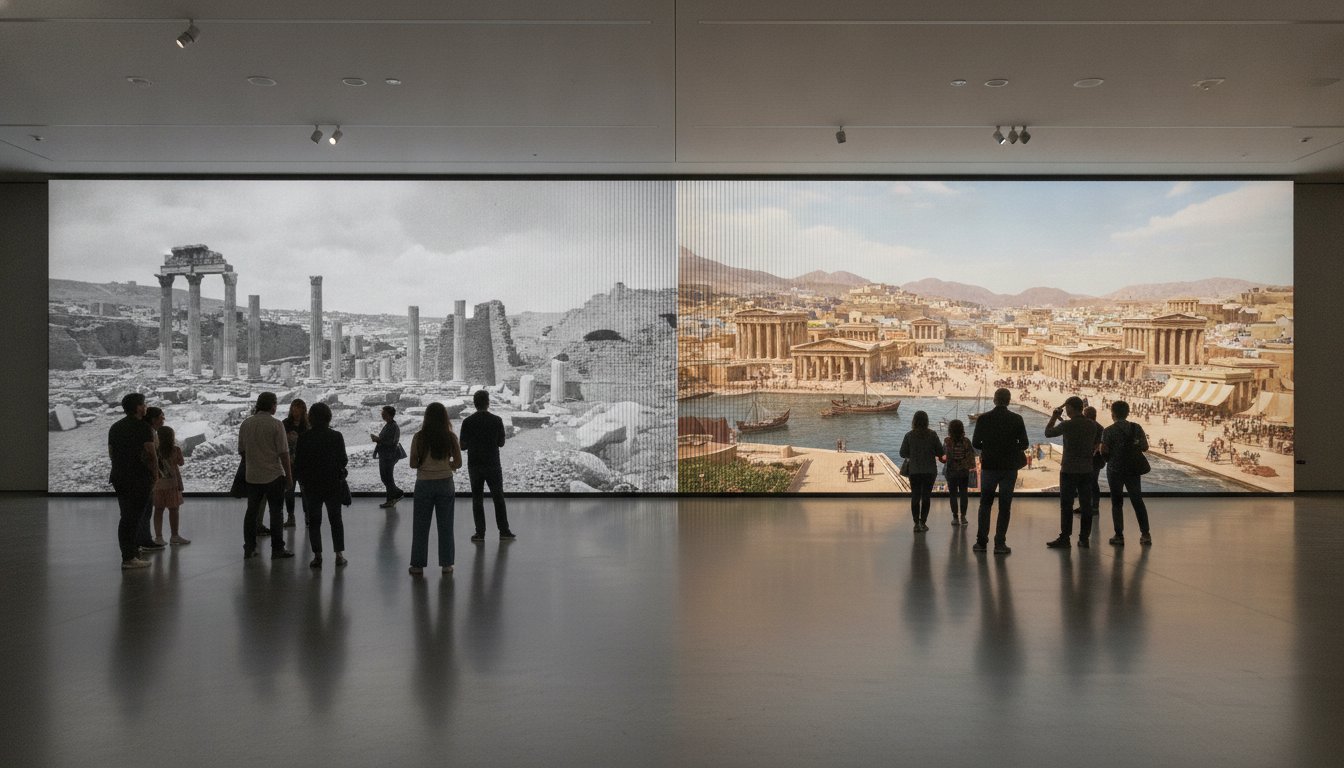
What if the most captivating element of your next gallery wasn’t a glowing screen, but a wall that breathes as visitors walk by? For many curators, the challenge is a persistent one: static displays often feel lifeless, yet the high maintenance costs and clinical feel of digital hardware can disrupt the very atmosphere you’re trying to create. You want movement, but you don’t want a novelty look that feels more like a postcard than fine art. High-quality lenticular printing for museum exhibits offers a sophisticated bridge between the two. It transforms a fixed surface into a living narrative, shifting and evolving based solely on the viewer’s perspective.
It’s a rare opportunity to engage an audience through pure materiality and light. This article explores how large-format lenticular installations turn architectural wall cladding into dynamic storytelling tools that require zero power and minimal upkeep. We’ll look at the transition from 2D graphics to multi-dimensional experiences, ensuring your exhibits remain both high-impact and remarkably reliable. From historical before and after reveals to complex scientific transformations, you’ll discover how to integrate these low-maintenance, non-digital interactive elements into your space with the precision of a master craftsman.
Key Takeaways
- Understand why leading curators are transitioning from high-maintenance digital screens to kinetic, power-free analog installations for a more organic visitor experience.
- Learn to use specialized lenticular printing for museum exhibits to create historical “Then and Now” transformations that reveal themselves as the viewer moves.
- Discover the technical nuances of large-scale materiality, including how to select the proper lens pitch and UV-stable materials for long-term durability in high-traffic halls.
- Master the spatial planning of your installation by identifying the optimal visitor “sweet spot” and lighting configurations that eliminate glare while maximizing depth.
- Explore the collaborative path from custom fabrication to final installation, ensuring your visionary concept is realized with technical precision and architectural harmony.
The Role of Lenticular Printing in Modern Museum Exhibit Design
Imagine a space where the architecture itself responds to the visitor. Lenticular printing serves as a kinetic storytelling medium, one that demands physical presence to unlock its secrets. It isn’t just a print; it’s a sequence of events captured in a single, static plane. By interlacing multiple images behind a specialized lens, we create a visual transition that occurs naturally as a person walks through a gallery. This technology bridges the gap between a silent photograph and a loud video screen, offering motion that respects the quiet contemplation of a museum environment.
Curators are increasingly seeking alternatives to digital monitors. While screens offer flexibility, they often carry a “black box” aesthetic that clashes with historical or fine art contexts. They require power, cooling, and constant software updates. In contrast, lenticular printing for museum exhibits provides a tactile form of interactivity. It rewards the viewer’s movement. This shift toward “analog” kinetic art stems from a desire to ground the visitor in the physical world, fostering a deeper psychological connection to the subject matter. When an image shifts based on perspective, it triggers a sense of discovery that static imagery simply cannot replicate.
Interactive Without the Interface
Traditional interactive displays often require a touch screen or a sensor, creating a barrier between the art and the audience. With lenticular installations, the visitor becomes the “play button” through their own natural movement. There are no buttons to press and no hardware to maintain. This creates a shared experience; two people standing at different angles see different truths simultaneously. It invites conversation and collective wonder without the sterile feel of a computer interface, making it ideal for high-traffic corridors where dwell time is precious.
Tactile vs. Digital Interaction
The physical depth of a well-executed lenticular piece offers a “wow” factor that pixels often fail to achieve. Screens emit light; lenticulars reflect and refract it. This difference is crucial for reducing “screen fatigue” in large exhibitions. By utilizing large format lenticular printing, curators can integrate motion directly into the building’s skin. It becomes part of the wall cladding rather than an appliance hung upon it. This seamless integration ensures that the technology serves the story, rather than distracting from it with glowing borders or tangled cables.
From Static to Kinetic: Storytelling Techniques for Curators
Historical Overlays and Transformations
Imagine walking past a panoramic view of a city street. From one angle, you see the cobblestones of 1890; from another, the glass skyscrapers of today. This “Then and Now” transformation is achieved through the flip effect, which switches between distinct images at specific viewing angles. It’s a powerful way to show the evolution of a landscape or the delicate restoration of an artifact without requiring digital overlays. Flip technology enables temporal storytelling by allowing two distinct moments in time to occupy the same physical space.
For more complex archival narratives, motion effects can simulate movement within a single photograph. A bird’s wings can appear to flap, or a crowd can seem to shift. This adds a sense of life to historical archives that might otherwise feel distant. To further enrich these displays with personal narratives, professional oral history filming services can capture the human stories that bring these historical moments to life. If you’re planning a room-scale installation, you might also consider the Agamograph. This method uses folded-surface kinetics to create massive wall installations that present completely different images depending on which side of the room the visitor stands. This approach is ideal for architectural wall cladding where the goal is a bold, spatial transformation.
While flip effects handle time, 3D depth handles scale. In scientific or biological exhibits, showing the layers of a cell or the vastness of a planetary system requires more than a flat surface. High-quality museum quality lenticular prints create an immersive sense of depth. They allow the eye to perceive foreground and background elements separately, mimicking the way we see the real world. This is particularly effective for architectural models, where the print can reveal the internal structure of a building as the visitor changes their perspective.
This depth encourages visitors to slow down. They move side to side, leaning in to see how layers interact. It manages visitor flow naturally; people don’t just glance and walk away. They engage with the content physically. This level of immersion is critical for complex subjects that require spatial awareness to be fully understood. If you’re looking to bring this level of depth to your next gallery, exploring custom lenticular solutions can help bridge the gap between abstract data and visceral experience.
Durability, Scale, and Materiality for High-Traffic Institutions
Museum galleries are demanding environments. Thousands of visitors pass through these spaces monthly, bringing with them a variety of environmental stressors. Light, humidity, and physical contact all play a role in the longevity of an installation. When specifying lenticular printing for museum exhibits, the conversation must move from artistic vision to technical durability. It’s about ensuring the kinetic effect remains as sharp on day 1,000 as it was on day one, maintaining its narrative power through years of public interaction.
Large-Format Lens Selection
Scale changes the rules of optics. While small-format prints use high-frequency lenses, architectural installations require a different approach. A 20 LPI (lines per inch) lens is often the superior choice for wide viewing distances. It provides a deeper “viewing window,” allowing the motion or 3D effect to remain stable even from twenty feet away. Balancing this pitch with image resolution is a delicate science. If the pitch is too fine, the effect collapses into a blur at a distance; if it’s too coarse, the visitor sees the physical lens structure. Refining this balance is why custom lenticular prototypes are an essential step in the curation process.
Material Integrity and Longevity
Material choice defines the installation’s life span. Acrylic is the gold standard for optical clarity and rigidity, making it ideal for fine art reproductions that require perfect color accuracy. PETG offers a more impact-resistant alternative, though it requires specific UV-stabilizing treatments to prevent yellowing under gallery lights. Both materials must withstand humidity shifts and temperature cycles within the institution. Surface protection is equally vital. Specialized scratch-resistant hard coatings allow for standard cleaning protocols without dulling the lens surface over time, ensuring the display remains pristine despite curious hands.
Safety standards are non-negotiable in public spaces. Museum-grade plastics must meet specific fire-rating standards, such as ASTM E84 Class A, to comply with strict building codes. Beyond the material itself, the mounting system must be as robust as the print. Options range from high-bond adhesive backings for permanent architectural cladding to mechanical frames that allow for modular exhibit rotations. Each choice impacts how the installation integrates into the architectural space, ensuring a seamless, secure, and permanent-feeling addition to the gallery’s narrative environment.

Planning and Designing Your Museum-Grade Lenticular Installation
Successful integration of lenticular printing for museum exhibits begins long before the first panel is printed. It requires a transition from traditional graphic design to spatial engineering. You aren’t just designing a picture; you’re choreographing an experience. This process starts by identifying the “sweet spot,” the specific zone where the visitor’s path intersects with the optimal viewing angle of the lens. By mapping the flow of the gallery, we ensure the kinetic narrative unfolds at the exact moment the audience is most receptive.
Lighting is the silent partner in any kinetic installation. To maximize the 3D or flip effect, the space requires directed point sources rather than diffuse, ambient light. We must balance this need with the challenge of avoiding glare on the lens surface. Image preparation is equally technical. The interlacing process involves slicing high-resolution graphics into microscopic strips that align perfectly with the lenticules. While these techniques are often found in kinetic advertising displays, adapting them for education requires a higher degree of precision to ensure that complex data remains legible from every angle.
The Design Phase: Vision to Prototype
Collaboration is the heartbeat of the design phase. We work closely with curators to identify the core narrative “flip” that will drive the exhibit. Is it a change in state, a passage of time, or a reveal of hidden layers? Calculating the viewing angles based on your specific floor plan is essential to prevent “ghosting,” where images bleed into one another. We always recommend starting with small-scale samples. These prototypes allow you to see how colors shift and how the motion feels in the hand before committing to full-scale architectural fabrication.
Installation and Alignment
Precision is the difference between a novelty and a masterpiece. During installation, vertical alignment is critical. If a panel is tilted by even a fraction of a degree, the motion effect will appear skewed or fail to trigger correctly for the visitor. Integrating these panels into existing wall structures requires a collaborative approach with exhibit builders to ensure the cladding feels like a natural part of the architecture. Final on-site adjustments to lighting and positioning are the last steps in creating a seamless encounter. If you are ready to transform your gallery into a dynamic narrative environment, request a consultation with our visionary team to explore the possibilities of custom fabrication.
Softmotion: Elevating Exhibit Narrative through Expert Fabrication
Realizing a vision for a public space requires more than just technical skill; it demands a partnership rooted in trust and seasoned expertise. Since 1997, Softmotion has served as a Visionary Guide for curators and architects, delivering over 1,000 projects that bridge the gap between imagination and physical installation. We don’t just provide prints. We manage the delicate transition from a two-dimensional concept to a multi-dimensional experience, ensuring that every nuance of the narrative is preserved in the final fabrication. Our role is to provide a sense of security throughout the creative process, acting as a collaborative partner rather than a distant vendor.
Our specialization in lenticular printing for museum exhibits is backed by a proven track record with both Fortune-500 brands and prestigious fine art institutions. We understand that in a museum setting, the work must be impeccable. It must honor the curator’s intent while meeting the rigorous safety and durability standards of a high-traffic environment. This balance of artistic sensibility and corporate dependability is what sets our work apart in the most demanding architectural contexts, where every detail contributes to the visitor’s emotional journey.
The Softmotion Process
We prioritize a risk-free collaborative journey, emphasizing clarity and composed execution from the very first consultation. Our team handles the end-to-end project management, from initial sampling to final on-site assembly. This methodical approach allows us to tackle bespoke solutions for non-standard architectural environments, such as converting static exterior surfaces into lenticular building facades. Whether it’s a single gallery wall or an entire building skin, we ensure the installation feels like a permanent, intentional part of the architectural narrative. We guide you from “what is possible” to “how it is achieved” with a steady, deliberate rhythm.
Why Experience Matters in Large-Scale Motion
Precision in large-format printing is a technical discipline earned over decades. When dealing with panels that must align across vast spans to create a singular motion effect, there is no room for error. Softmotion’s commitment to craftsmanship ensures a human-first quality in every piece, softening the technical nature of the production with an artistic touch. Our confidence comes from our portfolio; we don’t need to shout because the results speak for themselves. We invite you to experience this motion firsthand. By requesting a sample kit, you can feel the materiality and witness the kinetic transformation that has made us a leader in the field for over 25 years. Let us help you see the hidden potential in your next exhibit and provide the technical discipline to bring that potential to life.
Transforming the Museum Experience Through Kinetic Art
Static displays no longer have to remain frozen in time. By integrating high-quality lenticular printing for museum exhibits, you invite your audience into a participatory world where every step reveals a new layer of the story. This transition from the two-dimensional to the multi-dimensional respects the architectural integrity of your gallery while offering the engagement of motion without the burden of digital maintenance. It’s a way to ground the visitor in the physical space while providing a modern, kinetic encounter that feels both organic and intentional.
Achieving this level of spatial transformation requires a partner who understands the intersection of fine art and technical production. With over 1,000 projects delivered worldwide, our team specializes in large-scale architectural kinetic art and provides dedicated project management from the first prototype to the final installation. We guide you through the complexities of material selection and optical alignment with a composed, professional hand. Transform your next exhibit with Softmotion’s custom lenticular solutions and discover how a living wall can redefine your institution’s narrative. We’re ready to help you realize the hidden potential within your space.
Frequently Asked Questions
Is lenticular printing durable enough for high-traffic museum areas?
Lenticular installations are specifically engineered for high-traffic environments. We utilize industrial-grade polymers like acrylic and PETG that withstand physical contact and environmental shifts. When specifying lenticular printing for museum exhibits, we often apply specialized scratch-resistant hard coatings. These treatments ensure the optical lens remains clear even in galleries where curious hands are common. The result is a tactile, resilient display that maintains its kinetic impact over years of public interaction.
What is the maximum size for a museum lenticular installation?
There is no functional limit to the scale of a lenticular installation. While individual sheets have manufacturing constraints, we use precision tiling techniques to create seamless, room-scale wall cladding. This modular approach allows us to cover entire corridors or grand entrance halls with a unified narrative. Each panel is meticulously aligned during the installation process to ensure the motion effect remains consistent across the entire architectural surface, regardless of the total square footage.
Can lenticular displays be used outdoors for museum building facades?
Outdoor applications are entirely possible when using UV-stable materials and specialized fabrication methods. We convert static exterior surfaces into dynamic building facades by using weather-resistant substrates that handle temperature fluctuations and direct sunlight. These installations are engineered to meet strict architectural standards for wind load and safety. By utilizing lightfast inks and protective coatings, the kinetic storytelling remains vibrant and effective in an outdoor environment, creating a bold first impression for arriving visitors.
How do I light a lenticular exhibit to avoid glare?
Proper lighting is essential to unlock the depth and motion of the lens. We recommend using directed point sources, such as LED track lighting, rather than soft or diffuse ambient light. Position the lights to strike the surface at an angle that minimizes direct reflection toward the viewer’s eyes. This focused illumination ensures the light refracts through the lenticules correctly, maximizing the kinetic effect while eliminating the distracting glare that can sometimes plague glossy surfaces in bright galleries.
What kind of images work best for a ‘flip’ storytelling effect?
The most effective “flip” narratives use two images with similar compositions but contrasting content. For example, a historical “Then and Now” transformation works best when the horizon line or major structural elements remain in the same position. This consistency helps the visitor’s brain process the change as a meaningful evolution rather than a jarring jump. Simple, bold imagery with high contrast ensures the transition is clean and the storytelling remains clear from a distance.
Do visitors need to stand in a specific spot to see the 3D effect?
Visitors don’t need to stand in a single, rigid spot to experience the effect. While every installation has an optimal “sweet spot” designed for the gallery’s floor plan, the motion or 3D depth is visible across a wide viewing arc. As people walk past the display, the images shift naturally with their movement. This creates a participatory experience where the narrative follows the visitor, making the art feel responsive to their presence rather than a static object on the wall.
Is lenticular printing more expensive than traditional large-format graphics?
Lenticular printing represents a higher initial investment than standard large-format graphics because it involves specialized materials and high-precision interlacing. However, it offers significantly greater value through increased visitor dwell time and durability. Unlike digital screens, these installations require zero power and no ongoing hardware maintenance. When you choose lenticular printing for museum exhibits, you’re investing in a permanent, kinetic element that functions as both a storytelling tool and a durable piece of architectural cladding.
How do we maintain and clean a lenticular wall installation?
Maintaining a lenticular wall is straightforward and requires no specialized technical knowledge. You can clean the surface using standard non-abrasive cleaners and a soft microfiber cloth to remove fingerprints or dust. Because we use museum-grade plastics with scratch-resistant coatings, the lens is resilient to regular cleaning protocols. We provide specific maintenance guidelines for every installation to ensure the materials stay pristine, preserving the clarity and motion of the artwork for the long term.