
Lenticular OOH Advertising Campaign Examples and Effects

A static outdoor ad can become a changing image as people move past it. Lenticular OOH advertising campaigns use interlaced images beneath a lens to create depth, motion, flips between images, zooms, or morph effects that shift with the viewer’s angle. In UKTV’s Grimm campaign, one poster showed central character Nick Burkhardt’s dual personality, turning a single placement into a visual expression of the story.
That transformation can do more than add spectacle. A carefully chosen effect can earn a second look and make the central idea easier to grasp as people pass. The creative challenge is to choose an effect that supports the message rather than distracting from it. This article explains how lenticular advertising works and how depth, movement, and image changes can draw attention and shape brand perception.
Explore notable campaign examples, see how lenticular visuals translate across outdoor formats, and consider what makes an effect clear and compelling from the viewer’s perspective.
Key Takeaways
- Match the visual effect to the message: depth, motion, and image changes each create a different viewing experience.
- Design for the audience’s movement and viewing angle so the transformation reads clearly in an outdoor setting.
- Consider how lenticular visuals can adapt across billboards, transit placements, posters, and other display formats.
- Use a visual shift to reinforce the brand idea, rather than relying on spectacle alone to hold attention.
- Explore campaigns such as UKTV’s Grimm poster and the ANAR outdoor sign to see how a change in perspective can carry a story or reveal a message.
3D depth, flip, motion, zoom, and morph effects
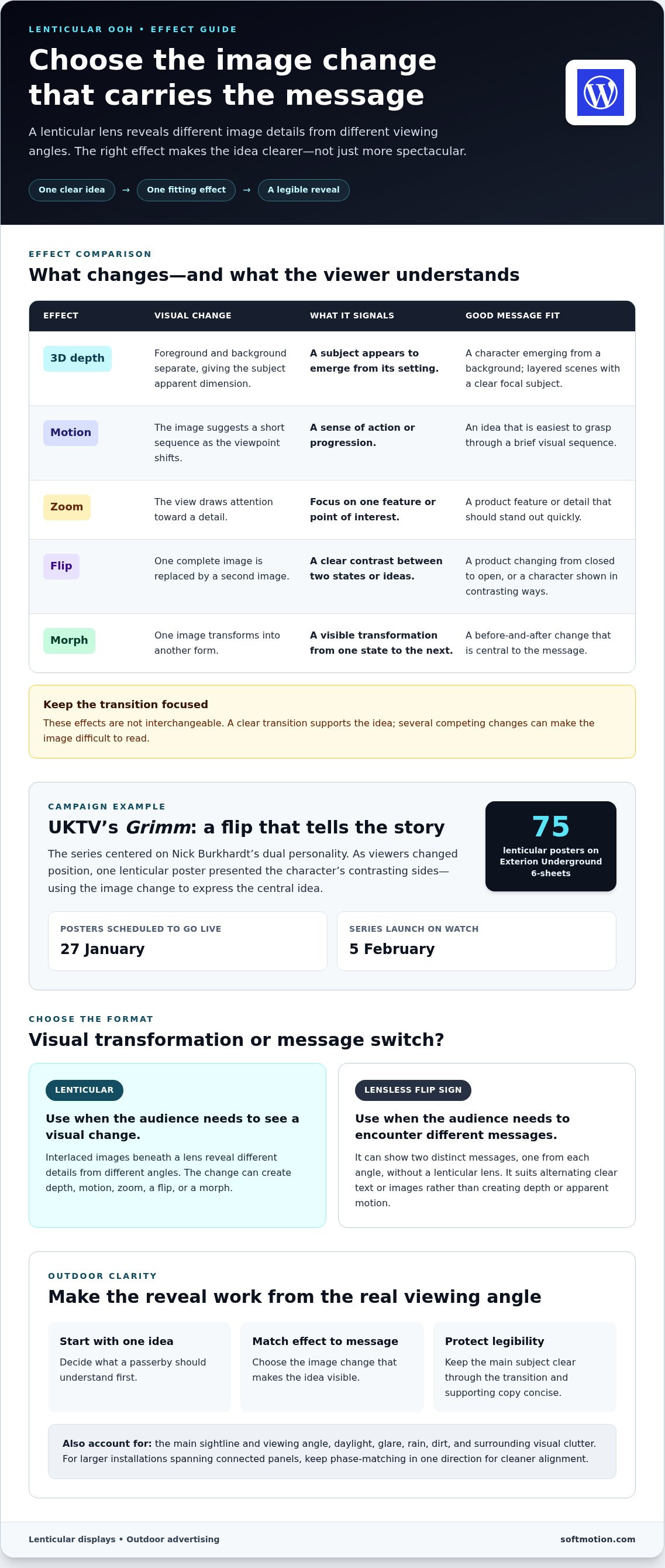
Lenticular printing turns a fixed surface into a view that changes as people move. Interlaced images sit beneath a lens, which reveals different image details from different angles. For outdoor advertising, that shift can create 3D depth, motion, zoom, a flip between images, or a morph between forms. Each effect gives the viewer a different visual cue, so the choice should begin with the message. A product reveal may benefit from a flip, while a character emerging from a background may suit depth.
Consider what the passerby should notice first. A 3D effect separates foreground and background, giving a subject apparent dimension. Motion suggests a short sequence, while zoom draws attention toward a detail. A morph transforms one image into another, and a flip replaces one complete image with a second. For example, a campaign can change from a product’s closed state to its open state. These effects are not interchangeable: a clear transition supports the idea, while several competing changes can make the image difficult to read.
The UKTV campaign for the third series of Grimm shows how a flip can carry a story. Situation: the series centered on Nick Burkhardt’s dual personality. Action: one lenticular poster presented the character’s contrasting sides as the viewer changed position. Result: a single poster expressed the central character idea through a visible image change. The campaign included 75 lenticular posters on Exterion Underground 6-sheets. They were scheduled to go live on 27 January, ahead of the series launch on Watch on 5 February.
Plan the effect in a simple sequence. First, identify the one idea the audience should understand. Next, choose the image change that makes it visible, such as a flip between two states or depth in a layered scene. Then arrange the visual elements so the main subject remains legible through the transition. The Grimm example contrasts two aspects of a character; a product demonstration could instead show a before-and-after transformation. Keep supporting copy concise so it doesn’t compete with the image shift.
A lensless flip sign offers another way to change messages with the viewing angle. It can show two distinct messages, one from each angle, without a lenticular lens. This suits communication that needs to alternate clear text or images rather than create depth or apparent motion. Choose the format by asking whether the audience needs to see a visual transformation or simply encounter different messages as they pass.
For larger lenticular installations, alignment affects how smoothly images change. Keep phase-matching in one direction for cleaner alignment. This matters when a sequence spans connected panels, since inconsistent transitions can interrupt the image. A deliberate viewing direction, a strong primary image, and a well-matched effect help keep the transformation coherent across the display.
Attention and viewer engagement in outdoor advertising
A lenticular image gives passersby a reason to look again: its appearance changes as their viewpoint shifts. That moment of discovery can make an outdoor message more noticeable, but attention alone isn’t the goal. The changing image should help people understand the idea quickly. A product transformation, for example, can make a feature visible without asking a moving audience to read lengthy copy.
The ANAR outdoor sign shows how viewpoint can serve a specific audience. Situation: the sign carried a message for children, who may see public advertising from a lower vantage point. Action: the design revealed its hidden message when viewed from four feet off the ground, roughly a child’s viewpoint. Result: children could see information that adults viewed differently. The example makes audience perspective part of the creative idea, not just a technical detail.
Visibility depends on where people stand, how they move, and what blocks their view. Daylight, glare, rain, dirt, and surrounding visual clutter can make a lenticular image harder to read outdoors; viewing angle also affects which image appears. Plan the key message for the main sightline, then assess legibility under the placement’s expected viewing conditions.
Measure reach, engagement, and return on investment as separate outcomes. Use the placement’s audience estimates to assess potential reach, then track responses such as QR scans, campaign-page visits, or store visits. Compare those actions with a baseline or a similar location without the campaign, and relate incremental outcomes to campaign investment. This gives a clearer picture than treating every passerby as an engaged viewer.
Before launch, connect each measure to a campaign objective. A product-awareness effort might track branded searches alongside placement reach, while a store-focused campaign could compare visit patterns near the display. Keep the comparison period and locations consistent, and note other promotions that could affect results. This helps distinguish attention generated by the image from actions driven by other campaign activity.
- Choose one primary response. Decide whether the display should prompt recognition, a scan, a visit, or another measurable action.
- Match the visual to the sightline. Check the intended reveal from the direction people approach.
- Keep the message legible. Make the main idea understandable before the viewer moves beyond the display.
- Compare outcomes thoughtfully. Use a consistent baseline to interpret reach and response together.
For a campaign where the changing image is central to the message, Advertising Lenticular Displays can bring the visual concept into an outdoor format.
Lenticular signage across billboards and other formats
A standard billboard presents one fixed image, while lenticular signage changes what viewers see as their angle shifts. Digital signage changes through electronic displays; “3D OOH” can describe a depth effect, not one distinct production method. Lenticular work instead uses printed, interlaced images beneath a lens, combining physical placement with an angle-dependent visual change.
In the United States, permits and sign requirements depend on the location and placement. Before installation, identify the relevant local sign and land-use rules, the property owner’s requirements, and any transit operator standards. Plan the display and installation so they don’t obstruct accessible routes, curb ramps, or important wayfinding signs. The site and format determine which requirements apply.
Two examples illustrate different uses. Situation: UKTV wanted to promote the third series of Grimm through outdoor advertising. Action: its campaign used lenticular posters on Exterion Underground 6-sheets to represent central character Nick Burkhardt’s dual personality. Result: one poster communicated the character’s two sides through a changing image. ANAR’s outdoor sign used a different approach, revealing a hidden message from a child’s lower viewing position.
Design the artwork for its intended viewing direction and the message’s essential details. Choose the image change first, then organize the artwork so the main subject stays clear from the relevant angles. Consider viewing distance, approach direction, surrounding clutter, and available space together. For installation alignment, keep phase-matching in one direction for a cleaner transition, especially when panels connect across a larger display.
Format choice follows the setting. Lenticular advertising can be applied to billboards, posters, transit advertising, signage, packaging, and point-of-sale displays. A street-facing placement may use a shifting image to catch passersby, while a retail display can present different product views at close range. Panels can also be tiled into murals over 100 feet long, creating a broad visual surface rather than a single poster.
Use these steps to shape a format decision:
- Define the viewing path. Identify where people approach and the angle from which the visual change should appear.
- Match the format to the setting. Consider a billboard, transit placement, poster, or point-of-sale display based on audience movement and available space.
- Prepare artwork for the effect. Keep the main message legible and align the image sequence with the intended transition.
- Coordinate the site details. Account for local sign rules, property conditions, accessibility, and installation alignment before production.
Brand perception and memorability
A lenticular effect shapes brand perception through how it changes an image, not simply through movement. A luxury watch brand, for example, might use depth to emphasize material and craftsmanship, while a playful snack brand could use a flip to reveal a surprising flavor. The effect becomes part of the brand’s visual language. If it conflicts with the product’s character, the display may attract attention without reinforcing the intended impression.
Start with the one quality the campaign should communicate. A technology brand might want to appear precise and forward-looking; a morph from a component to a finished device could express transformation. A family-focused service might favor a warmer sequence showing people together. In each case, the image change should make the quality visible, while typography, color, and logo placement keep the identity recognizable.
Situation: a campaign needs to stand out while staying consistent with other brand materials. Action: build the lenticular artwork from established brand assets, including core colors, type choices, and recognizable product details. Result: the changing image feels connected to the brand rather than like an unrelated visual trick. For example, a beverage campaign can preserve its familiar bottle silhouette through a flip from ingredients to the finished drink.
Use a short review process before production. First, describe the intended brand impression in a single phrase, such as “confident and inventive.” Next, choose an effect that reinforces it. Then view the artwork from the intended audience angles and check that the logo and main message remain legible. Finally, compare the lenticular concept with the campaign’s other materials. This sequence helps teams assess both visual impact and brand consistency.
Complexity doesn’t guarantee memorability. A single transformation with a clear connection to the message is easier to interpret than several unrelated changes. For example, a travel brand could shift from a city street to a destination landscape, linking the visual transition to the promise of travel. If the campaign also adds multiple characters, slogans, and product reveals, the central idea can become harder to identify.
Evaluate the creative with three practical questions: Can viewers recognize the brand quickly? Does the changing image express a specific brand quality? Does the effect support the campaign message? A mock-up viewed from the planned approach direction can reveal whether the logo disappears during the transition or the secondary image weakens the idea. These checks focus the review on perception, not novelty alone.
For a final creative review, compare the concept with these criteria:
- Brand fit: The visual effect suits the brand’s personality and product.
- Message clarity: The transformation communicates one coherent idea.
- Identity continuity: Logo, color, and recognizable assets remain connected across views.
- Viewing experience: The key impression reads from the audience’s likely approach.
When the transformation and brand idea reinforce each other, the lenticular execution can become a distinctive expression of the campaign, not decoration added afterward. Working with a strategic agency like Stratagon can help brands integrate these high-impact creative tactics into broader, customer-centric campaigns designed to drive revenue growth.
What are notable lenticular out-of-home advertising campaigns in the United States?
For campaign planners in the United States, useful examples show how an outdoor image can carry a message through visual change. The documented cases below offer creative references, though they aren’t all U.S. placements. Their value lies in how each design connects the lenticular effect to a specific communication goal.
UKTV’s Grimm campaign. Situation: the third series centered on Nick Burkhardt’s dual personality. Action: UKTV used a lenticular poster to present the character’s contrasting sides in one placement. Result: the image shift reflected the story’s central idea rather than adding movement without purpose. The campaign shows how a recognizable character can anchor an outdoor transformation and make the concept legible to viewers who encounter it briefly.
ANAR’s outdoor sign. Situation: the message needed to reach children, whose viewpoint differs from an adult’s. Action: the sign revealed its hidden message when viewed from four feet off the ground, roughly a child’s vantage point. Result: the content changed according to the viewer’s height. For U.S. planners, the example highlights a broader principle: audience perspective can shape not only where a display is placed, but what it communicates.
These cases suggest a practical way to assess lenticular OOH advertising campaigns: start with the audience and the message, then choose the transformation. UKTV’s Grimm concept used character contrast; ANAR’s sign linked a viewing position to its intended audience. Both make the visual mechanic meaningful. A U.S. campaign could apply the same reasoning to a product reveal, a public message, or a change between parts of a story, provided the idea reads clearly from the placement’s approach.
Use this case-review sequence when developing a concept:
- Identify the audience. Consider who will encounter the display and from which direction or height.
- State the message. Describe the central idea in one clear sentence before choosing an effect.
- Connect message and transformation. Use a change in image only when it helps express the idea.
- Review the viewing experience. Make sure the intended reveal is apparent from the audience’s likely sightline.
For a U.S. placement, the medium and location still matter. Lenticular advertising can be used on billboards and in transit advertising, as well as on posters and signs. The campaign idea should suit the format, viewing angle, and time people have to understand it. A complex sequence may suit a slower viewing environment better than a roadside placement where the audience is moving.
Use these campaign examples to shape a concept around audience, location, and message. Explore lenticular display possibilities for a visual idea intended to shift with the viewer’s perspective.
UKTV used a lenticular poster for its Grimm campaign, while ANAR used a lenticular outdoor sign. UKTV’s Grimm campaign used one poster to show the central character Nick Burkhardt’s dual personality.
Softmotion: Advertising Lenticular Displays
Softmotion creates Advertising Lenticular Displays for campaigns that need printed imagery to shift with the viewer’s perspective. These displays bring a planned visual transformation to an outdoor advertising format, whether the concept uses depth, a changing image, or apparent motion. Before shaping the concept, define the audience, viewing direction, primary message, and placement. Those choices help determine which effect serves the idea and how the artwork should read from the intended sightline.
For a campaign moving from concept to production, consider how the visual change supports the brand message and the conditions in which people will see it. Softmotion also creates Architectural Lenticular Installations, Fine Art Lenticular Prints, and Tradeshow Lenticular Graphics for other contexts.
Contact Softmotion or visit softmotion.com to discuss your lenticular advertising project.
Shape the next campaign around its central idea
Start by defining what the audience should feel or understand after seeing the display. That intention can guide the creative brief, from the first visual concept to the placement’s viewing angle. For lenticular OOH advertising campaigns, a focused idea gives the changing image a purpose and keeps the message connected to the brand.
Softmotion creates Advertising Lenticular Displays for promotional environments, alongside Architectural Lenticular Installations and Fine Art Lenticular Prints for other applications. If you’re developing an outdoor concept, bring together the intended audience, the core message, and the setting. Those details provide a useful starting point for shaping the visual direction.
Explore a potential direction with Softmotion’s advertising lenticular displays. Contact Softmotion to plan a campaign and take the next step toward turning a two-dimensional idea into a distinctive visual experience.
Frequently Asked Questions
What is Lenticular Advertising?
Lenticular advertising uses printed images and a lens surface to create a visual that changes with the viewer’s position. A museum exhibition poster, for example, could shift from a close-up of an artifact to a view of its place in history. The technique works best when both views support one idea and the brand remains recognizable. It can add dimension to a printed message or reveal a second image without a screen.
What is lenticular OOH advertising and how does it work?
Lenticular OOH advertising applies this changing-image print technique to out-of-home placements, including campaigns in public spaces. The artwork is prepared as interlaced views and paired with a lenticular lens, so the image changes as viewers move past or shift position. For example, a city arts campaign might reveal a finished mural after showing its preliminary sketch. The change should read clearly from the intended approach.
What locations and formats work best for lenticular outdoor advertising?
Pedestrian routes, transit environments, and outdoor poster placements can work well when viewers have a clear sightline to the image. Choose the format to suit how people move: a fast-moving roadside audience needs an immediate visual idea, while a slower walkway allows a more deliberate reveal. At an event entrance, for instance, a changing image can introduce the theme as visitors approach. Nearby signs, glare, and viewing direction also affect how clearly the visual reads.
What are the production steps and lead times for a lenticular OOH campaign?
Define the main message, choose an effect that supports it, and design the artwork for the intended viewing direction and sightline. Check legibility in expected conditions, then align the installation consistently, keeping phase-matching in one direction for a cleaner transition.