
Lenticular Displays for Stadium Branding: A Buyer’s Guide
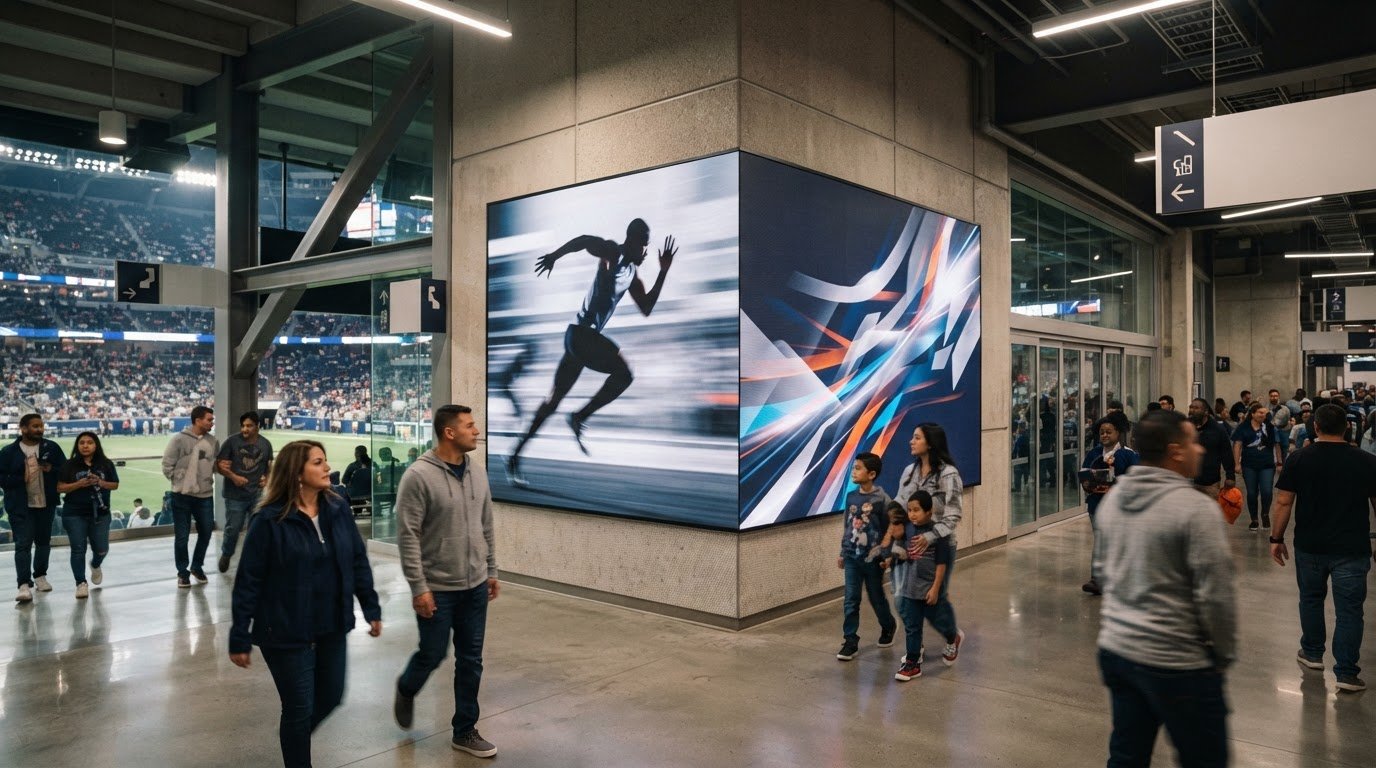
The strongest opportunity for lenticular displays for stadium branding may be a place where fans naturally move past the image. As their viewing angle changes, the graphic can reveal a visual shift that a static image cannot. But will the effect read from the stands, a concourse, or a busy entrance? Placement matters as much as the creative idea.
It’s reasonable to compare lenticular graphics with conventional environmental branding and to ask how a custom installation will fit around venue operations. The right answer depends on viewing conditions, the message, and practical details such as access and installation requirements.
This guide explains what lenticular displays can add to a stadium brand experience and how to assess a concept before committing. Learn how to evaluate locations, plan imagery for viewing distance and audience movement, compare lenticular graphics with static alternatives, and prepare useful project details for a production partner. The goal is a clear path from visual idea to a display designed for its setting.
Key Takeaways
- Assess whether a changing image suits the message and how fans move through the space.
- Test artwork at realistic viewing distances and angles before choosing a stadium location.
- Compare lenticular graphics, conventional print, and digital signage based on content needs, updates, and venue conditions.
- Discuss access, approvals, maintenance expectations, and installation constraints with the venue early.
- Before discussing samples, production, and installation for lenticular displays for stadium branding, prepare location details and creative goals.
What Lenticular Displays Can Add to Stadium Branding
A stadium brand surface can do more than show one fixed image. With lenticular displays for stadium branding, a printed graphic appears to shift as viewers change position, creating a visual transition or impression of depth without a digital screen. The effect is passive: it comes from the printed image and lens, not interactive software.
A changing view can help tell a story, such as moving from a team identity to a campaign message, or create a visual landmark within a space. These are ideas to assess, not guaranteed outcomes. Whether a display attracts attention or supports recall depends on its design, placement, audience, and venue conditions.
How the lenticular effect works in a public venue
A lenticular lens has narrow ridges that direct different parts of an interlaced image toward different viewing angles. As a person moves, the visible view changes, producing a flip, animation-like transition, or depth effect. The printed display itself doesn’t move. This Lenticular printing technology relies on coordinating the artwork with the lens so the intended views align.
For a large venue, assess the display from the audience’s actual approach, not only from a close-up sample. Artwork, lens specification, viewing angle, distance, and lighting all affect how clearly the transition reads. A concept that looks compelling in a studio may appear different across a concourse or as fans pass at an angle. Review it in conditions that resemble the intended setting.
Where stadium branding might use lenticular graphics
Start by considering how people move around a potential location, then decide what the visual should communicate. A concourse may suit a concise campaign transition for people walking past. A hospitality area could allow visitors more time to take in a brand story. An entrance might work as a visual landmark if the display fits the space and doesn’t conflict with venue operations or essential information.
These are possible applications, not claims about existing stadium installations. Match each idea to a clear message and the likely viewer path. A fixed, head-on viewing position may not reveal the changing image as intended. For more context on planning and producing large-format work, see the large format lenticular printing guide.
How Lenticular Stadium Displays Work: Design, Viewing, and Production
Start with the view the display needs to create, then work backward to the artwork and lens. Designers prepare source images for the chosen effect, such as a transition between two campaign messages or an image with a sense of depth. Those elements are precisely aligned with the lenticular lens so different views appear as a person changes position. For lenticular displays for stadium branding, design around the audience’s actual path, not an idealized, head-on view.
Choose an effect that serves the message
Movement should clarify the brand story, not compete with it. Consider whether visitors approach from one direction, pass quickly, or see the graphic from multiple angles. A transition may suit two related messages; a depth effect may better support one hero image. Ask a production partner to show how the proposed artwork and viewing position work together in a sample. That review can reveal whether the effect feels clear before the design is scaled.
Distance changes what viewers can make out. Review the concept from expected approaches and realistic viewing distances, including points where people are likely to pause or keep moving. Don’t assume details visible in a small proof will remain legible across a large installation. Surface texture, ambient and directional lighting, sightlines, and mounting conditions can also affect the result. Treat each location as its own design challenge.
Use prototypes and site information to reduce uncertainty
Before committing to full-scale production, gather the information a production partner needs to assess the concept:
- Photographs of the proposed location, taken from likely audience approaches.
- Approximate dimensions and details about the surface where the display may be mounted.
- Notes on viewing angles, sightlines, lighting, and physical obstructions.
- The intended brand message and the effect you want viewers to see.
Samples or prototypes let the team review image transitions, alignment, and legibility before moving to a larger format. Ask what the sample can demonstrate and how closely its viewing conditions represent the planned installation. The custom lenticular prototypes guide offers more context on prototype planning.
For broader production knowledge, the PRINTING United Alliance is a resource for exploring the printing and graphic arts industry. For a custom project, sharing site details and reviewing samples with a potential large-format lenticular production partner can help identify what needs further assessment before production.
Lenticular Displays vs. Other Stadium Branding Options
Choose a format based on what the message needs to do. A lenticular graphic can reveal a change as viewers move past it, while conventional print presents one consistent image. Digital signage can show changing or scheduled screen content. Each serves a different purpose, so consider the campaign, audience movement, update needs, and conditions at the proposed location.
When a lenticular display may fit the brief
Consider lenticular when the idea benefits from a visual shift, such as a transition between two related campaign messages or added depth in a brand image. The movement comes from the viewer’s changing perspective, so check whether people are likely to approach from useful angles and have time to see the effect. A production sample can help test the fit before finalizing the design.
A static graphic may be clearer when the message must be understood immediately from one fixed viewpoint or relies on detailed information. The visual effect should support the message, not make it harder to read.
When to consider another display format
If the brief depends on frequent content changes, timed messages, or screen-based material, digital signage may be a better match. That choice also brings operating considerations, including how content will be managed and what power or venue support is needed. Confirm those requirements with the venue and relevant providers.
Conventional printed graphics may suit a campaign that needs one stable image and a straightforward visual message. Their suitability still depends on the location, surface, and venue requirements. For lenticular displays for stadium branding, weigh the changing-view effect against simpler options rather than assuming one format is always superior.
- Lenticular: Explore when a perspective-based transition or depth is part of the creative idea.
- Conventional print: Consider when one clear, consistent image is the priority.
- Digital signage: Consider when content needs to change on a schedule or be updated on screen.
Softmotion creates lenticular displays and installations, not digital signage hardware. If motion-led physical advertising is part of your exploration, the guide to kinetic advertising displays offers related context. Make the decision against the brief and the site: what viewers need to see, how often the message changes, and what the venue can accommodate.
How to Evaluate a Stadium Lenticular Branding Project
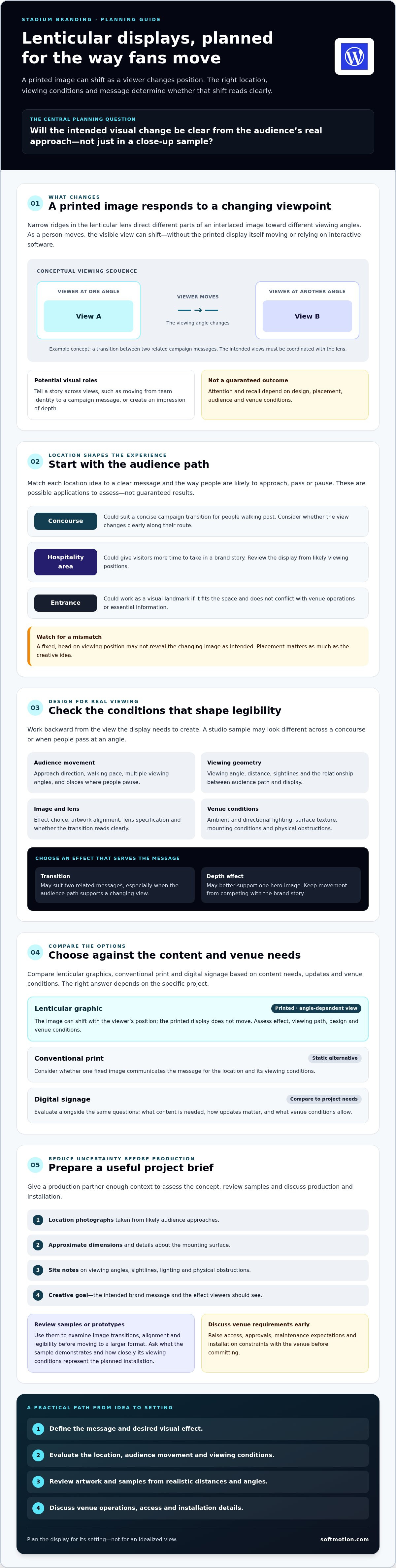
A compelling concept is only the starting point. Before commissioning lenticular displays for stadium branding, follow a clear sequence: define the objective, shortlist locations, document site conditions, test the artwork, then confirm production and installation responsibilities. This can bring practical questions to light before creative decisions become difficult to change.
Questions to resolve before requesting a proposal
Describe who the display is for, what the campaign should communicate, and where you’re considering placing it. Include likely viewing directions and how people move through the area. Share available dimensions, surface details, and location photographs, along with venue contacts if you’re permitted to do so. If information is incomplete, mark what still needs measurement or confirmation instead of treating an estimate as final.
Ask which assumptions require an on-site review or technical input. Confirm with the venue who handles approvals and what to check regarding access windows, operational restrictions, maintenance expectations, and installation coordination. Requirements for safety, accessibility, materials, fire performance, and mounting can vary by project. Verify what applies with the venue and qualified project professionals. A creative proposal is not an approval.
Assessing samples, production, and installation plans
Review samples from positions where the audience will encounter the display. Does the transition read clearly? Is the image legible at the expected distance? Does the effect suit the message? Use your observations to refine the concept before scaling up, and ask the production partner what the sample can and can’t establish about the final installation.
Then request written confirmation of the proposed scope and responsibilities. Check that the plan identifies who will provide or approve artwork, what production includes, how timing will be coordinated with the venue, and who is responsible for installation tasks. Keep venue approvals and project-specific technical requirements separate from the creative proposal, with an owner and next step for each open item.
- Objective: State the campaign message and intended audience.
- Location: Share dimensions, surface details, photographs, and likely viewing approaches.
- Feasibility: List assumptions that still need site or technical confirmation.
- Delivery: Clarify scope, responsibilities, schedule, approvals, and installation coordination.
With these criteria in hand, consider whether sampling, prototyping, production, and on-site installation fit your project. Explore Softmotion’s lenticular capabilities as a potential production partner, and confirm venue-specific requirements with the appropriate professionals.
Working with Softmotion on Lenticular Stadium Branding
Once you’ve clarified the campaign goal, candidate location, and venue requirements, a production conversation can turn the idea into a project plan. Softmotion creates custom large-format lenticular work, with project delivery that can include sampling, prototyping, production, and on-site installation. The company may be a partner to explore if the visual concept and site conditions appear compatible.
Softmotion was founded in 1997 and has delivered more than 1,000 projects worldwide. That provides general production context, not proof of stadium-specific work. For lenticular displays for stadium branding, the proposed artwork, viewing conditions, materials, mounting, and venue coordination still need to be assessed for the individual project.
What a collaborative project conversation can cover
Begin with the essentials: the branding goal, intended audience, candidate location, and visual concept. Explain what viewers should understand as they move through the space, and share the site information you already have. Identify open questions that need confirmation from venue contacts or qualified project professionals instead of treating unknowns as settled assumptions.
Samples or prototypes may help you assess whether the intended image transition suits the concept and likely viewing positions. Ask what can be reviewed at this stage, what needs more site information, and which decisions must wait for technical or venue confirmation. Clear answers keep creative exploration connected to practical delivery.
What to prepare before contacting a production partner
A concise project brief makes the first discussion more useful. Gather:
- The campaign objective, intended audience, and current brand assets.
- Initial dimensions, location photographs, and known surface information.
- Desired timing, plus any known access constraints or operational restrictions.
- Venue contacts, approval steps, and identified installation requirements.
Separate confirmed details from provisional ones. For example, a preliminary measurement can guide discussion, but the venue may need to confirm final site conditions, access arrangements, or installation requirements. Ask the production partner to clarify its proposed scope, responsibilities, and coordination points, while keeping venue approvals distinct from the creative and production plan.
If you’re ready to discuss a concept, site information, or whether sampling could help test feasibility, start a conversation with Softmotion. A clear brief is a useful beginning, and unresolved site questions can be identified during the discussion.
Bring Your Stadium Branding Concept Into Focus
The right lenticular display starts with a clear purpose and a realistic view of its setting. Consider how fans will approach the graphic, whether the visual shift supports the message, and what the venue requires for approvals, access, and installation. Samples and prototypes can help you assess the effect before moving toward full-scale production.
Softmotion has worked in lenticular production since 1997 and has delivered more than 1,000 projects worldwide. Its project capability can span sampling and prototyping through production and on-site installation. These are general experience credentials, not stadium-specific case studies, so your concept and venue conditions still need individual review.
If you’re considering lenticular displays for stadium branding, bring your creative goal, location details, and open site questions into an early project discussion. Discuss your lenticular display concept with Softmotion to explore what the setting may support.
Frequently Asked Questions
What is a lenticular display for stadium branding?
A lenticular display is printed imagery designed to change or shift as viewers move and see it from different angles. A lens over the artwork directs different image views toward different positions, creating a transition or impression of depth without a digital screen. For stadium branding, the effect could support a campaign message or visual identity, provided the concept is tested for the location and audience viewpoints.
Can lenticular displays be used in stadiums?
They can be considered for locations such as entrances, concourses, or hospitality areas, subject to venue requirements and project feasibility. The display needs to suit how people approach and pass it, as well as the available surface, lighting, sightlines, and mounting conditions. Before committing, confirm applicable material, safety, accessibility, and installation requirements with the venue and qualified project professionals. Assess each proposed location individually.
How does lenticular printing create a changing image?
Lenticular printing combines specially prepared, interlaced image artwork with a lens made of narrow ridges. Each ridge directs a different part of the image toward a particular viewing angle. As a viewer changes position, the visible image shifts, which can create a flip between views, an animation-like transition, or a sense of depth. The printed display itself doesn’t move, and the effect depends on suitable artwork and viewing conditions.
Are lenticular displays better than digital signage for stadium branding?
Neither format is universally better. Lenticular graphics create a printed, perspective-based visual shift, while digital signage suits content that needs to change on screen or follow a schedule. Compare the options by message, update frequency, viewing conditions, and venue operating needs. If one consistent image is clearest, conventional print may also be appropriate. Softmotion produces lenticular work, not digital signage hardware.
What should a stadium provide before requesting a lenticular display proposal?
Prepare the campaign objective, intended audience, proposed location, and message the display should communicate. Share available dimensions, photographs, surface details, and likely viewing approaches, marking estimates as unconfirmed. Include known venue contacts, approval steps, access constraints, desired timing, and any installation requirements already identified. This information helps a production partner discuss feasibility and identify what still needs confirmation from the venue or qualified project professionals.
How can a stadium test a lenticular design before full production?
Request a sample or prototype to review how the image changes and how clearly the artwork reads from expected viewing positions. Assess it from realistic distances and approaches where possible, and discuss what the sample can demonstrate about the proposed larger display. Sampling can help refine the visual concept before full-scale production, but it doesn’t replace checking the actual site’s lighting, surface, sightlines, mounting, and venue requirements.
Does Softmotion provide digital screens or lenticular displays?
Softmotion provides lenticular work, including advertising displays, architectural installations, fine art prints, tradeshow graphics, and samples. Its project capability can extend from sampling and prototyping through production and on-site installation. Softmotion doesn’t sell digital signage hardware. Founded in 1997, the company has delivered more than 1,000 projects worldwide for architects, advertisers, artists, and Fortune 500 corporations. Those projects represent general experience, not stadium-specific proof.