
Lenticular Brand Storytelling: 2026 Spatial Design Guide
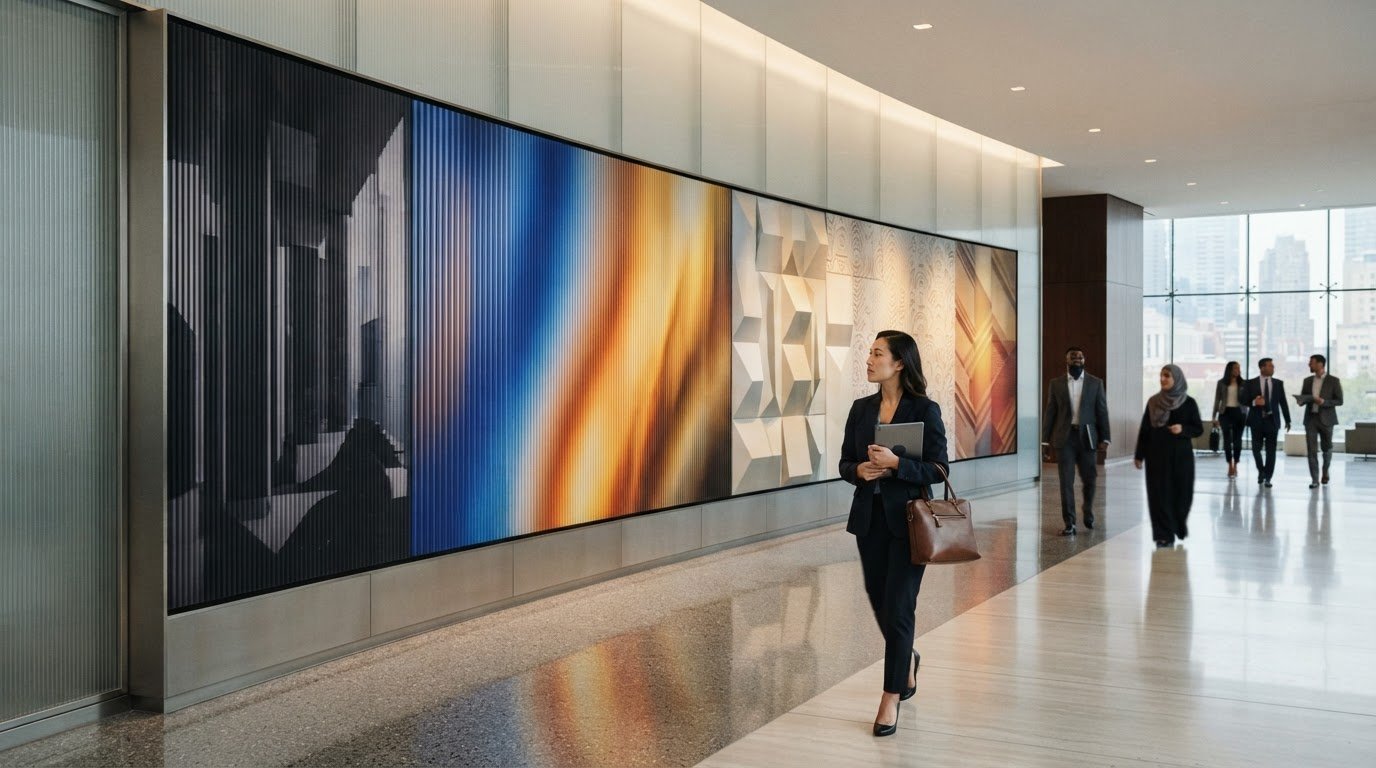
The most captivating motion display in modern spatial design doesn’t require a single pixel or a single watt of power. While high-traffic corporate lobbies and retail flagships drown under flickering LED panels, visionary teams are turning to lenticular graphics for brand storytelling to choreograph kinetic, screen-free journeys that stop visitors in their tracks. You’ve likely seen the core problem firsthand: digital screen fatigue is blunting consumer attention spans, while conventional static prints fall flat when tasked with communicating multi-layered heritage milestones or complex product evolutions.
Discover how large-format lenticular graphics transform static brand environments into kinetic, screen-free narrative journeys that captivate modern audiences. In this 2026 guide, we’ll unpack a reliable methodology for pacing brand stories to viewer velocity, compare lenticular mediums directly against high-maintenance digital signage, and provide the practical clarity needed to specify lens geometry, visual phases, and fabrication parameters with absolute confidence.
Key Takeaways
- Understand how precision optical arrays convert observer movement into dynamic, power-free animation across architectural environments.
- Harness lenticular graphics for brand storytelling by aligning specific visual effects, such as multi-phase flips and dimensional depth, with your spatial narrative goals.
- Compare operational frameworks to see how kinetic optical installations deliver immersive visual impact without the recurring maintenance or energy demands of digital video walls.
- Calculate viewing distance, transit velocity, and lens pitch to choreograph seamless visual transitions tailored to high-speed corridors or intimate corporate suites.
- Eliminate optical distortion and execution risks by establishing a rigorous end-to-end prototyping workflow before commissioning full-scale production.
The Mechanics of Motion: Why Lenticular Graphics Redefine Brand Storytelling
Static graphics demand that viewers bring their own energy to an inanimate wall. In contrast, The Mechanics of Motion behind lenticular systems transform spatial transit into an active, screen-free brand discovery. By transforming physical displacement into visual progression, lenticular graphics for brand storytelling convert passive observers into direct co-authors of the visual narrative.
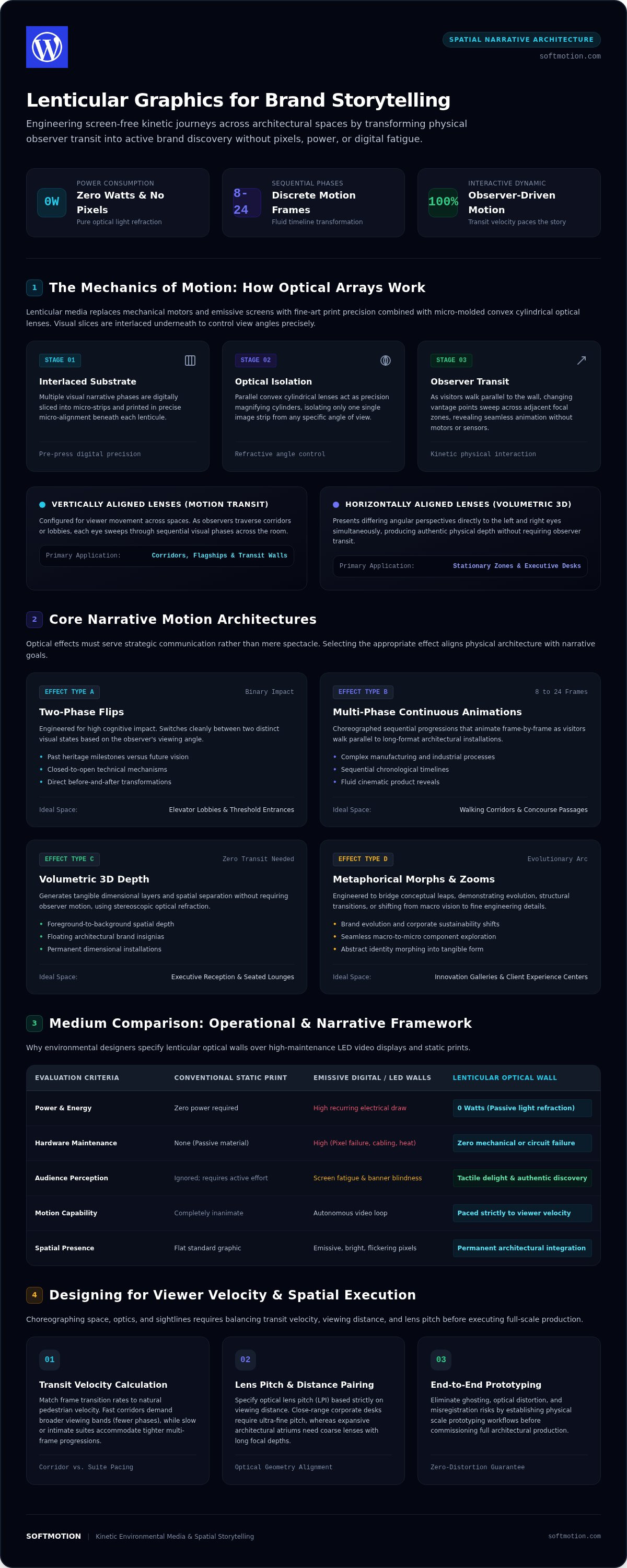
At its core, this medium relies on an engineered interplay between fine-art print precision and industrial optical design. Rather than demanding electrical cabling or glowing diodes, the surface refracts light through a micro-molded lens array, isolating distinct interlaced visual slices so that different eyes, or changing angles of view, perceive distinct imagery.
Decoding the Kinetic Medium: Optical Lenses and Interlacing
The system pairs an array of parallel, convex cylindrical lenses with an interlaced graphic substrate underneath. During pre-press production, multiple visual phases are digitally sliced into micro-strips and printed in precise alignment below each lenticule:
- Optical Isolation: Each individual lens acts as a precision magnifying cylinder, isolating and magnifying only one specific image strip from a given viewing angle.
- Observer-Driven Animation: As a person walks parallel to the wall, their changing vantage point sweeps across adjacent focal zones, revealing sequential frames without motors, sensors, or external power.
- Depth vs. Motion Thresholds: Horizontally oriented lenses present differing perspectives to the left and right eyes to generate true volumetric 3D depth, whereas vertically aligned lenses reveal shifting cinematic motion as transit occurs across the room.
Combating Screen Fatigue with Tactile, Passive Interaction
Digital fatigue is reshaping how people perceive physical spaces. Today’s audiences have developed subconscious banner blindness toward emissive LED video walls, instinctively filtering out bright, buzzing pixels as aggressive digital clutter. Analog optical displays pierce through this saturation because they feel authentic, permanent, and integrated into the surrounding architecture.
The sensory reward of discovery changes the emotional dynamic completely. When an observer realizes that a wall shifts from a historic manufacturing blueprint to a modern product reveal solely because they took three steps forward, the transformation feels unprompted. It sparks delight. Luxury flagships, private client suites, and corporate headquarters increasingly favor permanent architectural installations precisely for this quiet authority. By investing in custom lenticular graphics for brand storytelling, environmental designers achieve bold, kinetic communication while maintaining an elevated, human-first ambiance.
Core Narrative Visual Effects: Selecting the Right Motion Architecture
Every dynamic medium requires editorial discipline. When executing lenticular graphics for brand storytelling, motion must serve strategic communication rather than mere spectacle. Choosing the right optical effect dictates how visitors unpack your brand’s ethos, milestones, or technical innovations as they move through a venue.
Optical dynamics fall into distinct mechanical families, each engineered for specific narrative arcs and physical spaces:
- Two-Phase Flips: Best for binary storytelling, contrasting before-and-after states, past heritage versus future vision, or closed-to-open product mechanisms.
- Multi-Phase Continuous Animations: Ideal for walking corridors, breaking down complex industrial processes, fluid transformations, or sequential timelines across 8 to 24 discrete frames.
- Volumetric 3D: Optimized for stationary focal zones like executive reception desks, generating tangible spatial depth and layer separation without viewer transit.
- Metaphorical Morphs and Zooms: Engineered to convey brand evolution, sustainability shifts, or transitions from macro vision to fine engineering detail.
Two-Phase Flips vs. Multi-Phase Continuous Sequences
Two-phase flips deliver instant cognitive impact. Switching cleanly between two high-contrast images creates an immediate dialogue, making it a compelling tool for architectural before-and-after case studies. The technical challenge lies in eliminating ghosting, which occurs when traces of the latent image bleed into the active view. Precision interlacing and carefully matched color values between both phases ensure each scene displays cleanly.
Multi-phase sequences, by contrast, unfold gradually across multiple footsteps. Walking alongside a forty-foot installation reveals an assembly dissolving into component systems or a century of brand milestones advancing across the wall.
Dimensional Volumetric Depth: True 3D Layering Without Glasses
Architectural depth effects simulate actual physical space behind and in front of the lens surface. By separating typography into the foreground, brand figures into the midground, and contextual environments into an infinite background plane, the eye processes true stereoscopic parallax. Spatial designers must calibrate these focal planes carefully; pushing depth thresholds too aggressively in tight hallways can trigger eye fatigue, whereas calibrated layers invite sustained, comfortable engagement.
Metaphorical Transformations: Morph and Zoom Effects
Morphing bridges distinct corporate identities, illustrating modern shifts toward renewable initiatives or unified mergers with fluid grace. Similarly, zoom sequences pull viewers into the micro-craftsmanship of a product before pulling back to reveal global scale.
Achieving crisp visual transitions requires rigorous pre-production alignment. Evaluating physical mockups through lenticular samples ensures your creative concepts translate flawlessly from screen designs into clear physical motion.
Medium Comparison: Static Visuals vs. Digital Signage vs. Lenticular Wall Installations
Selecting the right medium for an architectural interior requires weighing visual pull against long-term operational reality. Conventional static graphics offer simplicity but lack narrative dimension. Commercial LED video walls deliver motion, yet they bring substantial operational friction, persistent power draw, and hardware vulnerability. Optical wall installations establish a third path, uniting the cinematic impact of motion with the structural permanence of architectural finishes.
- Static Murals: Low upfront cost and zero power draw, but incapable of conveying chronological progression or multi-state messaging.
- Digital Video Walls: High initial capital expenditure, heavy electrical consumption, recurring software maintenance, and inevitable component failures.
- Architectural Lenticular Walls: Moderate capital investment, zero operating or power costs, dynamic viewer-driven animation, and decades of physical durability.
Operational Permanence and Zero-Power Sustainability
Digital signage demands continuous electricity, dedicated thermal ventilation, and recurring operating system updates. A single failed LED driver, dead pixel cluster, or frozen media player disrupts the brand atmosphere instantly. Lenticular polymer arrays eliminate this operational vulnerability entirely.
Formed from durable optical substrates like PETG, these installations function with zero power, generate no heat, and never crash. For teams evaluating high-traffic concourses, reviewing real-world deployments of kinetic advertising displays demonstrates how zero-power motion delivers uninterrupted, reliable prestige year after year.
The Psychology of Movement: Viewer-Driven Reveal vs. Ambient Loop
Emissive digital screens run looping video regardless of whether anyone is watching. Visitors instinctively classify these unprompted broadcasts as ambient commercial noise and look away. Lenticular animation works differently because it unlocks strictly through human locomotion, rewarding physical presence with visual revelation.
Research indicates that dynamic displays can elevate engagement by up to 40% over static signs, while lenticular imaging carries a 300% higher probability of being noticed compared to conventional static print. The narrative unspools at the exact velocity of the viewer’s stride. Moving faster accelerates the story; pausing freezes the frame. By synchronizing personal movement with physical transformation, lenticular graphics for brand storytelling build an intimate cognitive connection that looping video simply cannot match.
Designing for Viewer Velocity: Choreographing Space, Optics, and Sightlines
A static graphic stays passive, but kinetic optical surfaces respond directly to physical velocity. Successfully applying lenticular graphics for brand storytelling requires treating pedestrian movement as an active narrative timeline. An airport corridor where travelers move at four miles per hour demands an entirely different optical setup than a boutique hotel lobby where guests pause, linger, and inspect surfaces up close.
Choreographing this journey requires close coordination across environmental graphic designers, lighting consultants, and master fabricators. To review exact material tolerances, consult the architect’s guide to large format lenticular printing when specifying substrate thickness and lens dimensions.
Lens Pitch Geometry: Matching LPI to Observation Distance
Lens pitch, measured in lenses per inch (LPI), establishes the focal resolution and depth profile of the installation:
- Low-Pitch Lenses (10 to 30 LPI): Engineered for wide viewing angles and long-distance sightlines (15 to 100+ feet), making them the natural choice for large architectural walls and high-traffic transit terminals.
- High-Pitch Lenses (70 to 100 LPI): Designed for close proximity (1 to 6 feet), preserving razor-sharp typography, delicate linework, and subtle photographic details in intimate corporate suites.
- Viewing Cone Calibration: Narrow viewing angles produce rapid image flips across short steps, whereas wide viewing angles extend narrative reveals across elongated pathways.
Architectural Lighting Integration: Eliminating Glare and Shadowing
Ambient illumination directly impacts how light refracts through cylindrical lenses. Point sources positioned directly opposite a lenticular wall cause specular hot spots that blind the underlying interlaced channels. Instead, designers should specify wall-washing or raking light fixtures positioned at an incident angle of 30 to 45 degrees relative to the lens plane.
Matte surface treatments and specialized anti-reflective optical coatings should also be evaluated for spaces featuring heavy natural fenestration. Controlling surface reflections preserves the high-contrast clarity needed for clean narrative transitions.
Interlacing Precision and Vector Alignment
Executing large-scale architectural murals across multiple adjoining panels demands microscopic mechanical precision. Substrate materials expand and contract with fluctuations in ambient room temperature and relative humidity. Even fractional shifting across panel seams can misalign the lens array, creating disruptive visual jitter.
Pre-production pitch testing calibrates print hardware output against specific lens production lots to ensure flawless registration down to the micron. When you are ready to engineer seamless kinetic murals for your venue, collaborate with our technical team to map out exact spatial geometries and alignment parameters.
Executing Large-Scale Kinetic Environments: From Prototype to Final Installation
Transforming an ambitious spatial vision into a kinetic reality requires a disciplined engineering roadmap. When scaling lenticular graphics for brand storytelling across expansive corporate spaces, transit hubs, or flagship interiors, the margin for error narrows to fractions of a millimeter. Success depends on moving deliberately through a proven four-stage execution framework: spatial narrative storyboarding, optical prototyping, precision substrate fabrication, and laser-aligned on-site commissioning.
The Crucial Role of Scaled Physical Prototyping
Computer monitors can’t accurately simulate analog optical physics. A digital screen emits direct RGB light, whereas a lenticular array refracts ambient illumination through curved polymer lenses. Software renderings simply cannot duplicate stereoscopic depth perception or the subtle cadence of phase transitions under real-world lighting.
Physical proofing eliminates risk. Reviewing scaled custom lenticular prototypes allows design teams to test color saturation, verify the legibility of fine typographic details, and measure switching angles in the project’s actual ambient environment. Presenting an authentic physical mockup aligns client stakeholders and design boards, providing complete confidence before committing to full-scale fabrication.
Precision Structural Fabrication and On-Site Panel Registration
Multi-panel wall installations demand an uncompromising mechanical backbone. Large optical polymer sheets cannot be applied like standard commercial wallcoverings. Instead, panels mount to rigid, CNC-routed sub-frames designed to maintain absolute surface flatness while accommodating micro-expansions caused by ambient temperature and relative humidity shifts.
Technicians use laser-guided alignment systems during installation to ensure vertical lenticule continuity across panel joints. Even a fractional variance of half a lens width disrupts the illusion of motion, introducing visible vertical seams. The commissioning process concludes with rigorous walking inspections along primary circulation paths, confirming that each visual phase unlocks cleanly and sequentially at the intended viewer velocity.
Transforming Static Architecture into Living Brand Narratives
Physical environments possess an untapped capacity to communicate, captivate, and endure. By synchronizing optical engineering with pedestrian velocity, lenticular graphics for brand storytelling replace passive viewing with an active journey of physical discovery. You can convey deep heritage, dynamic progress, and intricate engineering without a single kilowatt of power or the persistent maintenance headaches of digital displays.
Bringing these ambitious visions to life demands both artistic sensibility and uncompromising manufacturing precision. Since 1997, Softmotion has delivered over 1,000 installations worldwide, earning the trust of Fortune 500 corporations, renowned cultural institutions, and world-class architects. From initial optical pitch calibration to rigorous physical prototyping, our collaborative process ensures every panel aligns seamlessly to deliver zero-distortion clarity across every stride.
Ready to bring dynamic movement to your next environment? Collaborate with Softmotion to transform your architectural space into an unforgettable kinetic brand narrative that elevates your space for years to come.
Frequently Asked Questions
How do lenticular graphics tell a story compared to standard video displays?
Lenticular graphics unfold narratives through viewer movement rather than passive, timed playback loops. While digital screens run on continuous cycles regardless of who is watching, optical arrays require the observer to physically walk past or shift perspective. This puts the visitor in control of the narrative pace. The visual reveal feels discovered rather than broadcast, creating deeper cognitive retention without the ambient noise, glare, or screen fatigue of LED walls.
What is the maximum practical size for a large-format lenticular wall installation?
There’s virtually no physical limit on overall installation dimensions because large walls are engineered using modular, seamlessly tiled panels. While individual extruded lens sheets generally max out around 4 by 8 or 5 by 10 feet for shipping and structural rigidity, precision CNC edge-jointing and laser-guided registration allow technicians to tile panels together. Installations spanning fifty to one hundred feet across corporate lobbies and transit hubs are routinely built with pristine optical continuity.
Can lenticular graphics incorporate fine typography and complex brand logos without distortion?
Yes, fine typography and intricate vector branding can be rendered crisply by choosing the right lens pitch and graphic hierarchy. When applying lenticular graphics for brand storytelling, static brand marks or essential body copy are frequently anchored to a single dominant phase or positioned on an un-interlaced base layer. Selecting a higher lens frequency, such as 70 to 100 LPI, prevents the visual stepping that can distort delicate letterforms at close proximity.
How do lighting conditions affect the visibility and performance of a lenticular installation?
Controlled, indirect lighting is critical because cylindrical lenses refract light directionally. Direct frontal spotlights create harsh reflections that wash out underlying imagery and trigger premature ghosting between phases. The optimal setup uses diffuse architectural wall-washers or track fixtures positioned at an incident angle of 30 to 45 degrees along the lens axis. Anti-glare optical coatings should also be evaluated for spaces exposed to abundant natural daylight.
What file formats and preparation workflows are required for lenticular interlacing?
Production requires high-resolution layered files, typically delivered as multi-layered PSD, PSB, or TIFF documents at 300 to 600 DPI at final print scale. Each visual phase or spatial depth plane must exist on separate, clean layers without flattened blending effects. Master files undergo optical pitch calibration and dedicated interlacing software processing to divide and interleave image slices to match the exact physical pitch of the specified lens batch.
Is it possible to install lenticular brand installations in outdoor or high-humidity environments?
Yes, lenticular graphics for brand storytelling can thrive in demanding exterior or humid environments when specified with specialized engineering. Outdoor projects require UV-stabilized, high-impact polymers like modified PETG or acrylic to resist discoloration and brittleness. Fabricators also use moisture-resistant optical adhesives, perimeter expansion gaskets, and marine-grade structural sub-frames to safely accommodate the thermal expansion and contraction cycles caused by fluctuating seasonal weather.
What is the typical lifespan and maintenance routine for large-scale architectural lenticular prints?
Architectural lenticular installations typically last 10 to 15 years or longer indoors with minimal maintenance. Because they don’t contain electronic drivers, backlights, or moving mechanical parts, they require zero software patches or thermal ventilation. Ongoing care is straightforward: periodic surface wiping with an anti-static microfiber cloth and a mild, non-abrasive acrylic cleaner removes dust and smudges, keeping the optical faces clear and vibrant year after year.