
Lenticular Art for Urban Development: 2026 Visionary Guide
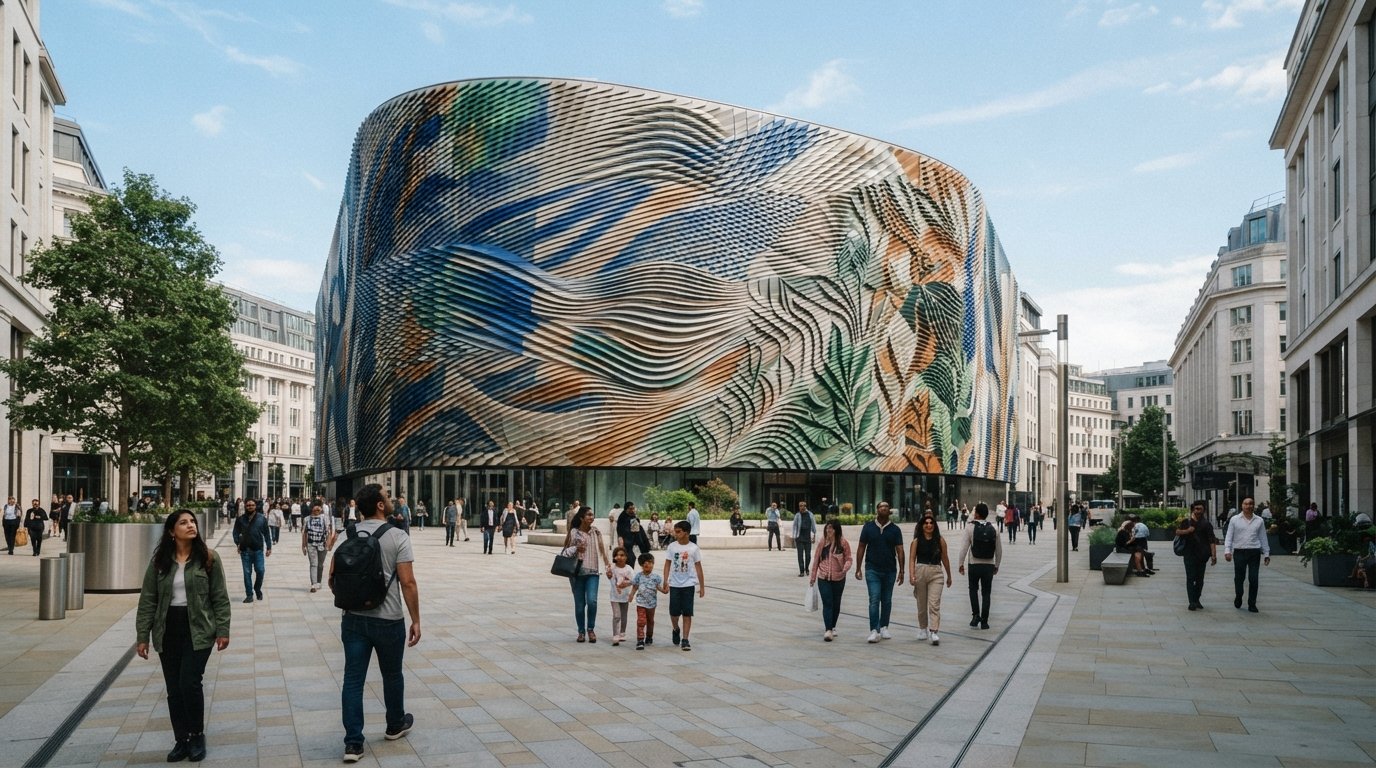
An average large digital billboard consumes as much electricity as eleven residential households every single year. While the glow of a digital screen once signaled modern innovation, it now often signals a maintenance liability and an energy drain that 2026 urban centers can’t afford. You know that creating a signature landmark requires more than just a static wall, but the hurdles of light pollution regulations make traditional media facades difficult to justify, leading many to seek lenticular art for urban development projects as a sustainable alternative.
This guide explores how these large-scale installations offer a sophisticated, zero-energy solution that transforms static surfaces into dynamic, human-powered experiences. We’ll examine the technical mechanics of architectural panels, the shift toward passive interactivity, and how these durable elements satisfy both municipal mandates and the modern need for “Instagrammable” placemaking. Discover how to bridge the gap between fine art and technical production to create a legacy project that breathes with the movement of the city itself. Through a blend of visionary design and grounded engineering, you can realize the hidden potential of any ordinary environment.
Key Takeaways
- Learn how lenticular art for urban development projects transforms static walls into interactive narratives that increase pedestrian dwell time and property value.
- Master the relationship between lens pitch and viewing distance to ensure your installation delivers a crisp, high-impact experience for every passerby.
- Evaluate the strategic advantages of passive kinetic facades, which bypass the high energy costs and strict light pollution curfews of digital displays.
- Understand the critical role of custom prototyping in bridging the gap between imaginative design and complex structural engineering.
- Gain confidence in your project delivery by partnering with experts who provide end-to-end fabrication and global installation support.
The Evolution of Urban Placemaking: Why Lenticular Art Matters in 2026
The city of 2026 demands more than just concrete and glass. It requires a pulse. As developers and architects look to differentiate their portfolios, the focus has shifted from passive viewing to active participation. Traditional public art often sits static, eventually fading into the background of a busy commuter’s daily routine. In contrast, lenticular art for urban development projects introduces a layer of discovery that rewards the pedestrian’s movement. By leveraging the optics of lenticular printing technology, these installations transform a simple walk down a corridor into a cinematic experience.
Smart city master plans are increasingly prioritizing “human-scale” interactions. These are elements that slow down the viewer, increase dwell time, and ultimately boost the desirability of a property. When a facade changes color or reveals a hidden narrative as someone walks past, it creates a psychological anchor. It turns a transit space into a destination. This perspective-shifting quality doesn’t just look impressive; it subtly influences pedestrian flow by encouraging rhythmic movement and engagement with the physical environment. Integrating lenticular art for urban development projects allows developers to achieve this without the maintenance burden of digital screens.
From Static Facades to Living Environments
Traditional murals are losing their impact in high-density areas where visual noise is constant. To cut through the clutter, developers are turning to kinetic placemaking. Kinetic placemaking is the intersection of architectural movement and pedestrian engagement. It represents a transition from a static facade to a living environment that responds to the viewer’s vantage point. This approach brands a development as a forward-thinking landmark, ensuring it remains relevant in an era defined by sensory experience.
Meeting the Demand for ‘Instagrammable’ Infrastructure
Modern infrastructure must do more than function; it must communicate. A dynamic background that shifts as a visitor moves provides the perfect catalyst for organic social media promotion. These landmarks change based on the viewer’s position, offering a unique moment for every camera angle. However, the true challenge lies in balancing this artistic vision with the functional requirements of public spaces. Integrating these features early through custom lenticular prototypes ensures that the final installation is as durable and safe as it is visually captivating.
Mechanics of Large-Scale Lenticular Art: Beyond the 3D Poster
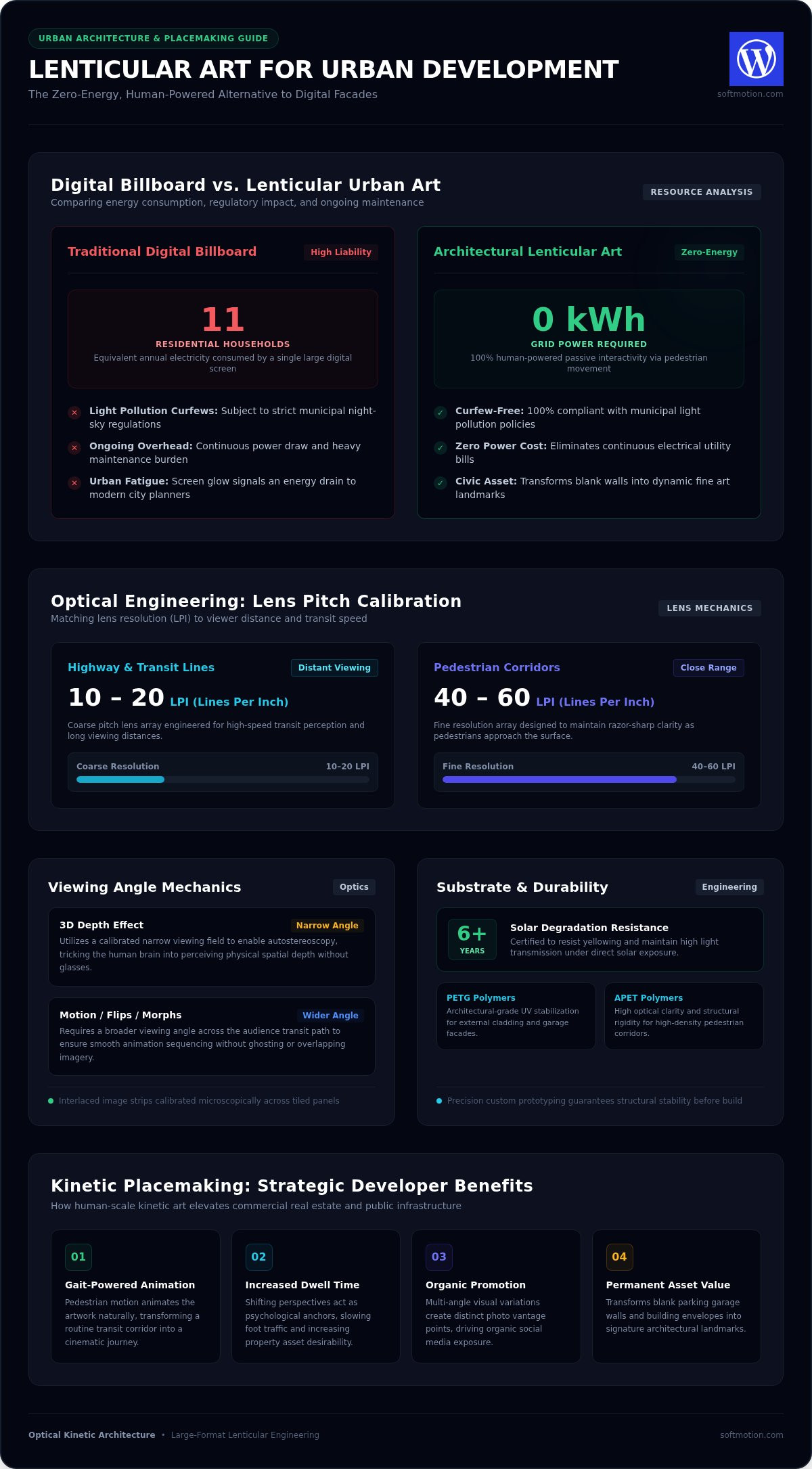
Large-scale lenticular art for urban development projects isn’t just an upsized version of a handheld postcard. It’s a precise feat of optical engineering. At this scale, the relationship between the lens and the viewer’s distance becomes the primary design constraint. For distant viewing on a highway or transit line, we utilize coarse pitch lenses, often between 10 and 20 LPI. Conversely, pedestrian corridors require a finer resolution, typically 40 to 60 LPI, to maintain clarity as people approach the surface.
The choice of effect depends entirely on the transit speed of the audience. A 3D depth effect requires a narrow viewing angle to trick the brain into perceiving autostereoscopy. Motion effects, such as flips or morphs, require a wider angle to ensure the animation sequence doesn’t “ghost” or overlap. Achieving this at scale requires specialized fabrication. We use UV-stabilized polymers, such as PETG or APET, which are certified to resist yellowing and maintain light transmission for over six years under direct solar exposure. These architectural-grade substrates ensure the installation remains a permanent asset to the project portfolio.
The Science of Viewer-Driven Motion
Lenticular technology utilizes the pedestrian’s natural gait to animate the art. As a person walks, their changing perspective shifts the light passing through the lens array, revealing different interlaced image strips. This creates a passive interactivity that requires no power. Optimizing this interlacing for massive surfaces, like the side of a parking garage, requires microscopic calibration. Utilizing large format lenticular printing ensures that the image remains crisp even when tiled across dozens of panels, maintaining the illusion of a single, fluid mural.
Lenticular vs. Agamograph: Choosing the Right Technique
While both techniques offer kinetic movement, their structural geometry differs. Lenticular lenses provide smooth, cinematic transitions across a flat surface. Agamographs use folded triangular louvers to create distinct perspective shifts based on which side of the fold the viewer is standing. Choosing the right technique depends on the project’s scale and the desired narrative. For a ten-story exterior cladding, the bold geometry of an agamograph might be more impactful. For a lobby feature wall, the subtle depth of lenticular printing offers a sophisticated, high-end feel. These choices fit within broader creative placemaking frameworks that prioritize civic identity and urban revitalization. Before finalizing your master plan, it’s helpful to review our architectural portfolio to see these different mechanics in action.
Lenticular Art vs. Digital Signage: A Strategic Comparison for Public Spaces
Digital screens are demanding. They require constant energy, specialized cooling, and frequent software updates just to remain functional. In a world increasingly focused on sustainability, the high-energy draw of LED arrays is becoming a liability for developers. An average large digital billboard consumes between 24,000 and 41,600 kWh annually, which is roughly equivalent to the electricity used by eleven residential households. Choosing lenticular art for urban development projects eliminates this operational tax entirely. These installations provide 100% share-of-voice and permanent presence without drawing a single watt from the grid.
Beyond energy costs, the psychological impact of “screen fatigue” is reshaping how we design luxury environments. While digital displays often feel intrusive or temporary, analog kinetic art feels integrated and premium. It doesn’t shout for attention; it earns it through the viewer’s own movement. This subtle, sophisticated interaction is why many top-tier developments are moving away from glowing pixels in favor of tactile, multi-dimensional surfaces that respect the architectural integrity of the site.
The Environmental and Regulatory Edge
Municipalities are tightening the reins on light pollution. From mandatory midnight shut-offs in France to Lyon’s ban on digital street advertising, the era of unrestricted LED facades is closing. Adopting kinetic advertising displays allows projects to bypass these zoning hurdles entirely. By following responsible outdoor lighting principles, you ensure your project remains compliant with “Dark Sky” initiatives while still providing a dynamic visual landmark. Over a ten-year lifecycle, a lenticular mural maintains a near-zero operational carbon footprint, whereas a comparable digital display will have consumed enough electricity to power eighty residential households for a year.
Total Cost of Ownership (TCO) Analysis
The financial argument for lenticular art is as compelling as the aesthetic one. While the initial capital expenditure for high-quality architectural lenticular panels is significant, the long-term operational savings are vast. There are no monthly utility bills, no cooling fans to replace, and no dead pixels to repair. These systems are designed for 10+ year durability, utilizing UV-stable polymers that thrive in extreme weather conditions where fragile electronics would fail. This “always on” reliability ensures that your signature architectural element never goes dark, providing a risk-free investment for the project portfolio.
Integrating Lenticular Art into Master Plans and Building Facades
Integrating lenticular art for urban development projects requires a shift from decorative thinking to structural integration. For a signature landmark to succeed, the kinetic elements must be woven into the master plan during the early schematic design phase. This is especially true for Transit-Oriented Developments (TODs), where the art can serve as a dynamic wayfinding tool. By orienting motion effects toward pedestrian flow or vehicular paths, developers can guide commuters through complex transit hubs using intuitive, non-digital cues. It’s a method of spatial storytelling that transforms a mundane commute into a guided experience.
Managing the timeline for these multi-year urban projects involves tight collaboration between architects and fabricators. We coordinate directly with structural engineers to address mounting requirements and wind-load calculations, ensuring that large-format panels remain secure in high-exposure environments. Whether the project is a single feature wall or an expansive facade, a methodical approach to the fabrication-to-installation cycle reduces risk for the developer. Our process ensures that the artistic vision remains intact while meeting the rigorous demands of public infrastructure.
Architectural Cladding and Building Envelopes
Modern building envelopes are no longer static barriers. They are interactive skins. We specialize in designing lenticular building facades that integrate seamlessly with curtain wall systems and rainscreen assemblies. These panels respond to the natural movement of city life. For night-time visibility, we recommend external lighting strategies that highlight the lenticular ridges, creating a shimmering effect that adheres to Dark Sky standards without requiring active LEDs. This approach allows the building to communicate its identity 24 hours a day without contributing to urban glare.
The Design and Sampling Journey
Precision is the foundation of every successful installation. This is why the creation of custom lenticular prototypes is a non-negotiable step in our process. A 1:1 scale mockup allows the design team to verify motion speed and color accuracy under actual site lighting conditions. This iterative journey ensures that the artist’s vision aligns with the developer’s goals and the fabricator’s technical constraints. We also prioritize safety and ADA compliance, ensuring that textures and mounting depths don’t obstruct high-traffic pedestrian zones. To begin your integration process, contact our fabrication team to discuss your project specifications.
Softmotion: Your Visionary Partner in Urban Kinetic Art
Realizing a large-scale vision requires more than just technical ability; it demands a partner who understands the high stakes of civic infrastructure. Since our founding in 1997, Softmotion has served as a visionary guide for architects and developers, delivering over 1,000 complex installations across the globe. Our portfolio reflects a diverse range of high-impact environments, from Fortune-500 headquarters to sprawling transit hubs and luxury retail districts. We specialize in lenticular art for urban development projects by blending the precision of industrial production with the nuance of fine art.
Our “Human-First” approach ensures that the technical complexity of the work never overshadows the emotional impact on the audience. We believe that urban spaces should inspire, not overwhelm. This is why we operate as a collaborative partner rather than a distant vendor throughout the entire creative journey. This methodology provides a sense of security and ease, allowing you to focus on the high-level vision while we manage the intricate details of optical registration, thermal expansion, and material durability.
Why Experience Matters in Large-Format Fabrication
Large-format lenticular printing is an unforgiving medium. Inexperienced fabrication often leads to “ghosting,” where images overlap incorrectly, or misalignment that ruins the kinetic illusion across multi-panel installs. Softmotion utilizes proprietary precision-alignment technology to ensure that every lens pitch and image strip aligns perfectly, even on massive architectural scales. We recently transformed a major transit hub into a motion-driven experience, where a 200-foot mural now responds fluidly to the movement of thousands of daily commuters without a single optical seam. This level of detail is what separates a simple mural from a signature architectural landmark.
Starting Your Project with Softmotion
Every landmark begins with a conversation and a rigorous prototyping phase. Our collaborative sampling process is designed to de-risk your vision, providing physical proof of concept that you can present to stakeholders before a single full-scale panel is printed. We manage the entire lifecycle of the project, including complex global logistics and on-site installation management across diverse international sites. Whether you’re reimagining a building envelope or creating a pedestrian landmark, we provide the technical discipline to realize that potential. Partner with Softmotion for your next urban development project to ensure a seamless, professional transition from your initial concept to a lasting urban reality.
Realizing the Kinetic Potential of the 2026 Streetscape
The shift toward passive, human-powered motion marks a new era in city building. By choosing lenticular art for urban development projects, you’re not just installing a mural; you’re creating a sustainable landmark that respects municipal light codes and eliminates the long-term tax of digital maintenance. These installations turn transit corridors into immersive experiences, rewarding every pedestrian’s movement with a unique visual discovery.
Softmotion brings the technical discipline needed to realize these complex visions. With over 1,000 projects delivered globally since 1997, our specialized architectural project management ensures every installation is as durable as it is inspiring. We handle the end-to-end fabrication and global installation, reducing risk while maximizing the emotional resonance of your project portfolio. The transition from a static environment to a multi-dimensional narrative is within reach.
Take the first step in transforming your building facade or public plaza. Request a custom lenticular sample for your development project to see the clarity and motion of our architectural-grade materials firsthand. Your vision deserves a partner who can see the hidden potential in every ordinary space.
Expert Insights on Urban Lenticular Installations
What is the maximum size for a lenticular urban art installation?
Lenticular installations have no technical upper limit because they are fabricated as modular tiled panels. We’ve delivered projects ranging from small lobby features to massive murals spanning hundreds of feet. By precision-aligning individual sheets, we create a seamless visual field across entire building facades. This modular approach allows for virtually unlimited scale while maintaining the optical integrity of the kinetic effect throughout the urban environment.
How does lenticular art hold up against UV exposure and extreme weather?
Architectural-grade lenticular art for urban development projects utilizes UV-stabilized polymers like PETG or APET to ensure long-term durability. These materials are engineered to resist yellowing and maintain optical clarity for six or more years under direct solar exposure. Since the system is analog, it lacks the fragile electronics or cooling fans that often fail in extreme temperatures, making it exceptionally resilient in public spaces.
Can lenticular cladding be integrated into existing building facades?
Lenticular panels can be retrofitted onto existing structures using standard rainscreen or curtain wall mounting systems. We collaborate with structural engineers to ensure the mounting hardware meets local wind-load and safety requirements. This allows developers to revitalize aging assets with dynamic, motion-driven art without requiring a full structural overhaul. It’s an efficient way to add a signature architectural element to an established property portfolio.
How do you determine the best viewing distance for large-scale motion art?
Viewing distance is determined by the lens pitch, measured in Lines Per Inch (LPI). For pedestrian corridors where viewers are within ten feet, we typically use 40 to 60 LPI lenses for fine detail. For transit hubs or highway-facing murals viewed from thirty feet or more, we utilize coarse 10 to 20 LPI lenses. This calibration ensures the kinetic motion remains fluid and the imagery stays crisp from the intended vantage point.
What is the typical maintenance required for a lenticular mural?
Maintenance for these installations is minimal, requiring only periodic cleaning with water and mild soap to remove urban dust or grime. Since there are no LEDs to burn out, no software to patch, and no electrical components to fail, the operational costs are nearly zero. This provides a significant advantage over digital screens, which often require expensive technical support and frequent hardware replacements to remain functional.
Is lenticular art considered a ‘digital’ or ‘analog’ medium for zoning purposes?
Lenticular art is classified as an analog medium because it relies on passive optical physics rather than active illumination or electronic refreshes. This distinction is critical for navigating strict municipal light pollution curfews and distracted driving regulations. By using lenticular art for urban development projects, you can achieve dynamic motion in zones where digital billboards are banned, ensuring your project meets “Dark Sky” compliance standards.
How does the design process differ for hoardings versus permanent installations?
Hoardings are typically temporary and focus on high-impact branding during construction, whereas permanent installations require more robust architectural-grade substrates and sophisticated mounting. For permanent works, we emphasize UV resistance and structural engineering to withstand a decade of environmental exposure. While both utilize motion, permanent projects involve a more rigorous iterative sampling process to ensure the art aligns with the long-term identity of the development.
Can Softmotion handle both the design and the physical installation of the project?
Softmotion provides a comprehensive end-to-end service that covers everything from initial creative concepting to global on-site installation. We don’t just print the panels; we act as a visionary guide through the entire fabrication and assembly process. This collaborative approach reduces risk for developers, ensuring that the final physical result matches the precision of the original digital design, regardless of the project’s geographic location or technical complexity.