
Lenticular Art for Galleries: How Motion Shapes a Work

A gallery wall can change without a screen. Lenticular art for contemporary galleries places two or more images beneath a surface of tiny lenses called lenticules, so the view shifts as people move. The work becomes an encounter with changing perspective, rather than a single image seen from one fixed point.
That movement is part of the artwork’s meaning. Viewers may shift position, tilt their heads, or pause to see one image give way to another. The layered construction creates transitions between images, while light and viewing angle influence what comes into focus.
This article explores how movement and image layering work, why scale and edition choices matter, and how placement can guide engagement in galleries and public spaces. It also considers how lenticular art can move beyond a framed print to become part of an installation, inviting people to experience the work as they pass through a space.
Key Takeaways
- Consider how image transitions and transparency can shape the meaning of a work, not just its visual effect.
- Match dimensions and edition choices to the artwork’s intent and the space where it will be experienced.
- Plan for viewers to shift their position, since movement is part of how they encounter the changing image.
- Think beyond the gallery wall: installation scale and placement can turn a passing view into an active encounter.
Movement and transparency in lenticular prints
Lenticular printing combines two or more images beneath a surface of tiny lenses called lenticules. Each lens directs parts of the images toward different viewing angles, so a viewer’s position changes what comes into focus. In lenticular art for contemporary galleries, that transition can carry meaning: a shift between images might suggest contrast, memory, or transformation. Here, transparency describes how image layers relate across the viewing sequence, not necessarily a clear printed sheet.
The technique also has a history outside galleries. Lenticular printing first appeared in the 1940s, often on novelty postcards and toys; companies including Vari-Vue began mass-producing lenticular images in the 1950s. Artists have adapted the method as an expressive medium. Sally Canzoneri found accordion-fold lenticular prints worked best with a fold depth of about one inch. The fold itself can shape how images appear as viewers move.
Unlike video, lenticular prints change with a viewer’s physical position rather than through screen playback. Traditional printmaking presents a fixed image, while lenticular work reveals transitions; holography creates a different optical effect. These distinctions help artists choose a medium suited to their intent. In lenticular art for contemporary galleries, image changes can become part of the artwork’s language, rather than an added effect.
Copyright and licensing depend on the images and permissions involved, so exhibition planning should account for image rights. Accessibility matters too: a written description of the image sequence can help visitors who cannot perceive or follow its movement.
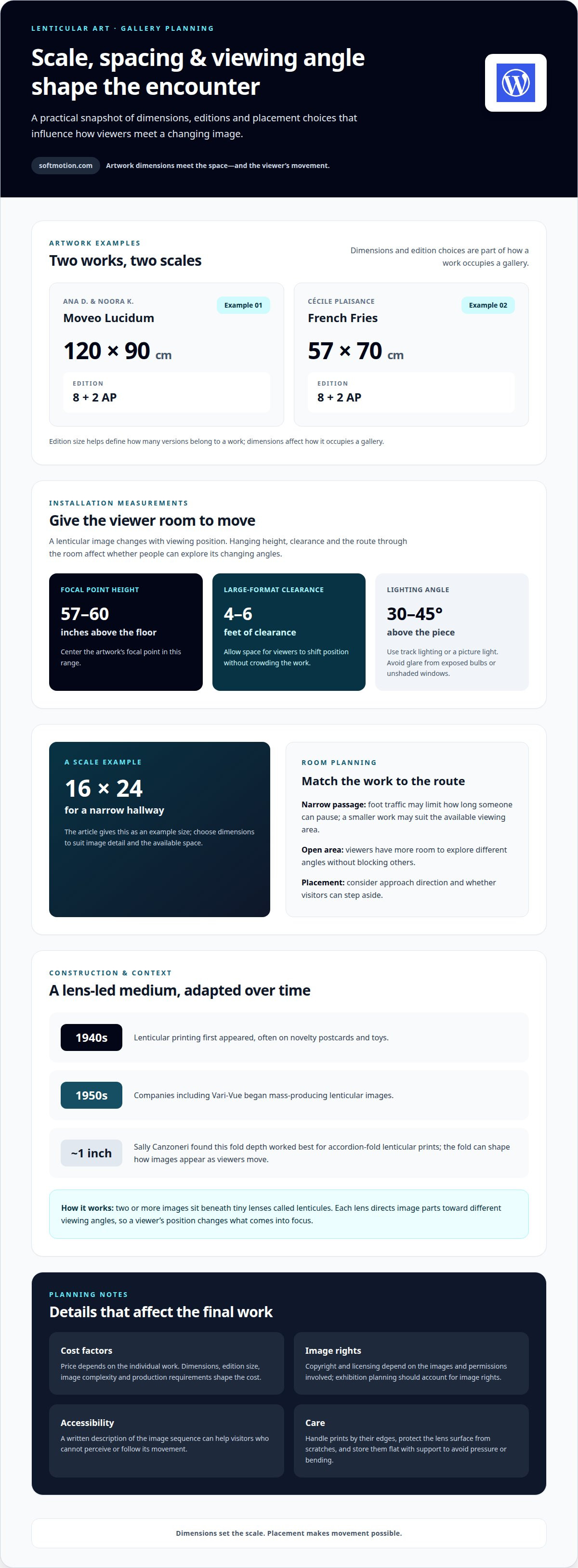
Gallery-quality production places printed image layers beneath a ribbed plastic lens, with the strips aligned to viewing angles. Size should suit both image detail and available space; 16×24 is an example for a narrow hallway. For care, handle prints by their edges, protect the lens surface from scratches, and store them flat with support to avoid pressure or bending that could distort the image.
Artwork dimensions and edition sizes
Dimensions shape how an image meets the viewer and fits its setting. Ana D. & Noora K.’s Moveo Lucidum measures 120 x 90 cm and is an edition of 8 + 2 AP. Cécile Plaisance’s French Fries measures 57 x 70 cm, also in an edition of 8 + 2 AP. These examples show how an artwork’s scale and edition can be considered together, rather than treating size as a framing detail.
For surreal, responsive artwork, scale can heighten the sense that an image reacts to the viewer. A close viewing position may reveal subtle transitions, while a larger format gives those changes presence across a wall. Artists can also use edition size to define how many versions belong to a work. This choice shapes presentation and collecting context, while the work’s dimensions affect how it occupies a gallery.
Hanging height and clearance affect how visitors encounter the image. Center the focal point 57 to 60 inches above the floor, and allow at least 4 to 6 feet of clearance for large-format artwork. That space lets viewers shift position without crowding the work. In a narrow passage, a smaller piece may suit the available viewing area better than a large installation.
Viewing distance depends on the work’s dimensions and the room’s circulation. Place track lighting or a picture light above the piece at a 30- to 45-degree angle. Soft, indirect daylight can support color contrast; avoid walls facing unshaded windows and areas near exposed bulbs, where glare can distort the effect.
Price depends on the individual work and is provided after a quote request. Dimensions, edition size, image complexity, and production requirements shape the cost. Consider these factors together: a responsive image designed for a spacious gallery has different scale and production needs from a compact work intended for close viewing.
Viewer movement and emotional engagement
A lenticular artwork makes the viewer’s position part of the visual experience. Moving from one side to another can reveal a different image, making looking an active choice. A straight-on view may offer a third reading rather than simply repeating either side. This changes the rhythm of viewing: visitors pause, shift their stance, and compare what appears from each angle. The sequence can make transition itself central to the artwork’s meaning.
A corrugated lenticular picture of King Frederik IV and Queen Louise of Mecklenburg-Güstow demonstrates this effect. From the left, viewers see the king; from the right, the queen; straight ahead, the images mix. Depending on the artist’s intent, this changing encounter can suggest duality, exchange, or ambiguity. The work doesn’t reveal every detail at once. Instead, viewers discover its visual structure by changing position and observing how the image responds.
Artists can also connect movement to language or memory. In Miggs Burroughs’ Signs of Compassion, each piece shifts between a hand gesture and its corresponding word. The viewer sees a sign, moves, then encounters its verbal meaning. That transition invites comparison between image and language without requiring a fixed sequence of interpretation. Sally Canzoneri’s photographs bring together images of women’s marches from 1913 and 2017, giving viewers a visual connection across distinct moments.
Placement helps determine whether people can engage with that shift. Near a hallway, entryway, or staircase, a lenticular work meets visitors as they pass, creating opportunities to view it from changing positions. In a narrow passage, foot traffic can limit how long someone pauses; an open area gives viewers room to explore different angles without blocking others. Consider the route through the space, the direction visitors approach from, and whether they can step aside to see the image change.
For exhibition planning, treat movement as part of the viewing experience, not a distraction from it. A work that changes from two sides may benefit from a clear approach path, while a sequence built around a direct view needs space for visitors to pause. The artist’s image choices, the viewer’s route, and the surrounding visual environment all shape the encounter. Each position offers another way into the work.
Lenticular art in galleries and public installations
In a gallery, lenticular art can function as both image and spatial language. SFMOMA’s “Don’t! Photography and the Art of Mistakes” exhibition included three sets of lenticular letters, printed at 20 LPI. The lettering became part of the exhibition’s visual environment, showing how this technique can shape more than a single framed artwork.
Public installations bring scale and sequencing into sharper focus. Joel Swanson’s synchronized lenticular panels at the Denver Convention Center measured 17 feet by 4 feet and were printed at 20 LPI. The panels worked as an extended composition. Planning lenticular art for contemporary galleries and public spaces means considering how separate elements relate to the architecture and the viewer’s approach.
Other projects show how the medium adapts to distinct sites. A lenticular installation designed by VLAD Stankovic with Preen Design measured 9 feet by 3 feet and used 28 LPI. Nick Cave’s permanent Garfield Station installation in Chicago included twelve large backlit lenticulars, using Microlens 20 LPI. These examples connect image design to the scale and character of a built environment.
Begin planning by identifying the site’s role in the work. Consider the available wall or structure, the direction visitors approach from, and whether the composition should read as one image or a sequence. A transit installation, such as Garfield Station, meets people moving through a public environment; a gallery presentation may invite a more deliberate encounter. These differences help shape dimensions and placement.
Lighting and existing architecture influence how the work reads. Lenticular art can use ambient light without screens or power cords, while Cave’s installation demonstrates a backlit presentation. For lenticular art for contemporary galleries, connect the visual language to the site’s light, scale, and circulation. Treat the artwork and its setting as parts of one experience, so the installation feels integrated rather than simply placed within the space.
Softmotion: Advertising Lenticular Displays
Softmotion helps artists and exhibition teams bring shifting images into gallery and public settings. For a work conceived around viewer movement, Fine Art Lenticular Prints turn an image sequence into a changing visual experience. Architectural Lenticular Installations can extend that idea across a built environment, while Advertising Lenticular Displays suit projects designed to draw attention through changing imagery.
Turn to Softmotion when shaping an artwork or installation and the physical format needs to support its concept. Consider the image sequence, dimensions, viewing positions, and surrounding space together: these choices influence how the finished work engages its audience. Start with a clear creative intention and an understanding of where viewers will encounter the piece.
To discuss a lenticular project, contact Softmotion.
Shape the Next Gallery Encounter
The next design decision is what you want visitors to carry with them after leaving the work. A shifting image can make a gallery encounter feel personal: each person discovers its transitions from a different position and at a different pace. That makes the concept, viewing route, and space around the artwork essential parts of the experience.
For lenticular art for contemporary galleries, the opportunity lies in treating motion as an artistic language rather than an added effect. Softmotion’s Fine Art Lenticular Prints, Architectural Lenticular Installations, and Advertising Lenticular Displays bring this visual approach to artworks, built environments, and display settings. The right fit begins with the idea you want the work to express and the audience you want to engage.
Ready to explore how a lenticular concept could take shape in your space? Contact Softmotion to discuss your project. A thoughtful first conversation can help you move from an image sequence to a distinctive encounter for your audience.
Frequently Asked Questions
What Is Lenticular Art?
Lenticular art is an image-based artwork designed to change visually as a viewer changes position. Artists can use the effect to shift between scenes, reveal hidden details, or suggest dimensional depth. Unlike a fixed image, the work’s appearance depends partly on where someone stands. The result can make looking feel exploratory, with viewers actively discovering the artwork’s visual sequence.
What is lenticular art and how is it made?
Lenticular art combines image layers with a lens surface that directs different parts toward different viewing angles. A typical production workflow begins by preparing the images, then interlacing their visual strips to align with the lens pattern. The printed image and lens must register accurately; a sample or proof can help assess transitions before the finished artwork is produced.
How are contemporary artists using lenticular techniques in gallery exhibitions?
Artists use lenticular techniques to make image changes part of a work’s concept, rather than treating them as decoration. Stefan Sagmeister’s Beautiful Numbers exhibition at Thomas Erben Gallery used multi-phase lenticular prints. The technique can support layered themes, contrasting imagery, or visual sequences that unfold as visitors move. In an exhibition, the image transition can be a curatorial choice that shapes how visitors encounter the work.
Which contemporary galleries and museums have shown lenticular art?
Examples include SFMOMA, which presented lenticular letters for “Don’t! Photography and the Art of Mistakes,” and Thomas Erben Gallery, which showed lenticular prints in Stefan Sagmeister’s Beautiful Numbers exhibit. The Art League also presented Sally Canzoneri’s “Double Takes” lenticular photography exhibition. These projects show how the technique appears in exhibition contexts as artwork, visual elements, and interpretive features.
How much does it cost to produce, frame, ship, and install lenticular artwork?
Price depends on the project and is provided after a quote request. Production costs are shaped by the image sequence, dimensions, materials, and print requirements. Framing depends on the chosen presentation, while shipping and installation depend on the artwork’s size and destination. Treat these as separate planning considerations, since the full project scope can affect each part differently.
How do galleries price, edition, authenticate, and sell lenticular artworks?
Galleries can document an artwork’s title, artist, dimensions, edition details, production method, and any accompanying authenticity records. Keep this information consistent across labels, sales records, and collector documentation. Pricing is a decision for the gallery and artist, informed by the work’s production and presentation. Before offering an edition, define its size and record each print clearly to support accurate cataloguing and sales.