
Lenticular Art for Corporate Spaces: Architectural Motion in Executive Environments

The most captivating motion in modern executive design requires neither a power cord nor a glowing pixel. If you walk into many corporate headquarters today, you’ll find expansive lobbies that feel either sterile and forgettable or dominated by buzzing LED video walls battling screen fatigue, dead pixels, and rising energy costs. High-value clients and top talent don’t connect with cold hardware; they connect with purposeful, tactile spaces. Integrating lenticular art for corporate spaces bridges this exact gap, turning passive architectural surfaces into responsive, kinetic canvases that shift naturally as viewers walk through the room.
In this guide, you’ll discover how large-scale architectural installations transform executive environments into dynamic, zero-electricity storytelling hubs that honor corporate heritage while projecting forward momentum. We’ll examine the optical craftsmanship behind screen-free motion, review practical building considerations like ADA wall protrusion limits, and outline a reliable commissioning framework to guide your project smoothly from custom optical prototypes to on-site assembly.
Key Takeaways
- Kinetic storytelling without screens: Discover how integrating lenticular art for corporate spaces replaces sterile walls and high-maintenance monitors with responsive, zero-electricity optical motion.
- Multi-dimensional narrative design: Learn how multi-phase flips and spatial depth techniques allow corporate headquarters to honor heritage while visually projecting future innovation.
- Superior total cost of ownership: Contrast physical lenticular installations with LED video walls to eliminate ongoing power costs, pixel degradation, and thermal management headaches.
- Architectural integration standards: Map viewer trajectory paths across executive lobbies and corridors while resolving critical lighting, sightline, and ADA protrusion requirements.
- Risk-free commissioning: Understand the enterprise production framework that uses physical optical prototypes to guarantee precision and visual impact prior to full-scale fabrication.
Beyond Static Walls: Why Corporate Spaces Demand Dynamic Lenticular Art
Architectural environments speak before an executive says a single word. While commercial interiors once relied on conventional framed prints or passive canvases, these traditional mediums often settle into visual white noise. High-profile executive spaces demand dynamic engagement. Architectural lenticular art redefines interior surfaces by transforming static partitions into responsive, kinetic planes. Unlike small promotional novelties or retail packaging, enterprise-grade installations use optical interlacing and heavy-gauge lenses engineered for expansive commercial spaces. Selecting custom lenticular art for corporate spaces elevates a standard corridor or entrance into an active architectural dialogue that unfolds in real time.
The Evolution from Traditional Corporate Art to Immersive Environments
Modern workplace design has shifted decisively toward hospitality-driven, human-centered environments. Passive decoration no longer reflects an innovative, forward-moving culture. Static photographs sit frozen on drywall, failing to reward repeat foot traffic. By contrast, lenticular printing technology unlocks dimensional storytelling across physical architecture. As employees and visitors navigate an atrium, the artwork animates in tandem with their movement. It delivers an immersive, participatory experience that reinforces institutional prestige, all without cumbersome headsets, apps, or delicate projection equipment.
The Psychology of Pedestrian Movement and Visual Activation
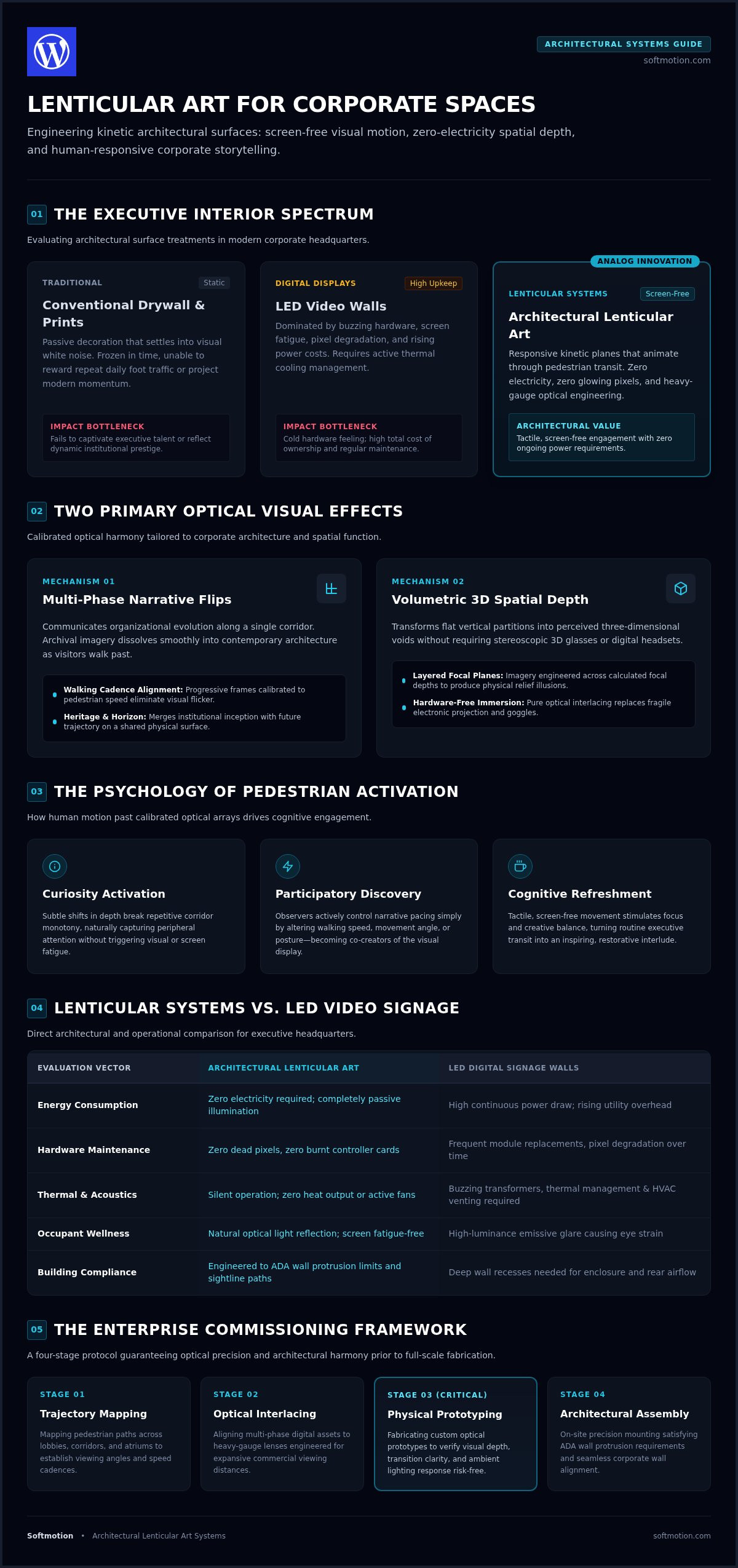
Pedestrian motion creates the engine for visual transformation. When people walk past a calibrated optical array, the gradual shift in viewing angles reveals alternate image phases. This optical mechanic taps directly into human spatial perception:
- Curiosity activation: Subtle shifts in depth break corridor monotony, naturally capturing peripheral attention without visual fatigue.
- Participatory discovery: Observers actively control the narrative pacing simply by adjusting their walking speed, direction, or posture.
- Cognitive refreshment: Tactile, screen-free movement stimulates creative focus, transforming a routine elevator walk into an inspiring pause.
Deploying thoughtfully engineered lenticular art for corporate spaces converts everyday corporate transit into an ongoing encounter with craftsmanship and company identity.
Lenticular Visual Effects: Selecting Motion and Depth for Corporate Interiors
Optical effects in enterprise architecture must serve spatial function rather than mere spectacle. While novelty items rely on abrupt, jarring picture changes, executive installations require calibrated optical harmony. Academic research exploring the impact of workplace art demonstrates that dynamic environments foster visual engagement and human connection across corporate environments. Specifying purposeful lenticular art for corporate spaces transforms interior expanses into sophisticated visual dialogues.
Multi-Phase Flips for Corporate Narrative and Heritage Storytelling
Every enterprise possesses a foundational history and a future trajectory. Multi-phase flips allow organizations to communicate this evolution across a single wall. Archival photographs of a company’s inception dissolve smoothly into contemporary structural designs as observers walk past. Engineering progressive frame sequences matched to average walking cadences ensures smooth, seamless transitions without flicker. Exploring curated fine art lenticular prints allows design teams to balance narrative depth with gallery-grade aesthetic restraint.
Volumetric 3D Depth and Spatial Illusion
Volumetric lenticular arrays turn flat surfaces into perceived three-dimensional voids without requiring stereoscopic glasses or digital headsets. By layering imagery along calculated focal planes, designers create the optical sensation of deep relief and floating geometric forms. This spatial expansion works wonders in narrow executive elevator vestibules or boardrooms, visually opening up structural enclosures while maintaining comfortable optical clarity.
Directional Agamograph Effects for Dual-Traffic Corridors
Corridors and security portals experience distinct pedestrian vectors: arrival and departure. Directional agamograph-style prints leverage these twin viewing trajectories. Consider how an installation can adapt to its audience:
- Arrival perspective: Greet clients and arriving staff with an inspiring brand vision, high-contrast typography, or bold visual iconography.
- Departure perspective: Present an organic, abstract pattern or serene compositional motif to employees transitioning home.
- Security thresholds: Maintain distinct messaging bifurcations across key transition points, providing two visual identities within a single structural footprint.
Planning these installations alongside a seasoned partner like Softmotion ensures optical registration remains razor-sharp from every architectural approach.
Lenticular Installations vs. Digital Signage: The Case for Analog Innovation
Digital displays were long seen as the easiest way to modernize a corporate lobby. Today, massive LED walls often evoke airport departure gates rather than executive distinction. As an academic analysis of lenticular art demonstrates, optical lens surfaces deliver flat, wall-hung sculptural dynamism while bypassing digital fragility. Choosing custom lenticular art for corporate spaces gives interior architects and facilities teams a permanent aesthetic asset that doesn’t suffer from software glitches, licensing subscriptions, or sudden hardware failures.
Sustainability, Operating Costs, and Zero-Power Operation
Digital video walls demand significant electrical power, dedicated audiovisual equipment closets, and extra HVAC cooling to counter persistent heat buildup. Over several years, technician service calls, pixel replacement, and calibration cycles drive up operating overhead. Optical lenticular surfaces, by contrast, rely on pure physics:
- Zero grid power: Operates day and night without drawing a single watt of electricity.
- Thermal neutrality: Produces no heat, eliminating the need for recessed fan ventilation or wall ducting.
- ESG alignment: Utilizes durable, architectural-grade optical polymers that won’t end up in an e-waste landfill every five years.
Combating Workplace Screen Fatigue with Tactile Media
Most knowledge workers spend their entire workday staring at emissive, backlit monitors. Meeting them at the front entrance with another wall of glowing pixels adds to cognitive exhaustion. Lenticular installations activate via ambient room light, providing a softer, reflective viewing experience that gives the eyes a welcome break while retaining captivating kinetic motion. The piece interacts naturally with architectural fixtures and changing daylight patterns, making the interior feel organic rather than electronic.
Stepping away from digital screens allows leadership to construct spaces that feel grounded and tactile. Integrating lenticular art for corporate spaces provides the visual intrigue of continuous motion alongside the structural permanence of fine architectural finishes.
Strategic Placement: Curating Lenticular Art Across Corporate Architecture
Optical media must be integrated into floor plans with architectural precision. Simply hanging a dynamic installation on any open wall overlooks the delicate geometry of human sightlines, pedestrian pacing, and environmental lighting. Properly curated lenticular art for corporate spaces demands an exacting balance between lens pitch, viewing clearance, and ambient light distribution to achieve seamless motion without optical ghosting.
Double-Height Atriums and Main Reception Foyers
Cavernous lobby atriums require broad visual statements. In these voluminous environments, installations anchor monumental feature walls, commanding attention from entering guests and riders on descending escalators alike. Engineering wide viewing cones ensures the artwork animates smoothly across wide angles, harmonizing with shifts in natural daylight filtering through expansive glass facades.
Elevator Lobbies, Executive Boardrooms, and Transition Corridors
Confined spaces call for controlled, linear motion. Along executive corridors and elevator portals, narrower viewing angles keep visual pacing in rhythm with pedestrian footsteps. Within boardrooms, subdued color palettes and deliberate shifts preserve professional focus while preventing visual fatigue. When designing multi-panel displays, alignment is paramount. Following proven frameworks for large format lenticular printing allows architects to embed seams naturally within custom architectural reveals or millwork.
Lighting Specifications and Lens Pitch Calibration
Lighting directly dictates optical performance. Because lenticular lenses act as tiny optical prisms, stray ambient light can introduce ghosting or wash out visual layers. Mastering these core technical parameters guarantees optimal clarity:
- Lenses per inch (LPI) selection: Low-LPI lenses with thicker profiles suit long-range atrium viewing, while fine, high-LPI sheets preserve crisp visual detail in close-contact corridors.
- Lighting geometry: Aim directional spotlights perpendicular to the lens ridges. Washing light directly down the linear lenticules blurs the interlaced imagery beneath.
- Anti-glare mitigation: Specify matte lens finishes or low-reflection surfaces to eliminate hot spots from commercial curtain walls and overhead fixtures.
- Regulatory compliance: Installations mounted between 27 and 80 inches above the floor must not project more than 4 inches into circulation paths to meet ADA protrusion standards, alongside adhering to local commercial interior fire codes.
Review your spatial layout with Softmotion to calibrate optical pitch, lighting parameters, and mounting tolerances tailored to your facility.
Commissioning Custom Corporate Lenticular Projects with Softmotion
Enterprise installations demand complete predictability. Executing architectural-scale art is never as simple as uploading a digital file to a standard print queue. Since 1997, Softmotion has executed over 1,000 installations worldwide for Fortune 500 corporations, renowned architectural practices, and major cultural institutions. Delivering monumental lenticular art for corporate spaces requires a disciplined, turnkey commissioning framework that eliminates creative risk long before the final panels arrive on site.
The Design, Sampling, and Digital Interlacing Phase
Every successful commission begins as a close collaboration among corporate art committees, interior architects, and brand leadership. Creative concepts are translated into multi-layered digital compositions, with each optical layer mathematically calibrated to match specific viewing distances and pedestrian movement paths. Rather than advancing blindly into final fabrication, teams evaluate physical custom lenticular prototypes. These tangible scale models allow decision-makers to inspect color fidelity, phase transitions, and visual clarity directly beneath the project’s actual ambient lighting.
Turnkey Fabrication, Site Logistics, and White-Glove Installation
Once the physical prototype earns full approval, full-scale fabrication begins using industrial-grade, UV-stable optical polymers and specialized large-format flatbed printing systems. Precision is everything. An alignment error of less than a millimeter across adjacent panels can shatter the optical illusion. Softmotion manages the entire journey from fabrication to final structural handover:
- Material engineering: Industrial optical media engineered specifically to resist UV yellowing, thermal expansion, and surface degradation over decades of display.
- Logistics coordination: Specialized crate rigging, freight scheduling, and facility staging aligned smoothly with building operations.
- Precision assembly: Dedicated installation teams align panel seams with sub-millimeter tolerances, integrating seamlessly with surrounding architectural millwork.
Investing in lenticular art for corporate spaces turns executive environments into enduring monuments to innovation. With three decades of optical craftsmanship guiding every phase, the commissioning experience remains as composed and dependable as the final installation itself.
Bring Kinetic Storytelling to Your Executive Environment
Static drywall and buzzing video walls no longer meet the elevated standards of modern workplace design. Physical kinetic installations replace digital fatigue with an authentic, participatory experience that animates naturally alongside pedestrian foot traffic, all without consuming a single watt of grid electricity. Specifying lenticular art for corporate spaces allows forward-thinking organizations to honor institutional heritage while projecting an ambitious vision through an enduring, tactile architectural medium.
Realizing enterprise-scale optical motion requires a fabrication partner with seasoned technical discipline. Since 1997, Softmotion has delivered over 1,000 corporate and architectural installations worldwide, serving as a trusted collaborator to Fortune 500 enterprises, world-class architects, and cultural museums. Our custom physical prototyping process guarantees optical precision, phase transition smoothness, and visual fidelity before final manufacturing begins. Transform your corporate headquarters with bespoke architectural lenticular art from Softmotion and establish an interior environment that inspires every client and colleague who walks through your doors.
Frequently Asked Questions
What is lenticular art and how does it function in a corporate interior?
Architectural lenticular art combines interlaced graphic imagery with specialized optical lenses to produce dynamic motion or 3D depth on a flat surface. In corporate lobbies and executive boardrooms, the artwork activates as visitors walk past. It requires zero electricity, batteries, or digital hardware. Instead, physical light refraction delivers fluid shifts in imagery based purely on the observer’s viewing angle, transforming ordinary structural walls into interactive, screen-free narrative centerpieces.
How does lenticular artwork differ from digital video screens or LED video walls?
Lenticular art is an analog, physical medium that relies on ambient light rather than powered electronic light emitting diodes. While LED video walls suffer from burn-in, dead pixels, high utility bills, and heat output, lenticular installations run maintenance-free 24/7. Integrating custom lenticular art for corporate spaces also eliminates workplace screen fatigue, offering a refined, tactile alternative that reads as high-end fine art rather than commercial electronic advertising.
Can our company integrate proprietary brand assets, history, and typography into the design?
Yes, every architectural installation is fully custom-engineered around your brand identity, corporate timeline, and aesthetic objectives. Archival photography, corporate values, architectural renderings, and vector logos can be layered into multi-phase flips or volumetric 3D graphics. Our design team collaborates closely with your brand committee to ensure all typography remains legible across designated angles while historical imagery transitions smoothly into your future vision.
What specialized lighting is required to illuminate large-scale lenticular wall art?
Standard directional track lighting or recessed spotlights provide ideal illumination when aimed perpendicular to the lens ridges. Washing light parallel along the ridges must be avoided, as it blurs the interlaced imagery underneath. Softmotion works directly with your interior architects and lighting designers to specify the correct color temperature and beam angles, preventing specular glare from nearby glass curtain walls and ensuring sharp optical clarity across all viewer transit paths.
How durable is lenticular wall art in high-traffic commercial environments?
Enterprise installations use heavy-gauge, shatter-resistant optical polymers engineered to withstand high-traffic commercial environments. Unlike fragile electronics or unvarnished canvas prints, these optical lens sheets resist scratches, yellowing from UV light exposure, and everyday impacts. Regular custodial maintenance requires only standard non-abrasive microfiber dusting and mild cleaners, ensuring the installation maintains museum-quality optical clarity over decades of continuous display in busy atriums and corridors.
What is the typical timeline for commissioning and fabricating custom architectural lenticular installations?
Commissioning lenticular art for corporate spaces generally spans several weeks to a few months, depending on overall scale, spatial complexity, and physical proofing cycles. The process moves through digital file preparation, physical optical proofing, large-format panel fabrication, and on-site assembly. Softmotion delivers physical scale prototypes first so leadership can review motion transitions and material finishes directly on site, ensuring the schedule proceeds smoothly without unexpected fabrication delays.
Can lenticular art panels be engineered to meet commercial fire codes and interior safety standards?
Yes, materials and mounting assemblies are engineered to satisfy strict commercial building safety codes. Installations can be fabricated using flame-retardant optical polymers that comply with Class A interior fire ratings. Mounting profiles are also engineered to maintain wall projection depths under 4 inches along circulation corridors, ensuring seamless compliance with federal ADA protrusion guidelines while securing panels firmly to underlying structural wall systems.