
Lenticular Art Commissions for Collectors: Value and Appeal
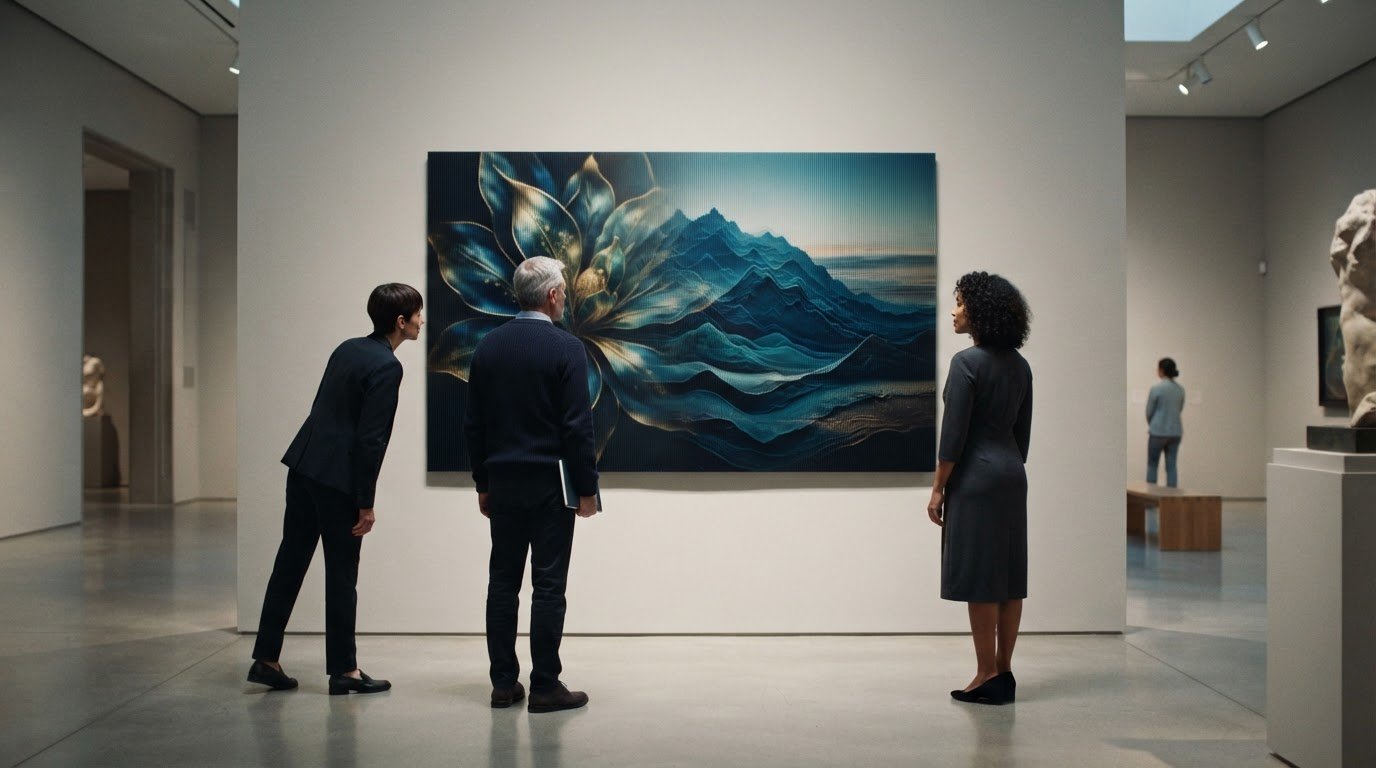
A lenticular artwork changes as you move: its printed image can shift between two or more visuals, or create an illusion of depth or motion. It doesn’t offer the full 360-degree perspective associated with a hologram. For collectors, the appeal of lenticular art commissions for collectors lies in how a fixed image can reveal new details from a different viewing angle.
The appeal goes beyond novelty. A carefully conceived piece invites viewers to participate, while its image sequence, viewing conditions, and presentation shape how it feels to live with and collect.
This guide to lenticular art commissions for collectors explains how lenticular effects work, what shapes their visual impact, and how to compare a bespoke commission with a fine art edition. It also covers the key considerations around concept, craftsmanship, display, and collecting.
Key Takeaways
- Understand how changing images and perceived depth make lenticular art an active viewing experience.
- Match the artwork’s visual effect to its intended viewing distance, lighting, and display setting.
- Compare a bespoke commission with a fine art edition by considering creative intent, presentation, and the experience you want to collect.
- Explore how lenticular printing can translate an artistic concept into a dynamic fine art print or larger visual installation.
Lenticular art and optical effects
Lenticular art makes a printed surface change as the viewer moves. A lens sheet directs different image strips toward each eye or viewing position, producing perceived depth, movement, or a changing sequence. The technique has appeared on printed collectibles since the 1940s, but fine art uses it to make the act of looking part of the work.
Glasses-free stereoscopic effects rely on two or more images, each prepared from a slightly different viewpoint. The lenses guide those images to the viewer’s eyes, creating an impression of depth without eyewear. The effect is not a full 360-degree view: the surface presents designed perspectives, not an unrestricted view around an object. More images can create transitions or animation, but they also demand precise alignment.
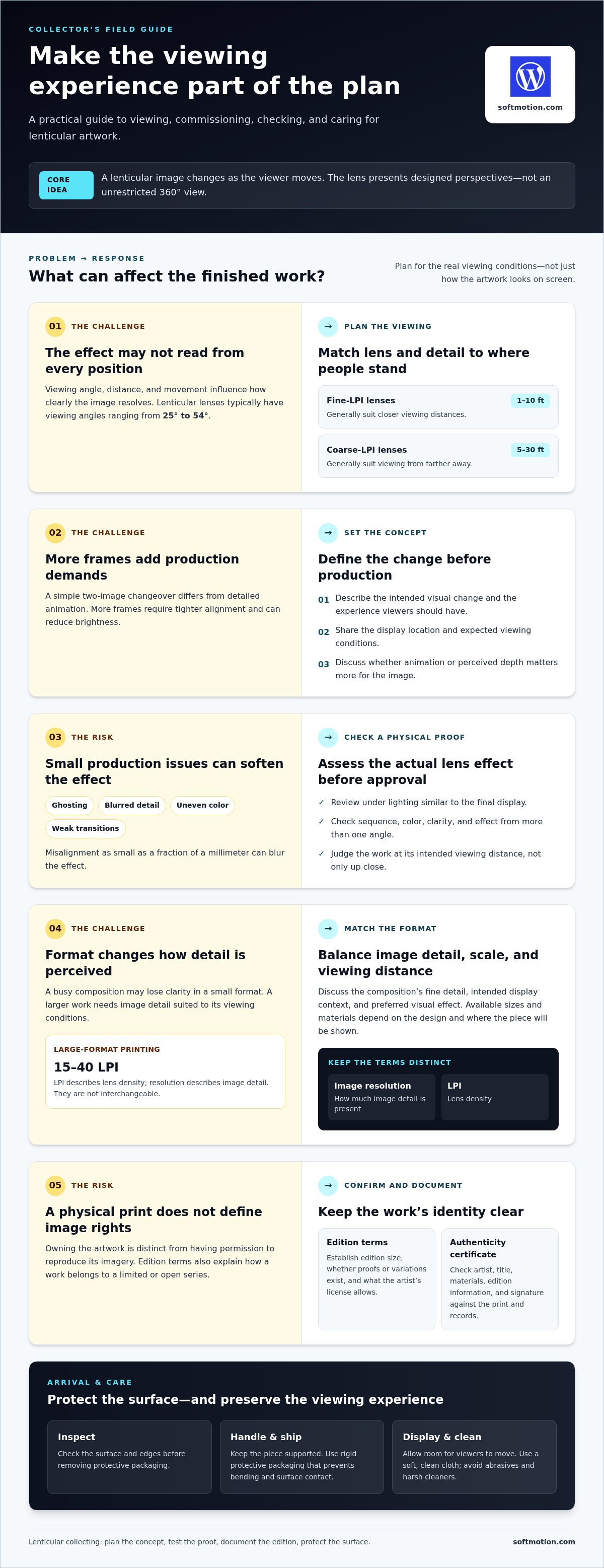
Viewing angle shapes what the work reveals. Lenticular lenses typically have viewing angles ranging from 25 to 54 degrees, so placement and movement affect how clearly images resolve. Fine-LPI lenses generally suit viewing distances of 1 to 10 feet, while coarse-LPI lenses generally suit 5 to 30 feet. Match the lens and image detail to where collectors will stand, rather than judging the piece only at close range.
Custom commissions are pursued through artists working with optical or kinetic imagery and specialist studios that can translate artwork into lenticular prints. Yaacov Agam began incorporating lenticular processes into his art in the late 1950s, offering a notable historical example of this artistic approach. In the United States, galleries and art fairs featuring optical or kinetic art can present relevant work; specialist studios focus on the technical production that makes a lenticular concept viewable.
A commission’s price and production time depend on its scale, image sequence, lens choice, file preparation, and proofing needs. A simple two-image changeover has different production demands from a detailed animation with many frames. More frames require tighter alignment and can reduce brightness. Reviewing proofs under the intended gallery lighting helps assess color, detail, and the final effect before production.
Collecting strategies and considerations
A thoughtful purchase starts with the image, then considers how it will be viewed, handled, and displayed. For a custom piece, clear decisions at each stage help align the finished artwork with your collecting goals.
Commissioning and Approving Artwork
Commissioning begins by translating an artistic concept into an image sequence for a lenticular surface. Describe the intended visual change, display location, and experience you want viewers to have. The artist and production studio can then develop image materials and a proof for review. Before production, assess the sequence, color, clarity, and effect under suitable viewing conditions. This review matters because a striking concept on screen may look different through a physical lens.
Ordering and Receiving Artwork
Once the artwork and production specifications are approved, confirm the final dimensions, presentation, delivery address, and packaging arrangements. On arrival, inspect the surface and edges before removing protective packaging, and keep the piece supported while handling it. For shipping, use rigid protective packaging that prevents bending and surface contact. Display the work securely, with enough room for viewers to move and experience the image transition. Clean it gently with a soft, clean cloth, avoiding abrasive materials and harsh cleaners that could mark the surface.
Quality Issues and Buying Risks
Common quality issues include ghosting, blurred detail, uneven color, and transitions that appear weak from the intended viewing position. Misalignment as small as a fraction of a millimeter can blur the effect. Review a physical proof under lighting similar to the final display, and assess clarity from more than one viewing angle. Larger artwork also needs a viewing distance suited to its lens and image detail. Treat commercial examples, such as lenticular postcards, as references for effects, not as proof that a larger custom work will look identical. Collectors exploring a bespoke visual concept can consider lenticular print possibilities as part of their planning.
Fine-art editions and collecting
A lenticular edition combines an artist’s image sequence with a lens material, so format choices shape its presentation and perception. For collectors, the key is matching the physical work to its visual purpose and documenting what makes each piece part of an edition.
Sizes, Materials, and Print Resolutions
Size, lens material, and image resolution determine how clearly a lenticular artwork reads at its intended viewing angle. Available formats depend on the piece’s design and display context, rather than one standard menu of sizes or materials. Large-format lenticular printing typically uses lenses in the 15 to 40 LPI range. Resolution describes image detail; LPI describes lens density, so the terms aren’t interchangeable.
Discuss the image’s fine detail, intended viewing distance, and whether animation or depth matters more. A busy composition may lose clarity in a small format, while a larger work needs image detail suited to its viewing conditions. A work intended for a museum-style display, for example, may call for a different balance of scale and movement than one viewed closely at home.
Licensing, Editions, and Authenticity Certificates
Licensing defines permitted uses of an image, while edition terms explain how a work belongs to a limited or open series. These details matter because owning a physical print is distinct from having permission to reproduce its imagery. Before purchasing, establish the edition size, whether proofs or variations exist, and what the artist’s license allows. Keep those terms with the transaction documents.
A certificate of authenticity can identify the artist, title, materials, edition information, and signature associated with a specific work. Check that its details match the print and any accompanying records. For a numbered edition, compare the number on the certificate with the one on the artwork. Clear documentation helps distinguish the intended edition from later reproductions and preserves useful provenance for future collecting.
Novelty alone doesn’t establish lasting artistic value. Consider how the artist uses optical precision to support the concept, whether the image sequence rewards repeated viewing, and how the material suits the display. These qualities help distinguish an engaging lenticular artwork from an effect used only to surprise.
Lenticular art and collector appeal
Lenticular prints sit between traditional fine-art prints and sculpture. A print often rewards close attention to a fixed image; a sculpture changes as the viewer moves around its physical form. Lenticular work brings movement to a flat surface through interlacing, so a shift in position can reveal another image or a sense of depth. Its appeal lies in this active viewing experience, not simply in the use of plastic.
That distinction matters when seeking a work with enduring visual interest. The Rolling Stones’ 1967 album cover for Their Satanic Majesties Request shows how lenticular imagery can make an object feel vivid and memorable. In contemporary art, the same principle can serve a concept: a changing portrait might explore identity, while a shifting landscape could suggest time or transformation. Motion becomes part of the artist’s composition.
Collectibility still depends on more than novelty. Consider the artist’s intention, the relationship between each image, the resolution of fine detail, and how the work reads from its intended viewing positions. Lenticular comic-book covers have appeared as collectible variants since the 1990s, showing how a changing image can distinguish an edition. For fine art, edition documentation and the work’s condition also help establish what a specific piece represents.
To assess an artwork, view it from several positions and notice whether each transition feels deliberate. Check that the interlacing supports the image rather than distracting from it, and consider whether the plastic surface suits your display and handling habits. Properly handled and framed lenticular prints can maintain clarity and color for decades. Collectors seeking a piece that unites image, motion, and material can explore a lenticular art concept for a considered fine-art presentation.
Softmotion: Advertising Lenticular Displays
Softmotion translates static visual ideas into lenticular work that changes with the viewer’s position. For collectors developing a fine-art concept, Fine Art Lenticular Prints bring this image-making approach into a collectible format. Architectural concepts can take shape as Architectural Lenticular Installations, while Advertising Lenticular Displays and Tradeshow Lenticular Graphics serve visual communication in public and event settings.
Consider Softmotion when your concept depends on movement, shifting imagery, or a surface that engages viewers from different angles. The setting and intended viewing experience can help determine which format best supports the idea. A lenticular effect may not suit artwork built around a single, unchanging image, but it can give a sequence or transformation a physical presence.
Visit softmotion.com to discuss your lenticular art concept with Softmotion.
Give Your Collection a New Point of View
Start by deciding what role a changing image should play in your collection. Should it invite a closer look, alter a room’s mood, or make an architectural surface feel newly expressive? A clear creative intention gives lenticular art commissions for collectors meaningful direction before production begins.
Softmotion creates Fine Art Lenticular Prints for collectible pieces, Architectural Lenticular Installations for spatial concepts, and Advertising Lenticular Displays for visual communication. The right format depends on the artwork’s purpose and where people will encounter it. A commission can begin with a single image or an idea that unfolds through movement, then develop into a visual experience shaped for its setting.
Bring your concept, reference images, or questions about a possible commission into the conversation. Contact Softmotion about a commission and explore how your idea might take form. A considered first conversation can help move an ambitious vision toward an artwork with a distinct presence in your collection.
Frequently Asked Questions
What Is Lenticular Art?
Lenticular art is designed to change appearance as the viewer changes position. Printed imagery and a lens surface turn a flat composition into an experience shaped by movement. An artist might use the shift to contrast two scenes, reveal a hidden detail, or suggest depth. The effect is optical, not a fully three-dimensional view around the artwork.
What is lenticular art and how does it work?
Lenticular art works by placing a lens sheet over narrow interlaced strips from multiple images. Each lens directs different strips toward the viewer, so the visible image changes with their position. For example, a portrait could transition between two expressions as someone walks past. The source images must be composed and aligned for the lens, making image preparation central to the finished visual effect.
What styles and image effects are available for commissioned lenticular artwork?
Commissioned lenticular artwork can use image changes, perceived depth, or animated movement. A two-image flip can contrast subjects or moments, while a stereoscopic composition creates an impression of depth. A sequence can suggest motion, such as a figure turning or an object unfolding. Choose an effect that strengthens the artwork’s idea: extra visual change isn’t automatically more expressive.