
Large Scale Lenticular Murals: The Definitive Guide to Dynamic Architectural Surfaces
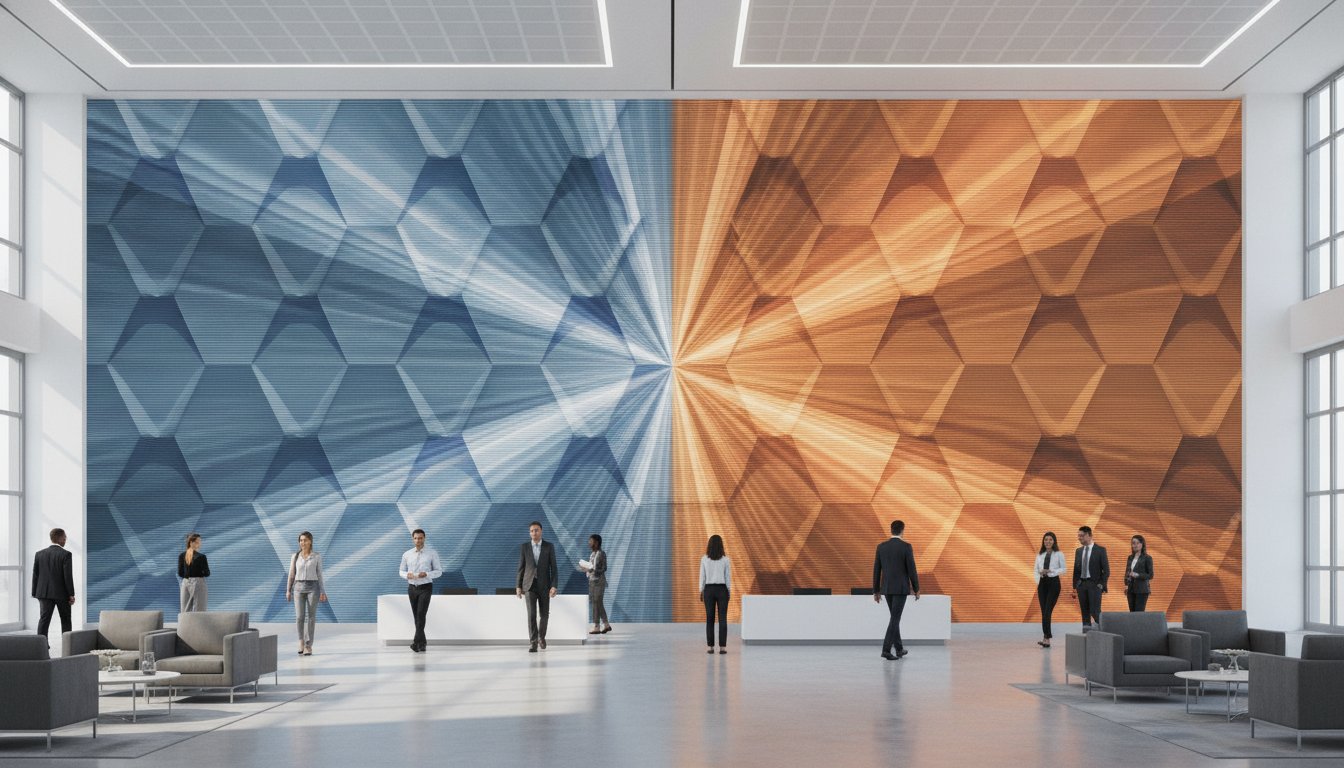
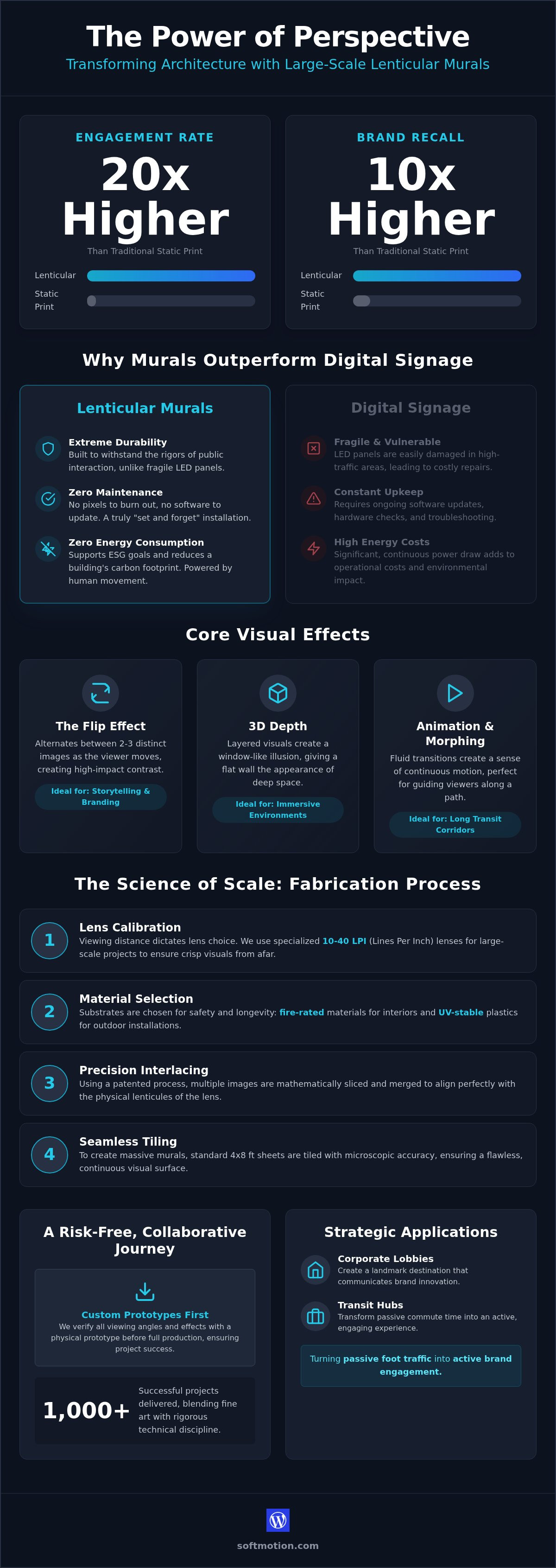
Did you know that lenticular media achieves 20 times higher engagement rates and 10 times the brand recall of traditional static print? In an era where digital screens often feel distracting and maintenance-heavy, the most impactful architectural interventions are often those that move with the viewer rather than at them. Large scale lenticular murals represent a sophisticated bridge between fine art and technical engineering. They offer a way to transform a standard transit hub or corporate lobby into a landmark destination without the high costs or technical vulnerabilities of digital signage.
You likely recognize the frustration of seeing a high-traffic wall feel uninspiring or flat despite a significant investment in design. We understand that the fear of technical failure in massive installations can often stall visionary projects. This guide will show you how to harness the power of physical motion to create a genuine wow factor that engages viewers on a human level. We will walk through the entire journey, from the initial conceptual vision to the end-to-end fabrication process; ensuring your next project is both a creative triumph and a grounded professional success.
Key Takeaways
- Discover how large scale lenticular murals reimagine static architectural surfaces as immersive, perspective-shifting environments that engage viewers without the need for digital power.
- Learn how technical variables like Lines Per Inch (LPI) and viewing distance are calibrated to ensure visual clarity. Precise lens choice is the foundation of every successful installation.
- Explore strategic applications for transit hubs and corporate lobbies. Kinetic surfaces turn passive foot traffic into active brand engagement.
- Understand the importance of a risk-free fabrication process. Utilizing custom prototypes verifies viewing angles before full-scale production begins.
- Gain insight into the collaborative journey of delivering over 1,000 successful projects. We blend fine art sensibility with rigorous technical discipline.
What Are Large Scale Lenticular Murals?
Static surfaces often fail to command attention in bustling environments. While traditional art remains fixed, large scale lenticular murals act as a living architectural skin that responds to the movement of the observer. These installations aren’t merely oversized posters; they’re engineered surfaces that utilize lenticular printing technology to create a multi-dimensional experience. As people walk through a corridor or wait in a lobby, the wall shifts, evolves, and tells a story based entirely on their physical perspective. This creates a “low-tech, high-impact” environment where the architecture itself becomes a participant in the room.
The Core Visual Effects: Flip vs. 3D Depth
The magic of these installations lies in the specific visual mechanics chosen during the design phase. We work with clients to determine which effect best suits the spatial flow of their environment.
- The Flip Effect: This is the most direct form of engagement. It allows two or even three distinct images to alternate as the viewer passes by. It’s ideal for storytelling or branding that requires high-impact contrast.
- 3D Depth: By layering visual information, we create a window-like illusion. A flat wall can suddenly appear to have miles of deep space, drawing the viewer’s eye into a secondary dimension.
- Animation and Morphing: For long transit corridors, fluid transitions are more effective. These effects create a sense of continuous motion, mimicking the pace of the commuter as they walk alongside the surface.
Why Murals Outperform Digital Signage in Public Spaces
Digital screens are often the default choice for dynamic content, but they come with significant baggage. Large scale lenticular murals offer a compelling alternative for high-traffic public spaces that prioritize reliability and sustainability. They require zero energy consumption. This directly supports corporate ESG goals and reduces the long-term carbon footprint of a building. Since there are no pixels to burn out or software to update, the maintenance requirements are virtually nonexistent.
Durability is another critical factor. Unlike fragile LED panels, these surfaces are built to withstand the rigors of public interaction. There is also a certain “analog magic” involved that digital screens often lack. A digital screen dictates what you see through a fixed frame, but a lenticular mural invites you to participate. The motion is powered by the human body, making the experience feel personal, tactile, and deeply integrated into the physical space.
The Science of Scale: How Large Format Lenticular Murals Are Fabricated
Fabricating large scale lenticular murals requires a transition from standard printing to precision engineering. At the heart of this process is the lenticular lens, a series of clear, extruded plastic ridges called lenticules. These ridges act as optical prisms, directing different slices of light to each eye or shifting the image as the viewer changes position. This creates the illusion of motion or depth. While small scale prints often use high LPI (Lines Per Inch) for detail, architectural projects demand a different strategy. Viewing distance dictates the lens choice. If a viewer stands 20 feet away in a lobby, a fine lens will lose its effect. Instead, we utilize specialized lenses ranging from 10 LPI to 40 LPI. These coarser lenses ensure the visual transformation remains crisp and legible from across a room.
Large Format Lenticular Sheets and Materials
Selecting the right substrate is as much about safety as it is about aesthetics. For interior installations, we prioritize fire-rated materials that meet strict building codes. Outdoor projects require UV-stable plastics to prevent yellowing or warping under direct sunlight. Interlacing is the mathematical slicing and merging of images for lenticular lenses. This complex preparation ensures that the final print aligns perfectly with the physical lenticules. This patented lenticular printing process illustrates the technical rigor required to maintain visual fidelity at this magnitude.
Achieving Seamless Visuals Across Massive Surfaces
The greatest challenge in creating large scale lenticular murals is scaling beyond the standard 4 foot by 8 foot sheet size. When an installation spans 50 feet, multiple panels must be tiled with microscopic accuracy. Any misalignment at the joints causes “ghosting,” where the images bleed into one another or the motion effect breaks. We engineer panel joints to ensure continuity, treating the seams as part of the structural design rather than an afterthought.
Our approach involves integrating large format lenticular printing into broader wall cladding systems. This ensures the mural sits flush with the surrounding architecture. If you’re planning a complex installation, exploring our custom fabrication options can help clarify the technical path forward. Precision mounting techniques allow us to maintain the integrity of the effect across hundreds of square feet, transforming a series of panels into one unified, moving canvas.
Strategic Applications for Large Scale Motion Displays
Environments define how we feel, yet most architectural surfaces remain static and silent. A massive wall in a high-traffic area is often a missed opportunity for engagement. Large scale lenticular murals offer a way to reclaim these passive surfaces, turning them into active participants in the room. By aligning the visual effect with the natural flow of foot traffic, we can create environments that feel alive. These installations don’t just sit on a wall; they interact with every person who walks past, creating a unique experience for every individual perspective.
Architectural Storytelling in Corporate Environments
In corporate lobbies, these murals serve as storytelling landmarks. Imagine a “before and after” flip that showcases a company’s evolution as a visitor walks toward the reception desk. It’s not just a decoration; it’s a narrative. This is where lenticular art for museum exhibitions translates perfectly to the corporate world. It brings a level of sophistication and archival quality that standard graphics simply can’t match. In windowless corridors or elevator banks, these surfaces introduce a sense of depth and movement, making enclosed spaces feel more expansive and dynamic.
Experiential Marketing and Public Engagement
Beyond the office, transit hubs provide the ultimate stage for physical interaction. Commuters are constantly in motion, which makes them the perfect audience for kinetic advertising displays. There is a profound psychological reward in this interaction. When a viewer’s movement “triggers” a visual change, it creates a sense of agency and discovery. This “analog interactivity” feels more human and less intrusive than a glowing screen. It encourages people to slow down, look back, and often share the experience on social media.
Retailers and museum curators use these surfaces to stop foot traffic in its tracks. A window display that morphs as you walk past creates a “double take” moment that digital screens often fail to achieve because we’ve become desensitized to glowing pixels. In museums, large scale lenticular murals invite physical exploration, turning the act of viewing into a performance. Whether it’s a feature wall in a flagship store or a fine art installation, the goal is the same: to reward the viewer for their presence and their movement through the space.
Project Management: From Prototypes to Installation
Executing a high-stakes architectural project requires more than a standard vendor relationship. It demands a rigorous, phased approach that mitigates risk at every turn. We begin with conceptual design, where we select the specific visual effect, such as Flip, 3D, or Motion, that aligns with the site’s architectural intent. This leads directly into developing custom lenticular prototypes. These physical models are essential for verifying viewing angles and image clarity before any full-scale production begins. Since 1997, we’ve refined this process to ensure that the transition from a digital concept to a physical landmark is seamless and predictable.
The Importance of Sampling and Prototyping
Why does a 12 foot by 12 foot mural require a 1 foot by 1 foot physical sample? Digital mockups cannot replicate the way physical lenticules interact with ambient light. Lighting conditions in a transit hub or a sun-drenched lobby differ wildly from a studio environment. Testing a small-scale sample on-site allows us to validate color accuracy and effect strength under real-world conditions. We collaborate closely with architects during this phase to ensure the mural integrates within broader cladding systems. This ensures that large scale lenticular murals don’t just sit on a wall; they become a structural part of the environment.
Installation Logistics for Large Scale Murals
The final phase is the most critical: on-site installation. Large scale projects often involve coordinating with general contractors and union labor, especially in public transit hubs or high-traffic corporate headquarters. We manage these logistics to ensure a smooth transition from the factory to the wall. A key part of this process is managing the “viewing cone.” We ensure the primary motion effect is calibrated to the paths commuters or visitors actually take. This precision prevents “dead zones” where the effect might break or become illegible.
After the installation is complete, these surfaces require minimal care. A simple cleaning protocol maintains the clarity of the lens, ensuring the architectural durability of the mural for years to come. If you are ready to start your next landmark project, contact our team for a strategic consultation. Our end-to-end management approach allows you to focus on the vision while we handle the technical complexities of bringing large scale lenticular murals to life.
Why Softmotion for Large Scale Lenticular Projects?
Choosing a partner for a landmark installation is a decision rooted in trust. When you’re dealing with the technical complexity of large scale lenticular murals, the margin for error is razor-thin. We don’t just provide prints; we act as a Visionary Guide for architects and Fortune-500 brands who need to transform high-traffic environments into memorable experiences. With over 1,000 projects completed since 1997, Softmotion brings a level of grounded professional reliability that only decades of specialized experience can offer. We handle every detail, from the first conceptual sample to the final screw in the mounting system. This end-to-end service ensures a risk-free journey for our collaborators, making the brand feel like a true partner rather than a distant vendor.
A Legacy of Innovation Since 1997
Our history is defined by pushing the boundaries of what’s possible with light and perspective. We’ve watched the industry evolve from simple novelties to sophisticated lenticular building facades that redefine city skylines. This evolution requires a manufacturer that understands the high stakes of architectural permanence. We respect the original vision of the architect, ensuring our project-based designs serve the building’s intent rather than distracting from it. This commitment to craftsmanship means your installation will remain as striking in ten years as it is on opening day. We possess the rare ability to see hidden potential in ordinary walls and the technical discipline to realize that potential.
Global Reach, Custom Precision
While our technical discipline is rigorous, our approach is deeply human and collaborative. We don’t believe in “off-the-shelf” solutions for visionary spaces. Every mural we create is built from scratch, tailored to the specific lighting, viewing distances, and foot traffic patterns of your site. Our ability to deliver and install projects worldwide means international clients receive the same precision and care, regardless of location. This global reach is paired with a quiet confidence; we don’t need to shout because our portfolio of high-stakes corporate and public projects speaks for itself. We’ve spent nearly thirty years preventing the common scale-related failures that can derail large scale lenticular murals. If you’re ready to turn a static surface into a dynamic landmark, partner with Softmotion for your next large-scale installation and experience the clarity of working with a seasoned leader.
Transform Your Space into a Living Landmark
Architectural surfaces shouldn’t just exist; they should inspire. By integrating large scale lenticular murals into your design, you replace passive transit with active engagement. You’ve seen how the science of light and perspective can turn a simple corridor into a multi-dimensional narrative without the fragility or energy costs of digital hardware. The key to success lies in the balance between visionary art and rigorous technical engineering.
With a legacy of delivering over 1,000 projects worldwide since 1997, we understand the high stakes of architectural scale. Our collaborative process includes custom prototyping to ensure your vision translates perfectly to the physical wall. We’re here to guide you through every technical hurdle, from lens selection to the final installation. It’s time to reimagine what your environment can achieve and create a lasting sensory experience for every person who walks through your doors.
Begin your dynamic mural project with a Softmotion expert consultation and discover the potential hidden within your architecture.
Frequently Asked Questions
How large can a lenticular mural actually be?
We don’t have a functional limit to the dimensions of a mural. We achieve massive scales by tiling multiple high-precision panels together. While individual sheets have maximum extrusion sizes, our engineering team ensures that the joints remain invisible to the viewer. This allows us to cover expansive transit corridors and building facades with a continuous, motion-driven surface that maintains visual integrity across hundreds of square feet.
Do large scale lenticular murals require special lighting?
Lighting is the engine that powers the lenticular effect. Directional light sources, such as track lighting or recessed spots, are ideal because they create the sharp shadows needed for the lenticules to function. Diffuse or fluorescent lighting can sometimes soften the transition between images. It’s important to evaluate your site’s specific ambient light during the prototyping phase to calibrate the lens and ensure the visual transformation remains vibrant and clear.
What is the lifespan of an architectural lenticular installation?
Architectural lenticular installations are built for longevity. Interior murals typically maintain their visual impact for 10 to 20 years or more. Unlike digital signage hardware that requires frequent component replacement, these physical surfaces are resistant to technical failure. The high-grade plastics we use are selected for their durability in high-traffic areas, ensuring your investment remains a landmark feature for the long term without the burden of constant maintenance.
Can lenticular murals be installed outdoors on building facades?
Yes, we design installations specifically for exterior building facades. These projects utilize UV-stable, weather-resistant materials that prevent yellowing and warping under direct sunlight. Since 1997, we’ve delivered over 1,000 projects globally, including outdoor environments that demand extreme durability. These kinetic surfaces provide a sustainable, low-maintenance alternative to digital screens, offering a unique visual experience that changes with the sun’s position and the viewer’s movement.
How do you clean and maintain a large format lenticular wall?
Maintaining a large format lenticular wall is straightforward and requires no technical expertise. You can clean the surface using a soft, lint-free cloth with mild soap and water. It’s important to avoid abrasive cleaners or harsh solvents that might scratch the plastic ridges. Because the installation is entirely passive, you won’t face the technical vulnerabilities or software updates associated with digital displays, making it a highly pragmatic choice for public spaces.
What is the typical lead time for a custom lenticular mural project?
Most custom projects require a lead time of 8 to 12 weeks from the initial consultation to final delivery. This window allows for our methodical, end-to-end process, which includes conceptual design, physical prototyping, and high-precision fabrication. We prioritize a risk-free collaborative journey, ensuring every technical variable is verified before full-scale production begins. This deliberate pace guarantees that the final installation meets the sophisticated standards required for high-stakes corporate and architectural environments.
Are lenticular murals fire-rated for public building codes?
Safety is a foundational element of our fabrication process. We use fire-rated substrates and lenses that comply with international building codes for public interior spaces. This is especially critical for installations in transit hubs, hospitals, and corporate headquarters where strict regulations apply. We work closely with your architectural team to provide the necessary certifications and ensure that large scale lenticular murals meet all local safety and electrification requirements.
How do I provide artwork for a large-scale motion mural?
Providing artwork for large scale lenticular murals is a collaborative process. We typically require high-resolution digital files for each image state in a flip effect, or layered files for 3D depth. Our team acts as a technical guide, helping you prepare your creative assets for the interlacing process. We ensure your original vision is respected while being mathematically optimized for the specific lens and viewing distance of your installation site.