
Large-Scale Lenticular Art: Designing Architectural Motion
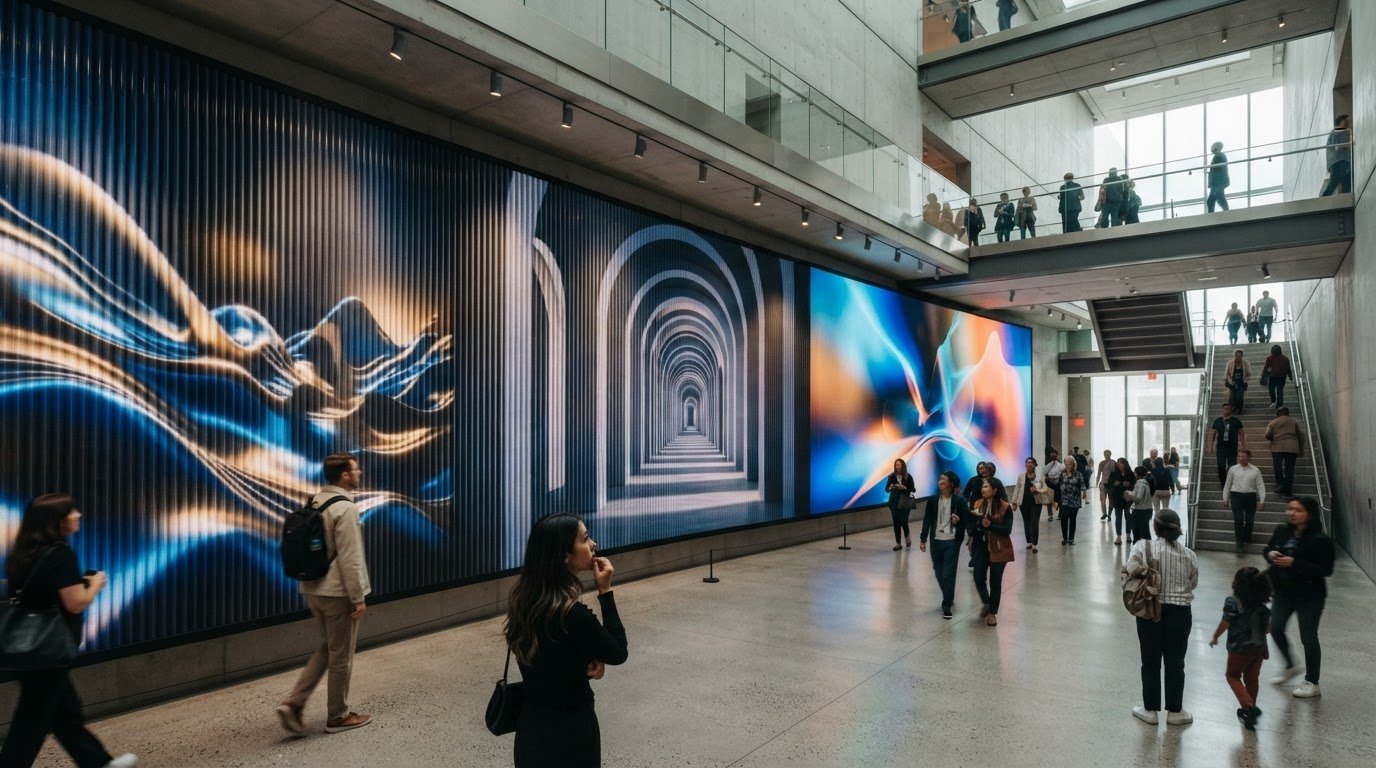
What if a wall could reveal a new image, shift as visitors move, or seem to open into depth? Large scale lenticular wall art can turn a static surface into an experience that unfolds with the viewer. Its impact depends on more than the visual effect: the movement needs to suit the room, the audience, and the message.
Planning helps answer practical questions: Will motion or depth suit this wall? How will the image change as people move through the space? Scale, viewing distance, lighting, image transitions, and visitor routes all influence the result.
This article explores the visual effects lenticular art can create at architectural scale and the design decisions that bring them into focus. You’ll learn how to build a practical project brief, account for changing viewpoints, and plan the journey from samples and prototypes to production and installation. Since 1997, Softmotion has delivered more than 1,000 projects worldwide across architectural, corporate, advertising, and fine-art environments.
Key Takeaways
- See how a changing image can give an architectural wall a visual story that unfolds as people move through the space.
- Understand the difference between image reveals, apparent motion, and simulated depth, then consider which effect best serves your message.
- Choose the creative response for your audience: a striking transformation, a gradual reveal, or an impression of added dimension.
- Build a clear project brief around purpose, audience, imagery, and the space, then develop technical specifications collaboratively.
- Learn how large scale lenticular wall art can move from an initial concept to a finished architectural installation through sampling, production, and installation.
Large-Scale Lenticular Art: Definition and Spatial Impact
Large-scale lenticular wall art is a printed artwork that changes appearance as viewers move past it or view it from different angles. A surface that first seems still can reveal a new image, shift between scenes, or suggest depth as people move through the space. The viewer’s position becomes part of the experience.
At architectural scale, the work can do more than fill a wall. It can mark an arrival point, invite people to pause, or connect a visual story to the character of a place. Consider how people encounter the wall: from a doorway, along a corridor, across a lobby, or while approaching reception. Mapping those sightlines early helps the artwork’s transformation relate to the room and its audience.
Lenticular art is print-based, not a digital display. The image is prepared and printed so different visual information appears at different viewing angles; it doesn’t rely on a screen to play content. For a concise overview of the technique, see Lenticular Printing Explained. At wall scale, the creative challenge is to make the printed change feel intentional in the architecture, rather than simply enlarging an image.
How does a lenticular wall image change with the viewer?
A lenticular lens directs different image information toward different angles. As a viewer shifts position, the lens brings another part of the prepared image into view. For example, a wall might show a building’s exterior from one approach, then reveal an interior scene as visitors move past it. The artwork stays in place; the viewer’s changing position creates the perception of transformation.
Where can large-scale lenticular art make a strong impression?
The strongest settings are those where people’s movement supports the artwork’s reveal. Consider the wall’s role as well as its size:
- Lobbies: A changing image can make arrival memorable and introduce an organization’s identity.
- Cultural spaces: A visual reveal can reward exploration and complement a place built around discovery.
- Workplaces: A carefully chosen sequence can express shared values or give visitors a distinctive welcome.
- Retail settings: A shifting scene can draw attention and create a moment of discovery along a customer’s route.
- Public environments: A wall can become a recognizable visual landmark for people passing through.
For architects and interior designers—such as the luxury commercial and residential specialists at pianta-design.com—the process starts with the experience the wall should create, then relates imagery and viewing angles to the actual environment. This is central to large format lenticular printing for architects: the artwork and space need to work together, so the visual change makes sense from the audience’s likely paths.
How Lenticular Wall Art Creates Motion, Change, and Depth
A lenticular artwork’s effect depends on two things working together: the images designed into it and the angles from which people see it. As viewers move, the information they see shifts. That change might read as a new image, a sequence of movement, or a sense of dimensional space. On a large wall, the effect should relate to the room’s message and the paths people take through it, not simply surprise them.
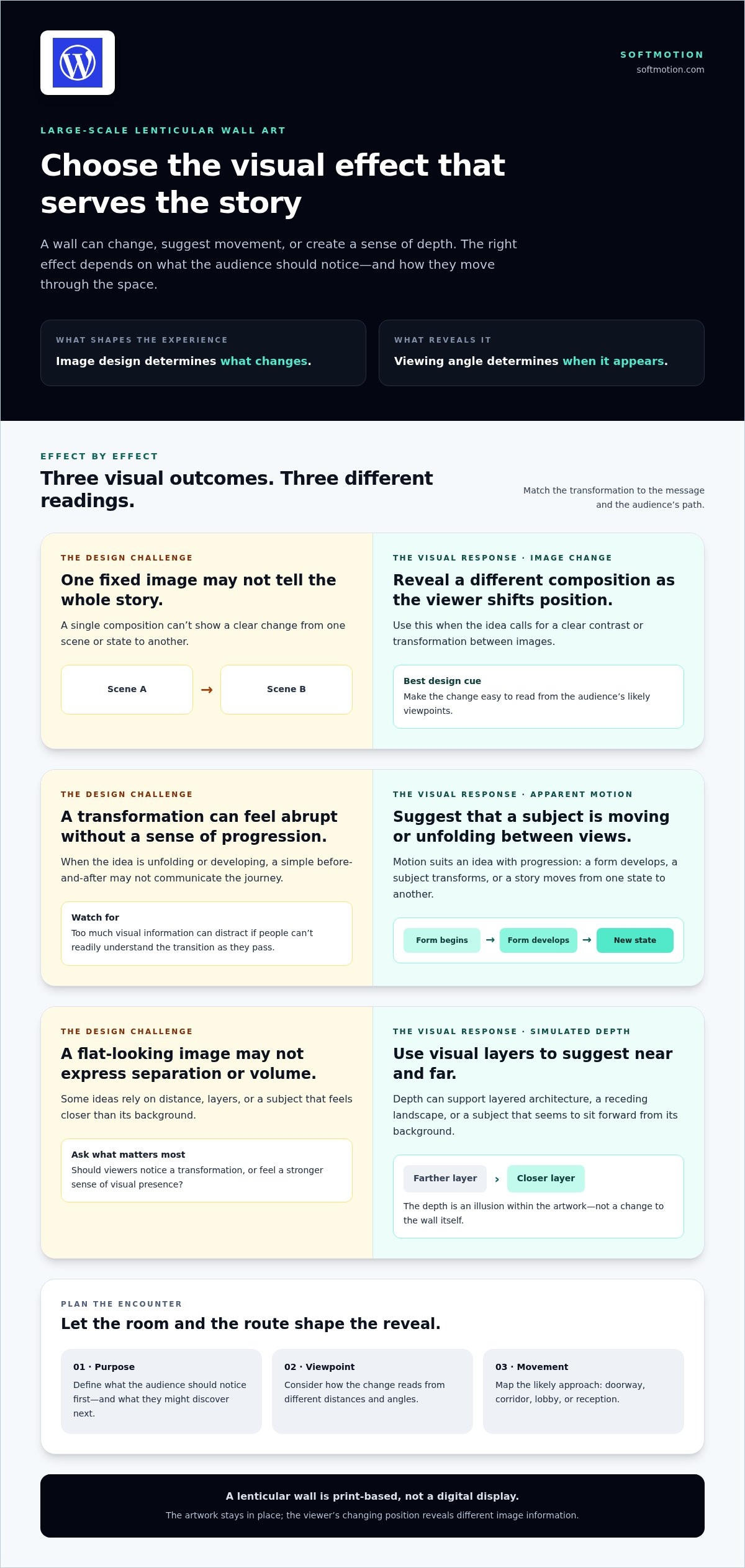
The image design determines what changes; the viewing angle determines when the audience sees it.
These outcomes can feel similar at first, but they communicate differently. An image change replaces one composition with another. Apparent motion suggests that something is moving or unfolding between views. Simulated depth uses visual layers to make parts of the image seem nearer or farther away. Each effect gives the audience a different way to read the wall.
When should a wall artwork use motion or image changes?
Motion works well when the idea has a progression: a form develops, a subject transforms, or a story moves from one state to another. A small number of distinct image states can create a clear contrast, such as a bare landscape giving way to a flourishing one. More frames or visual information won’t necessarily strengthen the story. If viewers can’t readily understand the transition as they pass, complexity may distract from the message.
When does dimensional depth support the idea?
Simulated depth suits imagery that gains meaning from separation, distance, or apparent volume. Layered architecture, a receding landscape, or a subject that seems to sit forward from its background can make a wall feel less like a flat picture and more like a spatial composition. The effect remains an illusion within the artwork, but it can give the viewer a stronger sense of visual presence.
An agamograph offers a related approach: different viewpoints reveal different compositions, so the viewer’s movement shapes the experience rather than a single fixed reading. For a project team, the useful question is what the audience should notice first and what they should discover next. That keeps the visual behavior in service of the idea.
Before choosing an effect, consider the artwork’s purpose and the audience’s likely movement. Is the goal to make a single transformation legible, create a feeling of volume, or reward people who approach from more than one direction? These distinctions give designers and curators a shared language for discussing the experience before settling on imagery. They’re especially useful for large scale lenticular wall art, where viewers may encounter the work from several distances and angles.
Softmotion develops custom lenticular and agamograph work for architectural environments, helping teams shape a concept into a wall-scale experience. Explore Softmotion’s lenticular work to see how changing views can serve a space.
Choosing the Right Lenticular Effect for Your Wall and Audience
Choose the effect by starting with the experience the wall should create, then testing that idea against the room. Is the artwork meant to reward people as they pass, hold attention while they pause, or communicate a clear contrast at a glance? The answers help narrow the creative direction before the team develops imagery. The most elaborate effect isn’t automatically the most effective; a simpler, more legible transformation may serve the space better.
| Creative outcome | Audience movement | Intended message | Desired visual response |
|---|---|---|---|
| Motion | Viewers move past or along the wall | A progression, transformation, or unfolding story | Notice a sense of movement across changing views |
| Image reveal | Viewers approach from a particular direction or shift their position | Contrast between two or more states or ideas | Discover a different composition as their viewpoint changes |
| Depth | Viewers see the artwork from a suitable range of angles | Layering, distance, or a sense of volume | Read the image as spatially layered rather than flat |
Use the table to guide a conversation, not as a rigid formula. A wall may combine outcomes, but each added visual behavior should strengthen the central idea. With large scale lenticular wall art, the design also needs to work at the distances and angles people will actually experience.
Match the effect to the story the wall needs to tell
Choose motion when the concept depends on progression, such as a subject changing over time or a visual story unfolding as someone walks by. An image reveal works when the contrast itself carries the meaning, such as showing two conditions, perspectives, or identities. Select depth when the composition gains meaning from visual layers or apparent distance. Ask what viewers should understand at a glance and what they might discover by looking again.
Design around real viewing conditions
Consider whether people approach from one direction, pass the wall from several sides, or see it while entering and leaving. A reveal designed for a single approach may be less legible in a corridor with cross-traffic. Also consider likely viewing distance and dwell time: someone walking through a lobby may have only a brief encounter, while visitors in an exhibition might pause and explore successive views. These conditions help determine how simple or layered the visual idea should be.
For an art-led brief, exhibition context matters alongside the artwork’s effect. The surrounding works, visitor route, and intended viewing experience can all shape the choice. Fine-art lenticular prints can give curators a point of reference as they consider how changing views should contribute to the wider presentation.
Before technical development, write a short experience statement: who encounters the wall, from where, and what should they notice or feel? This keeps creative decisions focused on the audience rather than novelty alone.
How to Brief a Large-Scale Lenticular Wall Art Project
A strong brief gives the creative team a clear purpose and a real understanding of the space without trying to solve every production question in advance. Start with what the artwork should do for its audience. Then provide enough context to develop the concept and viewing experience in relation to the site.
An actionable wall-art brief connects the project’s purpose, audience, imagery, viewing conditions, and site information.
- Define the purpose and audience. Identify why the wall matters, who will encounter it, and what impression or idea should stay with them.
- Describe the visual story. Share the subject, reference imagery, artistic or brand context, and the effect you’re drawn to, such as a reveal, transformation, or sense of depth.
- Explain the setting. Note where the wall sits, how people approach it, whether they pause or pass through, and which nearby features may shape the viewing experience.
- Gather site materials. Include dimensions, architectural drawings, photographs from different viewpoints, and known access constraints. Information about audience flow helps show how people will encounter the artwork.
- Agree on review points. Decide who needs to review the creative direction and what the team needs to understand before moving toward full-scale production.
What information should the creative brief include?
Be specific about the wall’s purpose, location, audience, and desired impression. Describe the visual story and share reference imagery that communicates mood, subject, or visual language. Include relevant brand or artistic context, along with a preferred effect if you have one. Building plans, dimensions, site photographs, and known access constraints help connect that ambition to the physical environment.
Keep creative objectives distinct from technical specifications. For example, you can say that people should discover a second composition as they move through a lobby without prescribing how the image must be produced. Develop the technical approach collaboratively, using the creative intent and site context to guide the process. This makes the brief useful without requiring the design team to resolve production details prematurely.
How can samples and prototypes help shape the final work?
Samples let the team assess image behavior and visual direction before full-scale production. They can clarify whether a transition feels legible, whether the imagery supports the intended mood, and how the changing view relates to the audience’s movement. A prototype provides a collaborative review point to refine the artwork and confirm that the developing concept still serves the project’s purpose.
Base feedback on the brief: what should viewers notice, from which approach, and what should the change communicate? This keeps reviews focused on the experience rather than personal preference alone. Custom lenticular samples and prototypes help project teams evaluate the concept and its viewing behavior before moving to full-scale work.
For large scale lenticular wall art, Softmotion’s project process spans samples and prototyping through full-scale production and on-site assembly. Start planning your lenticular wall project with a clear creative brief and materials that show how the space is used.
Bring Large-Scale Lenticular Wall Art to Life with Softmotion
A successful architectural artwork needs more than a compelling image. It needs a clear relationship between the idea, the people who will encounter it, and the space that will hold it. Softmotion works with project teams to develop custom lenticular and agamograph art for architectural environments, turning a spatial concept into a coordinated production project.
Since its founding in 1997, Softmotion has delivered more than 1,000 projects worldwide. Its work spans architecture, advertising, fine art, trade shows, and corporate environments, bringing experience with different spaces and audiences to each project. The creative aim is specific to the wall: what it should communicate, how people will experience it, and how its visual change can support that purpose.
From a wall concept to a coordinated production project
Project work can progress from samples and prototyping through full-scale production and on-site assembly. The team collaborates with clients to translate the intended audience experience into a visual direction, then develops the work in relation to its architectural setting. Sampling and prototyping provide opportunities to review the evolving concept before it advances to full scale.
The process creates useful decision points: clarify the creative intent, explore how the imagery behaves, review the developing direction, and coordinate production and assembly. Architects, artists, advertisers, and corporate teams may bring different priorities, but each project benefits from aligning the visual story with its environment. This connects creative ambition to the practical needs of a large-format installation without treating the wall as an isolated graphic.
Start a conversation about your lenticular wall art
You don’t need every technical detail resolved to begin. A concise outline gives the conversation a useful starting point and keeps the project grounded in its purpose. Share what you want the audience to experience, along with what you know about the site and creative direction.
- Purpose: What should the artwork communicate or contribute to the space?
- Location: Where will it be installed, and how do people encounter the wall?
- Audience: Who will see it, and are they likely to pause or move through?
- References: What imagery, visual qualities, or artistic context can help express the intended direction?
From that starting point, project scope can take shape around the environment and creative intent. Softmotion’s work spans the project journey from samples and prototypes to full-scale production and on-site assembly, with details developed in collaboration. If you’re considering large scale lenticular wall art for an architectural space, discuss a large-scale lenticular wall art project with Softmotion.
Make the Wall Part of the Experience
A wall can do more than frame a room. It can shape how people arrive, move through a space, and remember what they encountered. Picture that moment from the audience’s perspective: where someone first sees the artwork, how their view might change, and what idea should stay with them afterward.
Let that experience guide the creative conversation. A clear intention gives the imagery and the space a shared purpose, while leaving room for the right visual direction to emerge through collaboration. With large scale lenticular wall art, the most meaningful transformation feels connected to its environment and the people who use it.
Have a wall or spatial concept in mind? Explore your project with Softmotion and take the first step toward making the space distinctly its own.
Frequently Asked Questions
Does large-scale lenticular wall art need electricity?
No. A printed lenticular artwork creates its changing visual effect without electricity, unlike a screen-based display. The image shifts as a viewer changes position, so the artwork itself doesn’t need power to switch between views. If the surrounding installation includes separate illuminated elements, those are distinct parts of the project and may have their own electrical requirements.
Can lenticular wall art show more than one image?
Yes. It can present two or more images or visual states, depending on the creative brief. For example, a campaign wall might reveal different product designs as someone moves along it, while an artwork could shift between two compositions. Each view should contribute to the idea. If the images compete or feel unrelated, the change may be harder for an audience to interpret.
Is lenticular wall art the same as an agamograph?
No. The terms describe related but distinct things. Lenticular refers to a printed approach in which different image information is visible from different viewing angles. An agamograph is an artwork designed to reveal alternating compositions as the viewer changes position. The formats can share a viewpoint-dependent experience, but the terms aren’t interchangeable. In a project brief, describe the visual outcome you want, even if the exact format is still being developed.
Can lenticular wall art work in a busy public space?
Yes, it can suit a busy environment when the intended visual change fits the way people move through it. A transit passage, for example, may call for an effect that reads quickly from a main route, while a waiting area may allow closer attention. Consider sightlines, crowd flow, nearby visual distractions, and whether people approach from multiple directions when shaping the concept.
What should I provide when planning custom lenticular wall art?
Along with the project’s purpose and location, clarify who approves the creative direction and which image assets are ready to use. Note any visual identity requirements, content permissions, or stakeholder preferences that could shape the artwork. For large scale lenticular wall art, identify the main route people take past the wall and where they’re most likely to notice it first.
How do teams evaluate a lenticular effect before full-scale production?
Teams can review samples or prototypes against the intended viewing experience before moving to full scale. A practical review might involve viewing the work from marked positions that reflect actual approaches, then checking whether each image state is recognizable and the transition supports the project’s message. Gather feedback from the people responsible for creative approval and the space, so revisions address shared project goals rather than isolated preferences.