
Interactive Architectural Art: Transforming Static Surfaces into Dynamic Experiences
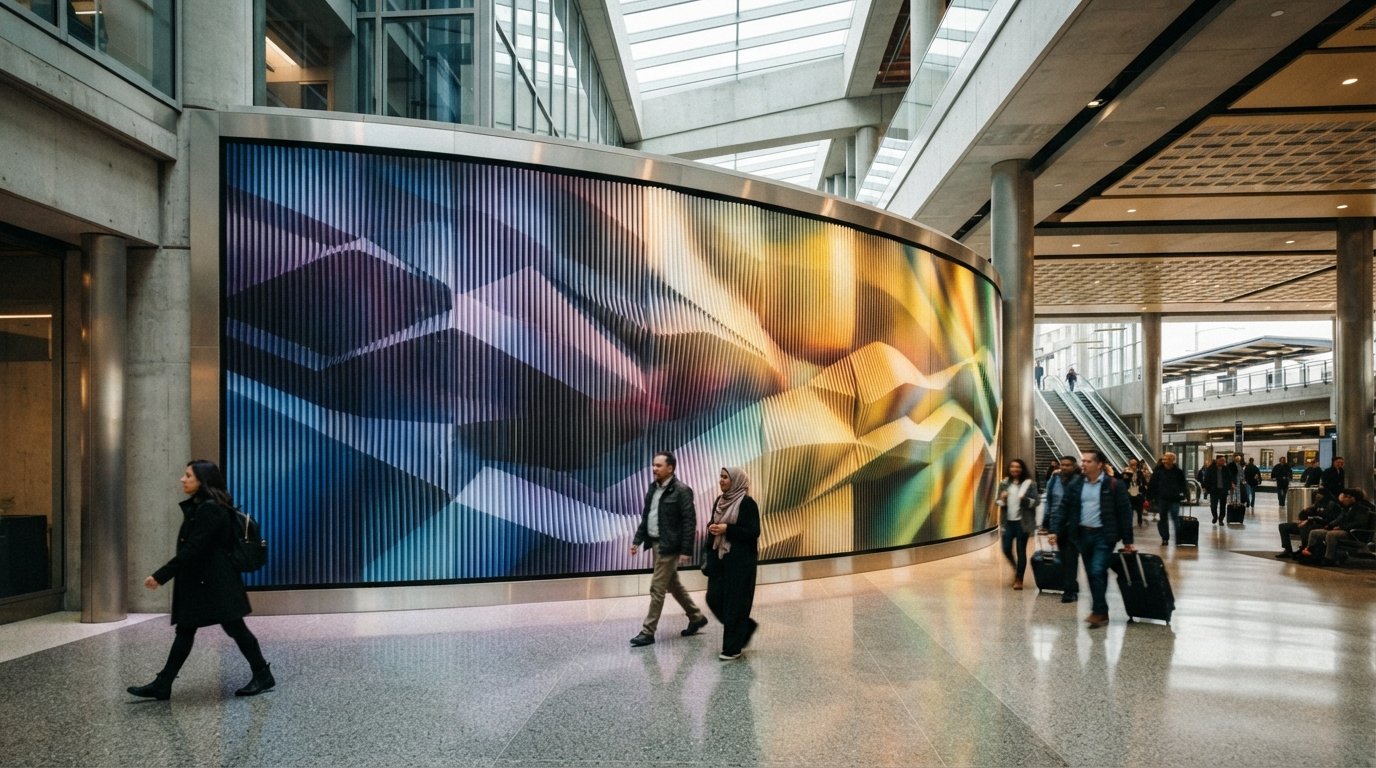
The most captivating interactive architectural art doesn’t require a single kilowatt of power or a complex motherboard to function. In an era where digital screens often flicker with technical glitches or contribute to a growing sense of visual fatigue, the most profound experiences are frequently those that remain grounded in the physical world. You’ve likely stood in a transit hub or a corporate lobby where the expensive digital signage felt cold, unengaging, or simply broken. It’s a common frustration for architects and designers who want to create a “wow” factor without the high energy costs and maintenance burdens of traditional electronic hardware.
We believe that a space only truly comes alive when it interacts with its inhabitants on a human level. This article explores how to integrate motion-driven, interactive art into architectural environments using sustainable, high-impact lenticular technology. You’ll discover how these analog installations transform static surfaces into living experiences that respond to every step a visitor takes. We’ll guide you through the transition from a two-dimensional concept to a multi-dimensional reality, outlining a clear path from the initial creative spark to a durable, power-free installation that commands attention and defines the atmosphere of any high-traffic zone.
Key Takeaways
- Learn how to replace high-maintenance digital screens with sustainable, power-free installations that eliminate technical failures in public environments.
- Discover the mechanics of interactive architectural art and how it uses the viewer’s own movement to trigger captivating visual transformations.
- Master the strategic design of spatial experiences by calculating viewing angles and walking speeds to maximize impact in high-traffic zones.
- Understand the essential transition from small-scale prototyping to full-scale architectural fabrication for a seamless and durable installation.
The Evolution of Interactive Architectural Art in 2026
Interactive architectural art is no longer a decorative afterthought. It’s a fundamental shift in how we inhabit and perceive the built environment. By 2026, the definition has matured from simple ornamentation to surfaces that respond intuitively to a viewer’s presence. We’re witnessing a transition from “art as an object” to “art as an experience.” In high-traffic public spaces and private corporate environments, the goal is now to create a living dialogue between the architecture and its inhabitants. Traditional design provides the bones of a space, but these dynamic installations provide the heartbeat.
From Decorative to Experiential Spaces
Static walls were once the conclusion of an interior design plan. Now, they’re the canvas for kinetic storytelling. Designers are reimagining the personality of buildings by moving beyond the frame. When art is integrated directly into the building’s skin, it ceases to be a separate entity and becomes part of the structure’s identity. This approach transforms a cold lobby into a warm, welcoming environment. It replaces the “dead” feeling of static walls with a sense of vitality and purpose. By utilizing lenticular technology, these installations achieve complex visual effects that traditional prints can’t match. This isn’t just about aesthetics; it’s about functionality. A space that adapts to its users feels more intuitive and less imposing.
Why Movement is the New Design Currency
Capturing the attention of a distracted viewer requires more than just a bright light. It requires a sensory connection. There’s a profound relationship between physical movement and visual memory. As a visitor moves through a space, the art changes in sync with their steps. This creates a personal sense of discovery. Movement is the play button. It turns a routine walk through a transit hub into a moment of genuine wonder.
- Engaging the senses: Passive interaction encourages people to slow down and observe their surroundings.
- Memory retention: People remember experiences they participate in more than those they simply watch from a distance.
- Zero-energy impact: Unlike digital displays, analog interactive architectural art delivers movement without increasing the building’s carbon footprint.
The psychological impact is clear. Dynamic environments improve visitor mood and increase the time spent in a space. They foster a sense of ownership and connection. In 2026, the trend favors these “passive” interactions because they’re durable, sustainable, and fundamentally more human than a flickering screen. By favoring the viewer’s path as the catalyst for change, architects are finding ways to reduce visual noise while significantly increasing emotional impact.
The Mechanics of Analog Interaction: How Lenticular Technology Works
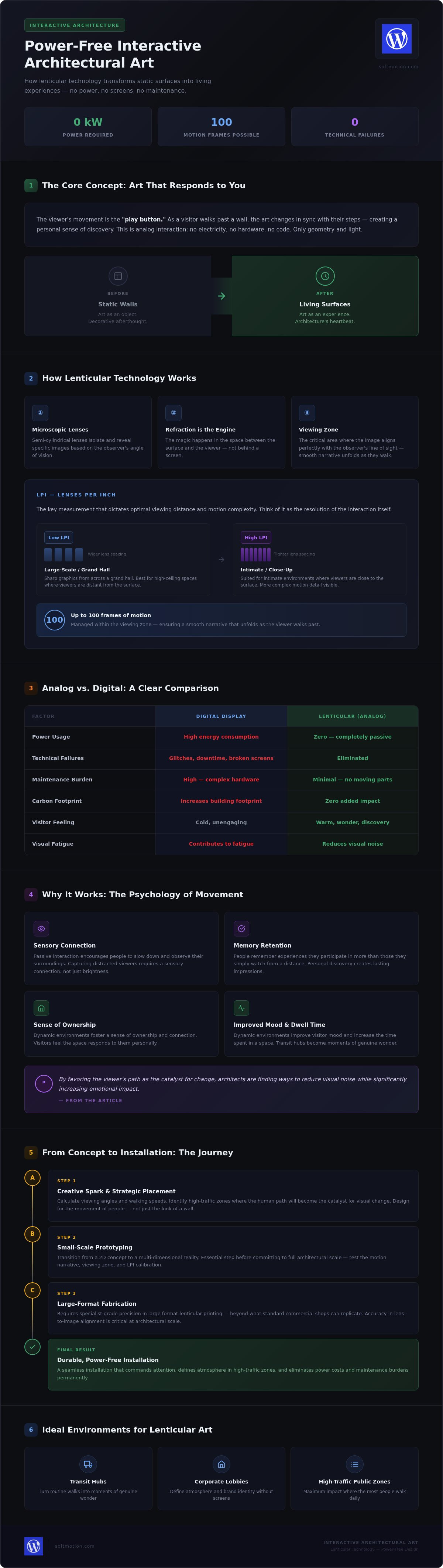
While digital displays rely on pixels and power, the most resilient forms of interactive architectural art rely on geometry and light. The magic doesn’t happen behind a screen; it happens in the space between the surface and the viewer. Refraction is the engine. By using a series of microscopic, semi-cylindrical lenses, we can isolate and reveal specific images based on the observer’s unique angle of vision. This creates a physical response to movement that feels fluid and intuitive.
The Science of the Lenticular Lens
Precision is the foundation of every successful installation. We measure this through LPI, or Lenses Per Inch, which dictates the optimal viewing distance and the complexity of the motion. A higher LPI is suited for intimate environments where viewers are close to the surface, while a lower LPI ensures that large-scale graphics remain sharp from across a grand hall. Achieving this requires a level of accuracy in large format lenticular printing that standard commercial shops simply can’t replicate. The viewing zone is the critical area where the image aligns perfectly with the observer’s line of sight. Within this zone, we can manage the transition between up to 100 frames of motion, ensuring a smooth narrative that unfolds as the viewer walks.
Perspective-Shifting Visuals Without Power
In many interactive architectural art installations, the viewer’s path serves as the “play” button. As you walk past a wall, it appears to move with you through a process called perspective shifting. This can manifest as a simple flip effect, where one image swaps for another, or as a sophisticated motion transition that mimics cinematic animation. The depth of these effects is further enhanced by architectural lighting. Strategic placement of overhead or directional lights can deepen the perceived 3D space or sharpen the clarity of a motion sequence. It’s a high-impact solution that remains completely passive.
Durability is just as vital as the visual impact. Using high-quality polymers instead of standard plastics ensures that the lenses don’t yellow or warp over time. These materials are engineered for high-traffic zones where physical contact and environmental changes are constant. To see how these technical details translate into a physical space, you might consider reviewing our guide on custom lenticular prototypes to understand the scaling process.
Analog vs. Digital: Choosing the Right Interactive Medium
Digital interaction often feels like a fragile promise. It relies on a complex ecosystem of sensors, power grids, and software updates that are inherently prone to failure. In contrast, analog interactive architectural art offers a “set and forget” reliability that digital alternatives simply can’t match. When you compare the lifecycle costs of a high-resolution LED wall against a lenticular installation, the gap is staggering. Digital systems require constant energy consumption and specialized technicians for every glitch. A physical installation, once mounted, performs perfectly for years without a single watt of electricity. It doesn’t flicker, it doesn’t crash, and it never needs a reboot.
Sustainability and Maintenance in Public Art
Public hubs demand a level of resilience that digital hardware rarely provides. Screens in transit centers often fall victim to “dead screen syndrome,” where a single failed component ruins the entire visual experience. These environments are harsh. They deal with humidity, heat, and constant physical vibration. While digital signage demands climate-controlled housing and frequent hardware cycles, lenticular technology thrives in these conditions. It’s an investment in permanence. By choosing a power-free medium, architects significantly reduce a building’s carbon footprint while eliminating the recurring costs of software licenses and energy bills. It’s a return to materials that age with grace rather than becoming obsolete after a few years of heavy use.
Physicality vs. Pixels
There’s an organic quality to light reflecting off a physical surface that a glowing pixel cannot replicate. Digital art often suffers from an “uncanny valley” effect, feeling detached from the physical architecture around it. Kinetic wall art, however, feels like a natural extension of the building’s skin. It integrates seamlessly into the environment, responding to the natural light of the space rather than competing with it. For those looking to merge art with structural elements, the Architect’s Guide to Lenticular Wall Cladding provides essential technical tips for integration. This tactile presence creates a sensory experience that feels grounded and authentic. It’s the difference between looking at a screen and feeling the space move with you. We’ve seen that the most impactful environments aren’t those that shout for attention with high-voltage displays, but those that reward the viewer’s movement with subtle, physical transformation.
Strategic Placement: Designing for the Human Path
The effectiveness of interactive architectural art depends entirely on the viewer’s trajectory. Architecture is static. People are not. If an installation doesn’t align with the natural flow of foot traffic, its transformative potential remains hidden. We don’t simply design for a wall; we design for the walk. By mapping the precise coordinates where a visitor’s line of sight intersects with the installation, we can ensure that the visual transition occurs at the peak of their engagement. This requires a deep understanding of geometry and human psychology to ensure the art “pops” at exactly the right moment.
Strategic placement often involves identifying underutilized visual real estate. Corners and long corridors are ideal because they naturally force a change in perspective as a person moves through them. This creates a “discovery” effect, rewarding the curious visitor with a shifting narrative that unfolds with every step. It turns a transitional space into a destination. When we calculate these viewing angles, we consider the height of the average viewer and the typical distance from the wall to create a seamless, immersive experience.
Optimizing for Transit and High-Traffic Areas
Designing for a transit hub requires a different rhythm than a quiet office. Commuters are often in a state of focused transit, meaning their interaction with the environment is usually a “sideways glance” while in motion. To capture this fleeting attention, the art must be bold and the transitions must be timed to a brisk walking pace. Scale is critical here. Larger lenses are often required for long corridors to maintain visual clarity and impact from a distance. For more on engaging moving crowds, you can explore our strategies for Interactive Lenticular Tradeshow Displays, which utilize similar principles of kinetic engagement.
Creating Intimate Moments in Corporate Lobbies
Lobbies and reception areas offer a different opportunity for interaction. Here, visitors often linger, wait, or move at a much slower pace. This allows for “slow motion” design, where the art reveals subtle details and complex transitions to those who take the time to observe. Integrating fine art lenticular prints into these spaces creates a premium, gallery-like atmosphere that defines the personality of a corporate headquarters. It provides a sophisticated “wow” factor that impresses clients and inspires talent. Whether it’s a bold statement in a grand entrance or a subtle discovery in a private lounge, the placement must feel intentional and integrated. To begin mapping the human path in your next project, connect with our visionary guides for a technical consultation.
Bringing Vision to Life: Custom Fabrication and Installation
Transforming a conceptual sketch into a massive interactive architectural art installation requires more than just high-resolution printing. It demands a rigorous transition from the digital file to the physical substrate. This journey begins with the realization that on-screen simulations, while helpful, can’t account for the nuances of ambient light or the physical texture of the lens array. We act as your technical partners throughout this process, bridging the gap between artistic vision and structural reality. Since 1997, we’ve delivered over 1,000 projects by prioritizing precision and collaborative discipline over shortcuts.
The Importance of Prototyping and Sampling
Digital previews are inherently limited when dealing with motion. They can’t simulate the way a visitor’s eyes interact with a physical lens array in a specific environment. This is why custom lenticular prototypes are the most critical milestone in the design phase. These physical benchmarks allow us to test viewing angles and lighting conditions on-site before moving into full production. A prototype is the only way to verify the ‘flip’ speed in the actual space. Seeing the effect in person provides the security and clarity needed to proceed with a large-scale investment, ensuring the sensory impact meets the original intent.
Scaling Motion Art for Architectural Impact
Moving from a small sample to a 100-foot installation introduces a unique set of technical challenges. It’s not a matter of simply enlarging a file; it’s about re-engineering the visual logic for a grander scale. We must manage the graphic continuity across multiple panels while maintaining the absolute integrity of the motion effect. Structural considerations become paramount as we transition from the two-dimensional to the multi-dimensional. Large-format wall installations require precise engineering to ensure the mounting system supports the weight of the high-quality polymers without compromising the alignment of the lenses.
Precision alignment is the final, non-negotiable step of the journey. If a lens is off by even a fraction of a millimeter, the entire visual narrative can collapse into a blur. Our project management team coordinates closely with architects, general contractors, and artists to ensure the installation process is methodical and controlled. This collaborative approach removes the risk from complex challenges. From the first sample to the final tile, the goal is a seamless transformation where the interactive architectural art feels like it was always meant to be the heartbeat of the building’s soul.
Reimagining the Future of Physical Environments
The shift toward interactive architectural art represents a conscious move away from flickering screens and toward enduring, human-centric design. You’ve seen how the viewer’s own path serves as the catalyst for motion, creating a sustainable experience that requires zero power and minimal maintenance. By prioritizing strategic placement and physical prototyping, architects can transform ordinary corridors into extraordinary sensory journeys that reward curiosity. This transition from the two-dimensional to the multi-dimensional doesn’t just change a wall; it redefines the soul of the building.
Realizing this vision requires a partner who balances artistic ambition with technical discipline. Since 1997, we’ve completed over 1,000 projects, providing end-to-end management that spans from initial samples to final installation. With our global fabrication and shipping capabilities, we ensure that your creative intent is preserved across every square foot of the installation. It’s time to move beyond the limitations of static surfaces and embrace a more rhythmic, living approach to spatial storytelling.
Transform your space with a custom Softmotion installation and discover the hidden potential within your architecture. We look forward to guiding you through the journey from a bold concept to a lasting, kinetic reality.
Frequently Asked Questions
Is interactive architectural art always digital?
No, interactive architectural art is not limited to digital screens or sensors. While many associate interaction with electronics, analog solutions like lenticular technology offer a physical response to movement. These installations engage the viewer through refraction rather than electricity. This approach provides a reliable, power-free alternative that remains functional even in environments where digital hardware might fail or require constant power. It’s about creating a living dialogue without the motherboard.
How does lenticular art change when you walk past it?
The transformation occurs through the precise refraction of light as your viewing angle shifts. As you walk past the installation, a series of micro-lenses isolates and reveals different images or frames of motion. This creates a fluid visual transition that responds directly to your pace and position. It feels as though the wall is walking with you, rewarding every step with a new perspective or a cinematic sequence of motion.
What are the maintenance requirements for a large-scale lenticular wall?
Maintenance for a lenticular installation is remarkably simple compared to digital hardware. Because there are no electronic components, software updates, or power requirements, the primary task is standard cleaning. We use high-quality, durable polymers that resist yellowing and physical wear. A gentle wipe-down with non-abrasive cleaners is typically all that’s needed to keep the visual clarity sharp. It’s truly a “set and forget” solution for busy public hubs.
Can interactive art be installed on curved surfaces?
Yes, we can adapt these installations to curved surfaces with careful technical planning. While the geometry of a curve affects how the lenses refract light, our fabrication process accounts for these shifts to maintain the integrity of the motion effect. We work closely with architects during the design phase to ensure the curvature enhances rather than distorts the viewer’s experience. This allows for a seamless integration into organic architectural forms and rounded corridors.
Is lenticular art suitable for outdoor architectural environments?
Our architectural installations are highly suitable for outdoor environments when engineered with UV-stable and weather-resistant materials. Unlike digital screens that struggle with glare and overheating in direct sunlight, lenticular surfaces thrive on natural light. The physical nature of the medium makes it resilient against temperature fluctuations and humidity. We select specific polymers and printing techniques to ensure the artwork remains vibrant and functional despite exposure to the elements.
How long does it take to fabricate and install a custom motion art project?
The timeline for a custom project typically ranges from several weeks to a few months, depending on the scale and complexity. This journey includes initial creative consultation, physical prototyping, large-format printing, and final on-site installation. We manage every step to ensure precision. Since 1997, we’ve delivered over 1,000 projects, ensuring that architectural-scale works follow a methodical approach where every panel aligns perfectly for the intended visual effect in the final space.
Do I need special lighting for interactive lenticular art to work?
You don’t need specialized theatrical lighting, but strategic illumination significantly enhances the depth and clarity of the work. Standard architectural lighting that provides clear, directional light helps the micro-lenses refract images more effectively. We often test lighting conditions during the prototyping phase to ensure the art “pops” as intended. Well-placed overhead or wall-wash lighting can sharpen the motion transitions and deepen the perceived three-dimensional space for every visitor.
What is the difference between a lenticular wall and a digital LED wall?
The primary difference lies in the source of interaction and the long-term lifecycle cost. While a digital LED wall requires constant power, software management, and hardware cooling, a lenticular wall is completely passive. These installations use the viewer’s movement as the “play” button, creating a tactile, organic feel that pixels cannot replicate. This results in a more sustainable, durable solution that eliminates the risk of technical failure or high energy bills in high-traffic zones.