
Immersive Kinetic Art Installations: The Future of Dynamic Spatial Design
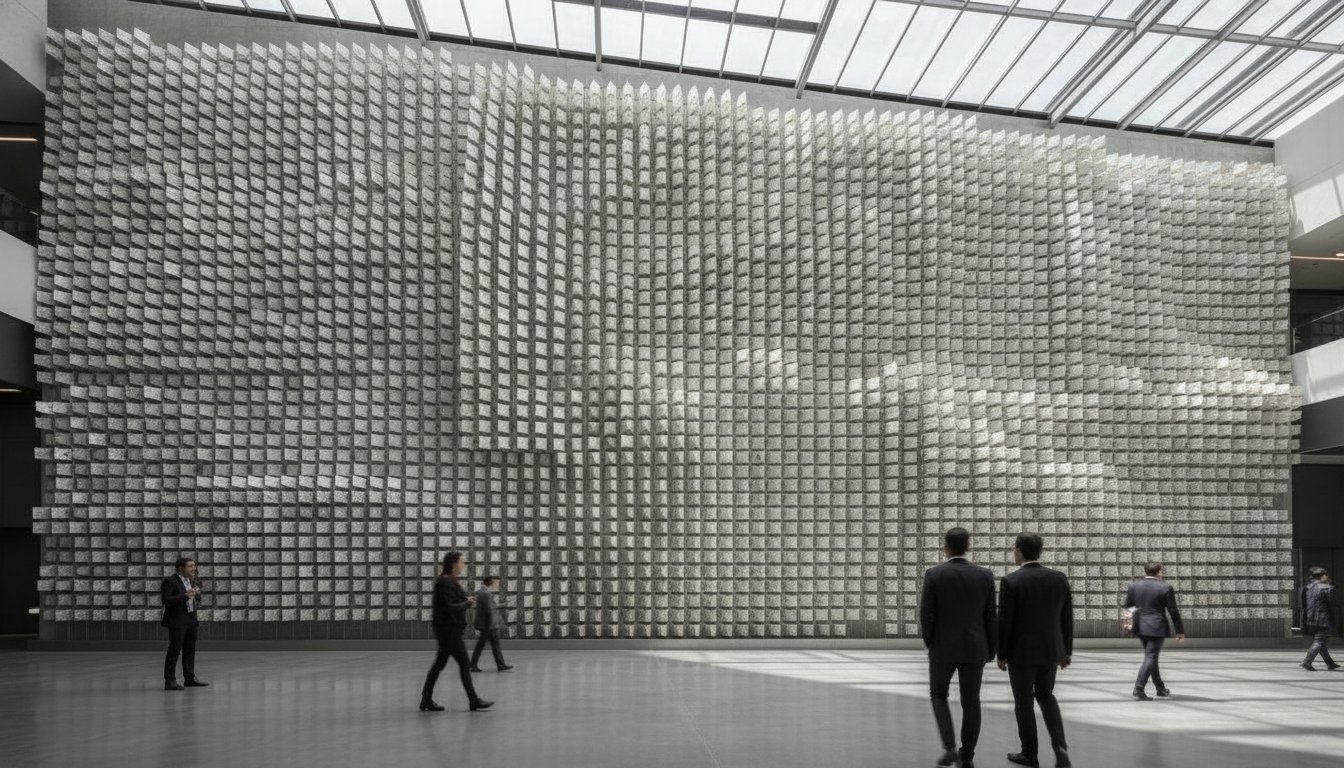
What if your walls didn’t just stand there, but breathed, shifted, and responded to the very people walking past them? For many architects and brand designers, the challenge isn’t just filling a space; it’s making that space feel alive without the high-maintenance flicker of digital screens. Immersive kinetic art installations offer a sophisticated solution to this dilemma, turning cold, static surfaces into fluid narratives that evolve with the viewer. It’s a shift from seeing a building as a shell to treating it as a living participant in the human experience.
We understand the frustration of environments that feel uninspired or the fear that mechanical complexity might lead to future failure. This guide explores how motion-driven visual installations transform static architecture into living, breathing sensory experiences. You’ll learn about the different types of kinetic art, the deep psychological impact of movement on an audience, and how to find a fabrication partner that balances bold vision with technical reliability. By the end, you’ll see why the most powerful motion doesn’t always require a motor or a power cord.
Key Takeaways
- Learn how the fusion of engineering and spatial psychology transforms traditional sculptures into environment-wide experiences that engage the senses.
- Compare active motor-driven systems with passive solutions to see how immersive kinetic art installations can achieve fluid motion without the maintenance of digital hardware.
- Discover why analog kinetic art provides a tactile 3D depth that digital pixels cannot replicate, offering a refreshing alternative to screen fatigue.
- Master the technical requirements of perspective mapping to optimize visual motion effects based on the specific movement patterns of your audience.
- Gain insight into a collaborative fabrication process that moves from initial prototype to final assembly, ensuring a risk-free transition from vision to reality.
Defining the Immersive Kinetic Art Installation in Modern Architecture
Immersive kinetic art installations represent a departure from the static confines of traditional design. They exist at the intersection of engineering, fine art, and spatial psychology. While traditional Kinetic art often focused on a single object in motion, modern installations reimagine the entire environment as a living entity. This transition moves the viewer from a state of passive observation to active participation. You aren’t just watching art; you’re moving through it. It’s a fundamental shift in how we perceive the built environment.
The Psychology of Movement in Public Spaces
Movement has a profound effect on how we navigate the world. Our brains are biologically tuned to detect motion in our peripheral vision, a trait that makes dynamic visuals far more engaging than static signage. In high-traffic transit hubs, these installations act as intuitive tools for wayfinding, subtly guiding the flow of crowds through rhythmic visual cues. Beyond utility, motion offers an emotional “pause.” In high-stress environments like hospitals or busy airports, a slow, shifting installation provides a moment of calm, grounding the observer in the present. It transforms a sterile corridor into a sensory journey.
Lenticular vs. Mechanical Kinetic Art
Designers generally choose between two primary schools of motion. Mechanical installations rely on motors, sensors, and robotics to create physical movement. While impressive, they often require significant maintenance and a constant power supply. In contrast, passive systems utilize perspective-shifting technology to create the illusion of movement. True immersion occurs when these surfaces surround the viewer, such as in lenticular building facades. These large-scale applications prove that you can achieve a dynamic, high-impact environment without a single moving part, relying instead on the viewer’s own journey through the space. It is a more sustainable, reliable way to integrate immersive kinetic art installations into permanent architecture.
The Mechanics of Motion: Active vs. Passive Kinetic Systems
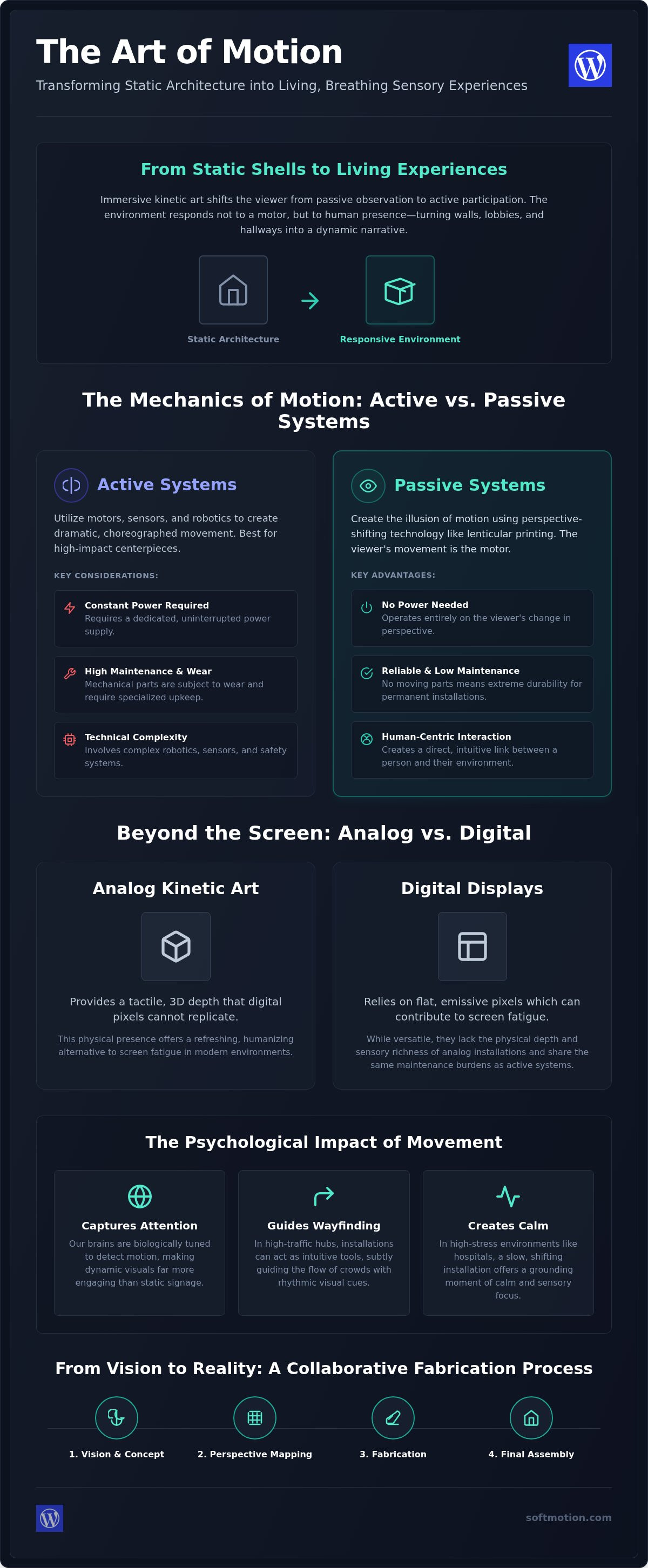
To understand the engineering behind immersive kinetic art installations, we must look at how motion is generated. Is it driven by electricity or by the observer? This choice dictates everything from the installation’s maintenance schedule to its emotional resonance within a physical space. While both approaches create a sense of wonder, they serve different architectural goals and operational realities.
Active Systems: Creating Robotic Choreography
Active systems utilize a complex array of motors, sensors, and robotics to achieve what MoMA’s definition of kinetic art describes as works that contain moving parts or rely on motion for their effect. These installations offer incredible drama. Imagine a large lobby sculpture that expands and contracts like a living lung, responding to the real-time data of a building’s occupancy. It’s high-impact and undeniably modern. However, this drama comes with significant technical baggage. Constant power requirements, safety sensors to prevent injury, and the inevitable wear of mechanical parts mean these systems require specialized maintenance. They’re often best suited for high-budget centerpieces or temporary exhibitions where a dedicated technical team is on standby. To ensure your next high-stakes production runs without a hitch, you can learn more about how Event 360 Pty Ltd provides professional audio-visual production.
Passive Systems: The Magic of Lenticular Perspectives
The benefits here are deeply pragmatic. Passive systems consume zero energy and offer an almost infinite lifespan compared to their robotic counterparts. There are no safety sensors to fail and no software versions to update. For permanent architectural projects, this reliability is invaluable. It transforms a static wall into a dynamic surface that remains functional for decades without intervention. If you’re looking to explore these maintenance-free possibilities, you can request a sample kit to see the depth of passive motion firsthand.
Choosing between active and passive isn’t just about the budget. It’s about the intended rhythm of the space. Active systems command attention through their own internal clock, while passive systems wait for the viewer to initiate the dance. This makes passive kinetic art uniquely suited for transit hubs and corporate corridors, where the journey of the individual is the primary focus of the design.
Beyond the Screen: Why Analog Kinetic Art Outperforms Digital Displays
In corporate lobbies and luxury retail flagships, we’ve reached a saturation point with digital signage. Screens are everywhere. This “screen fatigue” creates a psychological barrier where viewers subconsciously tune out flickering LEDs. Physical immersive kinetic art installations offer a refreshing contrast by providing a tangible 3D depth that pixels simply cannot replicate. While a screen remains a flat surface regardless of the resolution, analog motion exists in our physical space, interacting with the same air and light we do. This presence transforms a wall from a two-dimensional information board into a multi-dimensional sensory experience that feels permanent and intentional. Brands seeking to cut through this digital noise are increasingly turning to lenticular graphics for experiential marketing, which deliver a human-scale visual impact without a single power outlet.
Tactile Texture and Light Reflection
Digital displays emit light, often clashing with the carefully designed ambiance of a room. Physical installations, however, reflect it. This allows the work to change throughout the day as natural sunlight shifts or as interior lighting is dimmed. It creates a “human-first” quality that feels integrated into the architecture rather than tacked onto it. Luxury brands often prefer this sophisticated analog feel for window displays because it suggests craftsmanship and permanence. We see this in contemporary immersive kinetic art, where the interplay of light and shadow becomes as much a part of the piece as the physical structure itself. The result is a more organic, grounded visual that resonates with the viewer on a deeper level than a backlight ever could.
The Maintenance Advantage
The operational reality of digital walls is often a cycle of technical glitches, dead pixels, and mandatory software updates. A single failed module can ruin the entire visual experience. Passive kinetic systems eliminate these vulnerabilities entirely. They’re “always on” by design, requiring no power and no internet connection to function. This durability is why transit hubs and public squares prioritize analog solutions. When comparing the lifecycle costs of high-resolution LED walls against lenticular tradeshow booth design ideas and kinetic advertising displays, the analog choice becomes even more compelling. You avoid the hidden expenses of 24/7 electricity, cooling systems, and specialized IT support. By choosing a passive system, you invest in a permanent asset that maintains its visual integrity without a recurring maintenance fee or the risk of hardware obsolescence.
Designing for Perspective: Integrating Motion Graphics into Physical Environments
Designing immersive kinetic art installations requires more than just artistic vision; it demands a rigorous understanding of spatial geometry. We begin this process by mapping the viewer’s journey. Where do people enter the room? At what point do they turn? By identifying where they walk and where they linger, we can synchronize the art’s motion with their natural pace. It’s about turning a simple hallway into a timed performance. We then calculate the specific viewing angles, optimizing the “flip” or motion effect based on the average eye level of the audience. This ensures the visual transition feels fluid rather than jarring. Lighting design follows, where we focus on illuminating surfaces to reveal depth without creating distracting glare. Finally, material selection balances the aesthetic goal with the pragmatism of fire codes and long-term durability.
Spatial Flow and Viewing Corridors
The success of a project often hinges on the relationship between the art and the architecture. We distinguish between “head-on” interactions, where a viewer stops to engage, and “side-on” viewing, where the motion is triggered by transit. In narrow passages, the viewing corridor is tight, making the width of the space a critical factor for lenticular wall installations. By controlling these variables, we create “discovery moments” where the art only reveals its full complexity as the viewer reaches a specific vantage point. It transforms a routine walk into an interactive event.
Prototyping and Sampling
Digital renders can only go so far in a three-dimensional world. For large-scale kinetic work, physical samples are non-negotiable. They allow us to evaluate color shifts and motion speeds at a 1:1 scale, ensuring the final result matches the initial intent. The role of custom lenticular prototypes is to provide clarity and security for the client before full-scale fabrication begins. It’s a risk-free way to verify that the sensory impact is exactly right. If you’re ready to see how these principles apply to your specific environment, you can contact us for a technical consultation to begin the mapping process.
Bringing Static Surfaces to Life: The Softmotion Collaborative Process
At Softmotion, we don’t just print; we engineer perspective. Our “Visionary Guide” approach is built on the belief that every ordinary environment holds hidden potential for extraordinary movement. We act as a bridge between the initial creative spark and the technical discipline required for large-scale execution. This process begins by translating 2D brand concepts—often developed by strategic partners like LYFE Studio—into multi-dimensional kinetic experiences. We look at a flat logo or a static image and reimagine it as a shifting narrative that responds to the human body. Whether it’s a boutique retail window or a massive mural in a transit hub, our team manages the complexity so you can focus on the vision. Since 1997, we’ve delivered over 1,000 projects, proving that immersive kinetic art installations can be both breathtaking and operationally seamless.
Our commitment to end-to-end reliability means we’re partners from the first prototype to the final on-site assembly. This collaborative journey ensures that the emotional resonance of the artwork isn’t lost in the technical translation. We provide a risk-free path to innovation, combining traditional values of craftsmanship with the precision of modern fabrication.
Architectural Integration and Cladding
Modern architecture demands materials that are both beautiful and functional. Lenticular panels offer a unique solution as they serve as high-performance wall cladding while providing an ever-changing visual landscape. We work closely with architects to integrate these surfaces into corporate lobbies and elevator banks, ensuring a seamless structural fit. This isn’t about hanging art on a wall; it’s about making the wall itself an interactive participant in the building’s design. By collaborating early in the design phase, we help specify mounting systems and panel alignments that respect the integrity of the architecture while maximizing the motion effect for every visitor.
From Fine Art to Global Advertising
The scale of our work spans the entire spectrum of visual culture. We support curators and creators by producing lenticular art for museum exhibitions, where precision and color fidelity are paramount. At the same time, we scale these high-impact visuals for global trade shows and exhibitions where brands need to capture attention in crowded, competitive environments. For brands seeking inspiration on how to apply these principles in competitive event settings, our lenticular tradeshow booth design ideas demonstrate how passive kinetic technology commands attention without a single power outlet. This versatility is what makes passive kinetic technology so powerful. It’s a medium that feels equally at home in a quiet gallery or a bustling international airport. The future of spatial design isn’t found in a static frame or a glowing screen. It’s found in the fluid, living motion that happens when a person and a space finally meet.
The Evolution of Living Architecture
The shift from static environments to living, breathing spaces is no longer a distant vision; it’s a tangible reality. By prioritizing the viewer’s journey and embracing the reliability of passive motion, designers can bypass the fatigue of digital screens. We’ve explored how immersive kinetic art installations turn ordinary surfaces into responsive narratives that require no power and zero maintenance. It’s about creating a space that feels as dynamic and evolving as the people who inhabit it.
Bringing these complex visions to life requires a partner who understands the delicate balance between fine art and technical production. Softmotion has been a trusted leader in this specialized field since 1997, delivering over 1,000 successful projects for global architects and Fortune-500 brands. As precision large-format lenticular specialists, we provide the clarity and security needed to execute even the most ambitious spatial designs. Transform your space with a custom Softmotion kinetic installation and discover how motion can redefine your environment. The potential of your surfaces is waiting to be unlocked.
Frequently Asked Questions
What is the difference between kinetic art and interactive art?
Kinetic art primarily focuses on motion, whether it is actual physical movement or a perceived visual shift. Interactive art requires a direct dialogue or specific input from the viewer, such as touch or sound. In the context of immersive kinetic art installations, these categories often overlap. The movement of the viewer triggers the artwork’s inherent motion, creating a sophisticated experience where the visitor becomes a participant in the work’s transformation.
Can kinetic art installations be installed outdoors?
Yes, kinetic installations can be designed for outdoor environments, but material selection is paramount. We utilize UV-stable and weather-resistant substrates that are engineered to withstand temperature fluctuations and direct sunlight without warping. These installations are built to resist moisture and environmental wear. When planning an outdoor project, we carefully consider local wind loads and structural requirements to ensure the work remains a permanent and secure fixture of the landscape.
How long do lenticular kinetic installations last?
Lenticular kinetic installations are designed for long-term architectural permanence, often lasting decades in interior settings. Because they lack mechanical motors or electrical components, there is no risk of friction-based wear or circuit failure. We use archival-quality inks and durable polymers that resist yellowing over time. This makes them a far more sustainable choice than digital displays, which typically face hardware obsolescence or pixel failure within five to seven years.
Does kinetic art require a power source?
Not all kinetic art requires electricity. While active systems rely on motors and sensors, passive immersive kinetic art installations use the viewer’s perspective to generate motion. This analog approach is completely energy-efficient and maintenance-free. By utilizing light and geometry, the artwork remains “always on” without a single watt of power. It is an ideal solution for sustainability-focused projects or locations where running electrical conduits is impractical or visually distracting.
What is an agamograph in the context of kinetic art?
An agamograph is a specific form of kinetic art that uses a series of folded or corrugated surfaces to display different images from different angles. Named after the artist Yaacov Agam, this technique allows multiple distinct visuals to coexist on a single flat surface. As you walk past the installation, the images appear to flip or transform. It is a foundational concept in passive motion, serving as a precursor to modern lenticular technology.
How do you clean and maintain a large-scale kinetic wall?
Maintenance for passive kinetic walls is remarkably straightforward. Unlike digital signage that requires specialized IT support, these surfaces only need occasional cleaning with a soft, non-abrasive cloth and a mild, diluted soap solution. It is important to avoid harsh solvent-based cleaners that could cloud the lens surface. Because there are no moving mechanical parts to grease or software to update, the work remains visually striking with minimal intervention from facilities teams.
What are the best lighting conditions for motion-driven art?
The most effective lighting for motion-driven art is consistent, diffused illumination. While harsh spotlights can create distracting glare on the surface, soft ambient light allows the depth and color shifts to flourish. We typically recommend positioning light sources at a 45-degree angle to the surface to minimize reflections. Natural light is also highly effective, as the subtle change in the sun’s position throughout the day adds an organic layer of evolution to the visual.
How much lead time is required for a custom kinetic installation?
Lead times generally range from 8 to 12 weeks, depending on the scale and complexity of the project. This timeline includes the initial collaborative design phase, physical prototyping, and final fabrication. Larger architectural cladding projects may require additional time for structural coordination and on-site assembly. We prioritize a methodical, well-paced process to ensure every detail is perfect. Early consultation allows us to align our production schedule with your broader construction or renovation milestones.