
Brand activation lenticular displays: costs, uses and production
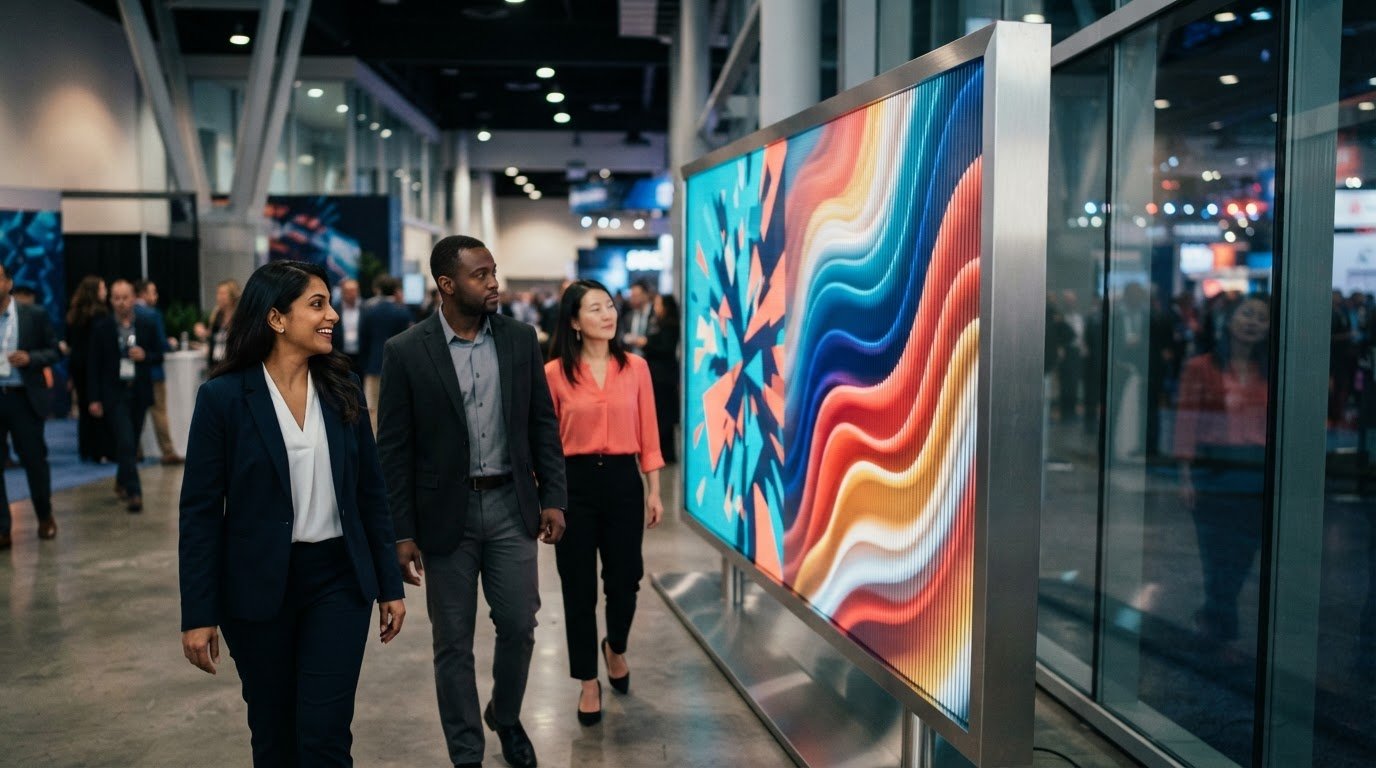
A flat display can hold attention for a moment; a lenticular one can change as people move. A brand activation lenticular display combines two or more images beneath a clear lens, so the visible image shifts with the viewer’s angle. It turns a static surface into a physical interaction, without relying on a screen.
That shift is the appeal of brand activation lenticular displays: the effect needs to feel immediate, while the idea behind it remains clear. This article explains how lenticular printing creates the change, what shapes production and cost, and how viewing distance, placement, and design affect the result. It also explores how these displays can support brand activations, from trade shows and conferences to high-traffic spaces, so you can decide when a changing image suits the experience you want to create.
Key Takeaways
- Choose between a changing-image effect, motion sequence, or stereoscopic depth based on the story you want the display to tell.
- Production choices such as display size, lens pitch, artwork, and viewing distance shape how the final piece is made and what drives its cost.
- Unlike digital screens, lenticular displays need no power, making them a physical option for spaces where a changing visual can make an impact.
- Keep the composition simple, use strong contrast, and place essential copy outside the moving image area for clearer viewing.
- Position displays where people pass from side to side, so the change in perspective becomes part of the brand activation.
What is Lenticular Printing?
Lenticular printing places two or more images beneath a clear lens, which directs each image toward the viewer at precise angles. As people move, the visible image changes, creating motion or a 3D effect without a screen.
Lenticular Lens Effects
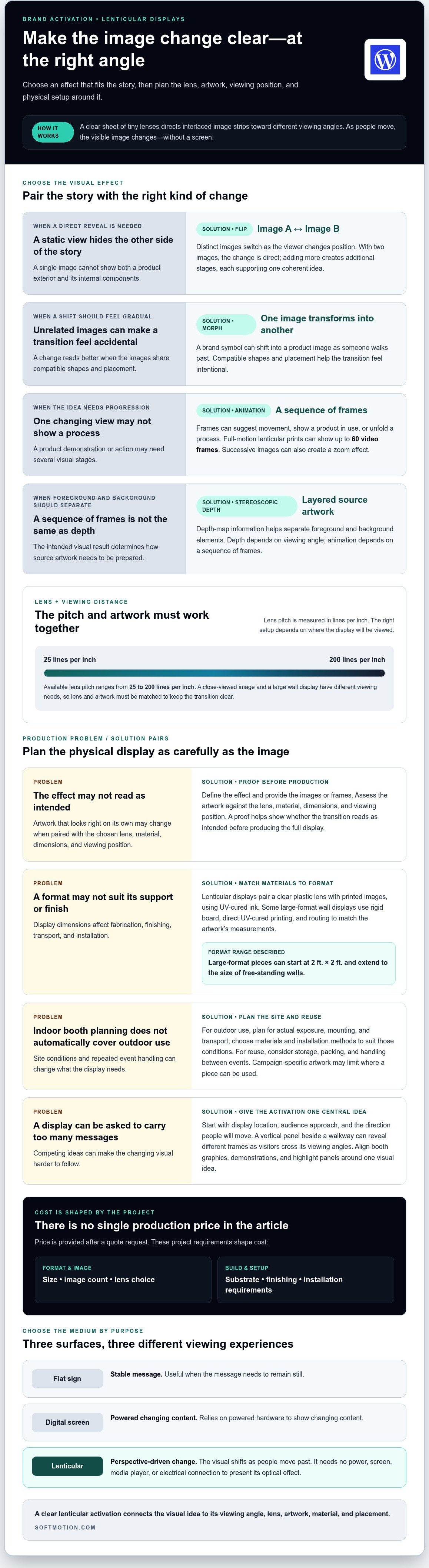
A lenticular lens is a clear sheet of tiny lenses that directs interlaced image strips toward different viewing angles. This optical effect makes one printed surface appear to show changing images. A panel can contain two or three images, and designs can include more when the visual sequence calls for it.
Lens pitch, measured in lines per inch, influences how the effect reads from different distances. The available range is 25 to 200 lines per inch. For example, a close-viewed image and a large wall display have different viewing needs, so the lens and artwork must work together to keep the transition clear.
Flip and Morph Effects
A flip effect switches between distinct images as the viewer changes position. One side might show a product’s exterior, while the other reveals its internal components. With two images, the change is direct. Adding more images creates additional stages, but each still needs to contribute to one coherent idea.
A morph effect makes the change feel more gradual, transforming one image into another across the viewing angle. For example, a brand symbol could shift into a product image as someone walks past. The images need compatible shapes and placement so the transition feels intentional, not like unrelated artwork appearing in sequence.
Animation and 3D Depth
Animation presents a sequence of images to suggest movement, such as a product being used or a process unfolding. Lenticular full-motion prints can show up to 60 video frames within a print. A zoom effect uses successive images to make a subject appear to move closer or farther away, giving a still surface a sense of progression.
Stereoscopic depth creates the impression that parts of an image sit at different distances. This 3D effect relies on layered source files with depth-map information, which helps separate foreground and background elements. The effect depends on the viewer’s angle, while animation depends on a sequence of frames. The United States Postal Service’s 2019 lenticular dinosaur stamp illustrates motion: two of its four designs show movement when rotated.
Production, outdoor use, reuse, and cost considerations
Lenticular displays combine interlaced artwork with a lens and a suitable print surface. Materials, dimensions, viewing conditions, and finishing all shape production planning and cost.
Materials and Printing Processes
A lenticular display pairs a clear plastic lens with printed images, using UV-cured ink to create a precise visual surface. Some large-format wall displays use rigid board, receive direct UV-cured printing, and are routed to match the artwork’s measurements.
The material affects how a display is fabricated, finished, transported, and installed. Large-format pieces can start at 2 ft. x 2 ft. and extend to the size of free-standing walls, so the support and finishing need to suit the intended format.
Display Applications and Reuse
A product demonstration can use a changing image to reveal internal components, while an animation can show the product in use. Retail signs and highlight panels can shift between a product image and a campaign message, making the visual change serve a clear purpose.
Promotional products, such as postcards or small keepsakes, bring the same effect to a compact format. Reuse depends on the campaign artwork and physical setup: a booth panel for repeated events needs suitable storage and handling, while a campaign-specific message may limit where it can be used.
For booth planning, start with the display location, the audience’s approach, and the direction people will move past it. A vertical panel beside a walkway can reveal different frames as visitors cross its viewing angles. Align booth graphics, product demonstrations, and highlight panels around one central visual idea, rather than asking a single lenticular surface to carry every message.
Proofing connects the artwork to the final viewing experience. First, define the intended effect and provide the images or frames needed to create it. Then assess the artwork against the lens, material, dimensions, and viewing position. A proof helps show whether the transition reads as intended before producing the full display.
Outdoor use requires planning for the actual site, including exposure, mounting, and transport. The material and installation method should suit those conditions; a display designed for an indoor booth does not automatically suit an outdoor placement. For reuse, also consider how the piece will be packed and handled between events.
Price depends on the project and is given after a quote request; size, image count, lens choice, substrate, finishing, and installation requirements shape cost. For teams planning an activation, lenticular display production connects the visual concept with material and fabrication decisions.
Comparison with standard signage and digital screens
Choose the display medium based on its purpose. A flat sign delivers a stable message, a digital screen plays changing content, and lenticular signage changes its visual as people move past. Each creates a different result in a retail aisle, event booth, or building lobby.
A lenticular display needs no power to present an optical effect, so it requires no screen, media player, or electrical connection. Its lenses direct different images toward viewers at specific angles. A digital screen, by contrast, relies on powered hardware to show changing content. This distinction can matter in a temporary booth, where access to outlets or cable routing affects placement.
Flat signage is useful when a message needs to stay visible from one position. Directional signs, such as an arrow pointing toward registration, need immediate clarity rather than an image transition. Lenticular graphics can instead create teaser signage: a product image shifts as people walk by, inviting a second look before they reach the booth. Keep directions and essential instructions stable and easy to find.
Digital screens suit campaigns that need video, changing schedules, or event updates. Lenticular displays offer a physical alternative when the content can be expressed through a limited set of images. For example, a retail panel might switch between a package view and a close-up detail. The effect is built into the printed surface, rather than played as a sequence on a monitor.
Lenticular displays are described as producing three times longer viewer engagement than standard flat signage. Treat that comparison as a reason to consider the format, not a promise for every placement. A clear visual idea, useful viewing angle, and steady flow of passing visitors all affect whether people notice the change. Complex images or an obstructed path can weaken the experience.
For a trade show, compare the media against the booth’s specific needs:
- Use flat signage for fixed directions, short instructions, and information viewers must read quickly.
- Use a digital screen for video, changing content, or information that needs frequent updates.
- Use lenticular graphics when the shift between images is central to the visual message.
Custom graphics can combine formats. A static panel can carry a booth name or directional cue, while a lenticular panel supplies the changing image. This keeps the practical message legible and gives the optical effect a distinct role. The best result comes from matching the medium to the message, rather than asking one display to do everything.
Design tips for legibility and viewing distance
Design lenticular artwork around one clear message, strong contrast, and the viewer’s expected distance. Larger displays viewed from a distance generally use 10-20 lenses per inch, while smaller panels viewed up close may use 40-75 lenses per inch.
Begin with placement, not artwork. A large-format print is typically viewed from a few feet away, so its central image needs to read at that distance. On a trade-show panel, a bold product silhouette against a contrasting background can remain recognizable as visitors approach. Fine details that work on a screen may disappear across a busy aisle.
Keep essential copy outside the moving portion. Small text within a changing image can blur or become harder to read as the viewer shifts position. Put a headline or callout in a static area, or use a separate panel for instructions. For example, keep the product name fixed while the adjacent image transitions between product views.
Build the composition around one visual idea. A sequence showing a bottle turning into its packaged form is easier to follow than several unrelated scenes competing for attention. The viewing angle determines which image reaches the eye, so organize the artwork to make each transition feel connected. Clear framing helps viewers understand what changed.
For animation, select frames that communicate a distinct action. A product demonstration might show a closed device, its components, then the assembled result. Lenticular full-motion prints can show up to 60 video frames, but adding frames does not automatically make the message clearer. Each frame should advance the same visual story rather than introduce an unrelated detail.
Depth effects need a different source approach from a simple flip. A 3D lenticular image requires layered source files with depth-map information, which separates foreground and background elements. Keep the focal subject clear and avoid placing fine copy across multiple depth planes. That helps the depth read as dimensional rather than distracting from the message.
Resolution and lens choice need to suit the finished scale. Prepare source images with enough detail for the intended display size, then assess the artwork at its expected viewing distance and angle. A close-viewed panel can reveal flaws that disappear across a room, while a distant display needs bold shapes and clean contrast.
Before fabrication, review the proof at the planned size and position. Check the image change along the viewer’s approach path, not only straight on. A practical test is to view a trade-show graphic from several points across its intended walkway and confirm that the main message remains legible.
Lenticular displays for brand activation and marketing
Measure an activation against its purpose, not just the display’s visual impact. Track audience interactions, campaign responses, and what visitors do after seeing the artwork, then compare the results with the campaign objectives. Brand activation lenticular displays are most useful when the changing visual supports a specific audience action.
Choose a primary outcome before selecting the format. A product launch might aim to prompt demonstrations, while a conference booth might focus on qualified conversations. For a retail campaign, the goal could be product discovery or visits to a featured display. Match each objective with a measure so the team can distinguish attention from meaningful engagement.
At an event, use a consistent observation method. Staff can tally how often visitors stop, interact, ask about the changing image, or continue to a product demonstration. A simple tally sheet can distinguish passersby from people who engage. If a lenticular lens reveals a product feature as visitors move, note whether the reveal leads to a question or hands-on interaction.
Connect the physical artwork to a campaign response when appropriate. A nearby QR code can lead to a campaign page, while a unique promotional code can track redemptions associated with the activation. Compare scans or redemptions with the campaign’s other traffic sources. These signals show response, but they do not capture every visitor who noticed the display.
For a photo area, record participation and resulting social activity using the campaign’s own tags or shared content. Photo opportunities can encourage visitors to capture and share the experience. Keep the visual prompt and campaign tag easy to find, then review the resulting posts for recurring questions, product interest, and audience reactions.
Use the same measurement approach across locations or event days. For example, record visitor interactions at each booth, then compare them with attendance patterns, placement, and artwork variations. This context helps explain why one display attracted more engagement. Don’t treat a raw count as proof that the format alone caused the difference.
The artwork should support the behavior being measured. A teaser image can create curiosity before a demonstration; a product sequence can help explain how an item works. For brand activation lenticular displays, match the message, materials, and measurement method to the campaign objective. Supporting signage or a campaign page can give visitors a clear next step.
After the campaign, bring observations together: staff tallies, interactions, QR scans, promotional responses, and visitor feedback. Compare each measure with the original objective, then use the findings to refine placement and artwork for the next activation. Plan an advertising lenticular display around the audience action you want to encourage.
Softmotion: Advertising Lenticular Displays
Softmotion creates Advertising Lenticular Displays for campaigns that need a printed visual to shift as audiences move. Turn to this offering when your activation calls for a physical image transition, product reveal, or distinctive event graphic rather than a powered screen. The creative direction can connect the effect to your campaign’s message, audience movement, and display setting, helping the finished piece feel purposeful within the experience.
For a trade show, the changing image can invite visitors toward a booth; in a retail environment, it can draw attention to a featured product. The right composition begins with the action you want the display to support. Share your project goals with Softmotion, or visit softmotion.com.
Give your next campaign a point of view
Strong creative direction starts with the audience’s experience: what should they notice, feel, or do next? Use that intention to shape brand activation lenticular displays, then carry the same visual language into the surrounding space and campaign materials. The display becomes more than a focal point when it connects with the wider environment.
Softmotion creates Advertising Lenticular Displays for campaign settings, Architectural Lenticular Installations for spatial applications, and Fine Art Lenticular Prints for image-led projects. Each format can serve a different creative purpose, from inviting a closer look to turning a surface into a distinctive visual experience.
Bring your campaign idea and intended setting into the conversation, and explore a direction that fits. Contact Softmotion about your display. Your next activation can begin with a clear idea and become an experience people want to explore.
Frequently Asked Questions
What is a lenticular display?
A lenticular display is a printed surface that presents different images as the viewer changes position. Its lens works with interlaced image strips, so the visual can flip, animate, or suggest depth. For example, a campaign panel can shift from a product’s closed form to its opened form. The display itself remains still; the perceived change comes from the relationship between the lens, artwork, and viewing angle.
What are the most common mistakes to avoid in lenticular projects?
Common mistakes include asking one design to communicate too many messages, placing fine copy in the changing area, and preparing artwork without considering its final viewing position. A crowded trade-show graphic, for example, can be hard to understand as visitors pass quickly. Start with one visual idea, keep essential text stable, and assess the artwork at its intended scale. For a depth effect, preserve the layered source material needed to build the image.
What resolution and file format should I use for a lenticular project?
Use high-quality source artwork sized for the final display, and preserve editable layers when the design needs dimensional depth. A universal resolution or file extension can’t be prescribed for every project because scale, image detail, and production method affect the required files. For a flip or animation, organize each image or frame clearly. For 3D depth, retain the depth-map information in the layered source file rather than flattening it.
What are lenticular displays in brand activation campaigns?
These are physical campaign graphics that use a changing image to make the audience’s movement part of the experience. A display might reveal a product detail as visitors approach an event booth, then support a conversation with staff. The format works best when the visual change serves a clear campaign purpose, such as introducing a feature or encouraging people to stop. It complements the wider activation rather than replacing its message or audience interaction.
What are effective brand activation ideas using lenticular displays?
Use the changing image to reveal a product feature, show a before-and-after transformation, or create a photo area visitors can capture and share. At a conference, a vertical display beside a walkway can shift as attendees pass. In a retail setting, a panel can transition between product views. Tie each idea to a next action, such as speaking with a representative or visiting a campaign page, so the visual moment connects with the activation.
How much do custom lenticular displays cost in the United States?
The price depends on the project and is provided after a quote request. Size, image count, lens choice, material, finishing, and installation requirements shape the cost. A compact promotional piece and a large display involve different artwork and fabrication decisions, so a useful budget starts with the intended format and setting. Clarifying the visual effect and use case also helps define the production scope without relying on a generic industry price range.
What factors affect lenticular display cost, size, and production time?
Artwork complexity, display dimensions, lens selection, substrate, finishing, and installation all influence the production scope. A design with multiple image transitions requires different artwork preparation from a single flip. Size also affects fabrication and how the piece will be handled at its destination. Production time follows the project sequence, including artwork preparation, proofing, fabrication, and installation planning, so the number of revisions and level of customization matter.
How do lenticular displays compare with digital signage and standard print displays?
Lenticular displays create an angle-dependent change without power, while digital signage presents content on powered screens and standard print keeps one image fixed. Choose a screen for video or frequently changing content; choose static print for directions that must remain constant. A lenticular piece suits a campaign where the transformation itself carries meaning, such as revealing a product detail. The right choice depends on the message and how people encounter it.