
Bespoke Lenticular Architectural Panels: The 2026 Specifier’s Guide

A wall should do more than just stand there. It should breathe, shift, and engage with every person who walks past it. You understand that in a luxury or corporate environment, every surface must command respect through its materiality and its narrative power. Yet, there’s often a lingering hesitation that adding motion might mean sacrificing durability or settling for promotional-grade materials that feel out of place in a high-end build. You want the visual impact of a digital installation without the coldness of hardware or the maintenance of screens.
Integrating bespoke lenticular architectural panels allows you to transform static environments into dynamic landmarks that respond intuitively to human movement. We’ve refined the process of translating 2D concepts into 3D kinetic realities, ensuring your vision holds its integrity at any scale. This guide provides a clear roadmap for the 2026 specifier, covering critical ASTM E-84 Class A fire ratings, material durability, and the precise lens selection required for sophisticated spatial transitions. You’ll discover how to master the technical specifications needed to deliver a seamless, high-performance surface that merges artistic ambition with grounded architectural reliability.
Key Takeaways
- Understand how passive interactivity transforms static walls into kinetic landmarks without the need for digital hardware or complex electrical infrastructure.
- Learn to select the correct substrate and LPI pitch to ensure your bespoke lenticular architectural panels meet stringent ASTM E-84 Class A fire ratings and long-term durability standards.
- Master the nuances between “Flip” and “Animation” effects to strategically guide viewer movement and narrative flow within high-traffic corridors.
- Discover the essential roadmap from 300dpi file preparation to physical prototyping that guarantees a seamless, risk-free installation at any scale.
- Leverage over 25 years of specialized expertise to bridge the gap between imaginative two-dimensional design and large-format multi-dimensional execution.
Defining the Bespoke Lenticular Architectural Panel
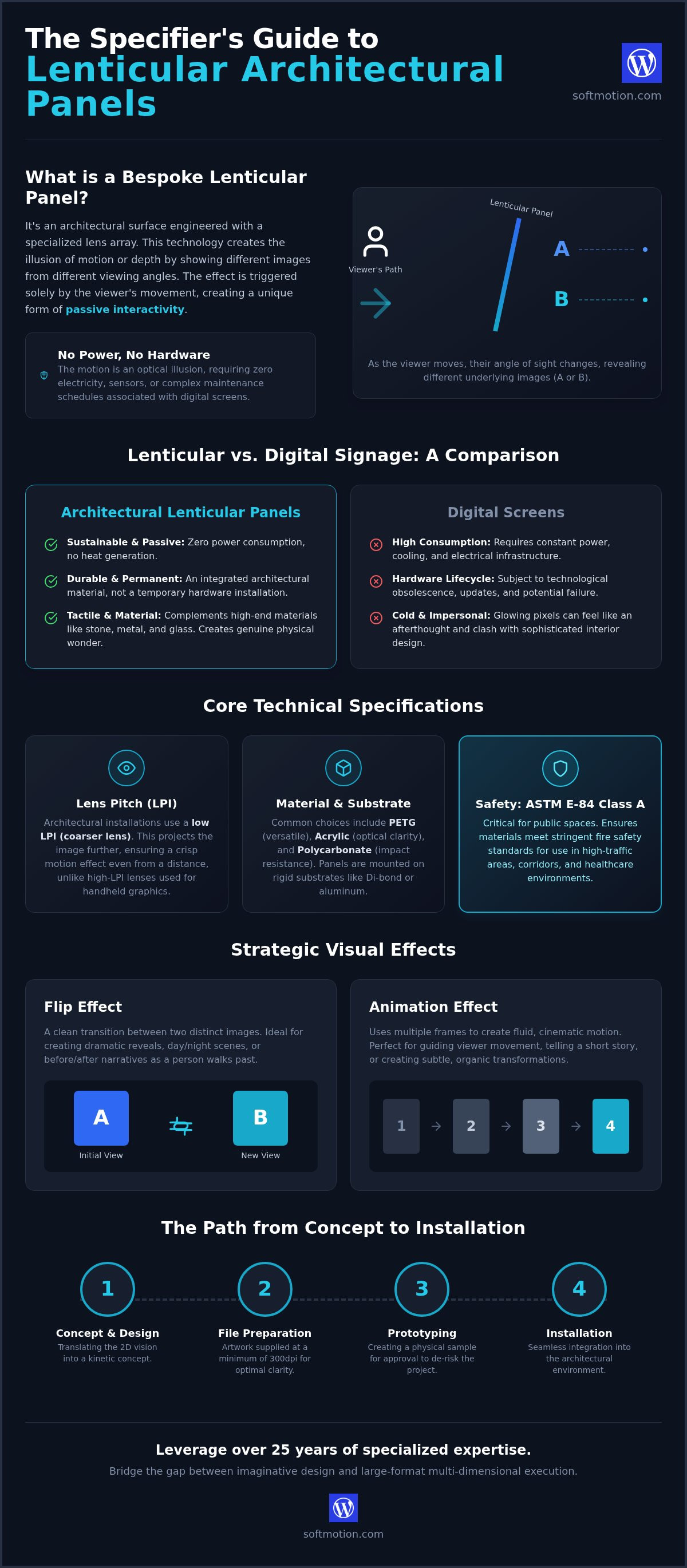
A surface should be more than a boundary; it should be a medium for movement. Bespoke lenticular architectural panels are multi-dimensional surfaces engineered with integrated lens arrays that manipulate light to create the illusion of depth or motion. Unlike static graphics, these panels rely on the principle of Lenticular printing to present different information to the viewer based on their angle of observation. This creates a state of passive interactivity. No sensors are required. No electricity is consumed. The motion is triggered entirely by the viewer’s physical transition through the space.
Architectural-grade panels differ fundamentally from the thin, promotional-grade materials found in mass-market advertising. They’re defined by their substantial thickness, optical clarity, and the precision required to maintain a seamless visual effect at a monumental scale. The kinetic skin effect is a sophisticated spatial storytelling tool that allows a building’s surface to communicate evolving narratives as viewers traverse the environment.
The Role of Lenticular in Modern Kinetic Architecture
Modern design is shifting away from static environmental graphics toward immersive, motion-driven environments. These panels integrate with kinetic architecture to create living facades that change character as the sun moves or as pedestrians pass by. In corporate lobbies, transit hubs, and luxury retail, this technology transforms a traditional wall into a responsive canvas. It turns a simple walk down a corridor into a sensory experience, where the architecture itself feels alive and attentive to the visitor’s presence.
Lenticular vs. Digital Signage: The Case for Physical Motion
Digital screens often feel like afterthoughts in a thoughtfully designed space. They bring high power consumption, heat, and a constant need for hardware updates. Physical lenticular panels offer a sustainable alternative with zero power requirements and minimal maintenance. They complement architectural materials like stone or glass far better than glowing pixels. There’s also a distinct psychological impact to this “discovery” in physical space. When a viewer realizes their own movement controls the visual change, it creates a moment of genuine wonder that digital hardware rarely replicates.
Technical Specifications: Lenses, Substrates, and Durability
Engineering a visionary concept into a physical reality requires a transition from artistic intent to rigorous technical discipline. Specifying bespoke lenticular architectural panels isn’t merely about choosing an image; it’s about selecting the optical engine that will drive the experience. The foundation of this technology lies in the “LPI” or Lines Per Inch. While high-resolution handheld graphics often use 75 to 100 LPI, architectural installations demand a much lower pitch. A coarser lens allows the light to be projected further, ensuring the motion effect remains crisp even when viewed from across a vast atrium or transit hall.
Materiality dictates both the aesthetic result and the structural longevity. PETG is often preferred for its versatility and ease of fabrication, but Acrylic remains the gold standard for optical clarity. For high-traffic environments where impact resistance is paramount, Polycarbonate provides the necessary toughness. Safety is never an afterthought. For public installations, we prioritize materials that meet the ASTM E84 Class A fire rating. This standard ensures a Flame Spread Index of 0-25 and a Smoke Developed Index of 0-450, providing the security required for exit routes and healthcare environments. You can explore these material nuances further by requesting lenticular samples to feel the tactile difference in substrate quality.
Anatomy of an Architectural Lenticular Sheet
The relationship between lens thickness and visual depth is a matter of precision optics. A thicker lens generally allows for a more dramatic 3D effect or a cleaner “flip” between two distinct states. These panels aren’t standalone; they require robust mounting to maintain their optical alignment. Common substrates include Di-bond or aluminum for rigid wall cladding, though direct-to-glass applications are increasingly popular for transparent partitions. Weight is a critical factor for large-format cladding. A standard 1/4 inch acrylic panel can be substantial, requiring a collaborative approach with structural engineers to ensure the mounting system can support the kinetic skin over time.
Comparing Lens Pitches for Different Viewing Distances
Finding the “sweet spot” for viewing is the most important technical decision you’ll make. A corridor with a 10-foot viewing distance requires a different lens geometry than a 50-foot terminal wall. While traditional extrusion is standard, research into 3D printing lenticular surfaces suggests new horizons for applying these effects to complex, non-linear geometries. When scaling these effects across entire lobbies, mastering large format lenticular printing becomes essential to ensure the motion remains synchronized across multiple panels. This prevents moiré patterns, those distracting visual interference ripples that occur when architectural lighting isn’t perfectly aligned with the lens pitch.
Strategic Visual Effects: From Flip to 3D Depth
Visual impact is the primary currency of modern architecture. When you specify bespoke lenticular architectural panels, you’re choosing exactly how a surface communicates with its occupants. These aren’t static decorations; they’re instruments of perception. The most fundamental effect is the “Flip,” where a panel oscillates between two distinct states. This allows a corporate lobby to transition between a brand’s heritage and its future vision, or a retail space to shift between seasons as a customer walks past. It’s a clean, decisive change that rewards the viewer’s movement with a fresh perspective.
Motion and Animation effects offer a more fluid experience. Instead of a sharp jump between images, the surface appears to ripple or evolve, following the viewer’s trajectory across a corridor. For projects requiring a sense of infinite space, True 3D Depth simulates spatial volume without the need for specialized eyewear. It makes a solid wall appear to recede into a deep, multi-layered environment. While these effects rely on micro-lenses, Agamographs provide a more structural, faceted alternative to traditional lenses by using physical zig-zag geometry to separate views across a monumental scale.
Designing for the Human Walkway
Designing for the human walkway requires a deep understanding of pace. If a transition happens too quickly, the effect feels frantic; if it’s too slow, the narrative is lost. We map image transitions to the average walking speed of a visitor to ensure the story unfolds naturally. For a more sophisticated, high-end feel, we often recommend the “Morph” effect. This creates a subtle, painterly transition between states rather than a hard flip. The Smithsonian Institution has highlighted the impact of lenticular prints in displays, noting how they invite visitors to slow down and engage with information through physical movement. Precision in the design phase is what prevents “ghosting,” that unwanted visual bleeding where parts of both images are visible simultaneously.
Lenticular Agamographs: A Structural Perspective
Agamographs aren’t just graphics; they’re architectural forms. Defined by a zig-zag architectural structure, they allow for massive, high-impact viewing that standard lens arrays sometimes struggle to achieve at extreme distances. You’d choose an Agamograph structure over a lenticular lens when the project demands a bold, graphic presence that feels integrated into the building’s skeleton. These structures are particularly effective when paired with strategic lighting. By illuminating the facets from specific angles, we can enhance the sense of motion and highlight the physical depth of the installation. It’s a risk-free way to create a landmark feature that feels both intellectually stimulating and technically grounded.
The Path from Concept to Installation: Managing the Project
Moving from a digital render to a physical installation is where many complex projects falter. For bespoke lenticular architectural panels, this transition requires a methodical, purposeful approach. We don’t just print; we engineer a visual journey. With over 1,000 projects delivered since 1997, our team has developed a “Risk-Free” framework that anticipates technical hurdles before they reach the job site. It starts with file preparation. To achieve the crystalline clarity expected in corporate environments, we require 300dpi at 1:1 scale. This ensures every lens is perfectly aligned with the interlaced data beneath it, preventing the visual distortion that plagues lower-resolution graphics.
Prototyping and Sampling: Eliminating Uncertainty
Seeing a digital simulation is one thing; feeling the motion in a physical space is quite another. We rely on custom lenticular prototypes to verify color accuracy and motion fluidity early in the design cycle. The “Mini-Master” sample serves as a critical proof of concept, allowing you to test the effect under actual site conditions. Lighting is the silent partner in these installations. We test how specific lobby lighting temperatures, from warm 2700K to cool 5000K, affect the perceived transition and contrast of the panels. This collaborative approval process ensures that by the time full production begins, every creative risk has been mitigated.
On-Site Installation and Precision Alignment
The final challenge is “Seamless Tiling.” Managing vertical seams across a massive installation requires millimetric precision. We handle the logistics of large-panel shipping and provide clear guidance on on-site alignment to ensure the kinetic effect remains uninterrupted across multiple sheets. Depending on the architectural integration, we suggest either standoff hardware for a layered, modern look or specialized adhesive systems for a flush finish. Once installed, these surfaces are remarkably resilient. Routine cleaning with soft microfiber and approved solutions will protect the optical surface for decades, maintaining the same vibrancy as the day it was unveiled. Ready to begin your project? Contact our team to discuss your custom fabrication needs today.
Why Global Leaders Spec Softmotion for Large-Scale Motion
Leadership in architectural design isn’t just about technical capability. It’s about having the discipline to execute a vision that others might find impossible. Since 1997, Softmotion has specialized in this exact intersection of fine art and precision engineering. We’ve delivered over 1,000 projects, transforming static surfaces into multi-dimensional narratives for some of the world’s most recognized brands. When you specify bespoke lenticular architectural panels through our studio, you aren’t just buying a material. You’re entering a collaborative partnership with a visionary guide who understands the profound nuances of spatial transformation.
Our reach is global. Whether it’s a corporate headquarters in London or a luxury retail flagship in New York, we manage the complexities of international logistics and on-site installation with composed authority. We recently transformed a Fortune-500 lobby from a conventional, static environment into a kinetic experience that greets every visitor with a shifting, organic landscape. This project highlights our ability to handle the scale and emotional resonance required for high-stakes environments, ensuring that the final result is both a technical success and a cultural landmark.
End-to-End Excellence: Design to Installation
Most vendors stop at the print. We believe the journey only ends when the final panel is perfectly aligned on your wall. Our unique capability lies in handling both the high-precision optical printing and the underlying structural fabrication. This holistic approach ensures that the artistic intent isn’t lost in the transition between different subcontractors. It’s a “Human-First” professional partnership where clarity and reliability are the primary objectives. We invite you to consult with a Softmotion visionary on your next architectural project to see how we can bring your kinetic concepts to life with total security.
Crafting Immersive Environments for the Future
Architecture is evolving. The future belongs to environments that feel responsive, alive, and attentive to human presence. Softmotion panels bridge the gap between fine art and functional architecture, turning necessary structural elements into primary narrative features. Our commitment to clarity, partnership, and multi-dimensional transformation has been the foundation of our work for over 25 years. We encourage you to explore our portfolio of 1,000+ successful installations. Each project represents a unique solution to a complex spatial challenge, proving that with the right guide, any static surface can become a masterpiece of motion and light.
Redefining the Narrative of Physical Space
A wall is no longer a mere boundary; it’s a narrative waiting to be activated. By integrating bespoke lenticular architectural panels, you move beyond the limitations of static surfaces to create environments that breathe and respond. We’ve examined the technical precision required for ASTM E-84 compliance, the strategic selection of lens pitches for monumental viewing distances, and the importance of rigorous prototyping. These elements combine to deliver a kinetic experience that feels both naturally integrated and intellectually stimulating.
Realizing a vision of this scale demands a partner who possesses both the artistic sensibility of a designer and the technical discipline of an engineer. Since 1997, we’ve delivered over 1,000 projects globally, earning the trust of Fortune-500 corporations through our commitment to clarity and collaborative care. Our end-to-end service ensures that your transition from concept to installation is managed with composed authority and millimetric precision. It’s time to transform your next environment into a dynamic landmark. Partner with Softmotion for your bespoke architectural installation and lead the shift toward a more immersive, multi-dimensional future.
Frequently Asked Questions
What is the maximum size for a bespoke lenticular architectural panel?
The scale of a bespoke lenticular architectural panel is essentially limitless when utilizing our precision tiling techniques. While individual sheets are constrained by the physical dimensions of the lens extrusion, we specialize in creating monumental, multi-panel installations that maintain optical synchronization across hundreds of square feet. Our expertise in project management ensures that vertical seams remain virtually invisible to the viewer, allowing for a continuous kinetic experience at a truly architectural scale.
Are lenticular panels fire-rated for use in public buildings and transit hubs?
Safety is a non-negotiable standard in our fabrication process. We prioritize the use of high-performance substrates that meet the rigorous ASTM E-84 Class A fire rating requirements. This certification confirms a Flame Spread Index of 0-25 and a Smoke Developed Index of 0-450, making our installations suitable for high-traffic public spaces, transit hubs, and healthcare environments. We provide all necessary documentation to ensure your project complies with the most stringent local building codes.
How do you clean and maintain architectural lenticular installations?
Maintaining the optical clarity of these surfaces is remarkably straightforward. We recommend using a soft microfiber cloth and a mild, non-abrasive soap solution to remove dust or fingerprints. It’s important to avoid harsh chemical solvents or abrasive pads that could scratch the lens array. Because these installations are passive and contain no digital hardware, they don’t require technical maintenance or software updates, ensuring a long-lasting and reliable visual feature for any corporate lobby.
Can lenticular panels be used for exterior building facades?
Exterior applications are possible when utilizing UV-stabilized substrates and specialized protective coatings. We select materials that resist yellowing and maintain color fastness even in sun-drenched environments. However, outdoor installations require a collaborative engineering approach to account for thermal expansion and wind loading. We’ve successfully delivered large-format projects for building facades that transform with the shifting daylight, providing a durable and dynamic alternative to traditional static cladding materials.
What is the typical lead time for a custom architectural lenticular project?
Every project follows a methodical timeline designed to eliminate risk and ensure precision. A typical lead time ranges from 8 to 12 weeks, depending on the scale and complexity of the visual effect. This duration includes the critical phases of digital proofing, physical prototyping, and final fabrication. We prioritize a collaborative journey, ensuring that each milestone is met with clarity and professional reliability to keep your broader construction schedule on track.
Do I need special lighting to make the lenticular motion effect work?
While lenticular effects rely on ambient light and viewer movement, strategic lighting design significantly enhances the final result. You don’t need specialized hardware, but even illumination is key to preventing distracting shadows or glare. We recommend avoiding high-intensity point sources that might create moiré patterns. Our team often performs light testing during the prototyping phase to ensure the chosen lens pitch interacts harmoniously with the specific color temperatures of your space.
How does viewing distance affect the choice of lenticular lens pitch (LPI)?
Viewing distance is the primary factor in determining the optimal lens geometry. For close-range interactions in a corridor, a higher LPI provides fine detail and smooth transitions. Conversely, large-scale installations viewed from across an atrium require a lower pitch to project the motion effect clearly at a distance. Selecting the correct LPI is a technical discipline that we master during the design phase to ensure the bespoke lenticular architectural panels perform perfectly.
What is the difference between a lenticular panel and an agamograph?
The distinction lies in the physical structure used to separate the images. A lenticular panel uses a micro-lens array to manipulate light at a granular level, creating fluid motion or 3D depth. An agamograph utilizes a larger, zig-zag architectural form to physically partition two or more distinct views. While both create a shifting visual experience, agamographs offer a more structural, faceted presence that is often favored for high-impact, monumental features where the architecture itself becomes the medium.