
3D Lenticular Wall Art: The Definitive Guide to Large-Scale Motion Installations
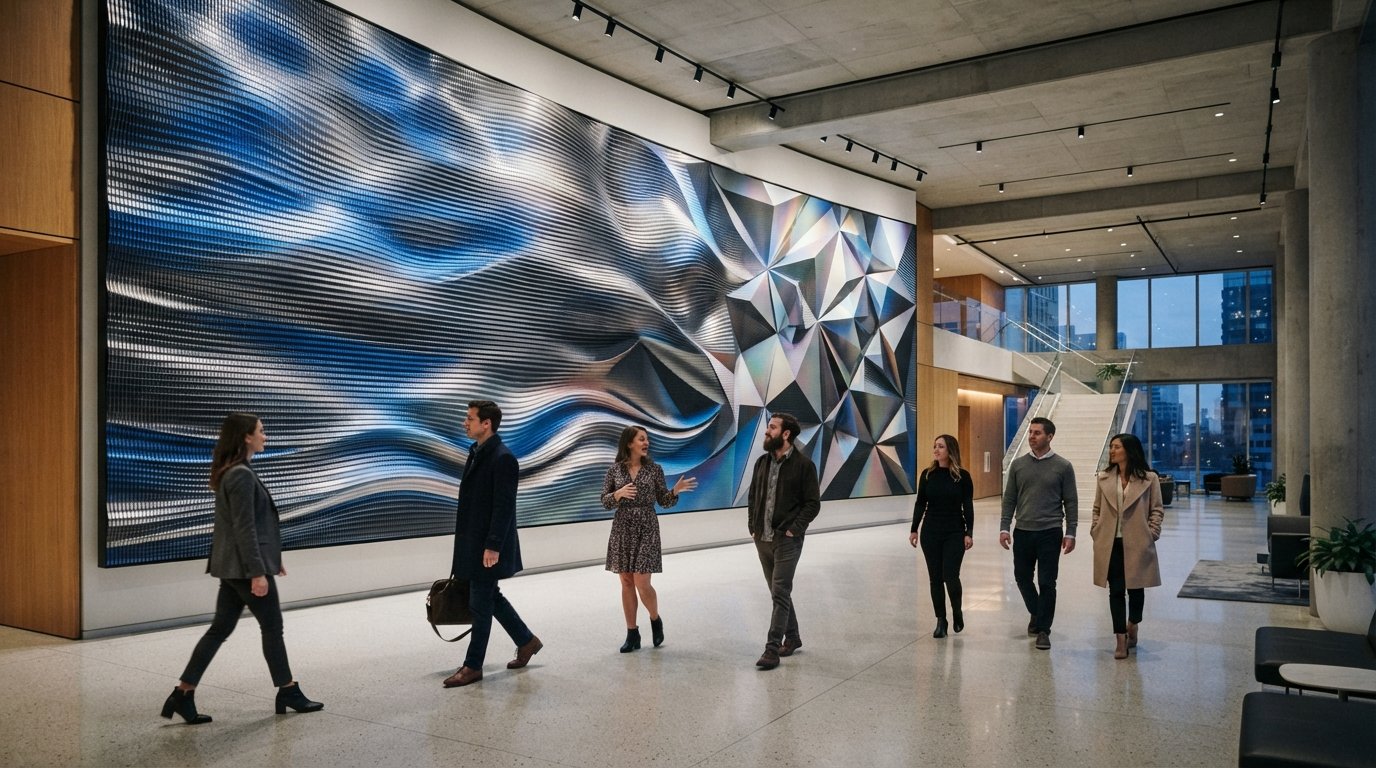
What if your walls could breathe, shift, and respond to movement without a single wire, pixel, or watt of electricity? In an era of screen saturation, the most captivating environments engage the senses through physical motion rather than digital glare. You’ve likely noticed that standard decor often fails to hold attention, while massive LED screens feel intrusive and demand constant maintenance. This is where 3D lenticular wall art redefines the boundaries of a room. It transforms a passive surface into a dynamic, perspective-shifting experience that reveals its secrets only as a person moves through the space.
We believe that a truly immersive environment should be both inspiring and grounded in professional reliability. This guide serves as your definitive roadmap to mastering motion at scale. You’ll discover how professional-grade lenticular technology provides a durable, low-maintenance alternative to digital signage while significantly increasing foot traffic engagement. From selecting the correct lens pitch for long-distance viewing to engineering modular tiling systems, we’ll walk you through the journey of turning a static wall into a visionary landmark. It’s time to bridge the gap between fine art and technical precision.
Key Takeaways
- Learn the critical differences between consumer-grade posters and professional 3D lenticular wall art designed for large-scale architectural environments.
- Understand how lens pitch (LPI) dictates optimal viewing distances and why precision interlacing is essential for maintaining visual clarity at scale.
- Discover the technical requirements for site preparation and lighting to ensure your motion installation remains sharp and free from distortion.
- Explore the engineering behind seamless tiling and high-end fabrication that allows kinetic graphics to span massive commercial walls.
- Master a collaborative design process that uses physical sampling and digital mockups to reduce risk and guarantee a flawless final result.
Defining 3D Lenticular Wall Art for Modern Environments
In a world of constant digital noise, the physical environment often feels left behind. 3D lenticular wall art is a perspective-shifting medium that uses specialized optical lenses to create the illusion of depth and movement. It isn’t a mere static image; it’s a multi-dimensional visual medium that reacts to the viewer’s presence. While many associate “3D” with consumer-grade novelty posters found in gift shops, architectural-grade installations are a different breed entirely. These professional systems are engineered to span entire walls, maintaining optical clarity and structural integrity at scales that would cause standard retail prints to fail.
One of the most compelling advantages of this technology is its ability to be interactive without power. In an era where sustainability is paramount, lenticular art offers a kinetic experience that consumes zero watts. There are no wires, no heat emissions, and no pixels to burn out. It’s an analog-interactive solution that provides the high-impact engagement of a digital screen with the durability and low maintenance of traditional fine art. Since 1997, we’ve seen how this “human-powered” movement creates a more profound emotional connection than any flickering LED panel.
The Shift from Static to Kinetic Surfaces
Static surfaces tell a single story. 3D lenticular wall art tells many. It captures attention in high-traffic zones by utilizing the psychology of parallax, the phenomenon where objects appear to shift based on the viewer’s position. This natural eye-tracking response creates an immediate, subconscious connection between the individual and the architecture. Unlike traditional vinyl murals or paint, which the brain quickly filters out as background noise, a kinetic surface demands a second look. It transforms a simple walk down a hallway into a moment of discovery, rewarding the viewer for their physical movement through the space.
Applications in Corporate and Public Spaces
Architects and designers use these installations to solve specific spatial challenges. In corporate lobbies, they serve as brand storytelling hubs, shifting between logos, values, and abstract art as guests move toward reception. In narrow corridors, the illusion of 3D depth can visually “push back” the walls, creating a sense of openness where none exists. Public transit hubs also benefit immensely. In areas where digital screens are prohibited due to driver distraction or safety regulations, lenticular graphics provide a safe, engaging alternative that remains vibrant and indestructible under heavy use.
The Mechanics of Motion: How 3D Lenticular Technology Works
Achieving a seamless kinetic experience requires a precise marriage between optical physics and digital artistry. At its core, 3D lenticular wall art relies on a series of parallel cylindrical lenses, or lenticules, that focus the viewer’s eye on specific slices of an underlying image. This underlying layer isn’t a standard print. It’s an interlaced file where multiple images are sliced into microscopic strips and woven together. When the lens is placed over this file, it isolates specific strips based on your viewing angle, creating the illusion of depth or movement.
Precision is the difference between a gimmick and a masterpiece. In large-scale fabrication, even a fraction of a millimeter in misalignment can destroy the illusion. Professional interlacing software calibrates the print to the exact extrusion tolerances of the specific lens batch. This prevents ghosting, a common flaw where two images overlap and blur the visual narrative. By controlling the light’s path, we can dictate whether a viewer sees binocular stereoscopy, known as 3D depth, or a sequential phase transition, known as a flip effect.
LPI and Viewing Distance Calibration
The resolution of these lenses is measured in Lines Per Inch (LPI). While handheld items use high pitches of 75 to 100 LPI, architectural installations demand a coarser 10 to 40 LPI. This ensures the effect remains crisp from twenty feet away. Choosing the wrong pitch leads to banding or visual noise. We often recommend reviewing a physical lenticular sample to verify the LPI against your specific sightlines before committing to full-scale production. Narrow viewing angles between 24° and 37° are utilized for deep 3D effects, while wider angles up to 54° enable smooth motion for walking traffic.
Material Science: Durability for High-Traffic Areas
Durability is non-negotiable for public art. High-traffic areas require materials like optical-grade PETG or polycarbonate that meet IBC Chapter 8 fire codes, specifically ASTM E84 Surface Burning standards. These substrates are typically 2.15 mm to 3.0 mm thick to provide the necessary focal depth for large-format graphics. UV-stabilized coatings prevent yellowing in sun-drenched atriums, ensuring the installation remains a permanent fixture of the architecture. Maintenance protocols are straightforward; large surfaces simply require non-abrasive, anti-static cleaning to maintain their optical clarity over time.
Architectural Scale vs. Retail Prints: Why Quality Matters
A common misconception is that all lenticular products are created equal. In reality, the gap between a retail-grade poster and professional 3D lenticular wall art is as vast as the difference between a snapshot and a masterpiece. Retail prints often rely on thin, unstable plastics that are prone to thermal warping and yellowing over time. For a permanent installation, these materials are a liability. Professional fabrication demands optical-grade substrates and direct-to-lens UV flatbed printing, ensuring that the visual impact remains vibrant for decades rather than months.
Investing in large format lenticular printing is about more than just size. It’s about engineering. High-end installations utilize heavy-gauge polycarbonate or PETG, which provides the structural rigidity needed to prevent bowing in large-scale environments. Color accuracy is another critical differentiator. While consumer prints often struggle with ghosting or muddy transitions, professional-grade systems use micro-calibrated interlacing to maintain razor-sharp clarity and consistent brand colors across every square inch of the surface.
Seamless Integration and Tiling
Scaling motion art to cover a 50-foot wide wall presents unique mechanical challenges. Since single lens sheets have maximum production dimensions, large murals require modular tiling. Achieving a monolithic look requires precision-engineered joints and custom-machined aluminum sub-frames. These frames hold each panel in perfect registration, allowing the kinetic effect to flow uninterrupted across the entire installation. Without this level of technical discipline, visible seams break the illusion and distract the viewer from the artistic experience.
Custom Agamographs vs. Lenticular Printing
Designers often weigh the benefits of traditional Agamographs against modern lenticular technology. Agamographs utilize a jagged, triangular geometry to show two distinct images, but they lack the fluid, multi-phase movement of a lens-based system. While Agamographs create a bold, structural statement, lenticular printing offers sophisticated transitions and stereoscopic depth. Choosing between them depends on the intended pace of the viewer. Lenticular excels in corridors where walking traffic triggers a smooth, cinematic transformation, whereas Agamographs provide a more rigid, architectural shift.

Specifying 3D Lenticular Wall Art: A Professional Checklist
Specifying 3D lenticular wall art requires a transition from traditional graphic design to spatial engineering. It’s not enough to provide a high-resolution image; the environment must be curated to support the optical illusion. A successful installation begins with a rigorous site survey that accounts for viewing distances and physical obstructions. If the viewer can’t reach the intended “sweet spot” where the interlacing resolves, the kinetic story remains untold. We analyze traffic patterns to ensure the motion phases align with the natural pace of people moving through the space.
Wall preparation is another critical factor that specifiers often overlook. The mounting surface must be perfectly flat, as even a minor deviation can cause the lens to bow. This bowing shifts the focal point of the lenticules, leading to localized blurring or “jumping” in the animation. We typically coordinate with general contractors during the early stages of a project to ensure the substrate is plumb and level. This grounded, professional approach eliminates the risk of visual distortion before the first panel is ever installed.
Lighting and Environmental Factors
Lighting is the lifeblood of motion art. 3D lenticular art requires diffused, overhead lighting to prevent lens glare. Directional light or harsh spotlights are the enemies of 3D depth, as they create internal shadows within the lens that interfere with the viewer’s binocular perception. For vibrant color reproduction, we recommend lux levels between 500 and 800. In glass-heavy architectural environments, managing reflections is essential. We account for how natural light shifts throughout the day, ensuring the artwork remains legible from morning through evening without being washed out by solar glare.
Installation Logistics and Site Surveys
Large-format polycarbonate or acrylic sheets carry significant weight, often requiring specialized mounting hardware like Z-clips or custom aluminum cleats. Because every environment is unique, the role of custom lenticular prototypes cannot be overstated. These physical samples allow architects to test the visual effect under actual site conditions, reducing project risk and ensuring stakeholder buy-in. Coordinating with on-site teams for integrated features, such as backlighting or recessed framing, ensures the art feels like a permanent part of the architecture. If you’re currently planning a high-traffic installation, you can contact our specialists to review your technical drawings and mounting requirements.
The Softmotion Collaborative Process: Concept to Installation
Transforming a visionary concept into a tangible landmark requires more than just technical skill; it demands a partnership rooted in clarity and discipline. Since 1997, we’ve acted as a visionary guide for architects and Fortune 500 corporations, navigating the complex transition from two-dimensional brand assets to immersive 3D lenticular wall art. With over 1,000 projects delivered globally, our process is designed to eliminate uncertainty. We don’t just provide a service; we offer a controlled, risk-free journey that bridges the gap between fine art and industrial-grade production.
Our methodology follows a purposeful narrative arc. It begins with “Discovery with Purpose,” where we align the artistic vision with the spatial constraints of your environment. We then move into digital 3D spatial mockups, allowing stakeholders to visualize the motion before we ever touch a lens. This collaborative approach ensures that the final masterpiece isn’t just a decoration, but a functional, perspective-shifting element of the architecture itself. By grounding the creative process in technical discipline, we turn hidden potential into a concrete reality.
Design and Interlacing Services
We don’t just print images; we translate narratives. Our design team works closely with artists to convert flat graphics into motion-driven visual experiences. This involves a rigorous iteration process where digital proofs are refined into physical samples. We understand that brand color consistency is non-negotiable. By micro-calibrating our interlacing software to the specific optical properties of our lenses, we ensure that corporate palettes remain vibrant and accurate from every viewing angle. It’s a meticulous transition from the two-dimensional to the multi-dimensional.
Full-Scale Fabrication and Installation
Quality is maintained through total control. Every project is crafted to perfection at our dedicated facilities, where we employ high-precision UV printing and specialized cutting techniques. This in-house production ensures that even the most complex architectural lenticular installations meet our exacting standards. Our global delivery capabilities include turnkey on-site assembly across North America, handled by field experts who understand the nuances of modular tiling. Once the installation is complete, we provide ongoing support and performance checks, ensuring your kinetic feature remains a durable, low-maintenance asset for years to come.
Designing the Future of Kinetic Environments
The transition from a static surface to a dynamic landmark requires a blend of artistic vision and technical discipline. You now understand that professional 3D lenticular wall art relies on micro-calibrated optics and site-specific lighting to achieve its transformative effect. By prioritizing architectural-grade materials over retail alternatives, you ensure your installation remains a durable, low-maintenance feature that engages every passerby.
Since 1997, we’ve refined an end-to-end process that takes projects from initial sampling to on-site assembly. With over 1,000 successful installations delivered for Fortune 500 brands and visionary architects worldwide, we possess the expertise to realize your most ambitious spatial concepts. We’re here to serve as your collaborative partner, ensuring every detail is executed with precision and care.
Ready to reimagine your space? Start your custom lenticular project with Softmotion today and discover the impact of motion at scale. Your vision deserves a canvas that moves with your audience.
Frequently Asked Questions
What is the maximum size for a 3D lenticular wall art installation?
There is no theoretical limit to the size of a 3D lenticular wall art installation. While individual rigid lens sheets typically reach a maximum dimension of 48 inches by 96 inches, we utilize a modular tiling system to cover massive surfaces. These panels are precision-jointed and mounted to engineered subframes, allowing for seamless murals that can span 50 feet or more across corporate lobbies and transit hubs.
How does lighting affect the 3D depth of a lenticular wall?
Lighting is the primary factor in how the human eye perceives depth and motion on a 3D lenticular wall art surface. Ideal conditions involve diffused, overhead lighting that evenly illuminates the lens without creating hot spots or internal shadows. Harsh directional spotlights should be avoided because they cause lens glare and interfere with the binocular stereoscopy required for 3D effects. We recommend maintaining lux levels between 500 and 800 for optimal clarity.
Can 3D lenticular art be installed outdoors on building facades?
Yes, lenticular installations are increasingly used for building facades and outdoor environments. For these projects, we specify UV-stabilized resins and coatings to prevent the thermoplastic lenses from yellowing or becoming brittle under direct sunlight. We also account for thermal expansion by using floating frame systems. These outdoor-grade materials ensure the kinetic artwork remains vibrant and structurally sound despite exposure to varying temperatures and environmental moisture throughout the year.
Is lenticular art more durable than a digital LED wall for high-traffic areas?
Lenticular art offers superior durability and lower maintenance than digital LED walls in high-traffic zones. Unlike screens, these installations consume zero electricity and produce no heat, eliminating the risk of pixel burnout or technical failure. The materials used, such as optical-grade polycarbonate, are highly impact-resistant and meet strict fire safety codes. This makes them an ideal solution for public transit hubs and schools where digital hardware would be too fragile or expensive to maintain.
How do I clean and maintain a large-scale lenticular installation?
Maintenance for a large-scale installation is remarkably straightforward and requires no specialized technical staff. Surfaces should be cleaned using a soft, non-abrasive microfiber cloth and a mild, anti-static cleaning solution. It’s important to avoid harsh chemical solvents that could damage the optical clarity of the thermoplastic lens. Because these are analog systems with no moving parts or electrical components, the primary task is simply keeping the surface free of dust and fingerprints.
What is the typical lead time for a custom architectural lenticular project?
Lead times vary based on project scale, but a typical architectural installation generally ranges from 8 to 12 weeks. This timeline includes the initial discovery phase, digital 3D mockups, and the creation of physical prototypes for site testing. Once the design is finalized, the fabrication and precision interlacing take place at our facility before the units are shipped for on-site assembly. We recommend engaging our team early in the design process to ensure seamless coordination.
Do I need special software to design images for 3D lenticular printing?
You don’t need specialized interlacing software to begin your project. Our team handles the complex technical interlacing required to map your art to the specific lens pitch. Designers simply need to provide high-resolution source files, typically in layered PSD or AI formats, with sufficient bleed and resolution. We then translate these 2D assets into 3D masterpieces, guiding you through the technical requirements for file preparation to ensure the final motion effect is sharp.
How do I prevent “ghosting” or double images in large-format prints?
Preventing ghosting requires micro-calibrating the interlaced image to the exact pitch of the lens batch. Even slight variations in lens extrusion can cause double images if the print isn’t perfectly aligned. We use high-precision UV flatbed printing to bond the image directly to the lens, which eliminates the registration shifts common in older lamination methods. Physical prototyping is also essential, as it allows us to verify visual clarity under site-specific lighting before full-scale production begins.