
Specifying lenticular surfaces for architectural installations
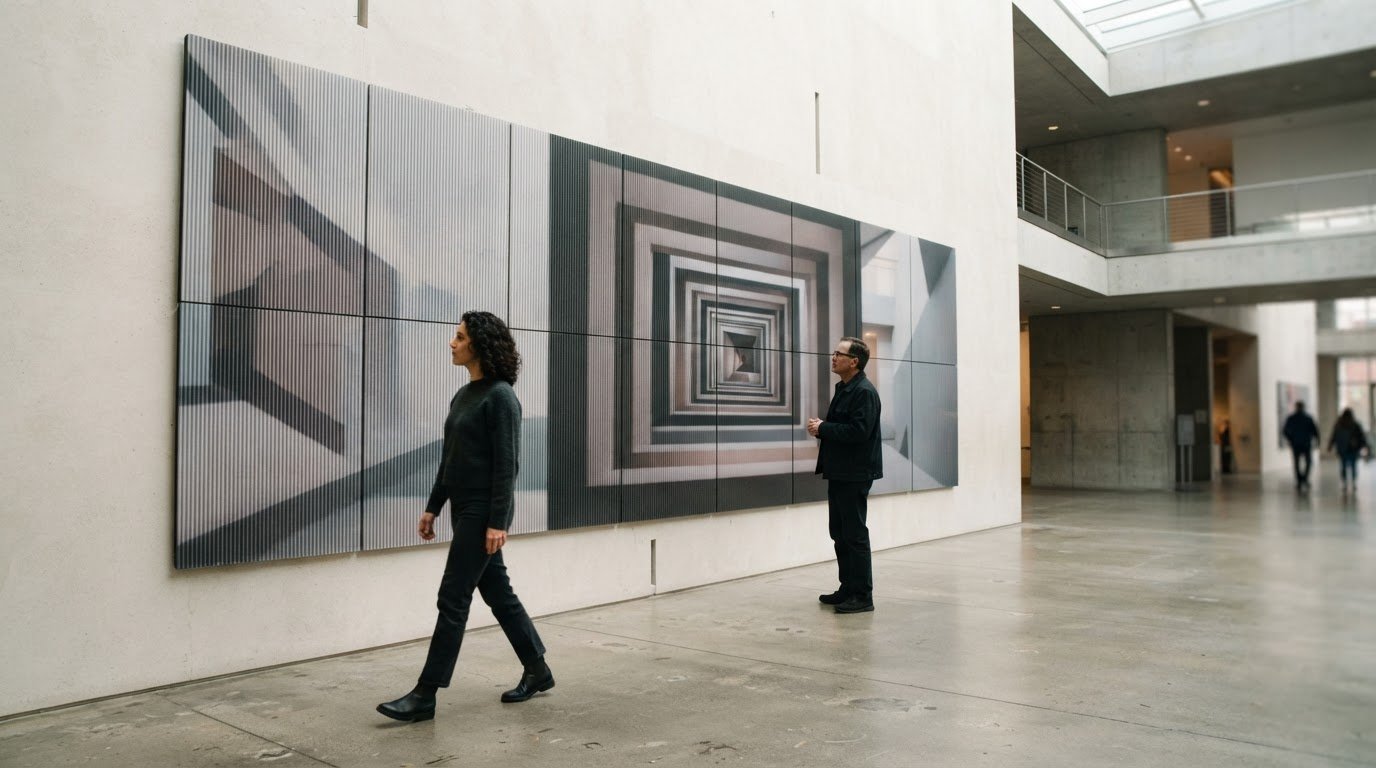
A tiled lenticular surface can carry a shifting image across a large architectural installation, but the panels need to be designed as one visual system. When specifying lenticular surfaces in architecture, align the lens direction, viewing angles and image transitions across panel edges so the effect reads coherently as people move through the space. For large-format lenticular art, 4 to 6 feet of viewing clearance is a useful planning reference.
It’s natural to focus first on the image, but in a public space, how people approach and pass it matters just as much. This guide to specifying lenticular surfaces in architecture explains how viewing angles, depth layers, and lens geometry shape the experience, especially in tiled installations. It also covers how traffic flow and lighting affect design, and what information helps develop a surface for a particular space.
Key Takeaways
- Plan panel alignment around how people approach and move past the installation, so image transitions feel intentional across the tiled surface.
- Use depth layers to shape what feels foregrounded, receding or in motion, while keeping the visual message clear.
- Choose lens geometry with the intended viewpoints and physical projection in mind; changing one can affect the other.
- Coordinate lighting, placement and traffic flow to help the artwork engage visitors in museums, memorials and other public spaces.
Viewing-angle range and number of supported viewpoints
Lenticular surfaces create a changing image without screens or power cords. Unlike kinetic facades, they do not rely on physical movement. Compared with perforated facades, they prioritize image transitions rather than openings through the surface. The right choice depends on whether the design goal is visual change, physical movement, or permeability.
For US projects, structural attachment, fire performance, weather exposure, and accessible circulation must be coordinated with applicable project requirements. These criteria depend on the building, location, and proposed assembly, so they should be addressed through the project’s architectural and engineering coordination. Additionally, if the surrounding space is part of a project seeking environmental credentials, sustainability consultants like Ekocentric can help verify that interior finishes and material selections align with green building certification standards.
A lenticular artwork combines a printed image with a microlens layer. The lens and print determine how the image changes as viewers shift position.
Drawings and schedules typically specify panel dimensions, lens orientation, image transitions, viewing zones, and interfaces with adjacent construction. A useful design brief includes site plans, elevations, expected viewer paths, lighting conditions, and the intended image sequence.
Professionals set dimensions by relating the installation’s scale to viewing distance and traffic flow. Large-format artwork benefits from 4 to 6 feet of clearance, while a 16×24 print can suit a narrow hallway where viewers pass close. Viewing angles and resolution are coordinated with the selected lenses and image detail; lenticular 3-D artwork guidance uses layered CMYK files at 300 dpi.
Fabrication depends on aligning the printed image with the lens pitch, since a mismatch can cause defects. Lenticular artwork can be installed and framed like regular canvas art. Maintenance should suit the installed assembly and its environment.
Viewing angle shapes the effect: artwork can be designed to change at angles of 25 degrees or less. A single panel can show 30 or more distinct frames, while full-motion effects can display up to 60 video frames within a print. One selected lens geometry has a viewing-angle range of 83.6 degrees; a viewing angle counted as valid required all 20 parallel rays to reach the intended image spot. These figures describe design possibilities, not a universal specification. For tiled surfaces, professionals coordinate each panel’s image transition and lens direction with the intended viewing paths.
Depth layers and visual information
Depth layers determine which parts of an image appear close, recede, or shift as a viewer moves. In lenticular 3-D artwork, printed images sit beneath a lenticular lens, creating perspective changes that make a flat surface feel spatial. A wall composition might place a foreground figure, a middle-distance structure, and a distant landscape on separate visual planes.
One useful principle when specifying lenticular surfaces in architecture is to assign each layer a clear visual role. A memorial image could bring a portrait forward while setting a symbolic landscape behind it. An exhibition surface might reveal a graphic motif within an architectural view. Lenticular 3-D guidance recommends limiting animation to minor actions involving one or two elements, so motion supports the message instead of competing with it.
Forward projection affects how dimensional an image appears. One design proportion places the forward projection at about one-third of the rear-layer depth, giving the composition a starting point for balancing projected elements with receding layers. The effect can then be shaped around the intended viewing position and the visual information in each plane.
Prism and trapezoid formats offer another approach to spatial imagery. They can create perspective shifts, image transitions, and visual changes as people walk past. Compared with classic lenticular images, prism images can look more substantial and object-like, with greater flexibility in shape and size. This can help the surface feel integrated with the architecture rather than like a conventional picture.
Professionals specifying lenticular surfaces in architecture can consider the image sequence, layer depth, and movement as a unified composition. A subtle shift in one foreground element may guide attention, while a broader transition can transform the overall impression. For a project that calls for carefully composed depth, develop a layered architectural image concept around the space, its viewers, and its intended message.

Lens geometry and the trade-off between viewpoints and protrusion
A lenticular facade or screen places a printed image behind lenses that direct different image portions toward viewers. As viewers change position, the optical effect shifts between distinct images or frames.
Lens Geometry
Lens geometry describes the relationship between each lens’s base diameter, curvature radius, and substrate height. One studied design uses a 2:1:1 ratio for those dimensions, creating an image spot 0.2 times the lens base diameter. That relationship matters because image spots determine how much visual information fits behind each lens. A lenticular print must also align its image with the lens pitch, or the display can show defects instead of a clean transition.
Viewpoints and Protrusion
Viewpoint capacity is the number of distinct image positions a lens arrangement can present as viewers move. One geometry fits 19 image spots on a lens backplane, supporting 19 viewpoints with different images. It lets viewers see the intended spot from up to 46.8 degrees away from the lens’s upward direction. For architectural design, the trade-off is between accommodating multiple viewing positions and coordinating the lens profile with the surface depth and surrounding details.
Lens selection should follow the display’s viewing context. A sheet with 161 lines per inch is described as suitable for short viewing distances, while lenses can be as small as 0.0062 inches. These figures illustrate how optical scale relates to image detail and proximity; they aren’t universal specifications for every architectural surface. A close approach may call for a different lens arrangement than a large display viewed across a public space.
Material and image preparation complete the optical system. Lenticular prints use microscopic lens ridges to refract light and separate the underlying images. Lens pitch, print alignment, and intended viewing angles need to be considered together. For example, a corridor display that shifts between two images needs a transition planned around the viewer’s path. A wider viewing zone may require more image positions.
Museums, exhibitions, memorials, and public spaces
In a museum gallery, lenticular imagery can draw attention to an exhibit and make a graphic or photographic motif feel more vivid. At a memorial, a custom sequence can shift between related images as visitors move, adding a visual dimension without changing the surrounding architecture. The movement comes from viewers’ changing perspective, not a digital screen.
Placement shapes the experience. Transitional spaces, such as a passage between exhibition rooms, naturally bring visitors past the artwork and reveal its changing images. A surface facing the direction of movement can make the transition easier to notice. Where people remain still, a composition that reads clearly from one primary angle may work better.
Lighting also influences what visitors see. Soft, indirect daylight can bring out color contrast without washing out a secondary image layer. For track lighting or a picture light, a recommended angle is 30 to 45 degrees above the artwork. This helps the installation remain legible while its images shift across the viewing area.
Scale and position should respond to how people encounter the space. One placement recommendation centers the artwork’s focal point 57 to 60 inches above the floor. In a gallery, this can support a considered viewing experience; in a public corridor, the design may also need to account for visitors who keep walking. Prism and trapezoid images can make content feel more object-like, while creating spatial transitions suited to exhibition graphics or architectural motifs.
Traditional artwork can be viewed from a fixed position; lenticular surfaces invite visitors to move and discover changing perspectives. Their role is visual, not a substitute for circulation or other building functions. Custom prism images can be adapted to a space and its use, allowing the image, placement, and movement to work together. Develop a lenticular concept for your public space with the intended visitor experience in mind.
Softmotion
Softmotion turns architectural concepts into lenticular surfaces designed around the space, image sequence, and viewer movement. For a tiled installation, this means connecting creative intent with practical decisions about viewing angles, depth, lens geometry, and panel alignment.
Turn to Softmotion when a project needs more than a changing image on a single print, particularly when the effect must work across an architectural surface or public setting. Softmotion creates Architectural Lenticular Installations, as well as lenticular displays and prints for other applications. Site plans, elevations, viewer paths, lighting conditions, and proposed imagery help shape the design.
If you’re developing a lenticular installation for an architectural project, contact Softmotion to discuss the concept.
Shape the next design decision
Start by turning the project’s architectural intent into a clear visual brief. Define the experience the surface should create, the images it should present, and how it should relate to the people and activities around it. With those priorities established, a specialist can develop a concept that connects the artwork to the space rather than treating it as an isolated graphic.
For teams specifying lenticular surfaces in architecture, Softmotion brings large-format lenticular printing and visual installation experience to the design process. Its offerings include Architectural Lenticular Installations, Advertising Lenticular Displays, and Fine Art Lenticular Prints. Each serves a different context, while the shared medium can transform a static image into a changing visual encounter.
Bring your project concept, relevant drawings, and intended imagery into the conversation. Discuss your project with Softmotion and explore how a lenticular surface could give the space a distinctive visual presence.
Frequently Asked Questions
Can I tile lenticular panels for large installations?
Yes, lenticular panels can be tiled to create a larger installation. Treat the panels as a coordinated composition, planning image alignment and lens direction across adjoining edges. For example, a continuous image can be divided into sections while preserving its intended transition as viewers move. The layout should also account for architectural boundaries, including corners, openings, and changes in wall plane.
What are lenticular surfaces in architecture?
Lenticular surfaces are architectural-scale visual works that use lenticular printing to make images change with viewer perspective. They can transform a wall, walkway, or other large surface into a motion-driven visual feature without relying on a screen-based image. A project might use a sequence of related images to bring movement to a lobby or exhibition space, while remaining part of the physical environment.
What are notable examples of lenticular architecture?
Examples include “Transforming Transit into Art at Union Station” and “Light in Motion at Dulles International Airport,” both presented as Softmotion installations. “A Moving Showcase for Iconic Cartier Design” shows another lenticular application, in a brand environment. These projects illustrate how lenticular imagery can bring visual movement to different settings, from a transport hub to a showcase.