
Lenticular Effect Design and Production: From Concept to Finished Work
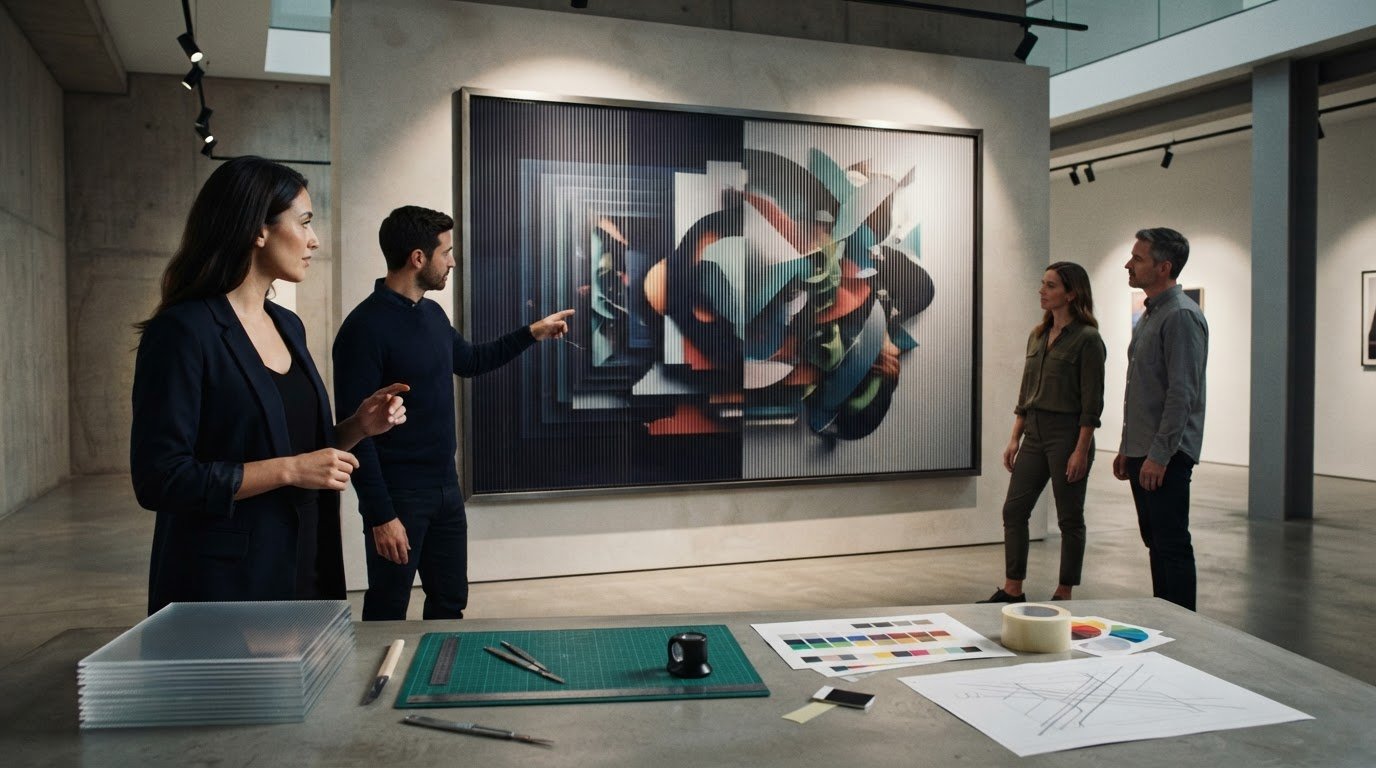
What if the best lenticular effect isn’t the one with the most movement, but the one that makes your message clear from the place people will see it? Choosing between depth, a changing image, or apparent motion is only the first decision. Successful lenticular effect design and production also depends on preparing artwork for the intended scale, viewing angles, and setting.
A concept that looks clear on a screen may read differently as a physical display. To plan effectively, match the visual effect to your message, then consider viewing distance, audience movement, dimensions, lighting, and installation before production begins.
This guide follows the process from concept and artwork through sampling, production, and installation. Softmotion has delivered more than 1,000 projects worldwide since 1997, working with advertisers, architects, artists, and corporations to bring custom lenticular work from an initial idea into the physical world.
Key Takeaways
- Choose a lenticular effect to suit the message, whether it should reveal depth, switch images, show motion, or transform one image into another.
- Design for the intended viewpoints. Audience movement and viewing distance affect how clearly the visual transition reads.
- Plan the location, dimensions, lighting, approach direction, and installation context before production begins.
- Connect creative intent with practical decisions, from concept and sampling to fabrication and installation.
- Lenticular work can be tailored for architecture, advertising, fine art, trade shows, and corporate environments.
What Is Lenticular Effect Design and What Can It Make an Image Do?
Lenticular effect design starts with the viewer, not the printing equipment. It plans how an image should change as someone looks from different positions or moves past it, then shapes the artwork to create that experience. A campaign might need two messages to take turns, while an artwork may call for a sense of space that appears to extend beyond the surface. The effect should serve the idea.
A lenticular effect is a planned visual change built into a physical image, revealed as the viewer’s angle changes. Unlike a static print, it can present different image information from different viewpoints.
The effect relies on two elements working together: prepared artwork and a lenticular lens, a surface made up of many fine lenses. The artwork is arranged in narrow interleaved sections, so each viewing angle directs different sections toward the eye. Lenticular printing describes this underlying process and its variations. In practice, lenticular effect design and production must account for both the intended visual transformation and where the audience will see it.
How does a lenticular image change as you move?
As a viewer shifts position, the lens array directs light from different parts of the prepared image toward their eyes. Those interlaced sections may belong to separate views or successive frames. At one angle, a first image appears. From another, a different view becomes visible, or the transition between views suggests movement.
The surface itself creates the change. There’s no screen or playback: the visual response comes from the physical relationship between the lens and the printed artwork. That makes the direction and range of expected viewing angles important creative choices, not just production details.
Which visual effects can lenticular design create?
Each effect shapes the viewer’s experience differently. Start by asking what the image needs to do: invite a closer look, reveal a contrast, or suggest transformation?
- Depth: Carefully arranged visual layers create an impression of dimension within a flat printed image. Use it to give a subject presence or create a sense of space, rather than to show a change between messages.
- Flip: Two or more distinct views appear in turn as the viewing angle changes. It can make a contrast legible, such as a before-and-after transformation or alternate campaign messages.
- Motion: A sequence of prepared frames creates the impression of action. It suits a story that unfolds across views, such as a product opening or a figure changing pose.
- Morph: One image appears to transform into another through a gradual visual transition. This can express evolution, connection, or a change in identity.
- Zoom: A subject appears to move closer or recede, adding visual emphasis or a sense of approach without relying on a screen.
- Agamograph: Related angle-dependent works reveal alternating images as the viewer moves. An agamograph uses its own image and surface arrangement, so it isn’t simply another name for every lenticular print.
The strongest choice is the one that makes the message easier to understand. An effect that draws attention but obscures the intended idea may be visually active yet communicatively weak.
How Does Lenticular Effect Design Turn a Concept into Artwork?
A strong concept doesn’t become production-ready simply by adding movement. It needs a visual sequence that communicates clearly from the positions where people will encounter it. Shape the artwork around the message, chosen effect, viewing conditions, and physical format from the outset.
Viewing conditions should guide the artwork before production begins, because angle and distance affect what the audience can see and understand. A design intended for a close-up print may need a different composition from a large installation viewed across a lobby. Making these decisions early helps keep the creative idea and physical result aligned.
How should the brief shape the visual sequence?
Begin with one clear question: what should the audience understand or feel? A gradual reveal can build anticipation, a before-and-after can make a contrast immediate, and a dimensional scene can give a subject visual presence. The sequence should support that purpose. Extra changes or details may attract attention, but they can compete with the message if they don’t earn their place.
Develop the concept in a deliberate order:
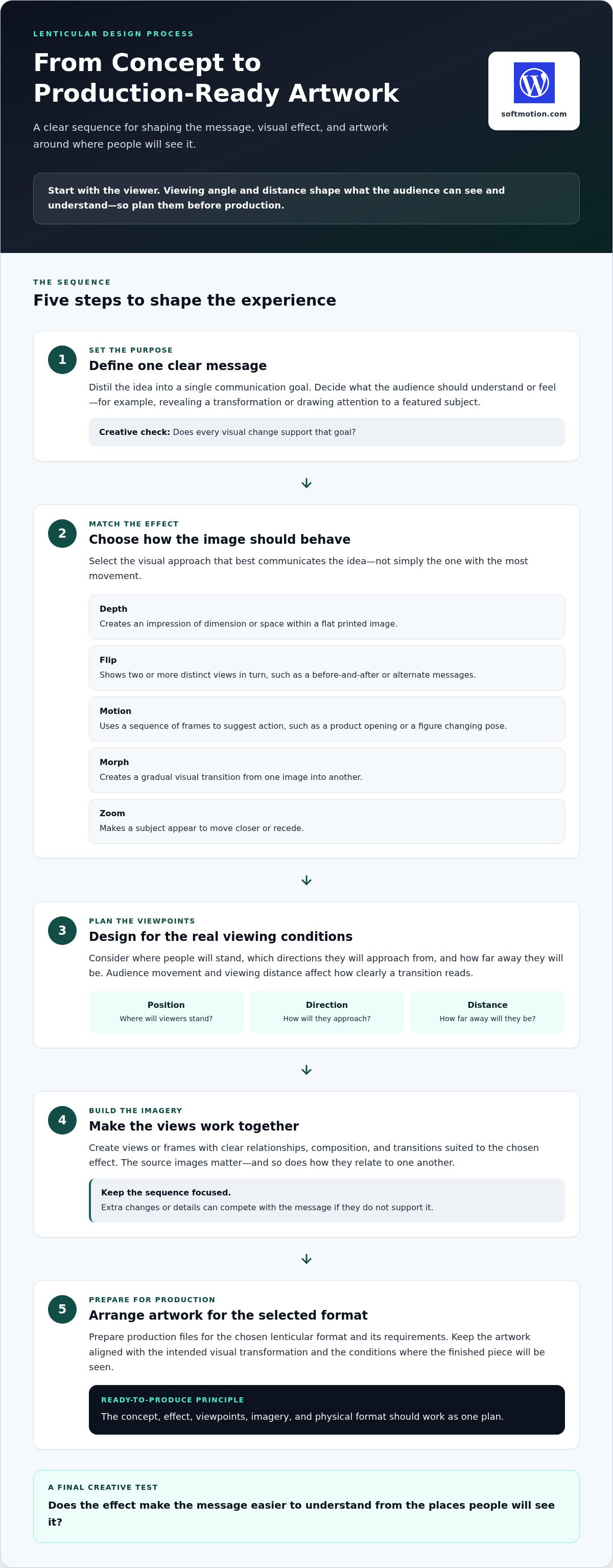
- Define the message. Distil the idea into a single communication goal, such as revealing a transformation or drawing attention to a featured subject.
- Choose the effect. Match that goal to depth, flip, motion, morph, zoom, or another suitable visual approach.
- Plan the viewpoints. Consider where the audience will stand, which directions they’ll approach from, and how far away they’ll be.
- Develop the imagery. Create views or frames that relate clearly, with composition and transitions suited to the effect.
- Prepare production files. Arrange the artwork for the selected lenticular format and production requirements.
What makes lenticular artwork production-ready?
Audience movement helps determine how the composition should unfold. If people will pass the work from side to side, the transition needs to make sense along that path. If they’ll view it from a fixed area, the design can focus on a narrower set of positions. Distance matters too: important subjects and changes need to remain legible at the intended scale and viewing distance.
Interlacing is a technical preparation step that organizes image information for the lens. It can’t repair weak imagery or an unclear sequence, so thoughtful design comes first. In this guide to large-format lenticular printing, scale is explored in an architectural context. For projects that need coordinated creative and production work, Softmotion’s lenticular design and production brings concept development, sampling, and fabrication into the same process.
How Do You Compare Lenticular Effects for a Real Project?
Choose an effect by asking what the audience needs to notice and how they’ll encounter the work. A lobby installation viewed as people walk past has different demands from a print someone can examine at close range. The right option balances message, visual clarity, narrative complexity, and viewing position. The most elaborate effect isn’t automatically the most effective. Added changes can distract if they don’t help communicate the idea.
Use this comparison to narrow the creative direction before artwork development:
| Effect | Visual change | Suitable communication goal | Planning consideration |
|---|---|---|---|
| Depth | Creates a layered impression of space within one image. | Give a subject dimension or a scene a stronger sense of presence. | Compose depth cues so the layers read from the audience’s likely viewpoint. |
| Flip | Switches between distinct images as the viewing angle changes. | Make a contrast or reveal alternate messages. | Keep both views clear and ensure the transition supports the story. |
| Motion | Shows a sequence of frames as apparent movement. | Show an action or progression that benefits from unfolding over several views. | Make the sequence coherent and consider how viewers will move past the work. |
| Morph | Transforms one image gradually into another. | Express evolution, connection, or a change in identity. | Make the starting and ending images recognisable, with a transition that feels intentional. |
| Agamograph | Reveals alternating images through a folded or angled viewing arrangement. | Present a changing image with a distinct physical rhythm. | Consider the surface structure and how the audience will move in relation to it. |
When is depth more useful than a changing image?
Depth suits a brief that needs spatial character rather than a sequence of messages. Layered imagery can give a subject presence or make a scene feel dimensional, while flip and motion effects ask viewers to notice a change between views or frames. The distinction matters: if the core idea is one richly composed scene, a change effect may add unnecessary narrative complexity. If the brief depends on contrast or progression, depth alone may not tell the full story. In either case, composition and viewpoint determine whether the visual cues remain legible.
When should a brief use motion, flip, or an agamograph?
Choose motion when the idea benefits from visible progression, such as a sequence that demonstrates how something unfolds. A flip is better suited to a decisive transition between images, especially when the contrast itself carries the message. An agamograph offers another angle-dependent approach, with a visual rhythm shaped by its particular surface arrangement. It isn’t simply a synonym for a lenticular print. For lenticular effect design and production, weigh each option against the audience’s likely path, the amount of information to communicate, and the setting where the work will be seen.
A useful test is to describe the intended viewer experience in one sentence. If the effect makes that sentence easier to understand, it’s serving the brief. If it demands attention without clarifying the message, simplify the approach.
What Should You Plan Before Lenticular Production Begins?
A successful project is shaped by more than its artwork. The intended experience has to fit the place, audience, physical dimensions, and installation context. Bring these factors into the conversation early, before a creative direction becomes difficult to adapt. In lenticular effect design and production, site information connects the visual idea to the practical work of making and installing the finished piece.
Use this checklist to establish a useful brief:
- Purpose: What should the work communicate, and what should viewers notice or feel?
- Audience: Who will encounter it, and are they likely to pause, pass by, or approach it closely?
- Location: Where will the piece be installed, and what surrounds it?
- Dimensions: What overall size and proportions should the work occupy?
- Viewing distance: From where will people first see it, and how close can they get?
- Installation context: How will the work be mounted, accessed, and experienced in the space?
These answers connect creative decisions, such as the type of visual change and composition, with production decisions about dimensions, fabrication, logistics, and installation. Neither side works in isolation. A compelling visual concept needs a format that can be produced and installed for its intended setting.
Which viewing and site conditions affect the result?
Map the likely path of the audience. People approaching from one direction may see the work differently from those moving past it from several angles. Consider sightlines from entrances and common routes, the intended viewing zone, and ambient lighting throughout the space. These conditions help determine where to place essential image details and how the visual experience should unfold. For architectural applications, this guide to lenticular building facades explores how a lenticular surface can relate to a building’s setting.
How do sampling and production decisions fit together?
A sample or prototype can help evaluate a visual idea before full-scale production. It gives the project team a way to assess how the concept reads in relation to the intended viewing experience and refine the direction as needed. Sampling is part of the design process, not a separate step from it.
Production planning then coordinates the artwork with dimensions, fabrication, logistics, and installation requirements. The details depend on the project’s scope, especially when a work moves from a small format to an architectural or environmental scale. Explore custom lenticular prototypes at scale for a deeper look at development-stage planning.
Planning a lenticular project? Explore Softmotion’s sampling and production support to bring creative and practical decisions into one project journey.
How Does Softmotion Bring Lenticular Effects from Design to Installation?
A lenticular project moves from an idea to a physical experience through connected creative and production decisions. Softmotion develops custom lenticular and agamograph effects through concept development, sampling, production, and installation. The approach can suit a fine art print, a trade show graphic, an advertising display, or a larger architectural or corporate environment.
Since 1997, Softmotion has delivered more than 1,000 projects worldwide. Its work spans projects with artists, advertisers, architects, and corporations, connecting the desired visual effect with the format and setting it’s intended for.
What does an end-to-end lenticular project involve?
Every project begins with creative intent: what should the work communicate, and how should an audience experience it? That direction informs the effect, imagery, scale, and practical production approach. Treating lenticular effect design and production as a connected process allows the creative idea to develop alongside the physical requirements of the finished work.
Sampling and prototypes offer a way to develop and assess a direction before full-scale production. They give the team and client a chance to review how the visual concept reads and refine it as the project takes shape. Production then coordinates artwork and fabrication with the intended dimensions and application. For large-scale work, installation and project management support the move from production into the physical environment, where placement is part of the audience experience.
The scale and setting vary by application. An architectural installation must relate to its surroundings; an advertising or trade show display needs to communicate within its event or brand environment. When campaigns pair dynamic optical displays with broader marketing collateral, commercial printers like Linemark provide the offset and digital production needed for multi-channel rollouts. Fine art and corporate projects bring their own creative priorities and spatial context. The project journey adapts to that scope rather than forcing every concept into the same format.
How can a project brief help start the conversation?
A useful brief doesn’t need to have every detail resolved. Start with the essentials:
- Audience and message: Who will see the work, and what should they take away?
- Application and location: Is it for architecture, advertising, fine art, a trade show, or a corporate environment, and where will it be experienced?
- Approximate scale: What dimensions or overall presence do you have in mind?
- Creative starting point: Share reference imagery, a visual direction, or an early concept if you have one.
These details give the project a clear starting point while leaving room to develop the right creative and production path. Explore Softmotion’s lenticular project capabilities and bring your concept into the conversation.
Give Your Concept a Physical Point of View
A lenticular project can begin with a simple question: what do you want someone to notice as they approach, pause, or move past the work? The answer can guide the creative direction before the artwork takes shape and give the team a shared reference for decisions as the idea develops into a physical experience.
With lenticular effect design and production, an image can do more than occupy a surface. It can reveal a message, create a sense of depth, or invite viewers to discover a visual change through their own movement. The strongest starting point isn’t a technical specification. It’s a clear intention for the audience and the place the work will inhabit.
Bring an early idea, a reference image, or a sense of what the project should achieve. Softmotion can help shape that starting point into a considered creative direction and a practical path toward the finished work. Discuss your lenticular effect project with Softmotion to start developing your concept.
Frequently Asked Questions
How does a lenticular effect work?
A lenticular effect combines specially arranged image content with a lens surface that directs different parts of the image toward the viewer at different angles. As someone changes position, the visible content can shift. For example, a display near a walkway can reveal a sequence as people pass, while a piece viewed mostly from one spot can be designed around a more limited viewing range.
What is the difference between lenticular depth and a flip effect?
Lenticular depth creates the impression of space within a scene, while a flip effect switches between distinct images. For example, a product image might appear to sit in front of a background, while a graphic alternates between two package designs. The choice depends on whether the idea is best communicated as one dimensional-looking scene or as a clear change from one view to another.
Can lenticular effects use photographs, illustrations, or both?
Yes. Lenticular artwork can use photographs, illustrations, or a combination, provided the imagery is planned for the intended effect. A photograph might show different stages of a subject’s movement, while illustration can offer more control over shape, color, and transitions. Combining the two can also work creatively, such as placing an illustrated element into a photographic scene, as long as the overall image remains coherent from each view.
Does lenticular artwork need special glasses?
No. Lenticular artwork is designed to be viewed with the naked eye, without special glasses. Its visual change comes from the printed image and lens surface, rather than glasses separating different images for each eye. That makes it suitable for public settings where people may encounter the work briefly or from different positions. The design still needs to suit the expected viewing angles and the environment around the display.
What is an agamograph, and is it the same as lenticular printing?
An agamograph is an artwork that reveals alternating images as the viewer moves in relation to its angled or folded surface. It shares the idea of changing views with lenticular work, but it isn’t simply another name for a lenticular print. The two approaches create angle-dependent experiences through different constructions. An agamograph can suit a concept where the surface’s changing rhythm is part of the artwork itself.
What information should I prepare for a lenticular design project?
Start with the project’s purpose, intended audience, application, location, approximate dimensions, and the message you want people to take away. Note whether viewers will pass the work, approach it, or see it from a regular viewing area. Reference images, sketches, or a preliminary creative direction can also help. This gives lenticular effect design and production a useful starting point, even if the visual concept is still taking shape.