
Lenticular Art for Public Buildings: 2026 Design Guide
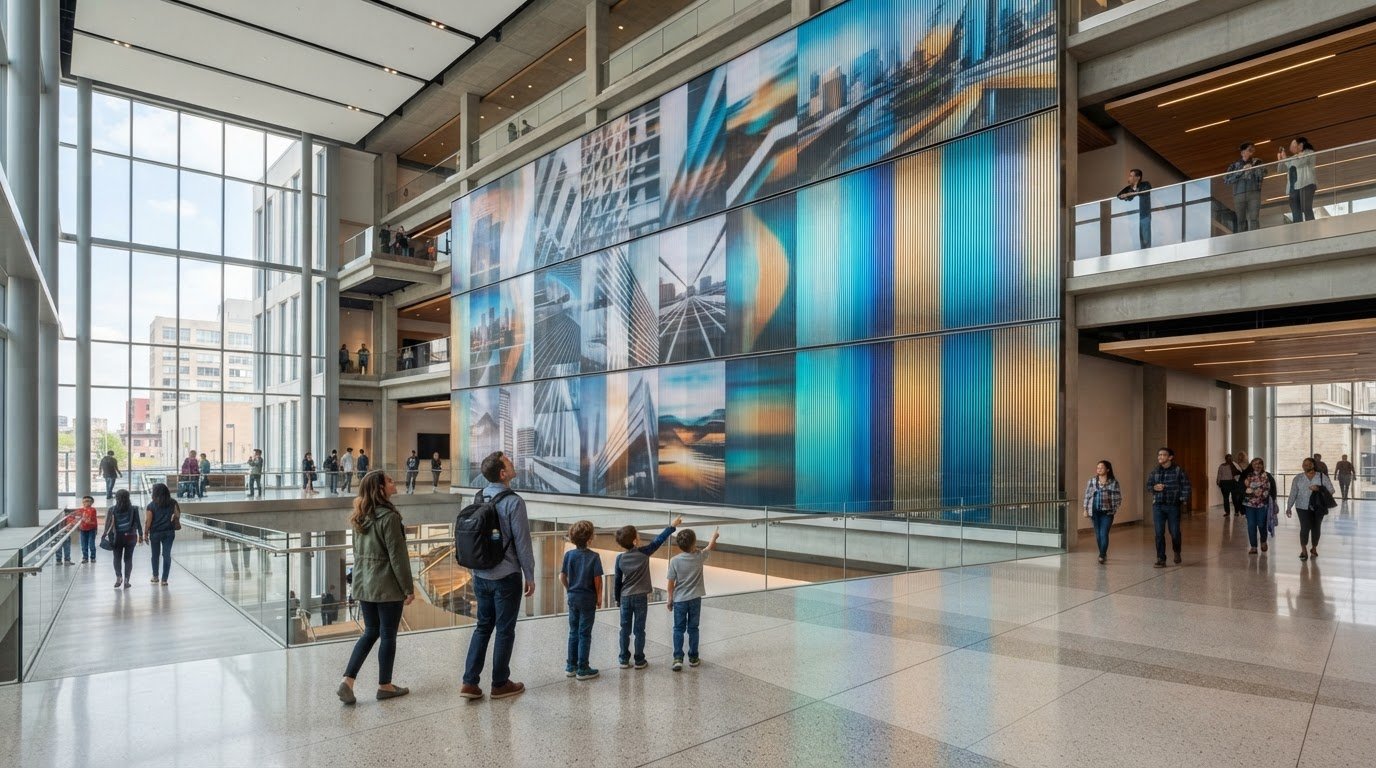
What if a public building’s walls could tell a story that changes as people move through the space? Lenticular art for public buildings turns a static surface into a viewer-driven experience, shifting between images or revealing depth as visitors approach, pass by, or pause. For the effect to work, the artwork needs to suit the building, its audience, and the way people use the site.
The strongest projects connect a civic story to the visitor journey, then shape the artwork around sightlines, scale, materials, and installation planning. This guide explains how lenticular movement works, where it can make sense in public buildings, and what to consider as a concept develops into a large-scale installation. It also covers how creative direction, sampling, precision production, and coordination bring an artwork from an initial idea to a finished experience.
Key Takeaways
- Understand how lenticular art for public buildings can shift with a viewer’s position to create a distinctive civic experience.
- See how lens pitch and viewing angle influence what audiences notice as they approach, pass, or pause.
- Compare lenticular artwork with murals and digital displays to identify which medium best supports your project’s story.
- Use a clear planning sequence to align the concept with the site, audience, and input of key project stakeholders.
- Explore how creative development, sampling, production, and installation planning can move a large-scale concept toward completion.
Why Lenticular Art Belongs in the Public-Building Experience
A public building is more than its walls. It’s a sequence of encounters: arriving at an entrance, finding a route, gathering with others, or pausing to reflect. Lenticular art for public buildings can give those moments a visual story that responds to the visitor, rather than presenting the same view from every position.
A conventional wall image looks consistent as people pass. A lenticular artwork can reveal a different image, a sense of depth, or a shift in perspective as the viewer changes position. That change can make a civic story feel discovered, not simply displayed. It might mark the transition into a cultural venue, establish a welcoming identity in a civic lobby, or offer a moment of contemplation in a library. The purpose should guide the effect.
What makes lenticular art different from a conventional mural?
A lenticular lens has fine ridges that direct different parts of an image toward the viewer at different angles. The artwork is prepared so those image elements align with the lens. As someone moves, the visible view changes. Lenticular printing offers a foundational overview of this process. Depending on the design, the result can be an image transition, layered depth, or a shift in perspective.
The movement is viewer-driven. Unlike a digital display, the artwork doesn’t rely on animation playing on a screen to change. The audience’s position activates the optical effect. This can suit spaces where the intended experience is physical and spatial. It also means the team should consider how people approach and pass the work, not just how it looks in a straight-on rendering.
Where can public-building lenticular art create meaning?
Location shapes the story. An entrance can create a memorable arrival; a circulation area can reward movement along a route; a gathering space can invite visitors to compare what they see from different viewpoints. A prominent interior or exterior wall may offer a broader canvas, but visibility, approach, and the audience’s pace still matter.
Consider the building’s purpose and visitor journey. A library might use an artwork to suggest discovery or shared knowledge, while a cultural venue could create anticipation. In civic buildings and other public institutions, imagery might reflect local identity or invite a moment of reflection. These are starting points, not fixed formulas.
Assess the audience, specific location, viewing path, and design goal together. A concept should work for the people who use the space and for the way they encounter it. When those elements align, a wall can become part of the building’s experience, changing as visitors move through.
How Lenticular Art Turns Viewer Movement into a Visual Experience
A lenticular image is built from fine image strips arranged beneath a ridged lens. The lens directs different strips toward the viewer at different angles, so a change in position can reveal a new image or shift the apparent depth and perspective. The artwork stays still. The experience changes as people move.
Two design factors help shape that experience: lens pitch, the spacing of the lens ridges, and viewing angle, the direction from which a person sees the work. Together with image composition and scale, they influence how clearly the intended change appears. There isn’t one setting for every wall. A work intended for visitors passing close by needs different design thinking from one viewed across a broad hall, where the audience may see it from farther away.
How do viewing distance and angle shape the effect?
Viewing distance is the space between the artwork and its intended audience. Angle changes as someone approaches, passes alongside, or looks across a room. A design centered on one straight-on viewpoint may not work well on a busy route where people see the artwork in motion. Before finalizing the composition, map where visitors enter, pause, turn, and continue. That route helps identify which views matter most.
For lenticular art for public buildings, this is a practical design step, not a technical afterthought. A wall beside a circulation path may call for a clear transition that reads quickly as people walk past. An artwork at the far end of a large hall may need imagery and scale that remain legible at a distance. Project-specific samples or prototypes let the team assess the effect, scale, and viewing conditions before full production.
Which visual effects can suit civic storytelling?
Choose an effect to serve the story, rather than adding movement for its own sake. Image transitions can connect two related ideas, while apparent motion can suggest change or progression. Dimensional depth may give a scene a more spatial quality. The result depends on the design and how visitors encounter it, so samples can help align the creative intent with the site.
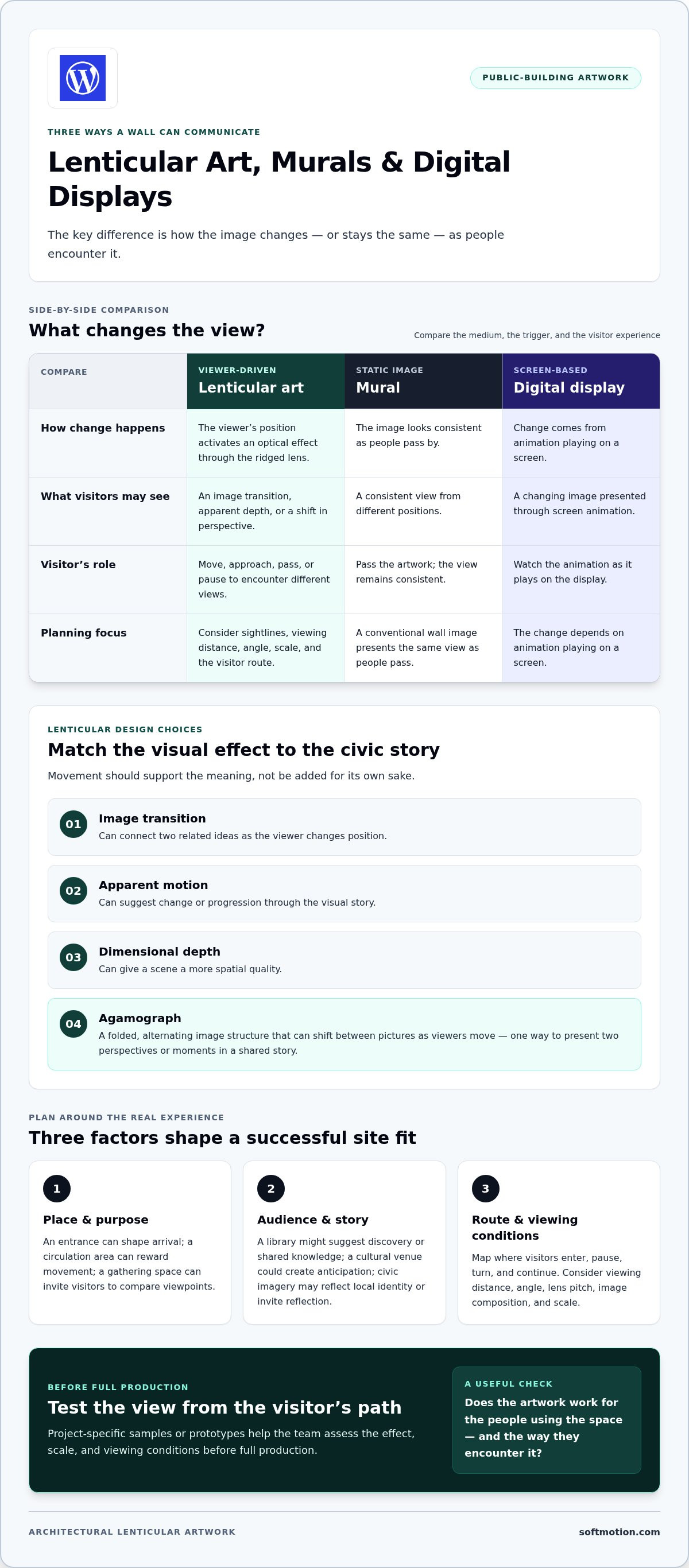
An agamograph is one approach: its folded, alternating image structure can shift between pictures as viewers change position. A civic institution might use that exchange to present two perspectives or moments in a shared story. Whether the goal is discovery, continuity, or contrast, the chosen effect should feel relevant to the institution and its audience.
Softmotion develops architectural lenticular artwork from samples and prototypes through full-scale installation. To explore how a concept can be tailored to a specific space, see its architectural lenticular installations.
Lenticular Art, Murals, and Digital Displays: Choosing the Right Fit
Each medium shapes a public space differently. The useful question isn’t which one is best in every situation, but how each communicates the building’s story and what visitors need from the experience.
| Medium | How it conveys change | What activates the experience | How audiences encounter it |
|---|---|---|---|
| Lenticular artwork | Can shift between images or reveal apparent depth and perspective. | The viewer’s changing position and angle. | As people approach, pass, or view the artwork from different points. |
| Conventional mural | Presents one consistent image. | No change is required; the image remains visually stable. | As a continuous visual backdrop or focal point. |
| Digital display | Can present changing screen-based content, including updates or interactive material. | Powered display technology, with content controlled through the system. | As a screen-based experience, often viewed directly or interacted with. |
These distinctions describe how each medium works, not its lifespan, maintenance, energy use, or total cost. Those considerations depend on the project, site conditions, materials, and operating needs, so include them in the planning conversation.
When does lenticular art suit a public-building brief?
Lenticular art can suit a brief built around movement, image transformation, or layered storytelling. It works best when the intended audience can see the artwork from useful positions, such as along a corridor or while approaching a lobby. It is a visual artwork, not a substitute for wayfinding or information that needs frequent updates.
When might a mural or digital display be a better match?
A mural is a strong fit when the priority is one coherent image that visitors can take in at a glance. A digital display may be more suitable when information changes often or the experience calls for screen-based interaction. Neither is inherently superior. Match the medium to the communication goal, visitor journey, and setting.
For lenticular art for public buildings, start by asking what the audience should notice, feel, or understand as they move through the space. If a stable image or frequently updated information better serves that purpose, another medium may be the clearer choice. Let the brief lead.
Planning Lenticular Art for a Public Building: Site, Story, and Audience
A strong concept needs a clear public purpose and a workable path from design to installation. Bring architects, building owners, curators, facilities teams, and other relevant stakeholders into the conversation early. Their perspectives help connect the artwork’s story with the site, visitor experience, and practical requirements.
How should a team define the artwork’s public purpose?
Start with the building’s identity, the people who use it, and the response the artwork should invite. Should visitors discover an image transition, follow a narrative, or see a familiar subject from a changed perspective? A concise creative brief can capture the intended story, audience, location, and desired encounter before detailed image development begins.
Then use a sequence that keeps creative and site decisions connected:
- Define the story. Agree on what the artwork should communicate and why it belongs in this building.
- Map the site. Review sightlines, visitor routes, viewing distances, lighting conditions, mounting surface, and relevant exposure.
- Understand audiences. Consider how different visitors approach, pass, or pause at the artwork, including accessibility needs.
- Test the design. Use a project-specific sample or prototype to assess the image effect in relation to the intended viewing conditions.
- Coordinate installation. Align scale, substrate, access, handling, and installation planning with the building team.
Accessibility, safety, building requirements, and local standards are project-specific considerations for the team to review. Addressing them alongside the creative brief helps ground the artwork’s visual ambition in the realities of the site.
How do sampling and installation planning reduce uncertainty?
A sample or prototype gives the team a chance to evaluate image transitions and viewing conditions before full-scale production. It can reveal whether the composition reads as intended from the routes and distances visitors are likely to use. Large-format production also connects design decisions to the mounting surface, handling access, and coordination with the installation team.
For more production context, read this large-format lenticular printing guide. Softmotion brings concept development, sampling, production, and installation planning together for architectural artwork. Discuss a lenticular installation concept with a team experienced in shaping large-format work for architectural settings.
From Public-Building Concept to Installed Lenticular Artwork with Softmotion
A civic artwork must carry a story and belong to its setting. Softmotion develops custom large-format lenticular artwork for architectural spaces, connecting creative direction with production and installation planning. Founded in 1997, the company has delivered more than 1,000 projects worldwide, bringing experience across architectural and fine-art work to decisions about scale, site, and how audiences encounter the finished piece.
What does a collaborative project journey involve?
The process begins by aligning the artwork’s story with its location and intended effect. A creative brief clarifies what the institution wants visitors to see or feel, where the work will sit, and how people are likely to move around it. Those choices inform image development, so the visual idea and physical setting evolve together.
Samples and prototypes give the team a way to review visual direction before full-scale production. They help stakeholders assess how the image reads and whether its intended effect suits the planned viewing experience. Once the direction is established, fabrication planning connects the artwork’s scale and substrate to the site, while installation coordination brings the project team’s practical requirements into view. The aim is a considered progression from concept to finished installation, with creative and architectural decisions in conversation throughout.
For projects focused on exterior building surfaces, Softmotion’s lenticular building facades guide offers additional context. To explore how sampling informs larger work, see the custom lenticular prototypes guide.
How can a project team take the next step?
Gather a few useful starting points: site images, approximate dimensions, the project’s goals, and the priorities of the people involved. These details help frame a discussion about the building, the audience journey, and the visual encounter the team hopes to create. The initial brief doesn’t need to resolve every design decision.
If you’re considering lenticular art for public buildings, explore a public-building lenticular project with Softmotion. Softmotion can develop the direction from the creative brief through sampling, production, and installation planning.
Bring a Civic Story into View
Lenticular art for public buildings can make a familiar space feel newly responsive, revealing a shift in image, depth, or perspective as visitors move. The strongest results begin with a clear story and a thoughtful fit between the artwork, its location, and the way people encounter it. Comparing mediums and testing the design with samples or prototypes helps teams move from creative ambition toward practical decisions.
Softmotion develops architectural and fine-art lenticular projects, with more than 1,000 projects delivered worldwide since 1997. Its work can span the full journey, from samples and prototypes through production and installation, bringing creative and site considerations together.
Have an early concept or a defined site in mind? Explore a lenticular art project for your public building with Softmotion, and start shaping the story for the people who use the space.
Frequently Asked Questions
What is lenticular art for public buildings?
Lenticular art for public buildings is a custom image designed to change as viewers see it from different positions. Fine image elements align with a ridged lens, allowing the artwork to reveal an image transition, apparent depth, or a shift in perspective as people move. In a civic setting, the changing view can support a building’s story and create a visual encounter along an entrance, corridor, gathering space, or prominent wall.
How does lenticular art work on a large wall?
Large-format lenticular artwork combines carefully arranged image elements with a lens that directs different views to the audience at different angles. At architectural scale, the design needs to account for the wall’s dimensions and the distances and routes from which people will see it. A sample or prototype can help the project team assess the intended effect and viewing conditions before moving to full-scale production and installation planning.
Can lenticular art be used inside public buildings?
Yes. Interior settings can include entrances, lobbies, circulation areas, gathering spaces, and other walls where visitors can encounter the work. The right location depends on the building’s purpose and how people move through it. A corridor may call for an effect that reads as visitors pass, while a gathering area might invite people to pause and view the artwork from different positions. Site-specific design helps align the image with that experience.
Is lenticular art suitable for outdoor public buildings?
It can be considered for exterior architectural settings, but suitability depends on the specific site and its conditions. The project team should review exposure, mounting surface, scale, sightlines, access, and installation requirements during design development. These factors influence material and production decisions, so an exterior concept should be planned for its actual location rather than treated as interchangeable with an indoor installation.
Does lenticular art need electricity to create motion?
No. Lenticular artwork doesn’t need electricity to create its visual change. The effect comes from the relationship between the printed image, the lens, and the viewer’s changing position. As someone approaches, passes, or views the work from another angle, a different image element becomes visible. This differs from a digital screen, where powered display technology presents changing content.
What should a team consider before commissioning lenticular art for a public building?
Start by defining the story, audience, and intended visual effect. Then map the location, viewing routes, sightlines, lighting, mounting surface, and relevant site exposure. Involve owners, architects, curators, facilities teams, and other stakeholders early, and include accessibility, safety, building requirements, and local standards in the project review. Samples or prototypes can help evaluate the design before full-scale production and installation coordination.
How is lenticular art different from digital signage?
Lenticular art changes visually as the viewer’s position changes, using a printed image and lens rather than powered screen content. Digital signage uses display technology to show electronic content, which may be updated or designed for screen-based interaction. Lenticular artwork suits a physical visual experience; digital signage can be a better fit for frequently changing information. The appropriate choice depends on the project’s communication goals and audience needs.