
Lenticular Art for Government Offices: Guide to Civic Spaces
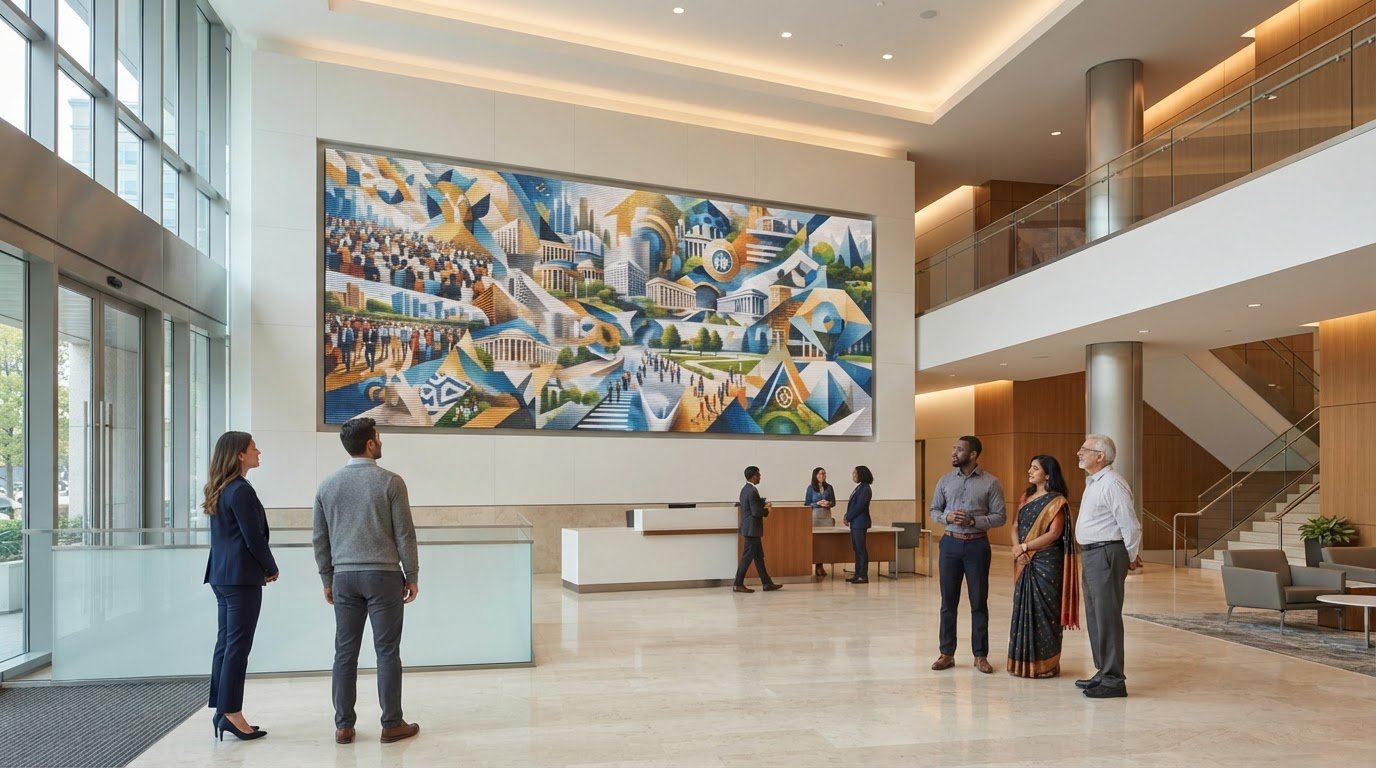
What if a civic space could tell its story differently as people move through it? Lenticular art for government offices adds motion and depth to a public-facing environment, giving local history, community identity, or civic purpose a more visible presence. Choosing artwork for these spaces calls for care: it should feel welcoming, fit the setting, and respond to practical site conditions.
A distinctive visual idea becomes part of a space through thoughtful planning. This guide explains what lenticular art can contribute, the questions that shape a successful installation, and how to present the format to stakeholders and decision-makers. Softmotion brings artistic development and large-format production together, working from samples and prototypes through production and installation to create site-specific work. Storytelling, viewing conditions, scale, and project coordination all help turn the vision into a physical artwork.
Key Takeaways
- See how civic artwork can express a place’s history, public services, and shared identity in a more human way.
- Understand how lenticular effects shift with the viewer’s angle to create transitions, apparent motion, or depth.
- Assess how audience, purpose, sightlines, viewing distance, light, and dwell time shape lenticular art for government offices.
- Use a clear project sequence, from defining the civic purpose to testing samples and planning installation, to keep the artwork aligned with its message.
- Learn how Softmotion’s experience, built through more than 1,000 projects worldwide since 1997, supports a collaborative path from prototypes to full-scale production and installation.
Why Lenticular Art Can Give Government Offices a More Human Civic Presence
Government offices serve the public, but their interiors can feel defined by counters, walls, and formal procedures. Art can make a space feel more welcoming without diminishing its civic purpose. A work inspired by local landscape, shared history, public service, or community identity can connect an institutional interior to the people who use it.
Lenticular art is a physical image that changes as the viewer’s angle changes, revealing different imagery, apparent motion, or a sense of depth. That transformation gives a civic story a visual form people can encounter as they move through a space. Lenticular art for government offices works best as an artistic installation, not as a replacement for wayfinding or service information. Signs direct visitors to destinations. Artwork can welcome them, prompt reflection, or express what makes a place distinct.
What lenticular art adds to a civic interior
A lenticular lens directs different image information toward viewers at different angles. As someone approaches or passes the work, one image may transition into another, elements may appear to move, or the composition may seem dimensional. For an accessible overview of the medium’s mechanics and applications, see Lenticular Printing: An Overview.
The effect is physical and immediate. Viewers don’t need a screen, app, or instructions to notice the shift. A historical image might transition into a present-day scene; a landscape might reveal details associated with a community’s identity. The aim is not to overwhelm visitors, but to give the interior a focal point that rewards attention and supports a sense of welcome.
Where government-office art can serve the public
Location shapes how people encounter a work. At an entrance, visitors may see it briefly while orienting themselves, so a clear transition visible from the approach path matters. In a reception or public-service area, people may spend longer waiting and have more time to notice changes in the imagery. A civic gathering area brings different audiences together, while a staff-facing interior can offer an everyday connection to place.
Before settling on a concept, consider who uses the space and how they move through it. Map likely viewing distances and approach angles, note ambient light, and consider whether people pass quickly, pause, or gather. A work designed to be seen from one direction may not read as intended from another. Keep its story distinct from essential instructions, and consider how its placement relates to circulation and nearby activity.
Start with a specific purpose: what should visitors feel, notice, or learn about the community? Answering this question connects the visual experience to the space and gives the project a clearer basis than decoration alone.
How Lenticular Art Creates Motion and Depth in a Government Office
A lenticular image is built from narrow image segments aligned beneath a ridged lens. Each ridge directs light from particular segments toward a different viewing angle. A person standing to one side may see a different part of the composition than someone approaching from another direction. The viewer changes the effect simply by moving through the space. No button, app, or software interaction is needed.
A lenticular image doesn’t play an animation on a screen; it reveals a designed visual change as the viewer shifts position. In a civic setting, that distinction matters: the artwork is a physical part of the interior, and its sequence can be designed around how people move through the space.
Choosing an effect that supports the civic story
Let the message guide the effect. A gradual transition can connect past and present or bring two perspectives into view, making it a natural fit for a story about change or shared history. Apparent depth can draw attention to a subject or create a stronger spatial impression, but it should support the artwork’s purpose rather than compete with the architecture.
An agamograph offers another visual approach: different images appear from alternating angles. This can suit a concept built around contrast or multiple viewpoints. For teams shaping lenticular art for government offices, the key question is not how dramatic the effect can be, but which visual shift best expresses the civic idea. The National Endowment for the Arts: Supporting Civic Art offers broader context on the role of arts in public life.
How viewing angle shapes the experience
Plan around actual approach paths. People may encounter the artwork head-on, pass it from one side, or view it while turning toward a reception desk. Those routes influence which image appears first and whether the transition feels clear. A concept that reads well from one position may look different from another, so account for likely viewing distances and how long people may pause nearby.
Lighting also affects how a surface is perceived. Review the planned placement in context, including nearby light sources and changes in brightness across the day where relevant. Samples and prototypes let the project team assess image sequence, color, motion, and depth before full-scale production. Softmotion’s lenticular samples and prototypes help make that visual planning tangible.
Use these tests to refine the work, not to chase an effect for its own sake. When the image sequence, viewing angle, and civic message support one another, movement becomes part of the storytelling rather than a distraction.
How to Evaluate Lenticular Art for Different Government-Office Spaces
The same artwork can feel welcoming in a lobby and distracting beside a service counter. Start by defining the room’s public role, then assess how people encounter the work: who uses the space, where they approach from, how far away they stand, and whether they pause or keep moving. These questions help teams evaluate lenticular art for government offices as part of the environment, not as an isolated image.
Use the comparison below as a design aid. It describes planning considerations, not formal code requirements. Accessibility, safety, and building requirements depend on the project and site, so review them with the relevant authorities.
| Space | Audience and purpose | Design considerations |
|---|---|---|
| Public lobby | Visitors arriving, orienting themselves, or waiting to meet someone | Make the visual idea easy to grasp from the main approach; consider a brief viewing moment and changing sightlines. |
| Service area | People focused on forms, staff guidance, or completing a task | Account for queue movement and waiting patterns; keep the artwork from competing with essential information or staff interactions. |
| Council or civic meeting space | Participants gathered for discussion, public business, or community events | Relate scale and subject matter to the room’s function, and consider whether viewers see it seated, standing, or from multiple directions. |
| Staff-facing interior | Employees passing through or spending time in shared work areas | Consider repeated daily viewing, available wall space, and a tone that supports the character of the workplace. |
Match the installation to the room’s public role
A lobby often calls for a legible first impression. Visitors should be able to take in the central idea without stopping to decode a complex sequence. In a service area, people may view the work while waiting, but its movement and visual emphasis should remain secondary to the task at hand. In a civic meeting space, the subject and scale can acknowledge the room’s shared purpose without overwhelming discussion or other activity.
Staff-facing spaces have a different rhythm. A work encountered regularly can support a quieter, more reflective story than one designed for a quick public arrival. In every setting, test how the image reads from likely positions, not only from directly in front.
Balance creative ambition with public access
Plan for visitors with different heights, mobility, vision, and familiarity with the building. Consider whether someone can view the work from a seated position, whether its key imagery remains understandable at a distance, and whether circulation routes leave room to pause without blocking movement. Keep essential directions and service information clear and visually distinct from the artwork.
Content and tone deserve equal care. The civic story should suit its audience and context, with attention to how people with different experiences may understand the imagery. Review site-specific access and building considerations early with the project team and relevant authorities. This grounds creative decisions in the realities of the room while leaving space for a distinctive public-facing work.

From Civic Art Brief to Installation: A Practical Lenticular Project Path
A strong installation begins with a clear civic purpose, not an effect chosen for novelty. A defined brief connects the institution’s message to the audience, image sequence, scale, and setting. It also gives artists, project teams, stakeholders, and production partners a shared reference as the idea develops into a physical work.
Build a brief around audience, message, and setting
Clarify who will encounter the artwork, what they should notice, and where their view is likely to begin. Gather accurate site dimensions, photographs, information about the surrounding environment, and feedback from relevant stakeholders. Separate the essential civic message from optional visual details so each creative choice strengthens the story rather than obscuring it.
- Define the purpose and audience. Describe the civic story the work should communicate and the people most likely to see it. A brief might focus on local history, public service, or a shared community identity.
- Document the site. Record the intended location, available dimensions, likely viewing positions, and relevant environmental context. Include photographs that show the artwork’s surroundings, not only the wall or surface where it may be installed.
- Develop the visual concept. Translate the core message into an image sequence and choose an effect that supports it. Keep stakeholder input focused on what the work needs to express while allowing room for artistic interpretation.
- Review samples and prototypes. Use samples to assess how the image changes across viewing angles and whether the sequence reads as intended. A prototype helps the team consider the creative direction in relation to scale and site conditions before full production. Explore custom lenticular prototypes for more on prototype planning.
- Coordinate production and installation. Align the approved artwork, dimensions, production planning, and installation details with the site information. Keep communication clear among the people responsible for the artwork, building, and installation so decisions remain connected through each stage.
Use samples and prototypes to resolve design decisions
A small sample makes an abstract conversation concrete. Reviewers can see how imagery transitions, how viewing angle affects the sequence, and whether the intended change is understandable. Prototype review adds an opportunity to consider the work at its planned scale and in relation to its surroundings. For more context on production planning, consult this large-format lenticular printing guide.
For a civic project, review is also a useful time to bring stakeholder perspectives together. Ask whether the visual effect supports the brief, whether the central message remains clear, and whether the proposed placement suits the site. Softmotion’s process covers samples, prototyping, production, and installation, connecting creative development with fabrication planning. Explore a collaborative path for your civic-art concept.
Working with Softmotion to Realize Lenticular Art for Government Offices
A civic artwork must carry meaning for the people who encounter it and respond to the physical space. Softmotion brings creative development and large-format production into one project path, from samples and prototypes through full-scale production and installation. That continuity keeps the visual concept connected to the site as the work takes shape.
Founded in 1997, Softmotion has delivered more than 1,000 projects worldwide for architects, advertisers, artists, and Fortune 500 corporations. This experience spans different creative and architectural contexts, without relying on a one-size-fits-all approach. For lenticular art for government offices, the civic brief remains the starting point, guiding decisions about imagery, viewing experience, and scale.
Bring creative intent and production expertise together
Collaboration begins with the purpose of the space, the story the artwork should carry, and the audience’s experience of it. These elements shape the visual concept and inform production planning early, rather than leaving fabrication as a final step detached from the artistic idea.
Lenticular transitions, apparent motion, dimensional depth, and agamograph effects are creative options, not fixed formulas. The right approach depends on the brief. A sequence might connect different moments in a community’s history, while alternating views could express distinct perspectives. Samples and prototypes make these choices tangible, allowing the team to assess how the visual idea behaves before full-scale production. Each project is shaped around its creative and architectural context.
Define a clear next step for a civic project
To begin a project, outline the intended space, the people who will encounter the work, the central civic story, and the visual effect you’re considering. Site dimensions, images of the environment, likely viewing positions, and relevant stakeholder input can clarify the context. You don’t need to settle every design decision in advance; the goal is to establish a shared starting point.
From there, the concept and production plan can develop together, with samples and prototypes translating creative intent into a physical proposal. Scale, imagery, and installation planning are tailored to the project and its setting. This process gives teams room to align the artwork’s purpose with the realities of its location.
If you’re considering a civic installation, share the space, audience, and story you have in mind with Softmotion to begin a project conversation.
Give Your Civic Story a Place to Move
A public building can do more than support the work of an institution. Its walls can help people feel connected to the place, its history, and the community it serves. With a clear story at its center, lenticular art for government offices can turn a passing glance into a moment of discovery while responding to the space and the people who use it.
Start by bringing together the location, the audience, and the idea you want the artwork to express. These give a creative conversation something meaningful to build on, whether the vision is still emerging or already taking shape.
Softmotion can translate that vision into a site-specific work through a collaborative process that connects artistic intent with production planning. Start a conversation about a lenticular art project and begin shaping an artwork connected to your civic space.
A thoughtful idea can become part of how people experience and remember a place. Your civic story is ready for its next perspective.
Frequently Asked Questions
Is lenticular art suitable for a government office?
Yes. Lenticular art can suit a government office when its imagery, placement, and visual effect fit the room’s purpose and audience. A modest transition in a reception area, for example, may create interest without drawing attention away from staff or service information. When planning lenticular art for government offices, consider the emotional tone as well as the physical setting, and involve relevant stakeholders in shaping the concept.
Can lenticular artwork communicate a city or agency’s history?
Yes. A carefully composed sequence can bring archival imagery into conversation with present-day scenes, helping viewers notice continuity or change. A city might explore how a streetscape has evolved, while an agency could use visual storytelling to reflect a history of public service. Select images that are accurate, appropriately contextualized, and meaningful to the intended audience, rather than relying on dates or labels alone.
How does lenticular art differ from digital signage?
Lenticular art is a physical artwork whose image shifts as viewers change position. Digital signage uses electronic displays to present screen-based content, which may include information or changing media. The two serve different purposes: signage can communicate timely directions or announcements, while lenticular artwork can express an idea through image, material, and perspective. A project brief can clarify whether the priority is public information, artistic storytelling, or a distinct role for each.
Can lenticular art be installed in an existing government building?
Yes. An existing building can be considered for a lenticular installation. Before settling the design, the project team needs to understand the available surface, dimensions, surrounding features, and how people use the space. Current site photographs and measurements help ground early discussions. Installation planning should account for the building’s specific conditions and coordinate with the people responsible for the site, so the artwork is considered in its real context.
What image rights are needed for a government lenticular art project?
Rights depend on the source and intended use of each image. Before production, identify who owns photographs, illustrations, archival materials, maps, and other visual assets, then secure permission for the planned use where required. An image available in an archive or online isn’t automatically cleared for an artwork. Review agency marks, identifiable people, and usage terms attached to supplied materials with the appropriate rights holder or legal team.
How can a government agency involve the public in choosing civic artwork?
An agency can invite public input at defined points, such as gathering stories or themes before developing the concept, then sharing selected directions for feedback. Make the purpose of participation clear: community members might contribute ideas, respond to imagery, or advise on local context, while a designated team manages the commissioning decision. Offering more than one way to contribute can help people engage without requiring them to attend a single meeting.
Does lenticular art work in both temporary and permanent public-art programs?
It can be considered for either, depending on the program’s aims and the project’s site conditions. A temporary installation might explore a timely theme or test a concept in a public setting; a permanent work may call for a longer-term plan for care, documentation, and future building needs. Clarify the intended duration early, since it can shape decisions about the artwork’s role, installation approach, and how the institution plans to maintain it.