
Lenticular Art for Art Consultants: Project Selection Guide

What if the strongest lenticular artwork isn’t the one with the most dramatic effect, but the one that belongs in the space? For art consultants, lenticular art can transform a static wall into an experience of movement, depth, or change. The challenge is matching that experience to the client’s creative ambition, the site’s conditions, and the people who will encounter it.
You may already see the medium’s potential, yet need a clear way to explain it to decision-makers and assess whether the concept can translate into a successful installation. This guide will help you evaluate lenticular art for art consultants by looking at the visual effect, viewing experience, site requirements, and production path.
Explore how 3D, flip, animation, morph, and zoom effects support different briefs, and how sampling and prototyping can clarify the direction before full-scale production. With experience across fine-art and architectural projects, Softmotion works collaboratively to carry concepts from early exploration toward finished installation. The result: a more confident recommendation, grounded in both artistic intent and practical fit.
Key Takeaways
- Match each lenticular effect to the commission’s purpose, audience movement, viewing distance, and scale.
- Evaluate lenticular art for art consultants through both artistic intent and the realities of the site, including sightlines, ambient light, and viewer flow.
- Use a concise evaluation checklist to explain technical choices as clear outcomes clients and stakeholders can understand.
- Bring sampling and prototyping into the project journey to refine the visual direction before full-scale production and installation.
- Keep the brief, artwork decisions, and stakeholder expectations aligned from concept through installation.
What Lenticular Art Offers Art Consultants Beyond a Static Image
Lenticular art adds a change of viewpoint to the artwork itself. As a viewer moves, the image can shift between pictures, reveal a sequence, or suggest dimensional depth. For consultants, the value isn’t novelty alone. It’s the ability to make a concept unfold in a way that responds to the artwork’s setting and the audience’s movement through it.
Client-ready definition: “A lenticular image changes what it shows as the viewer changes position; screen-based animation changes over time on a display.” The distinction helps set expectations: lenticular art doesn’t require a screen to play motion, and the perceived change depends on viewing angle. A concise overview of lenticular printing technology can help explain how the lens presents different image information from different positions.
Motion, flip, morph, and simulated depth describe distinct visual outcomes. Motion or animation suggests a sequence; a flip switches between images; morphing makes one image appear to transform into another; and 3D uses layered image information to create an illusion of depth. The artwork doesn’t physically move or respond like an interactive display. The effect should serve the concept, not compete with it.
How viewing angle creates movement, change, and depth
A lenticular lens directs different parts of an image toward different viewing angles. As someone walks past or shifts position, the visible information changes. With a flip or animated sequence, that change reads as a new image or moment. With simulated depth, layered visual elements appear to occupy different distances within the picture. These experiences are related but not interchangeable. Choose the one that best expresses the artwork’s idea.
Where lenticular art can support a client brief
In a gallery or fine-art setting, a changing image can reveal a second reading or reward a viewer who spends time with the work. In corporate interiors, it can make a visual narrative unfold along a corridor or in a shared space. In architectural settings, the effect can relate the artwork to movement through the site. The intended route and viewing pace matter: a pass-by encounter calls for a legible effect, while a place to pause can invite closer observation.
Use the effect to give the audience a role without overstating their control. Their movement changes the view; it doesn’t trigger a screen-based performance. For further context on curatorial considerations, see the fine art lenticular prints curator’s guide. This framing helps make lenticular art for art consultants easier to present: explain what viewers will see, how their position shapes the experience, and why that experience belongs in the brief.
How Art Consultants Can Match Lenticular Effects to the Commission
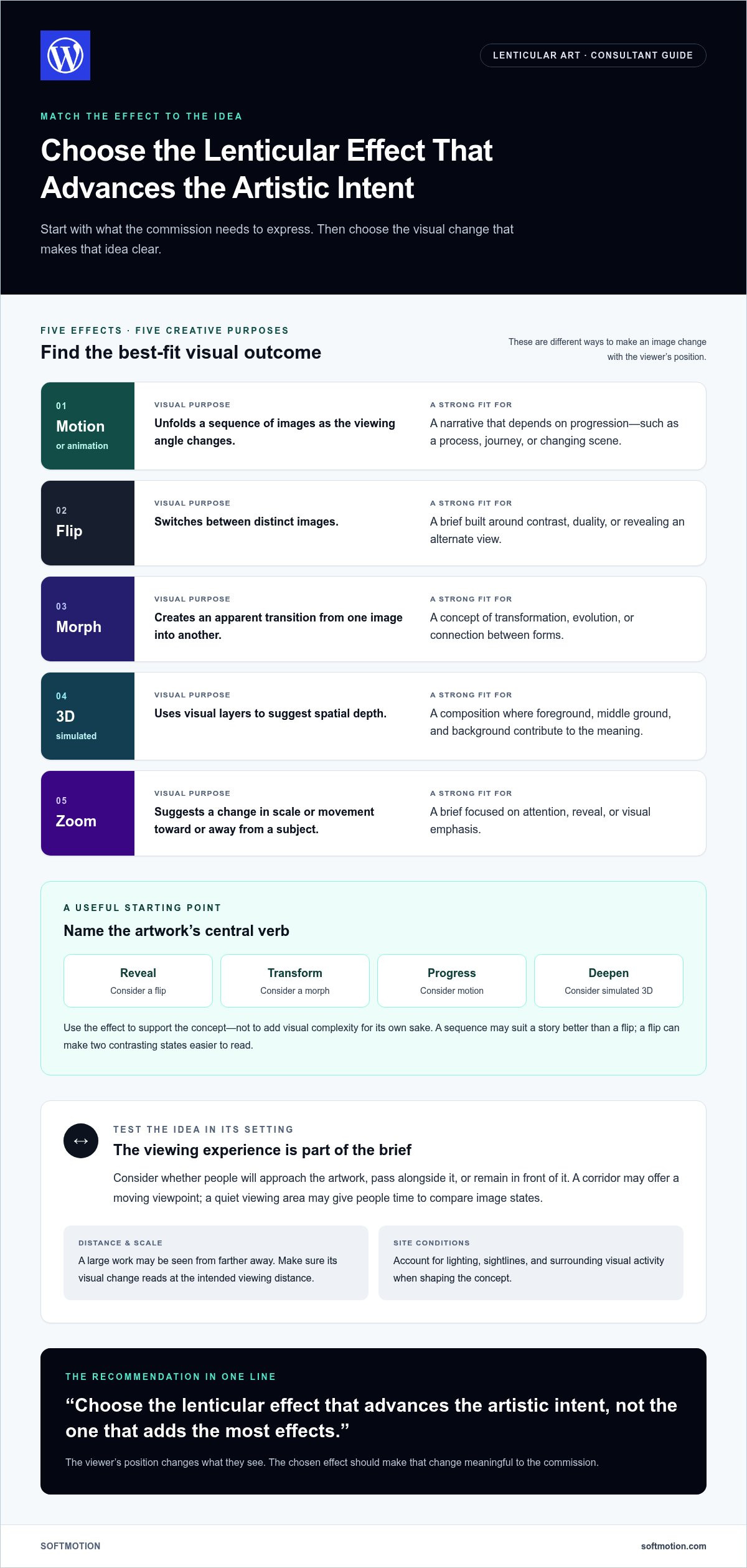
Start with the commission’s purpose, not a list of effects. Is the artwork meant to reveal a narrative, make a transformation visible, or add a sense of space to a composition? The answer helps narrow the options and gives clients a reason for the recommendation beyond visual novelty.
“Choose the lenticular effect that advances the artistic intent, not the one that adds the most effects.”
| Effect | Visual purpose | Suitable brief |
|---|---|---|
| Motion or animation | Unfolds a sequence of images as the viewing angle changes. | A narrative or concept that depends on progression, such as a process, journey, or changing scene. |
| Flip | Switches between distinct images. | A brief built around contrast, duality, or revealing an alternate view. |
| Morph | Creates an apparent transition from one image into another. | A concept of transformation, evolution, or connection between forms. |
| Simulated 3D | Uses visual layers to suggest spatial depth. | A composition where foreground, middle ground, and background contribute to the meaning. |
| Zoom | Suggests a change in scale or movement toward or away from a subject. | A brief focused on attention, reveal, or visual emphasis. |
Choosing an effect that fits the idea
Think about the artwork’s central verb: reveal, transform, progress, or deepen. If a sequence carries the story, motion may fit better than a simple flip. If the concept hinges on two states, a flip can make their contrast legible. Morphing suits a gradual visual shift, while simulated depth is most effective when spatial layering supports the composition rather than distracting from it. Scale also matters: a large work may be encountered from farther away, so its visual change needs to read at the intended distance.
Testing the idea against audience and viewing conditions
Consider how people will meet the artwork. Will they approach it, pass alongside it, or remain in front of it? A corridor may offer a moving viewpoint; a quiet viewing area may give people time to compare image states. Account for distance, lighting, sightlines, and surrounding visual activity when shaping the concept. These conditions inform how the work is experienced and what should be made clear in a sample or prototype.
For more on the considerations involved in larger work, explore this large-format lenticular printing guide. It can help connect the visual choice to production planning. For consultants developing lenticular art for art consultants’ projects, Softmotion’s lenticular sampling and production support can help carry a selected direction toward a resolved artwork.
Assessing Lenticular Art for Scale, Site, and Client Expectations
A compelling concept needs to work in the space where people will encounter it. Before recommending a direction, translate the site into practical questions: where will viewers stand or move, how far away will they be, and what else competes for their attention? These are not reasons to reduce artistic ambition. They’re design inputs that help shape an artwork’s scale, imagery, and intended viewing experience.
For lenticular art for art consultants, a site review also creates a shared frame of reference. It helps clients and project stakeholders discuss what the artwork can communicate in that particular environment, rather than relying on an abstract description of the effect.
What to assess in the space before recommending a concept
Map the likely approach routes and viewing positions, including whether people will pause, pass by, or see the work from several angles. Note the available viewing distance and the artwork’s relationship to circulation, furniture, windows, and nearby visual elements. Then consider ambient light, potential glare, and competing graphics. Record relevant architectural and installation coordination needs early, so the concept can respond to the space as it is, rather than being treated as a flat backdrop.
- Scale: How will the composition read from the closest and most distant viewing positions?
- Sightlines: Which angles are likely to be visible during everyday movement through the space?
- Light and surroundings: What illumination, reflections, or neighboring visuals may affect attention?
- Coordination: Which architectural features and installation decisions need to inform the artwork plan?
Use these observations to frame options, not to close them down. A constrained sightline may suggest a more focused viewing direction; a longer approach may give the audience time to notice a gradual change. The client’s ambition remains central, while site knowledge helps make that ambition specific and achievable.
Using samples and prototypes to align stakeholders
A lenticular sample makes the angle-dependent change tangible. Rather than asking a client to imagine how the image shifts, consultants can demonstrate it and discuss the experience together. A prototype can then help refine image sequencing, composition, and how the work reads at its intended scale. These steps turn visual preferences into informed decisions before full production.
Softmotion has delivered more than 1,000 projects worldwide and supports work from samples and prototyping through full-scale production and installation. That experience across fine-art and architectural settings offers relevant production context, while each project’s artwork and site still call for their own approach. For more on how prototypes support larger commissions, see the custom lenticular prototype guide.
A Practical Lenticular Art Evaluation Checklist for Client Presentations
A strong recommendation gives stakeholders more than an effect name. It connects what the artwork will do visually to what the client wants people to experience, and shows how the idea fits the site and delivery plan. Use this checklist to shape a clear, confident presentation of lenticular art for art consultants’ projects.
Five questions to answer before presenting the recommendation
- 1. What should the artwork communicate, reveal, or transform? State the idea in a phrase, such as “reveal a second perspective” or “make a gradual transformation visible.” This keeps the artistic objective in focus.
- 2. Which effect serves that intention? Explain whether a sequence, image change, morph, or suggestion of depth best expresses the idea. Describe the effect in terms of what viewers will see, not just how it’s produced.
- 3. How will the audience encounter the work? Consider whether people will approach, pass, pause, or view it from several positions. Connect that behavior to the intended pace and discovery of the artwork.
- 4. How do the site and scale shape the experience? Summarize the key sightlines, available viewing distance, lighting, surrounding visuals, and installation context. Explain how these inform the composition and presentation.
- 5. What should stakeholders review before production? Identify whether a physical sample or prototype would help clarify the image transition, composition, or intended scale. Include the decisions and coordination needed to move toward delivery.
Explain the outcome, then show it
Technical terms can support a conversation, but they shouldn’t carry the recommendation. Instead of saying, “The artwork uses a flip effect,” try: “As you move past the artwork, one image gives way to another, revealing two connected sides of the story.” Then link that viewer experience to the client’s artistic, spatial, or experiential objective.
A sample or prototype makes the explanation tangible. Invite stakeholders to view it from different positions and discuss whether the change feels clear and appropriate to the brief. This shared review helps turn an abstract proposal into a specific visual rationale: what the audience will perceive, why that matters, and how the concept relates to the space.
Keep the presentation concise: lead with the client’s goal, describe the viewer experience, and show how the effect, site, sample review, and delivery coordination support it. Explore Softmotion’s lenticular capabilities as you shape the next commission.
Taking a Lenticular Art Commission from Brief to Installation
A successful commission moves through deliberate decisions, from the first conversation to the finished work in place. The consultant helps keep the client’s creative ambition, the artwork’s visual behavior, and the realities of the site connected throughout. A clear sequence gives stakeholders shared reference points and helps the team resolve questions before they affect later stages.
From creative brief to approved visual direction
Begin by shaping the brief around the concept, intended audience, desired effect, setting, scale, and project requirements. Clarify what the artwork should communicate and how people are likely to encounter it. This gives the production team a focused starting point and helps the consultant explain why a particular visual direction fits the commission.
Next, develop and review samples or prototypes. A sample can demonstrate the effect; a prototype can help stakeholders assess how image choices and sequencing work together. Review the visual direction with the client and relevant project partners, then refine it before full-scale production. The consultant’s role is to gather responses, distinguish essential changes from personal preference, and keep decisions aligned with the original intent.
Coordinating production and installation with confidence
Once the direction is approved, production and installation planning should reflect the artwork and its intended setting. The approved composition informs fabrication, while the site context informs how the work will be positioned and integrated. Keep the client, creative team, production partner, and other project stakeholders aligned on decisions and responsibilities as the work progresses.
For lenticular art for art consultants, this connection between concept and delivery is central: the chosen effect must carry through the finished artwork and make sense in its installed environment. Softmotion supports projects from samples and prototyping through full-scale production and installation, bringing experience across fine-art and architectural settings. Founded in 1997, Softmotion has delivered more than 1,000 projects worldwide. Each commission still calls for a considered approach shaped by its own brief and site.
With a shared visual direction and clear coordination, the project can move from an ambitious idea to an artwork designed for its place and audience. Discuss a lenticular art project with Softmotion.
Move Your Lenticular Art Brief Forward with Confidence
The strongest lenticular recommendation begins with the experience the client wants to create. Match the effect to the artistic intent, then consider how scale, sightlines, lighting, and audience movement shape the work. Samples and prototypes can help clients and stakeholders understand the visual direction before full-scale production.
That’s the practical value of lenticular art for art consultants: transforming a creative ambition into a site-responsive artwork with a clear rationale and considered path to installation. Softmotion has delivered more than 1,000 projects worldwide since its founding in 1997, supporting commissions from samples and prototyping through full-scale production and installation.
Bring your concept, setting, and project goals into the conversation. Discuss your lenticular art project with Softmotion and take the next step toward an artwork shaped for its audience and place.
Frequently Asked Questions
What is lenticular art?
Lenticular art uses a lens structure over printed imagery to create a visual change as the viewer moves. Depending on the design, the image may reveal motion, switch between images, appear to morph, or suggest depth. Unlike screen-based animation, the change comes from the viewer’s position rather than a powered display. For consultants, the key is choosing an effect that supports the artwork’s concept, audience, and setting.
How do art consultants choose the right lenticular effect?
Choose the effect that best expresses the artwork’s intent and the experience the client wants to create. Motion can unfold a sequence; a flip can show contrasting images; morphing can suggest transformation; and simulated depth can add spatial layering. Then consider how people will approach or pass the work, their viewing distance, the lighting, and the site. For lenticular art for art consultants, samples or prototypes can help stakeholders assess the proposed effect together.
Can lenticular art be made for large architectural spaces?
Yes, lenticular art can be developed for large-scale architectural environments, with the concept and production approach shaped around the specific site. Review scale, sightlines, viewing distance, ambient light, surrounding activity, and installation coordination early in the process. Softmotion works on large-format lenticular projects and supports them from samples and prototypes through full-scale installations. This collaborative process helps connect the visual ambition to the architecture and the way people experience the space.
What should an art consultant include in a lenticular art brief?
A useful brief records the client’s artistic intention, intended audience, setting, desired visual effect, approximate scale, and project requirements. Include how viewers are expected to move through or encounter the space, along with viewing conditions and installation considerations. Identify key stakeholders and the decisions they’ll need to review. This context gives the creative and production teams a stronger foundation for developing samples, refining the concept, and aligning the finished work with the client’s goals.
How can clients preview lenticular artwork before production?
Clients can review lenticular samples and prototypes to see how imagery changes with viewing angle and decide whether the effect supports the concept. A physical sample helps make the medium easier to understand; a prototype can also inform discussion of composition, transitions, scale, and likely viewing positions. Consultants can invite stakeholders to view the work from different angles, then gather feedback on what feels clear, compelling, and appropriate before the project advances.
Is lenticular art suitable for galleries and corporate spaces?
Lenticular art can suit galleries, fine-art settings, corporate environments, and architectural spaces when its visual change serves the project’s creative and spatial goals. Consider the artwork, audience, viewing conditions, and installation context rather than selecting the medium for novelty alone. Explain what viewers will perceive as they move and how that experience supports the brief. Samples or prototypes can help stakeholders evaluate the direction before full-scale production begins.
How does a lenticular art project move from concept to installation?
A lenticular art project typically moves from a creative brief to effect selection and visual development, followed by sample or prototype review, refinement, production, and installation planning. The consultant helps keep client goals, artwork decisions, site needs, and stakeholder feedback aligned at each stage. Softmotion provides end-to-end support from samples and prototyping through full-scale production and installation, with the approach tailored to the artwork and its environment.