
Interactive installation art and the role of visitor participation
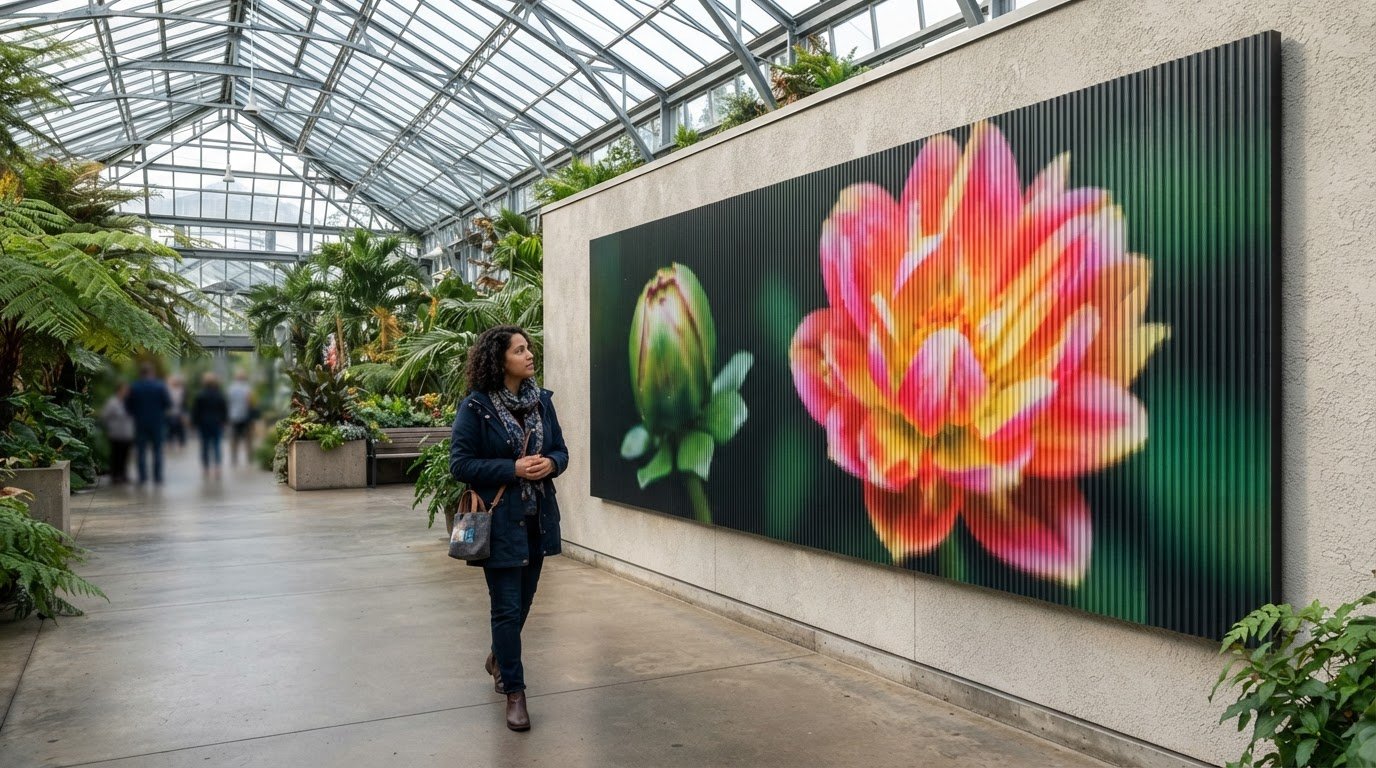
A compelling artwork can begin when someone enters a room. In interactive installation art, visitors help shape the experience through movement, touch, or other forms of participation. Sensors and digital tools can translate those actions into changes in light, imagery, sound, or space, turning a static encounter into a responsive one.
A striking visual can capture attention, but participation gives people a role in what unfolds. The interaction need not be complicated: a step, gesture, or shared presence can become part of the artwork’s language.
Here, you’ll learn how visitor participation influences an installation, how sensors and technology create responsive experiences, and what distinguishes interaction from immersion. Examples from Tokyo, Bordeaux, and other locations around the world show how artists and designers invite audiences to move through, affect, and connect with a work.
Key Takeaways
- See how a visitor’s movement, touch, or presence can become part of an artwork, shifting the audience from observer to participant.
- Understand how technology developed from early experiments into digital and computer-based forms of interaction.
- Explore how installations around the world use responsive light, projection, and immersive spaces to shape distinct experiences.
- Learn how sensor-driven responses work and when lenticular architectural installations can bring movement and visual transformation to a space.
Art that relies on spectator participation
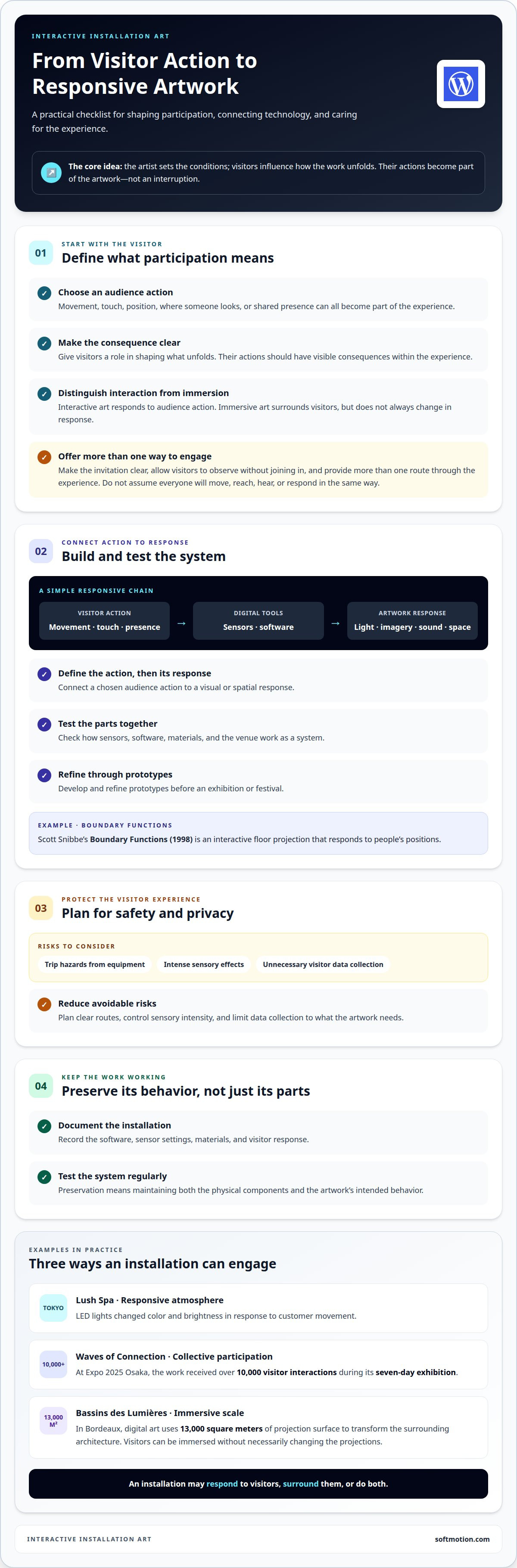
Participation shifts an artwork from something an audience observes to something its members help shape. In interactive installation art, a visitor might move through a space, touch a surface, or choose where to look. The artist sets the conditions, while participants influence how the work unfolds. Their presence becomes part of the artwork, not an interruption. This gives audience members agency: their actions have visible consequences within the experience.
Marcel Duchamp’s Rotary Glass Plates illustrates how participation can begin with a simple instruction. Viewers had to stand one meter away to see its optical illusion. Robert Morris’s Bodyspacemotionthings, shown at Tate Modern from 22 May to 14 June 2009, invited visitors to engage bodily with sculptural forms. One work directed the viewer’s position; the other made physical exploration central. Both show how an artist can shape participation through the relationship between a person and an artwork.
Participation can also create a social exchange. In 1971, Gordon Matta-Clark cooked a pig beneath Brooklyn Bridge and served 500 pork sandwiches as part of a performance. Eating together made the audience part of the event, not simply its observers. This kind of agency differs from pressing a button: participants affect the work by gathering, sharing, and responding to one another.
Es Devlin’s work at the Las Vegas Sphere in 2023 offers another way to consider collective experience. A large-scale environment can gather an audience inside a shared visual world, even when each person’s actions don’t alter its imagery. That distinction matters: immersion surrounds visitors, while participation gives them a role in changing or completing an experience.
Inclusive art venues can offer different ways to participate instead of assuming every visitor will move, reach, hear, or respond in the same way. For a public-space installation, artists can make the invitation clear, allow visitors to observe without taking part, and provide more than one route through the experience. These choices broaden participation while preserving visitor agency. A computer may register movement, but the artwork’s design determines whether people can approach it comfortably and choose their level of involvement.
Technology and the history of interactive art
Interactive art’s history spans mechanical experiments, live media, and computer-based environments. Some early examples date to the 1920s, while interactive art emerged in the late 1950s. In the 1970s, artists used video and satellites to explore live performance and audience exchange. These technologies could transform a fixed artwork into a dynamic event, shaped by its setting and participants.
Interactive art responds to audience action; immersive art surrounds visitors, but doesn’t always change in response. Digital art describes work made or presented through digital tools, and it may be interactive, immersive, both, or neither. Scott Snibbe’s Boundary Functions (1998), an interactive floor projection, shows how a digital environment can respond to people’s positions.
Computer-based interactivity helped the form become a larger phenomenon in the 1990s, as digital art entered the art world in the late 1990s. Maurizio Bolognini’s Collective Intelligence Machines series dates from 2000. Artists such as DRIFT offer a useful lens on the meeting of art, nature, and technology: consider how a work can translate natural patterns into a designed environment. Emerging tools, including motion sensing and responsive projection, can make such environments shift with visitors.
Artists design an installation by first defining the audience action, then connecting it to a visual or spatial response. They test how sensors, software, materials, and the venue work together, refining the artwork through prototypes before an exhibition or festival.
The cost depends on the project and is established after a quote request; scale, sensing systems, software, fabrication, and installation all shape the budget.
Safety and privacy risks can include trip hazards from equipment, intense sensory effects, and unnecessary collection of visitor data. Designers can reduce these risks by planning clear routes, controlling sensory intensity, and limiting data collection to what the artwork needs.
Preserving interactive art means maintaining both its physical components and its intended behavior. Document the software, sensor settings, materials, and visitor response, then test the system regularly; Doug Wheeler’s immersive practice, developed since the 1960s, underscores why an artwork’s environment matters as much as its visible elements.
Examples of installations around the world
Installations in Tokyo, Osaka, and Bordeaux show how different spaces invite different kinds of engagement. At Lush Spa in Tokyo, LED lights changed color and brightness in response to customer movement. A visitor’s motion became part of the visual composition. The work connected each person’s presence to the surrounding atmosphere, rather than asking them to remain an observer.
At Expo 2025 Osaka, Waves of Connection received over 10,000 visitor interactions during its seven-day exhibition. That response suggests how a shared artwork can gather individual actions into a collective experience. Its title points toward connection, while its interaction count shows participation at scale. The example also raises a useful design question: how can an installation make each person’s contribution feel meaningful within a crowd?
In Bordeaux, Bassins des Lumières offers a different model, with 13,000 square meters of projection surface. Here, digital art transforms the surrounding architecture into an expansive visual environment. The scale can immerse visitors without necessarily requiring them to change the projections. Comparing it with Lush Spa clarifies an important distinction: a work may surround people, respond to them, or do both.
At Sónar Festival, the DesigualinBeta installation consisted of two immersive areas. Dividing the experience into separate spaces can shape how visitors move and what they encounter. Another project featured a 360-degree immersive tunnel with mirrors and LED lights. Reflections multiply visual information, while the tunnel’s circular field places the viewer within the image rather than outside it.
Exhibitions can also make the audience’s relationship to an artwork the focus. Tate Modern’s Juan Downey event ran from 23 to 26 October 2012. Barbara Kruger’s Thinking of You. I Mean Me. I Mean You. was ongoing at London’s Serpentine South Gallery as of February 2024. These examples show how setting, movement, and shared attention can shape a visitor’s connection with art, even when the work responds differently to each person.
Sensor-based visitor interaction
A sensor turns a visitor’s action into information an artwork can use. For example, a motion sensor can detect someone crossing a defined area, and software can translate that input into a change in light, sound, or projection. The artistic choice lies in the connection between action and response. A brief movement might shift a color, while a slower approach could reveal another visual layer. Each response gives visitors a reason to explore.
One project used a biometric panel to generate a personalized light show. This example shows how sensor-based interaction can go beyond detecting someone’s presence. The panel’s input informs a visual response designed for an individual visitor. In an immersive setting, that connection can make technology feel less like a hidden control system and more like part of the artwork’s expressive language.
Design begins with the intended experience, not the sensor. An artist might want a projection to follow a visitor, reveal an image when someone pauses, or shift as people gather. Each aim calls for a different relationship between input and output. Clear, immediate responses help participants understand how they can influence the work; a delayed or subtle response can instead invite closer observation.
Calibration helps make that exchange feel natural. A motion-responsive wall, for example, must distinguish a deliberate gesture from incidental movement. The team aligns the sensor’s field with the installation’s layout, then tests how the visual response appears from different positions. Advanced sensing can capture more nuanced inputs, but added complexity matters only when it serves the artist’s vision.
For a responsive visual environment, the essential design choice is what visitors can change and how clearly the artwork answers them. Explore ways to shape a responsive visual environment through considered movement, imagery, and space.
Softmotion: Architectural Lenticular Installations
Softmotion creates Architectural Lenticular Installations that bring motion and visual change to built environments. Lenticular imagery shifts as viewers move past a surface, making their viewpoint part of the experience without sensor-triggered responses. This approach suits projects that need a dynamic visual feature, with the image itself as the central medium.
For artists, architects, and organizations exploring how imagery can engage an audience in a physical setting, lenticular work offers another path from static display to spatial experience. Softmotion also creates Fine Art Lenticular Prints, Advertising Lenticular Displays, and Tradeshow Lenticular Graphics for different presentation contexts.
Contact Softmotion to discuss an Architectural Lenticular Installation for your space.
Shape the next encounter
The next creative decision is how visitors should influence the experience. Sensor-led interaction is one path; imagery that shifts with a viewer’s position offers another. For interactive installation art, this distinction can guide the concept, spatial design, and relationship between the artwork and its audience.
Softmotion’s lenticular work brings motion into a space through changing imagery. Its offerings include Architectural Lenticular Installations for built environments, Fine Art Lenticular Prints for artistic presentation, and Advertising Lenticular Displays for brand communication. Each format can make a viewer’s movement part of the visual encounter, without treating every project as a sensor-driven installation.
Start with the quality you want people to notice, then consider how the space and viewing angle can support it. Contact Softmotion about interactive art to explore how a lenticular approach could serve your project. A thoughtful concept can turn a familiar surface into an experience people choose to look at again.
Frequently Asked Questions
What is interactive installation art?
Interactive installation art is a spatial artwork designed to change in response to a visitor’s action or presence. Unlike a display that simply presents an image, it creates an exchange: a visitor moves, selects, or touches, and the work responds. The artist determines which actions matter and what follows. That relationship can be direct and visible or subtle enough to reward closer attention.
What are famous examples of participatory installation art?
Notable works include Robert Morris’s Location Piece (1973), Dominique Gonzalez-Foerster’s Séance de Shadow II (bleu) (1998), and Franz West’s Viennoiserie (1998). Their titles and dates offer starting points for exploring how artists have approached participation across different periods. When looking at a work, consider what role the visitor has, how the space shapes that role, and whether participation changes the experience.
What technologies are used in interactive art installations?
Artists use sensors, computers, software, projection, video, and lighting to connect visitor actions with changes in an artwork. The right technology depends on the intended exchange: a movement sensor can register a visitor’s position, while an interface can let someone make a deliberate selection. Video and satellite technologies have also supported experiments with live performance and interaction. The technical system serves the artistic idea, not the other way around.
How do museums make interactive installations accessible to visitors?
Museums can offer several ways to experience an installation, including watching without participating. Clear instructions, uncluttered routes, reachable controls, and responses that don’t rely only on sound or color can make an encounter easier to navigate. For example, a work might pair a visual cue with a written prompt and leave space for visitors to pause. These choices support different ways of engaging without changing the artwork’s central idea.
How much does it cost to create an interactive art installation?
The cost varies with scale, sensing systems, software, fabrication, and installation.