
How to Meet Structural Requirements for Hanging Heavy Art
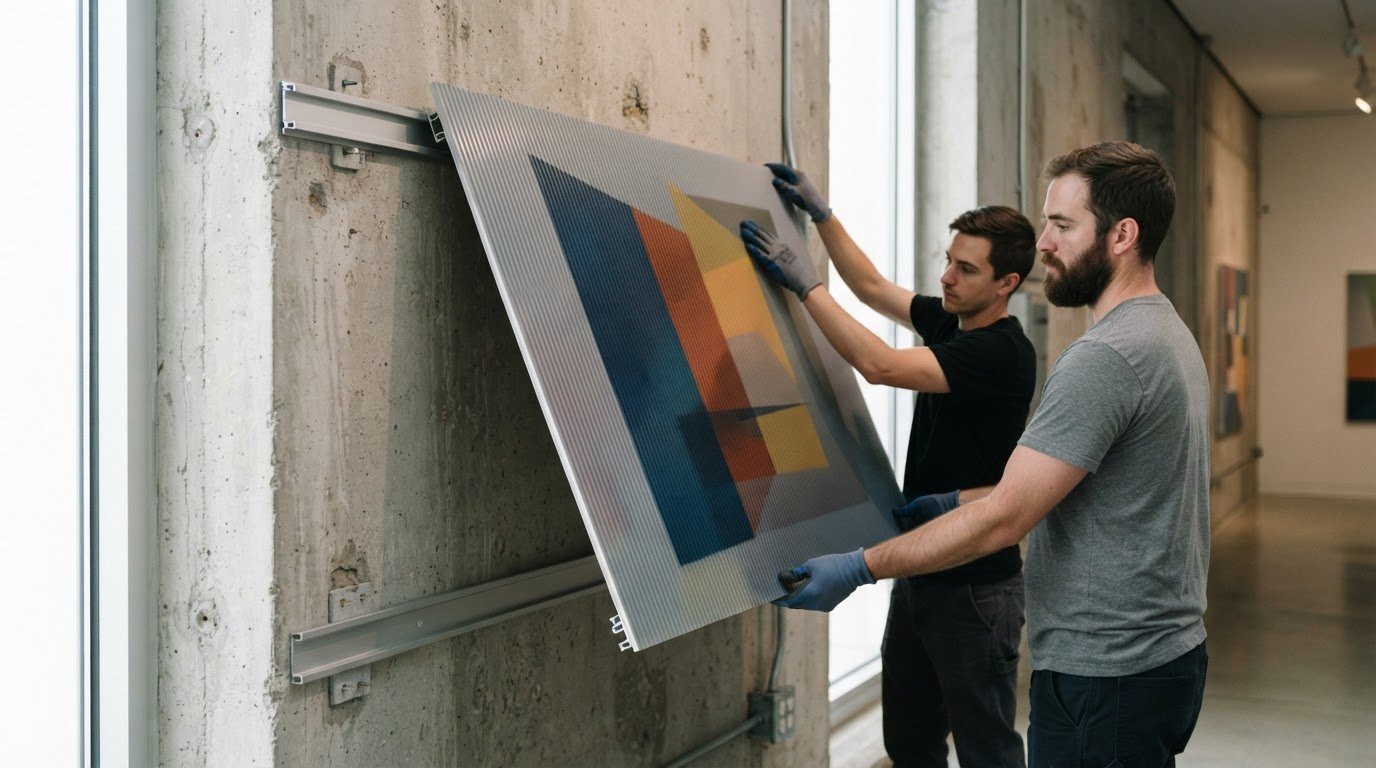
The least damaging hanger isn’t always the safest one. The structural requirements for hanging heavy art start with matching the hardware to both the artwork’s weight and the wall type; for pieces weighing more than 20 pounds, anchor into a wall stud. Adhesive strips may leave less evidence behind, but they aren’t the right choice for every frame or surface.
It’s natural to want to protect a finished wall when hanging a substantial mirror or sculptural work. The key is to balance minimal damage with secure support, not to choose hardware by appearance alone. This guide explains how to weigh those priorities and select a mounting method suited to the piece.
You’ll learn how to assess an artwork’s weight, identify common wall types, and avoid unnecessary holes without compromising stability. We’ll also explain why mirrors and sculptures may need different support from a flat framed picture, and when a rail, cleat, or professional installation can make hanging safer and more considered.
Key Takeaways
- Match hanging hardware to both the artwork’s weight and the wall’s construction, rather than relying on a hanger’s appearance.
- Reduce wall damage by choosing a mounting method suited to the surface, while recognizing that the least invasive option may not support a heavy piece.
- Use secure, well-distributed support for mirrors and sculptures, whose weight and shape can call for a different approach from a flat frame.
- Consider a rail or cleat when the artwork’s scale, weight, or placement makes a simple picture hook unsuitable.
Choosing hanging hardware for artwork weight and wall type
Match each frame’s hardware to its weight, dimensions, and wall connection. Structural requirements for hanging heavy art also depend on where the piece will be displayed.
-
Assess Artwork Weight, Size, and Center of Gravity
Weigh the complete artwork, including its frame and glazing, before selecting hardware. A wide painting or one with a low, off-center mass can pull unevenly, even if its total weight seems manageable. Check how the weight is distributed and how the frame’s fittings connect. When the frame allows, use two suitably spaced attachment points rather than relying on a single central wire for a heavy piece.
-
Compare Hardware Weight Thresholds
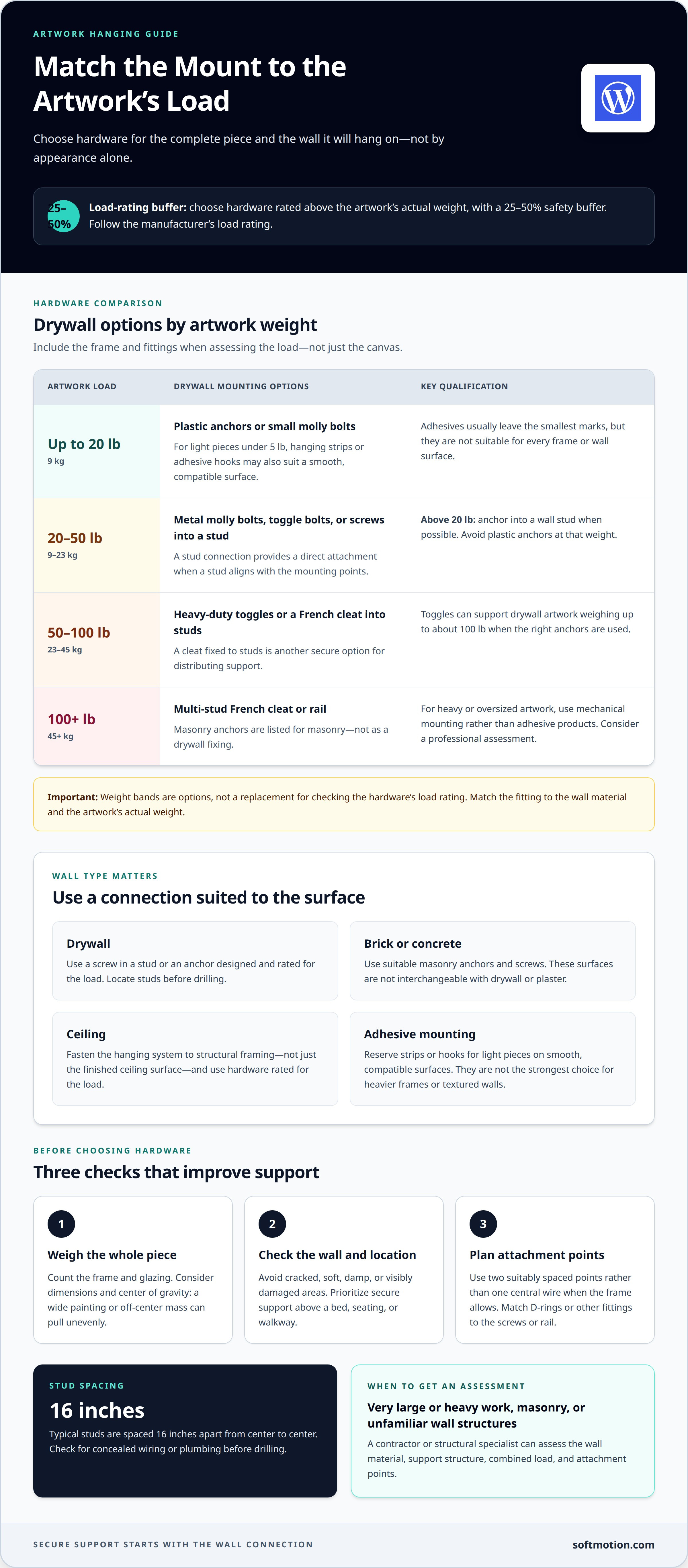
Choose hardware rated above the artwork’s actual weight, with a 25-50% safety buffer, and follow the manufacturer’s load rating. For artwork weighing more than 20 pounds, anchor into a wall stud; avoid plastic anchors at that weight. Pictures under 5 pounds may suit hanging strips or adhesive hooks, while nails and pin hooks can support moderate-weight art. A thin nail in a stud can hold around 20 pounds, but coarse-threaded wood screws in a stud can hold pictures over 50 pounds.
-
Consider Placement Risks
Assess the consequences of a fall before choosing placement above a bed, seating, or a walkway. A heavy frame that comes loose could strike someone, so prioritize a secure wall connection over minimizing holes. Typical studs sit 16 inches apart, making stud alignment relevant to a wide frame or gallery wall. On drywall, use a stud or an anchor designed and rated for the load; on brick or concrete, use suitable masonry anchors and screws. Match frame fittings, such as D-rings, to the chosen screws or rail.
What is the least damaging way to hang pictures?
Adhesive strips usually leave the smallest marks, but they aren’t suitable for every frame or wall surface. In the United States, review lease and property rules before drilling. For safe ceiling hanging, fasten to structural framing, not just the finished surface.
-
Assess Wall Condition and Load Capacity
Inspect the wall before choosing a mounting method. Avoid cracked, soft, damp, or visibly damaged areas, which may weaken the connection. Identify whether the wall is drywall, plaster, brick, or concrete, then choose a fixing designed for that material. For heavy or valuable pieces, have a technician or structural specialist assess whether the wall can support both the artwork and its fittings.
-
Locate Wall Studs and Hidden Utilities
Locate studs before drilling into drywall. Typical wall studs are spaced 16 inches apart from center to center, which can help position a frame’s mounting points. Use a stud finder and check the planned drilling area for concealed wiring or plumbing before making holes. If the wall’s construction or utility routes remain unclear, don’t guess; move the placement or arrange a professional assessment before drilling.
-
Choose a Wall-Friendly Hanging Approach
Use adhesive strips for light pieces only when the surface is smooth and compatible with the product. They usually leave the smallest marks, but they’re not the strongest option for heavier frames or textured walls. For heavier art, use a mechanical connection suited to the wall, such as a screw in a stud or a correctly rated drywall anchor. If you rent, confirm drilling permissions and plan any holes around the artwork’s final position.
-
Determine Whether Professional Assessment Is Needed
Bring in a contractor or structural specialist for very large or heavy artwork, masonry, or unfamiliar wall structures. Their assessment should consider the wall material, support structure, combined load, and intended attachment points. For a ceiling-hung work, connect the hanging system to structural framing and use hardware rated for the load; the ceiling finish alone isn’t support. Plan a gallery wall with pieces centered about 57 inches above the floor and spaced 3 to 6 inches apart.
Can heavy artwork be hung on drywall?
Yes, heavy art can hang on drywall without a stud if you use suitable anchors rated for its weight. Screws fixed into a stud provide a direct connection; the right anchor depends on the load and wall material.
-
Choose Between Studs and Anchors
First, check whether a stud aligns with the artwork’s mounting points. Screws installed into a stud are a common option for drywall, and a French cleat fixed to a stud offers another secure method. If no stud suits the position, use anchors designed for drywall and rated for the artwork’s full weight. Include the frame and fittings when assessing the load, not just the canvas.
-
Select Hardware for the Wall Material
Next, match the anchor to the drywall load. For artwork up to 20 lb (9 kg), plastic anchors or small molly bolts are options. For 20-50 lb (9-23 kg), consider metal molly bolts, toggle bolts, or screws into a stud. For 50-100 lb (23-45 kg), use heavy-duty toggles or a French cleat into studs. For 100+ lb (45+ kg), listed options include masonry anchors or a multi-stud French cleat or rail. Toggles can support drywall artwork weighing up to about 100 lb when the right anchors are used. These ranges don’t replace the hardware’s load rating.
-
Attach Hardware to Studs or Masonry
For a stud connection, position the fitting over the stud and choose screws suited to the frame hardware. A pilot hole helps guide the screw, and drilling into the stud provides a more solid mount than using a screwdriver alone. In brick or concrete, use masonry anchors, suitable screws, and appropriate drilling tools. Plaster, drywall, brick, and concrete are not interchangeable surfaces. For heavy or oversized artwork, use mechanical mounting rather than adhesive products, and distribute the load through fittings designed for the wall connection.
Specialty hanging methods for mirrors and sculptures
Mirrors and sculptures need support suited to their shape, mounting points, and center of gravity. Choose the mounting method before deciding where to display the piece.
-
Match the Hanging Method to the Artwork
Inspect the back of each mirror or sculpture and identify its intended mounting points. A mirror’s fittings must keep it stable and prevent shifting. Don’t substitute a wire unless the frame and hardware are designed for one. For a three-dimensional sculpture, account for projections and uneven weight, which can pull a single central support off balance. Two suspended supports often provide greater stability by distributing the load across separate points. Measure the distance between the fittings and transfer their positions accurately to the wall.
-
Consider a French Cleat or Mounting Rail
Choose a French cleat for a heavy or wide work that needs broad, level support. Its two interlocking parts attach separately to the wall and artwork, helping the piece sit securely; mounting the wall section to a stud adds support. A continuous rail can also suit a large display or several pieces, provided the track and attachments match the combined load. Rail-cable kits can support up to 300 pounds per track, while AS Hanging rail tracks support up to 50 pounds per linear foot. Treat these as rated limits, not targets, and follow each system’s load instructions.
- Before installation, align the wall connections and artwork fittings, then use a level to check the mounting points. A large textured sculpture may need two people to lift and place safely. After hanging, confirm the work sits securely without tilting, rocking, or pressing unevenly against its supports. For a dynamic visual display, explore Advertising Lenticular Displays, where imagery shifts with the viewer’s perspective.
Softmotion
Softmotion creates large-format lenticular prints and visual installations that bring artwork into a space. Once you’ve planned the wall and mounting method, its work can transform a static surface into an image that shifts with the viewer’s perspective.
For projects that call for integrated visual impact, Softmotion creates Advertising Lenticular Displays, Architectural Lenticular Installations, Fine Art Lenticular Prints, and Tradeshow Lenticular Graphics. The right format depends on the artwork’s purpose and the setting where people will experience it. For heavy art, mirrors, or sculptures, base the mounting decision on the object’s weight, wall structure, and suitable hardware.
Contact Softmotion to discuss how lenticular artwork could shape your space.
Shape a Space Around the Art
Meeting the structural requirements for hanging heavy art is one part of creating a considered display. Next, decide how the artwork should transform the space and what viewers should experience. With the mounting plan settled, you can develop the visual concept with confidence.
Softmotion creates lenticular work for fine art, architecture, and advertising, including Fine Art Lenticular Prints, Architectural Lenticular Installations, and Advertising Lenticular Displays. These offerings add movement and depth to visual projects, complementing spaces where art is designed to engage viewers from different viewpoints.
If you’re ready to explore a lenticular concept for your space, contact Softmotion about your art. Let a thoughtful next step turn a secure display into a distinctive visual experience.
Frequently Asked Questions
Can I use adhesive strips for heavy textured wall art?
Usually, no. Adhesive strips are a poor fit for heavy textured art: uneven surfaces can limit contact, and the artwork’s weight adds strain. Choose mechanical support suited to the wall and the complete framed piece instead. For a light picture, follow the adhesive product’s surface-preparation and weight instructions, and don’t use strips on surfaces they aren’t designed for.
Can pictures be hung on plaster walls?
Yes, pictures can be hung on plaster, but the wall’s condition and backing matter. Plaster was common in older homes, especially those built before 1940, and may crack or crumble if drilled carelessly. Check for loose or damaged areas, choose a fastener intended for the wall assembly, and drill carefully. Stop if the plaster breaks apart rather than holding the mounting point securely.
How Do You Safely Hang Heavy Textured Art?
Start by weighing the complete piece and identifying its stable mounting points. If the frame supports it, attach a D-ring on each side so the load doesn’t depend on one central wire. Arrange for someone to help lift and position large, textured work. If you use picture wire, stick-on felt pads a few inches in from the bottom corners can reduce forward leaning.
How do I hang heavy art without finding a stud?
Use anchors designed for the wall material and rated for the artwork’s full weight, including its frame and fittings. For drywall, toggle bolts or metal molly bolts may be appropriate, depending on the load and anchor rating. Distribute support across the frame’s intended mounting points. An anchor’s maximum rating doesn’t replace the need to match the hardware to the actual installation.
How do you hang heavy art on drywall (with and without studs)?
With a stud, use screws suited to the frame fittings to create a direct connection. Without one, choose drywall-rated anchors, such as toggle bolts or molly bolts, with load ratings suited to the complete artwork. For a very large piece, a French cleat attached across studs can distribute the support. Don’t rely on adhesive alone for heavy work, and avoid mounting into damaged drywall.
How high should art be hung?
For an open wall, place the artwork’s center about 57 inches above the floor. Above furniture, use a different reference: position the bottom edge about six to eight inches above the furniture. To mark the hanger accurately, measure from the artwork’s center to its hanging point, then transfer that offset to the wall. This keeps the chosen center height consistent after installation.