
Engaging Commuters with Transit Hub Visual Installations: The 2026 Guide to Kinetic Lenticular Art

What if the most captivating display in a modern station didn’t require a single watt of electricity? For years, the default response to sterile corridors has been to bolt on more glowing screens, yet these often add to the sensory noise rather than the passenger experience. In 2026, the most effective transit hub visual installations aren’t digital at all. They are kinetic surfaces that harness the commuter’s own movement to breathe life into static walls.
You likely recognize the frustration of managing high-maintenance hardware that’s prone to vandalism and rising energy costs. It’s a common pain point in an industry searching for durability without sacrificing beauty. This guide explores the transition from flat, two-dimensional surfaces to multi-dimensional, motion-driven art. We’ll show you how to achieve a sophisticated “wow” factor using energy-efficient lenticular technology that requires zero power. You’ll discover how to elevate passenger satisfaction scores while maintaining a grounded, pragmatic approach to long-term facility management.
Key Takeaways
- Discover how kinetic surfaces reduce perceived wait times by turning functional transit paths into memorable architectural experiences.
- Learn why transit hub visual installations using lenticular technology offer a sustainable, zero-power alternative to high-maintenance digital screens.
- Gain insights into designing for high-traffic corridors, focusing on the specific viewing angles and proportions needed for large-scale impact.
- Identify the durability benefits of passive kinetic art, which resists environmental wear and vandalism in demanding public spaces.
- Understand the collaborative process of taking a visionary concept from custom sampling to full-scale architectural implementation.
Beyond Wayfinding: Reimagining the Passenger Experience in 2026
For decades, the measure of a successful transit hub was its efficiency. Can a passenger get from Point A to Point B without getting lost? In 2026, this metric is shifting. Efficiency is the baseline; experience is the differentiator. Modern transit hub visual installations are no longer mere decorations. They serve as architectural anchors that define the identity of a space. This transition reflects a broader movement toward experiential urbanism, where every commute is treated as a narrative journey rather than a chore.
Static environments can feel oppressive during long commutes. Kinetic art introduces a rhythmic quality that mimics natural life. Environmental psychology suggests that visual engagement significantly reduces perceived wait time. When a wall moves as you move, your brain shifts from passive waiting to active discovery. This isn’t just about aesthetics. It’s about changing how people feel while they move through a space. It transforms a sterile corridor into a destination.
We live in an era of digital saturation. Every surface seems to glow with an advertisement or a status update. Commuters are developing a subconscious blindness to digital signage. They crave something tactile and physical. Analog motion, powered by lenticular printing technology, offers a physical interaction that feels more authentic than a pixelated screen. It’s a sophisticated alternative that honors the architecture while engaging the senses without adding to the noise of the digital world.
The Evolution of Transit Hub Aesthetics
The shift from brutalist concrete to light-filled, dynamic environments is well underway. Visual installations now influence passenger flow by creating visual milestones that guide the eye naturally through a corridor. These landmarks do more than look good. They provide a tangible return on investment by increasing passenger satisfaction and creating “Instagrammable” moments. These social shares turn a local station into a global destination, proving that transit hub visual installations can turn infrastructure into a cultural asset.
Addressing the Commuter’s Emotional State
Transit environments are inherently chaotic. High-precision visual movement can counteract this stress by creating a sense of calm through predictable, elegant motion. This human-first quality of analog movement feels organic rather than artificial. At Softmotion, we specialize in converting static walls into visionary narratives. We see the hidden potential in a 50-foot corridor and use our technical discipline to realize that potential. Our approach ensures that every installation is a risk-free collaboration that results in a lasting architectural legacy.
The Science of Motion: How Lenticular Technology Transforms Transit Walls
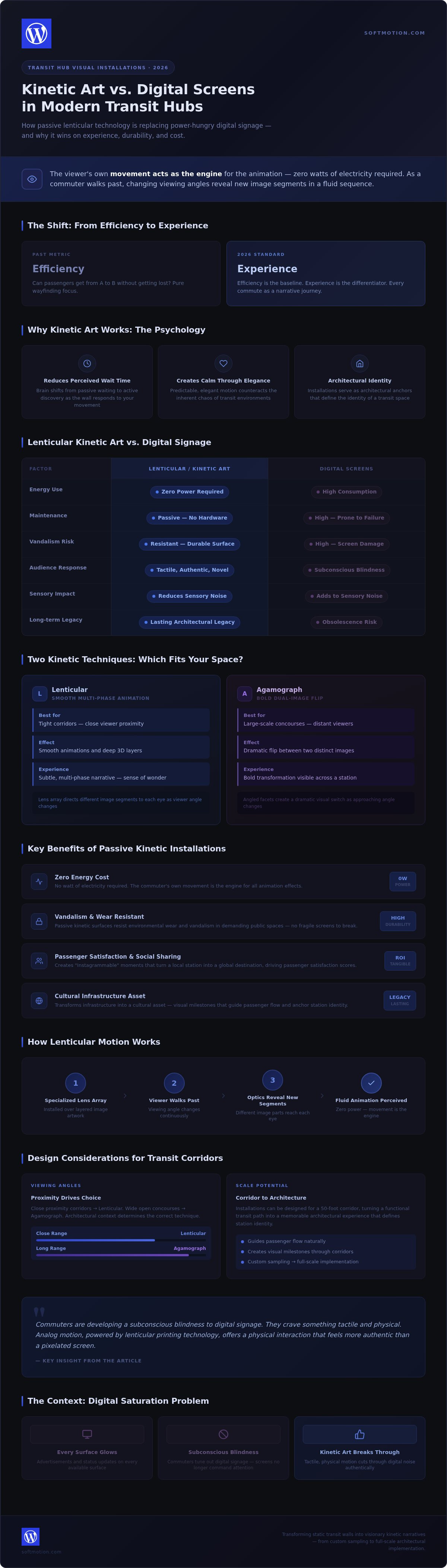
The transformation of a static surface into a living experience relies on a precise marriage of geometry and optics. Large-format lenticular printing uses a specialized lens array to direct different parts of an underlying image to each eye. As a commuter moves, the angle of view changes, revealing new segments of the art in a fluid sequence. Lenticular motion is a perspective-driven visual shift occurring as the viewer walks past. This passive interactivity is the hallmark of modern transit hub visual installations. It requires no power, yet it commands attention with an elegance that digital screens cannot replicate.
The magic happens without batteries or sensors. The viewer’s own pace acts as the engine for the animation. This creates a personal connection between the passenger and the architecture. When a wall responds to your presence, the environment feels less like a concrete box and more like a responsive partner. It’s a sophisticated way to engage an audience that has become numb to the aggressive flicker of traditional advertising.
Lenticular vs. Agamograph: Choosing the Right Effect
Selecting the right visual technique depends on the architectural context and the desired emotional impact. Lenticular effects excel in tight corridors where viewers are close to the wall. They offer smooth animations and deep 3D layers that invite a sense of wonder. In contrast, Agamograph wall art uses a series of angled facets to create a dramatic flip between two distinct images. These are ideal for large-scale concourses where commuters approach from a distance. While lenticular provides a subtle, multi-phase narrative, Agamographs deliver a bold transformation that can be seen across a station.
Custom Fabrication for High-Traffic Environments
Engineering these installations for public spaces demands more than just artistic vision; it requires technical discipline. Since 1997, we’ve delivered over 1,000 projects, honing a process that ensures every installation stands up to the rigors of a transit environment. We use high-end architectural substrates that resist wear while maintaining the clarity of the lens. Precision is non-negotiable. If the lens alignment is off by even a fraction of a millimeter at scale, the motion effect collapses.
Integrating these graphics into existing building facades requires a collaborative partner who understands the transition from two-dimensional concepts to multi-dimensional realities. Our end-to-end production process includes custom sampling to ensure the impact is achieved before the final implementation. If you’re ready to explore these possibilities, viewing our architectural lenticular installations can provide the inspiration needed to begin your journey. This risk-free approach allows architects to reimagine sterile surfaces as visionary landmarks that remain both durable and captivating.
Lenticular vs. Digital Signage: Why Passive Kinetic Art Wins
Digital signage often promises interactivity, but it frequently delivers a constant burden of maintenance. In the demanding environment of a station, hardware fails and software glitches. Passive kinetic art offers a different path. It provides high-impact motion without the tether of a power grid. This shift from active electronics to passive optics transforms how we approach transit hub visual installations. It’s a move toward permanent architectural value rather than temporary technology. By removing the screen, we remove the barrier between the viewer and the environment.
Reliability is the cornerstone of any public infrastructure. While a digital screen requires 24/7 uptime and climate-controlled housing, a lenticular installation is inherently resilient. It resists the common pitfalls of public spaces, such as vandalism and environmental wear. If a screen is scratched, the repair is costly and technical. If an architectural lenticular surface is scuffed, it remains functional and beautiful. This durability isn’t just a convenience; it’s a fundamental requirement for busy corridors that experience high volumes of passenger traffic every day.
Sustainability is no longer an optional feature in urban planning. Non-electronic motion art represents a significant step forward in green architecture. By eliminating energy consumption, these installations reduce the carbon footprint of the transit hub. They don’t contribute to light pollution or heat generation, making them more comfortable for passengers in enclosed spaces. It’s a sophisticated way to achieve a “wow” factor while remaining deeply committed to environmental responsibility.
The Total Cost of Ownership (TCO)
The financial narrative of digital versus analog is often misunderstood. Many focus on the upfront fabrication costs of kinetic art while ignoring the hidden, compounding expenses of digital energy bills. Over a decade, the cost of powering and cooling a wall of screens can exceed the initial investment. Lenticular installations eliminate the need for ongoing IT support and complex content management systems. They’re built to last decades, not years. This longevity makes them a pragmatic choice for visionary architects who value long-term stability over short-lived trends. Still, where commercial multimedia remains essential, organizations can explore מכירה, התקנה וניהול של מערכות שילוט דיגיטלי ומוזיקה לעסקים to see how professional screen networks and curated audio are implemented for modern venues.
Commuter Engagement Metrics
Screens have become background noise. We’ve learned to ignore them because they represent a transactional relationship. Kinetic walls trigger a different response: the “Stop and Stare” factor. Because the motion is tied to the viewer’s own movement, it creates a moment of discovery. Even for those in a rush, peripheral interaction occurs. The art moves in the corner of their eye, providing a sense of spatial awareness and calm. This high-level engagement is explored further in our guide to Kinetic Advertising Displays, which details how motion art captures attention in high-traffic zones. By choosing physical art over commercial screens, transit authorities elevate the entire passenger experience.
Strategic Planning: Designing Visuals for High-Traffic Corridors
Successful transit hub visual installations begin long before the first panel is printed. They start with a rigorous analysis of the commuter’s journey. We look at the speed of the crowd and the primary lines of sight to determine the optimal viewing angle for motion. If a passenger is rushing toward a platform, the animation must be bold and legible at high speeds. Conversely, art placed near waiting areas can afford a more intricate, multi-phase narrative. This level of strategic planning ensures the work feels integrated rather than added on.
Scale dictates the technical specifications of the lenticular lens. A 50-foot mural requires a different lens pitch than an individual pillar to maintain the illusion of depth across a vast distance. Proportion is everything. We balance the scale of the artwork with the architectural volume of the concourse. Lighting also plays a critical role. While digital screens often fight against ambient transit light, kinetic art uses it. We design surfaces to maximize the kinetic effect using existing station illumination, creating a natural brilliance that feels organic to the space.
Safety remains a non-negotiable priority in public infrastructure. Every installation must meet stringent fire codes and ADA standards for public art. Our materials are selected for their durability and compliance, ensuring that visionary beauty never compromises operational safety. We navigate these technical requirements with a quiet confidence, allowing you to focus on the creative vision while we handle the regulatory discipline.
The Design and Prototyping Phase
Seeing is believing, especially when dealing with multi-dimensional effects. Custom prototypes are essential for securing stakeholder approval and refining the visual impact. We provide custom sampling at various scales to test how the motion translates from a digital concept to a physical reality. This risk-free approach allows architects to experience the “wow” factor before full-scale fabrication. For a deeper look at this process, explore our Architect’s Guide: Custom Lenticular Prototypes.
Installation Logistics in Active Hubs
Transit hubs never sleep, and disruption must be kept to a minimum. We manage the entire journey from our specialized facility, using off-site fabrication to ensure precision and quality control. Our panels are engineered for seamless integration, creating “invisible” seams that allow for massive, uninterrupted murals. With over 1,000 projects delivered since 1997, our end-to-end project management approach provides the security and ease you need for complex implementations. If you are ready to transform your space, you can request a lenticular sample kit to see the quality of our architectural finishes firsthand.
Softmotion: Your Visionary Partner in Transit Transformation
Since 1997, Softmotion has refined the art of spatial transformation. We’ve delivered over 1,000 projects, each one a testament to our commitment to craftsmanship and technical precision. We don’t just provide prints; we act as a Visionary Guide for architects and urban planners. We see the hidden potential in a sterile corridor and possess the technical discipline to realize it. Our work bridges the gap between imaginative concepts and concrete, multi-dimensional realities.
Transit hub visual installations require a partner who understands the unique pressures of public infrastructure. We offer a collaborative, risk-free approach that prioritizes your creative vision while maintaining professional reliability. Whether your project is in a local station or a global transport hub, our expertise ensures a seamless transition from two-dimensional designs to high-impact architectural landmarks. We believe the best partnerships are built on clarity, trust, and a shared passion for elevating the human experience within the built environment.
Our End-to-End Production Process
Our journey begins with a deep design consultation. We develop technical specifications that align with your architectural goals and the specific flow of your station. From high-precision printing to selecting durable, fire-rated substrates, every step is handled with meticulous care to ensure perfect lens alignment at scale. The process concludes with a managed assembly, where our team ensures quality assurance on-site. This methodical flow guarantees that the final result resonates with your audience and stands the test of time. It’s a controlled, professional process that removes the risk from complex creative challenges.
Start Your Transit Project Today
The first step toward transforming your environment is experiencing the technology firsthand. You can request specialized samples to see how our motion effects perform under transit lighting and within the context of your specific site. If you have unique architectural requirements, our team is ready to consult on custom solutions that meet your needs. We’re here to guide you from the initial “what is possible” to the final “how it is achieved.” Contact Softmotion to discuss your transit hub installation and begin the collaborative journey toward a more engaging, motion-driven passenger experience.
Shaping the Future of Public Motion Art
The transition from sterile infrastructure to experiential landmark is a journey of technical discipline and creative vision. You’ve seen how passive kinetic surfaces solve the modern challenges of screen fatigue and high energy costs. These installations don’t just occupy space; they respond to the human rhythm of the station. By choosing durable, analog motion over fragile digital hardware, you ensure that your project remains a captivating landmark for decades.
Softmotion brings over 25 years of specialized expertise to every collaboration. Since 1997, we’ve delivered more than 1,000 successful projects, providing end-to-end management from the first prototype to the final on-site assembly. We specialize in large-format architectural motion that turns ordinary walls into visionary narratives. If you’re ready to redefine your space with transit hub visual installations that inspire and endure, we’re here to guide you.
Partner with Softmotion for your next transit installation and bring your imaginative concepts to life with a seasoned leader in multi-dimensional art.
Frequently Asked Questions
Are lenticular transit hub visual installations durable enough for high-traffic areas?
Yes. Softmotion uses high-end architectural substrates specifically engineered for public environments. Since 1997, we’ve delivered over 1,000 projects, many in demanding urban centers. The materials are resistant to impact and surface wear, making them ideal for the constant flow of passengers. Unlike digital hardware, there are no delicate electronics to fail or break under physical stress. This ensures the installation remains a permanent, beautiful feature of the station for years to come.
How do lenticular displays compare to digital signage in terms of cost?
Lenticular installations offer a lower total cost of ownership compared to digital alternatives. While the initial fabrication is a custom investment, you eliminate ongoing expenses like electricity and software licensing. There’s no need for 24/7 IT support or hardware replacements every few years. These transit hub visual installations provide a permanent architectural feature that remains vibrant for decades without a recurring monthly utility bill or high energy consumption.
Can lenticular art be integrated into existing transit station walls?
Yes, our panels are designed for seamless integration into existing station architecture. We work closely with urban planners to ensure the graphics fit perfectly onto concrete, metal, or glass surfaces. Our end-to-end production process includes managing the logistics of mounting panels with invisible seams. This allows us to convert static, uninviting corridors into dynamic experiences without requiring a complete structural overhaul or expensive modifications to the building’s facade.
What is the maximum size for a lenticular wall installation?
There is virtually no limit to the scale of a lenticular installation. We achieve massive dimensions by tiling high-precision panels together to create unified murals that can span 50 feet or more. Each panel is engineered to align perfectly; this ensures the motion effect remains consistent across the entire surface. This modular approach allows us to transform entire concourses or long pedestrian tunnels into immersive, multi-dimensional journeys that captivate every passing commuter.
Does kinetic lenticular art require special lighting in subway stations?
No special lighting is required; however, ambient light is essential for the kinetic effect to function. Lenticular technology uses the existing illumination in the hub to reveal different image phases as viewers move past. We analyze the lighting conditions of your specific site during the design phase. This ensures the visual shift is maximized under standard station lights, creating a natural brilliance that feels organic to the environment without adding extra power requirements.
How long does the design and fabrication process typically take?
The timeline varies based on the scale and complexity of the project. A typical journey involves custom design consultation, technical specification development, and high-precision printing. We also prioritize a prototyping phase to ensure stakeholder approval before full-scale implementation. Because we’ve delivered over 1,000 projects since 1997, our methodical process is highly efficient. We provide specific lead times once the project scope and architectural requirements are defined during our initial collaborative consultation.
Are these installations resistant to vandalism and graffiti?
Yes, the architectural-grade materials we use are specifically chosen for their resilience in public spaces. The outer surface of the lenticular lens is durable and can be treated with anti-graffiti coatings. Unlike digital screens, which are prone to shattered glass or hardware failure, these physical installations are robust. They maintain their visual integrity even in high-traffic zones, providing a secure and low-maintenance alternative that resists the common wear and tear of urban environments.
Can you create custom 3D effects for transit hub branding?
Absolutely. We specialize in high-precision 3D depth and multi-phase animations tailored to specific transit hub visual installations. We can convert static logos or campaign imagery into visionary narratives that shift as commuters walk past. Our “Visionary Guide” approach ensures that your brand identity is reimagined as a multi-dimensional experience. This creates a memorable architectural landmark that strengthens the passenger’s connection to the hub’s unique identity while providing a sophisticated “wow” factor.