
Dynamic Wall Installations for Real-Time Brand Storytelling
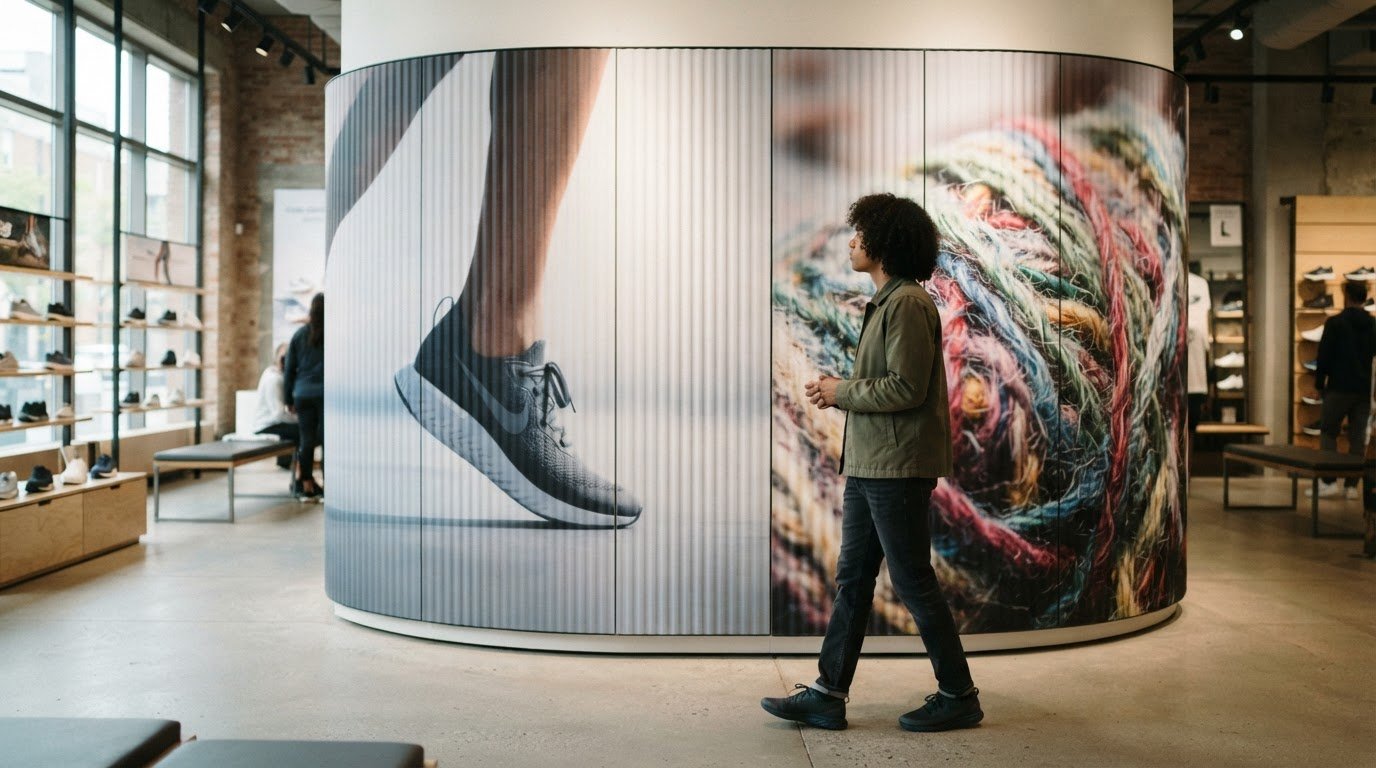
A brand story doesn’t need a screen that updates every second to feel alive. Dynamic wall installations for brand storytelling can use motion, scale, and changing viewpoints to make a message unfold as people move through a space.
Real-time content and audience participation can add another layer, inviting visitors to shape what they see rather than simply pass by. But not every installation needs sensors or constant updates. The right approach depends on the story, setting, and audience.
This article explores how live content and participation can work alongside visual design, and why movement, scale, and viewing angles shape the experience. You’ll learn how these choices can help a brand create a memorable encounter and connect an installation to marketing outcomes.
Key Takeaways
- Use content that responds to the moment or to audience participation when it strengthens the story, rather than adding interactivity for its own sake.
- Connect engagement features to clear marketing goals so audience responses can inform how an installation performs.
- Build brand narratives into the space itself, using visual choices that make the experience distinctive and memorable.
- Plan movement, scale, and viewing angles together to shape how the story appears to visitors across the space.
Real-time content and dynamic storytelling
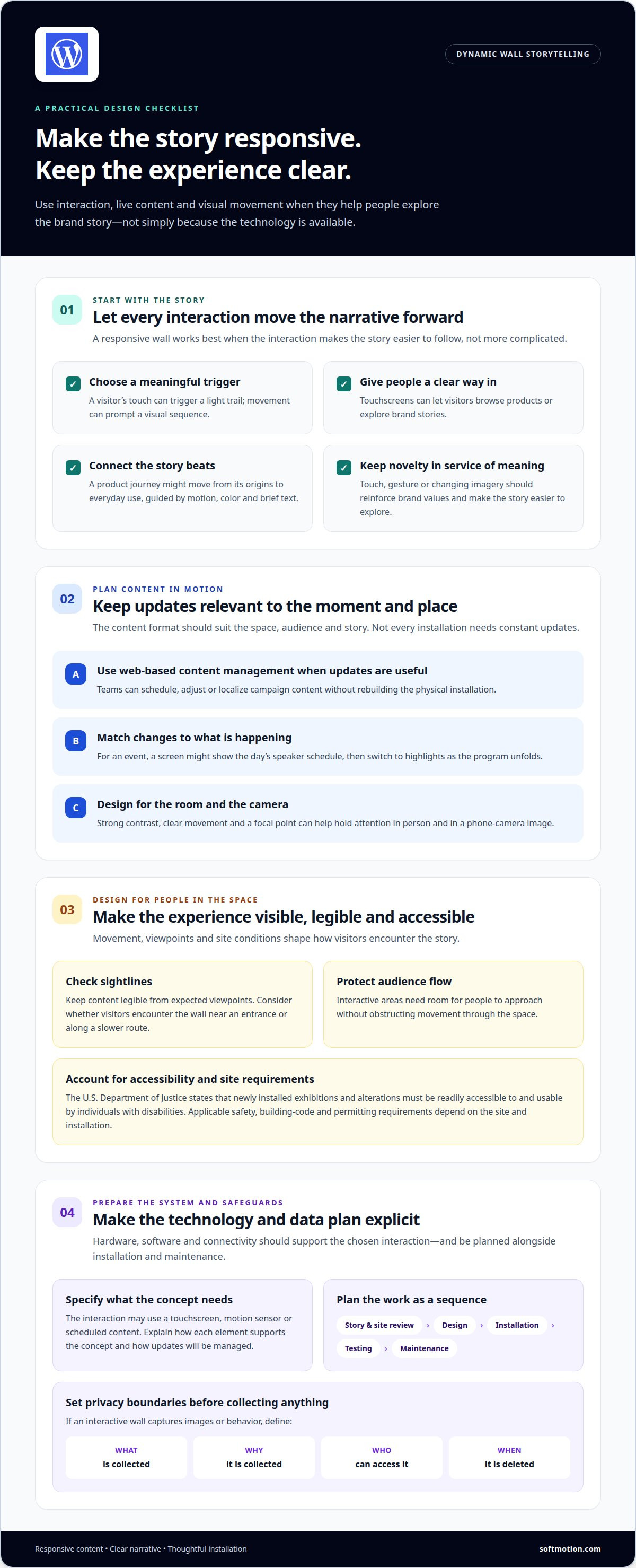
Real-time storytelling can turn a wall from a fixed backdrop into a responsive platform. A visitor’s touch might trigger a light trail, while movement could prompt a visual sequence. Touchscreens can also let people browse products or explore brand stories. Each interaction should advance a clear narrative, not distract from it.
Web-based content management can help teams schedule, adjust, or localize campaign content without rebuilding the physical installation. For example, an event team might update a screen with the day’s speaker schedule, then replace it with highlights as the program unfolds. The content format should suit the space, audience, and story.
Camera-ready visuals can make a wall compelling both in person and through a phone camera. Strong contrast, clear movement, and a focal point help hold attention in the room and in a shared image. Responsive artwork that changes as someone moves can create a memorable moment visitors may choose to record and share.
Engaging design connects brand values to a simple visual journey. A sequence might move from a product’s origins to its everyday use, using motion, color, and brief text to guide viewers. In an immersive brand experience, touch, gesture, or changing imagery should make the story easier to explore, not add complexity for its own sake.
Accessibility and site requirements belong in the planning process. The U.S. Department of Justice states that newly installed exhibitions and alterations must be readily accessible to and usable by individuals with disabilities. Applicable safety, building-code, and permitting requirements depend on the site and installation. The project team should account for them in the design and installation plan.
Hardware, software, and connectivity depend on the chosen interaction, such as a touchscreen, motion sensor, or scheduled content. The project team should explain how those elements support the concept and how updates will be managed. Planning typically moves from story and site review to design, installation, testing, and maintenance. Interactive walls can also raise privacy concerns if they capture images or behavior, so define what is collected, why, who can access it, and when it is deleted.
Audience engagement and measurable marketing outcomes
Responsive displays invite audiences to participate, while defined measures show how that engagement supports marketing goals. The strongest installations connect each interaction to a clear purpose.
Brand Innovation and Audience Perceptions
Brand innovation is the visible expression of a company’s willingness to rethink how it communicates. A responsive wall, for example, can react to visitors’ movement instead of repeating a fixed message. That difference can influence how customers perceive the brand: the experience feels participatory and modern. For marketers, the design should reflect genuine brand values, not novelty alone, so the interaction reinforces the intended impression.
Brand Visibility and Audience Engagement
Brand visibility creates opportunities for engagement by making a message easier to notice and approach. In a busy retail space, a prominent display can introduce a product story, while an interactive prompt can invite customers to explore a feature or campaign. Trackable actions, such as selections or interactions, help teams assess which content attracts attention. Visibility earns the moment; relevant content gives audiences a reason to stay.
Viewing Angles and Audience Flow
Viewing angles and audience flow determine when people encounter a display and what they can see. A wall near an entrance may reach passersby, while a display along a slower route can support deeper exploration. Content should remain legible from expected viewpoints, and interactive areas need room for people to approach without obstructing movement. Thoughtful placement helps engage visitors without disrupting how they use the space.
To measure outcomes, match each interaction to a campaign objective. A product exploration experience might track selections; an event wall might record participation or social sharing. Sensor-based analytics can offer insight into audience behavior and preferences, helping teams refine content, product placement, or campaign choices. Interpret those signals in context: interaction counts indicate activity, while the content viewed and the setting help explain its relevance.
For a lasting visual presence, consider how a responsive brand wall can bring the story into the space.
Differentiating brands through memorable experiences
A wall communicates a brand story effectively when imagery, movement, and spatial elements support one clear narrative. Le Cube and Funarea show how installations can make architecture part of the experience.
From Passive Advertising to Immersive Experiences
Immersive experiences shift advertising from a message people simply view to an environment they can explore. That matters when a brand wants visitors to connect with its story, not just notice its name. Le Cube, designed by MANA and Scott Oster for Le Bon Marché, enclosed a concave skate ramp within a reflective cube. Its physical form made the installation part of the experience.
Experiential Retail Environments
In experiential retail, dynamic walls integrate brand content with the architecture and movement of a store. This can help retailers make product stories part of the environment, rather than separate messages on a screen. Funarea, designed for Galeries Lafayette Paris Haussmann, was suspended 12 meters above the store. Its position transformed an overhead space into a visible feature of the shopping experience.
Memorable Brand Storytelling Experiences
A memorable installation gives the audience a clear narrative to follow through imagery, movement, and the arrangement of elements. For example, a brand can present its origins, product craft, and future vision as connected story beats across a physical space. The National Institute for Occupational Safety and Health (NIOSH) notes that stories can hold attention better than formal instruction and help people remember and apply information.
LED walls can also function as part of experiential architecture, shaping how people perceive and move through an environment. Integrating a display with surrounding surfaces, materials, and sightlines makes the story feel rooted in the space—much like how commercial workspace planners such as 3S Interior Design coordinate interior architecture and functional fixtures to establish cohesive brand environments. Le Cube illustrates this principle: its reflective enclosure and concave ramp created a distinctive setting, not simply a surface for advertising. This can make a brand narrative feel specific to its place.
Retailers can use video walls to showcase products, promotions, brand stories, product launches, advertisements, and customer testimonials.
Immersive content on LED walls can foster a deeper emotional connection with a brand.
Art walls can combine physical textures, interactive sensors, generative graphics, and architectural design rather than relying only on flat, pre-recorded video loops on standard screens. For interior environments where tactile finishes and spatial staging take center stage, design specialists like rawdesigns.au illustrate how curated materials and thoughtful layouts shape how people perceive and connect with a space.
Visual memory, motion, scale, and viewing angles
A wall’s visual impact depends on more than its screen or image. Motion, scale, and viewing angles shape how visitors experience the work in a physical space.
Motion in Wall Installations
Motion is the planned change in imagery that guides a viewer’s attention across a wall. A slow transition can reveal a product detail, while a sharper shift can create contrast between story moments. In anamorphic content, perspective-manipulated visuals create an illusion of depth on a flat screen. Movement should enhance the narrative, not compete with it.
Scale and Visual Impact
Scale describes how an installation relates to its surroundings and the people viewing it. Raytrace, a triangular passage at Ventura Centrale, measured 25 meters long and 6 meters high. That scale made the artwork part of the route itself, rather than a small image beside it. The takeaway: size works best when it supports the space’s purpose and visitors’ movement.
Viewing Angles
Viewing angles are the positions from which visitors see the intended image. An anamorphic illusion depends on a specific perspective, so designers consider sightlines, camera positions, and audience flow before developing content. If people approach from several directions, the visual may need to remain legible beyond one ideal viewpoint. Planning those angles early helps the physical experience and phone-camera image feel seamless.
Projection mapping offers another way to create depth by aligning digital imagery with physical objects. For example, projected graphics can follow an architectural surface or sculptural form, making the content appear integrated with its setting. Design decisions should account for the viewing position, surrounding structure, and intended image together. This alignment helps an installation feel coherent in person and memorable in photographs.
Anamorphic LED illusions are designed around specific viewing angles so that they can also work through a smartphone camera. Anamorphic LED walls should be incorporated into event concepts early, with viewing angles, audience flow, camera positions and spatial constraints informing content development. LED walls can display experiential content such as technical animation and 3D anamorphic illusions. Projection mapping integrated with LED walls aligns projected visuals with physical objects to create a sense of depth and dimensionality.
Softmotion: Architectural Lenticular Installations
Softmotion creates Architectural Lenticular Installations that transform static surfaces into motion-driven artworks, revealing changing images as visitors move through a space. This approach suits brand stories that benefit from shifting perspectives and visuals shaped by the viewer’s position.
For campaigns, Advertising Lenticular Displays and Tradeshow Lenticular Graphics bring motion-led visuals into brand environments. Fine Art Lenticular Prints offer another format for presenting imagery from changing viewpoints. The right direction depends on the space, the story, and how audiences will encounter the work.
If your project calls for a wall installation that makes movement part of the narrative, contact Softmotion to discuss your vision.
Shape the Next Chapter of Your Brand Story
Start by defining what visitors should understand, feel, or remember after encountering the installation. That intention can guide the visual direction, the role of movement, and how the work belongs in its setting. For teams exploring dynamic wall installations for brand storytelling, a focused creative brief helps turn an ambitious idea into a clear design conversation.
Softmotion creates Architectural Lenticular Installations, Advertising Lenticular Displays, and Fine Art Lenticular Prints. These formats offer different ways to bring shifting imagery into architectural, campaign, or artistic contexts. The right fit starts with the story you want to express and the space where audiences will experience it.
Bring your concept, setting, and priorities into the conversation. Contact Softmotion to discuss your installation and explore how a considered visual approach can give your brand story a distinctive presence.
Frequently Asked Questions
What are dynamic wall installations for brand storytelling?
These are large visual works that use changing imagery, movement, or viewer perspective to express a brand narrative in a physical space. Unlike a fixed poster, the image can shift as people move past it or interact with the installation. For example, an architectural wall might reveal different parts of a campaign message from different viewing positions, making the space itself part of the story.
What metrics can measure engagement and return on investment for branded wall installations?
Useful engagement measures include interaction counts, dwell time, content selections, and social shares, depending on the installation. For a retail launch, a team could compare product interactions with campaign outcomes tracked through its sales channels. To assess return on investment, connect attributable outcomes to the installation and campaign costs. Engagement indicates audience activity, but it does not by itself establish financial return.