
Dynamic Visual Installations: 2026 Practical Guide
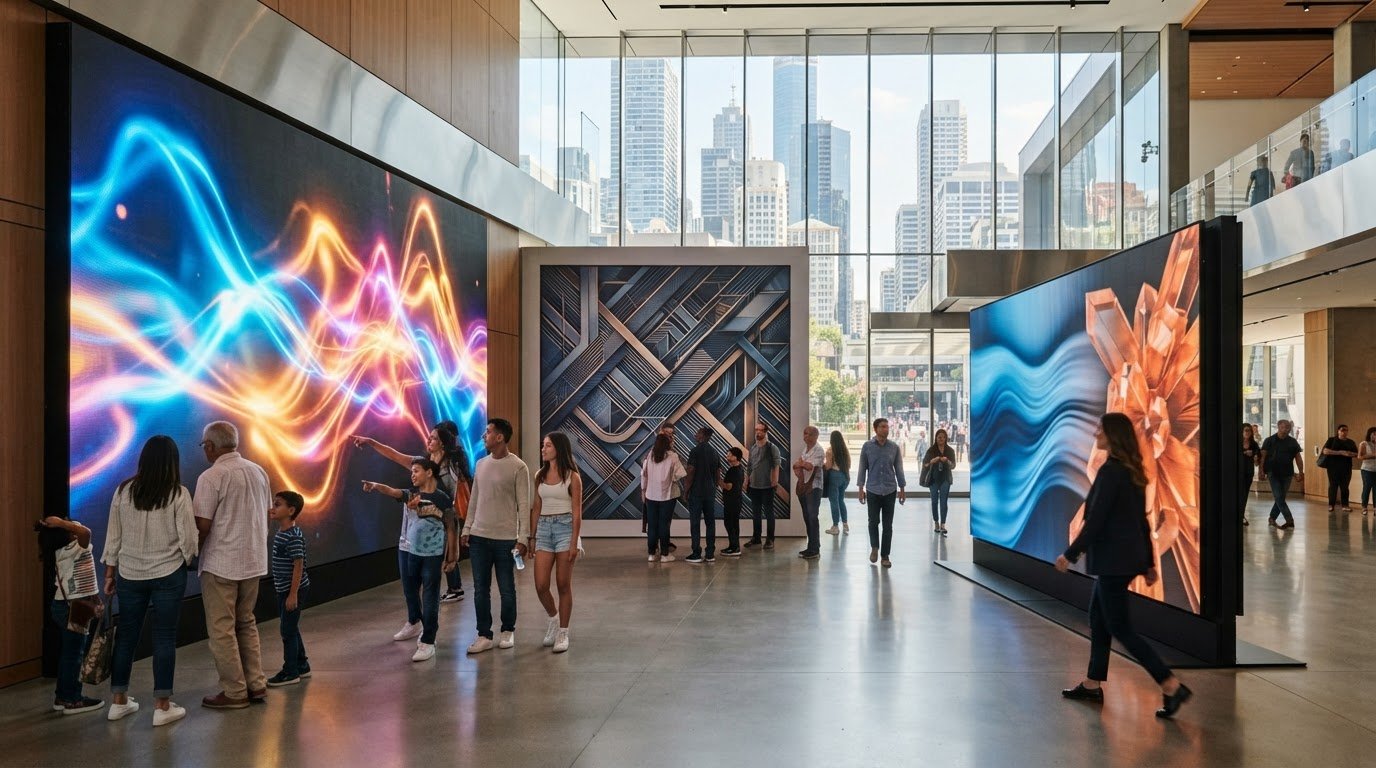
More motion doesn’t automatically make a space more memorable. The right choice among dynamic visual installations for spaces depends on how people move through the environment, what they come to do, and what the installation should help them feel. A screen, a fixed graphic, and a motion-driven physical artwork each shape the experience differently.
It’s easy to be drawn to a dramatic concept, then discover it doesn’t suit the audience, circulation, or physical conditions of the site. Start with those conditions, not novelty alone. The visual idea and the way it can be produced and integrated need to work together.
This guide compares screen-based displays, fixed graphics, and lenticular installations that shift as viewers move. You’ll learn how to assess each format against a space’s purpose, audience, and physical context, and which project details can make planning more productive. Since 1997, Softmotion has delivered more than 1,000 projects worldwide, bringing creative intent and production experience together to shape visual experiences for architectural, advertising, fine-art, tradeshow, and corporate settings.
Key Takeaways
- Understand how visual motion differs from physical movement, and how a shifting image can transform a space without moving components.
- Compare digital displays, environmental graphics, and lenticular installations by content changes, viewer experience, spatial integration, and project needs.
- Use a four-step framework to match dynamic visual installations for spaces to their purpose, audience, setting, and format.
- Assess viewing distance, circulation, sightlines, and dwell time to anticipate how people will encounter the installation.
- Align project details from brief through installation to connect creative intent with site conditions.
What dynamic visual installations for spaces can make possible
Dynamic visual installations for spaces shape how people perceive and experience an environment. Unlike an image displayed separately from its surroundings, a spatial installation is designed in relation to its place and audience. Its scale, placement, sequence, materials, or response to a viewer’s movement can make it part of the space’s visual language. It might draw attention, support a story, or give a setting a distinctive atmosphere.
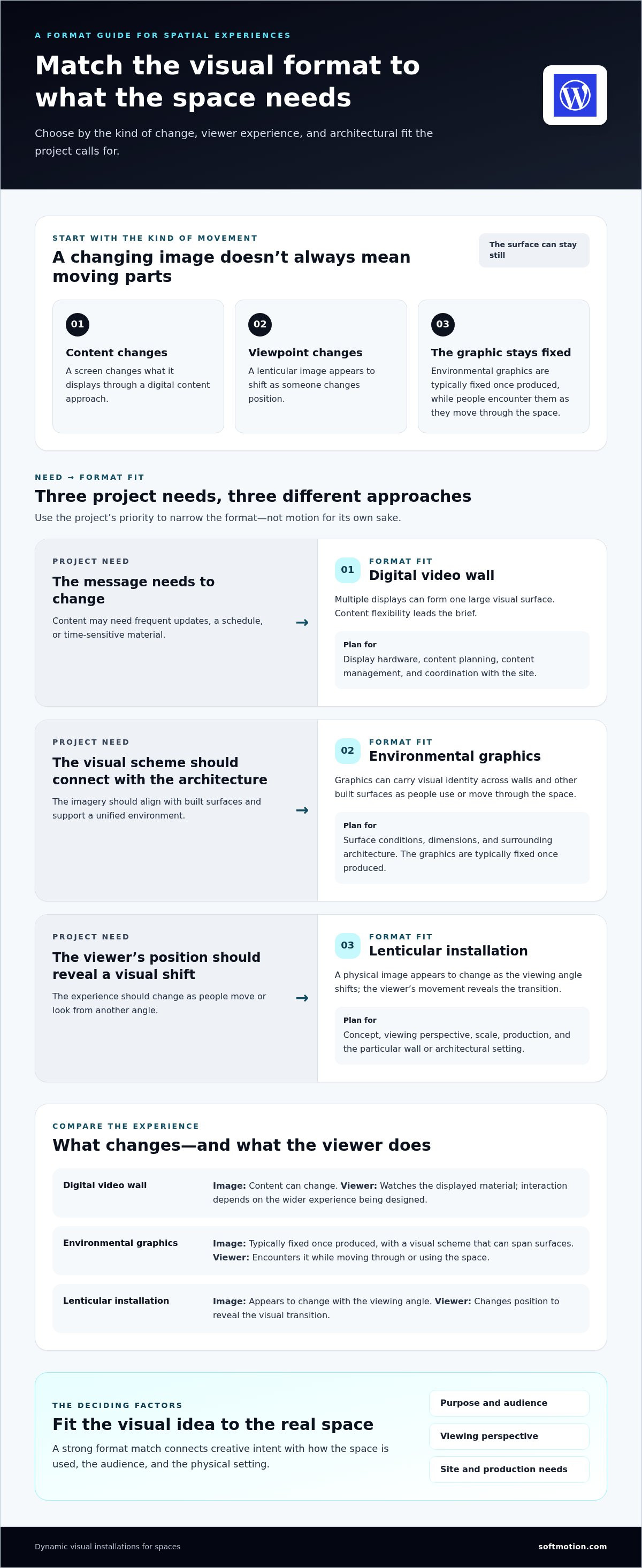
Dynamic doesn’t always mean that physical components move. A screen can change its content, while a lenticular image can appear to shift as someone changes position. In both cases, movement is visual: it comes from the image or from the viewer’s changing viewpoint. The broader idea of video installation also shows how moving images can be designed as part of an environment rather than viewed apart from it.
From a static surface to a changing visual experience
Sequence, changing imagery, scale, and perspective can all create a sense of movement. A lobby wall might reveal a transition as visitors pass. A retail display might shift between images when viewed from different angles. An exhibition piece might use a changing sequence to draw visitors into a subject. The surface can stay still while the experience changes.
This distinction helps clarify a project’s intent. A standalone screen is often treated as a display for content. A spatial installation is planned in relation to its surroundings: how it fits a wall, relates to architecture, and meets people along their route. The difference isn’t simply the format. It’s whether the visual work has a deliberate role in the experience of the place.
Where dynamic visual installations can add value
The meaning of “dynamic” depends on the setting and its audience. A corporate environment might use a visual feature to express identity or communicate a shared story. An architectural space may call for work that responds to its scale and materials. In retail, the aim might be a distinctive visual moment; in a cultural setting, deeper interpretation or an invitation to look more closely. For an event, an installation can establish atmosphere and create a focal point—versatile settings like The Atrium Venue illustrate how adaptable room layouts can be tailored to support impactful visual staging and guest engagement.
Different goals call for different kinds of movement and attention. Clarify what the space needs the visual experience to do:
- Identity: Express a place, organization, or brand through imagery that feels connected to its surroundings.
- Storytelling: Use a sequence or visual change to introduce an idea, exhibit, or narrative.
- Orientation: Help people notice a destination or understand where to focus within an environment.
- Engagement: Give people a reason to pause, look again, or view the work from another position, without assuming a specific measurable result.
Start with the people and purpose, not motion for its own sake. When the visual approach reflects how a space is used and what its audience should experience, the installation feels integrated rather than added on.
Compare digital displays, environmental graphics, and lenticular installations
Each format creates a different relationship between image, audience, and place. A digital video wall can present changing content across multiple displays. Environmental graphics can carry visual identity across built surfaces. Lenticular work offers a physical image that shifts with the viewer’s perspective. The right fit depends on whether the project prioritizes frequent updates, integration with the architecture, or a visual change experienced in person. The International Sign Association (ISA) covers the broader sign and visual communications field, where these approaches meet distinct design and production needs.
| Format | Content change | Viewer interaction | Spatial integration | General project considerations |
|---|---|---|---|---|
| Digital video wall | Content can change through a digital content approach. | Viewers watch the displayed material; interaction depends on the wider experience being designed. | Multiple displays form a large visual surface within the environment. | Requires display hardware, content planning, and coordination with the site. |
| Environmental graphics | Typically fixed once produced, though the visual scheme can span multiple surfaces. | People encounter the imagery as they move through or use the space. | Graphics can align with walls and other built surfaces to support a unified environment. | Design needs to account for surface conditions, dimensions, and surrounding architecture. |
| Lenticular installation | A physical image can appear to change as the viewing angle shifts. | The viewer’s movement and position reveal the visual transition. | The work can be developed in relation to a particular wall or architectural setting. | Concept, viewing perspective, scale, and production need to align. |
When screens are the right visual medium
Choose a screen-based approach when the message needs to change frequently, follow a schedule, or present time-sensitive material. A video wall can combine multiple displays into one large visual field, but content and hardware are essential parts of the project—as seen in mission-critical environments where organizations rely on systems from Activu Corporation to manage complex display networks. Plan how material will be created and managed alongside how the displays fit the site. A digital display is a strong fit when content flexibility leads the brief.
When printed or lenticular work fits the experience
Environmental graphics can connect identity and imagery directly to the surfaces people see as they enter, wait, or move through a setting. Lenticular work creates another kind of change: the image shifts with the viewer’s position, without moving components or refreshing digital content. For projects exploring this physical format, this guide to large-format lenticular printing offers a perspective on relating image, scale, and architecture.
Audience experience matters as much as medium. A person might pass a graphic while walking, pause to explore a changing image, or watch a screen from a distance. Softmotion develops lenticular visual experiences around creative intent and architectural context, connecting the desired effect with production and installation planning.
No format is universally best. Compare how often content needs to change, how viewers encounter the work, and how closely it should relate to the architecture. That balance points toward an approach suited to the space, rather than novelty alone.
How to evaluate an installation for your space and audience
A strong visual concept starts with the conditions it must serve. Before choosing a format, clarify what the installation should do, who will encounter it, and how the site shapes that encounter. This helps distinguish a changing message that may need regular updates from a lasting visual identity intended to belong to the environment.
Audience movement should inform installation design: where people approach, pass, pause, and look determines how the work is seen.
Start with the space’s purpose and audience
Identify who will encounter the work and the route they are likely to take. Note where people first see it, whether they approach from one direction or several, and whether they pass quickly or have reason to stay. A corridor and a gallery may share a wall, but they call for different visual rhythms: one is experienced in motion, while the other may invite sustained attention.
Next, name the primary purpose. A welcome, an orientation cue, a brand story, and an artistic statement each call for a different emphasis. If several goals matter, decide which leads and which support it. This keeps the creative brief from becoming a collection of competing objectives.
Match visual behavior to site conditions
Document the physical setting before settling on a format. Include surface dimensions, likely viewing angles, ambient light, surrounding architecture, access for installation, and maintenance expectations. These details connect the intended visual effect with what the site can accommodate. If a concept depends on a particular vantage point, compare it with actual sightlines rather than an assumed ideal view.
Record site constraints in the creative brief. Photos, plans, and notes about circulation help the design and production teams work from the same information. Keep the format open until the site is understood. A useful brief explains what the work should express and where practical adjustments may be needed.
A four-step framework for choosing a direction
- Define the purpose. State the installation’s main role, such as welcoming visitors, orienting them, telling a story, or creating an artistic experience. Clarify whether content must change or the visual identity should endure.
- Map the audience. Describe who uses the space, where they approach from, how long they may spend there, and whether they tend to move through or gather.
- Assess the setting. Record dimensions, surfaces, sightlines, viewing distance, light, circulation routes, installation access, and ongoing care expectations.
- Compare formats. Weigh each format’s visual behavior against the audience and site conditions. Select an approach that supports the purpose without working against how people use the space.
This process gives project planning a practical foundation. For dynamic visual installations for spaces, the most effective direction aligns the intended experience with how people actually use the environment.
From creative brief to installed visual experience
A compelling concept becomes a successful physical installation through a clear sequence of decisions. Align the creative objective with the site, develop the visual direction, review samples, plan production, and coordinate installation. Each stage gives the team a chance to resolve questions while the work is taking shape, rather than leaving key details until the site is ready.
Early alignment matters for dynamic visual installations for spaces. An effect may look convincing in a concept image but behave differently at the intended scale or from the audience’s actual viewpoint. Samples and prototypes offer a practical way to discuss transitions, composition, and viewing experience before full-scale production. Explore custom lenticular prototypes to see how prototyping can support large-format planning.
Build a brief that connects vision and practical needs
A useful brief describes both the desired experience and the conditions the work must fit. Include the audience, site, visual message, intended dimensions, and how people are expected to view the installation. Share architectural drawings and reference images when available, along with known installation constraints. These details help creative and production teams work toward one outcome, connecting artistic intent with the physical context.
Be specific about what the work should communicate. A brief might aim to welcome visitors, express an identity, or create a visual transition experienced from a particular approach. Separate essential requirements from open creative questions. That clarity gives the team room to develop the idea while keeping decisions anchored to the project’s purpose.
Use samples and planning to prepare for installation
Samples turn an abstract description into something people can see and discuss. For lenticular work, a sample can show how imagery changes with viewpoint and whether the visual direction supports the intended experience. Use it to refine the concept before full-scale production, while continuing to consider how the finished work will relate to the site.
Planning connects the approved direction to production and on-site assembly. Coordinate the artwork and production approach with site access, installation conditions, and the practical steps needed to bring the work into place. Drawings and site information can surface constraints early, while clear communication keeps design decisions connected to execution.
Softmotion’s project work can span samples, prototyping, production, and on-site assembly, bringing creative intent and site conditions into the same conversation. Learn more about Softmotion’s lenticular installation work.
Bring dynamic visual installations for spaces to life with Softmotion
Some environments call for visual movement without making the experience screen-led. Lenticular and agamograph work can create a physical, motion-driven feature, using imagery that shifts as people view it from different positions. In an architectural space, this brings change into the built environment while making the artwork part of the place itself.
Softmotion develops custom lenticular projects by bringing creative direction and production considerations into the same conversation. Founded in 1997, the company has delivered more than 1,000 projects worldwide. Its work spans architectural, advertising, fine-art, tradeshow, and corporate environments, serving architects, advertisers, artists, and Fortune 500 corporations.
A specialist partner for large-scale visual work
A large-scale visual idea needs to hold together beyond the initial concept. Imagery, viewing experience, architectural context, and production approach all inform one another. Softmotion’s project work can progress from samples and prototyping through production and on-site assembly, connecting creative intent with the physical realization of the work.
Projects often involve several perspectives. Architects bring knowledge of the site; artists and advertisers bring the visual idea; production planning focuses on how that idea can be made and installed. Aligning these considerations early keeps the design conversation grounded without narrowing its creative potential.
Softmotion’s work spans varied contexts, from architectural settings and corporate environments to fine-art displays, advertising, and tradeshows. Each has its own audience and purpose. The visual direction can be developed around those needs rather than imposed as a one-size-fits-all treatment.
Define the next step for your project
A productive first conversation doesn’t require a finished design. Gather the essentials that can clarify the opportunity:
- Space: Describe the environment and share available drawings, dimensions, or site information.
- Purpose: Explain what the installation should express or contribute to the experience.
- Audience: Note who will encounter the work and how they move through the space.
- Visual references: Gather images, sketches, or examples that suggest the atmosphere or motion you have in mind.
These details frame the project around creative intent, site context, and production needs. They also give the team a shared basis for exploring how a lenticular or agamograph approach could serve the intended experience.
If you’re considering dynamic visual installations for spaces, discuss your visual installation project with Softmotion. Share your setting, audience, and visual direction to begin shaping an idea around the space it’s meant to transform.
Shape the next visual experience in your space
A project can begin with a simple question: what should people carry with them after they encounter this place? The answer can guide the scale, mood, and character of a visual idea before it becomes a finished design. Imagine the moment you want to create, whether it’s a sense of arrival, curiosity, connection, or reflection. That intention gives the creative conversation a meaningful starting point.
For dynamic visual installations for spaces, the opportunity is to make the visual experience specific to its setting and the people who use it. A reference image, sketch, or a few notes about the atmosphere you want to evoke can help turn an early thought into a direction worth exploring.
Bring Softmotion your initial idea, along with what you know about the space and its audience. Explore your visual installation concept and start shaping a work around the place it will inhabit.
Frequently Asked Questions
What is a dynamic visual installation for a space?
It’s a visual work designed to shape how a physical environment is experienced, rather than simply display an image. Dynamic visual installations for spaces can use digital content, integrated graphics, or imagery that appears to shift with a viewer’s position. A feature in a reception area might create a sense of arrival, while an exhibition installation could invite visitors to view a subject from more than one angle.
Are dynamic visual installations always digital?
No. Digital screens are one possible medium, but a visual experience can also use physical printed work. Lenticular imagery can appear to change as a person moves, while environmental graphics can give a fixed surface a strong visual identity. Consider whether the project needs to update its message, present a perspective-responsive image, or establish a consistent visual character. That distinction helps narrow the format before design begins.
How do I choose between a video wall and a lenticular installation?
Choose based on how the image needs to behave. A video wall suits content that changes over time, such as announcements or rotating campaign material. Lenticular work creates a visual shift through the viewer’s changing perspective, so the experience depends on where someone stands or walks. Ask whether the image should update on its own or change as the viewer moves.
Can lenticular installations be designed for architectural spaces?
Yes. Softmotion develops custom lenticular projects for architectural and corporate settings, considering the visual concept alongside the site and intended viewing experience. A project can move from samples and prototyping through production and on-site assembly. To start planning, identify the wall or area and how people encounter it. That context helps shape a direction that relates to the architecture rather than treating the artwork as a separate surface.
What information should I prepare before planning a visual installation?
Prepare a short project brief that identifies the space, the main purpose, and the people who will see the work. Add a plan or dimensions if available, then mark likely approach routes and important viewpoints. Include reference images to communicate mood or subject matter, and note whether the message should stay consistent or change over time. These details help turn an initial idea into a focused design discussion.
How does a lenticular visual change as people move around it?
Lenticular imagery is designed so the visible image can shift as the viewer changes position. The transition may suggest motion, reveal another image, or create a sense of transformation across the surface. To assess the effect for a particular space, consider the route people naturally take and the angles from which they’ll encounter the work. The concept should make sense from the viewpoints the audience is likely to experience, not just from one ideal position.