
Custom Lenticular Art: A Practical Commissioning Guide
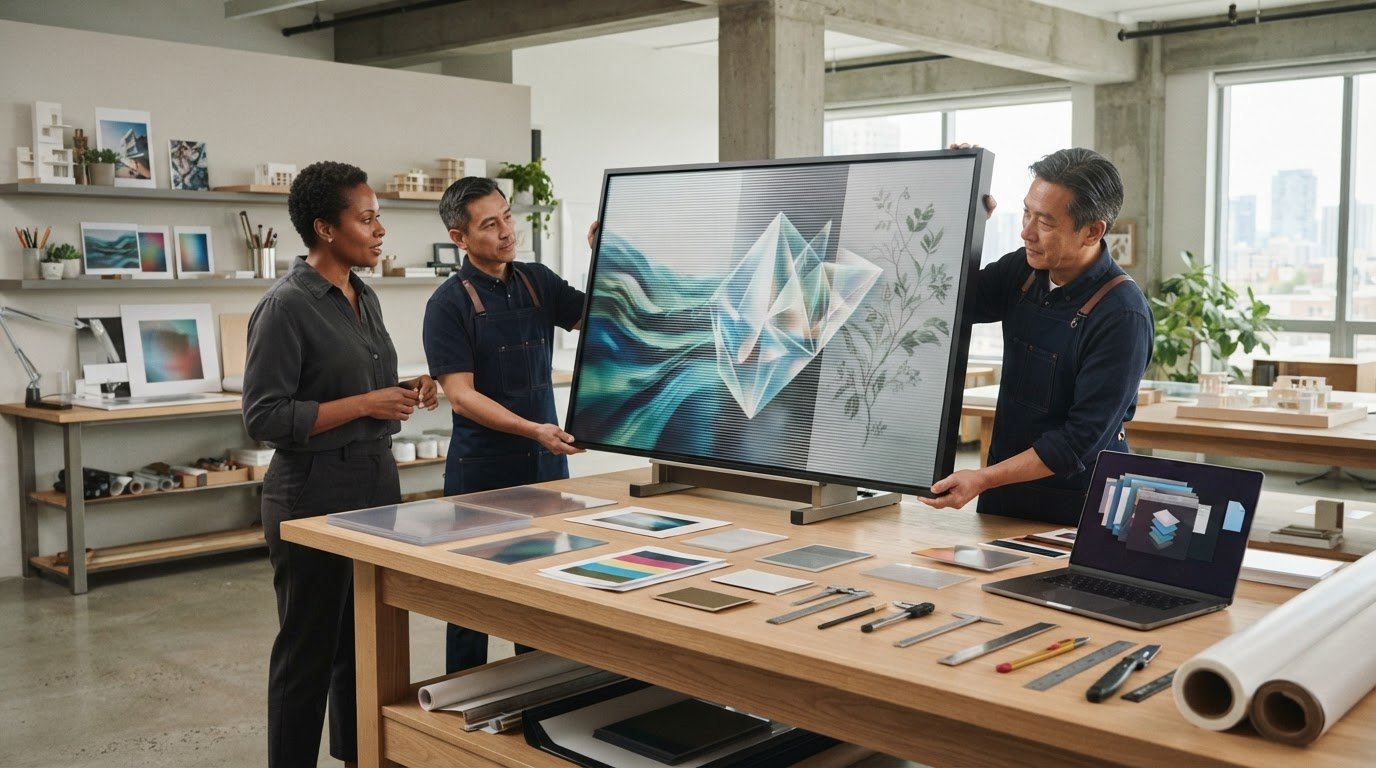
The best custom lenticular art for artists may be the work that moves least. A subtle shift in viewpoint can reveal a detail or deepen an image, while a dramatic change may distract from the idea. The effect should serve the artwork, not compete with it.
It’s natural to wonder whether a concept will translate, what files a fabricator needs, and how to choose a production partner. Lenticular work brings creative decisions and technical precision together, but you don’t have to resolve every production detail on your own.
This guide will help you shape an artistic concept into a production-ready work and discuss it confidently with a specialist. You’ll learn how to choose an effect that fits your intention, prepare a useful brief, review samples or prototypes, and compare fabrication approaches. A clear process can carry an idea from initial concept toward a finished work while keeping its purpose in view.
Key Takeaways
- Choose a lenticular effect by starting with the viewer experience you want, not motion for its own sake.
- Turn your concept into a production conversation by identifying the visual states or layers the work should reveal.
- Compare custom lenticular art for artists by creative purpose, viewing conditions, and the fabricator’s approach to samples and production.
- Before approval, confirm the artwork versions, dimensions, viewing context, and who will prepare or approve production files.
- Bring a clear concept and practical questions to a specialist to explore a path from idea toward fabrication.
What Makes Custom Lenticular Art Right for an Artist’s Concept?
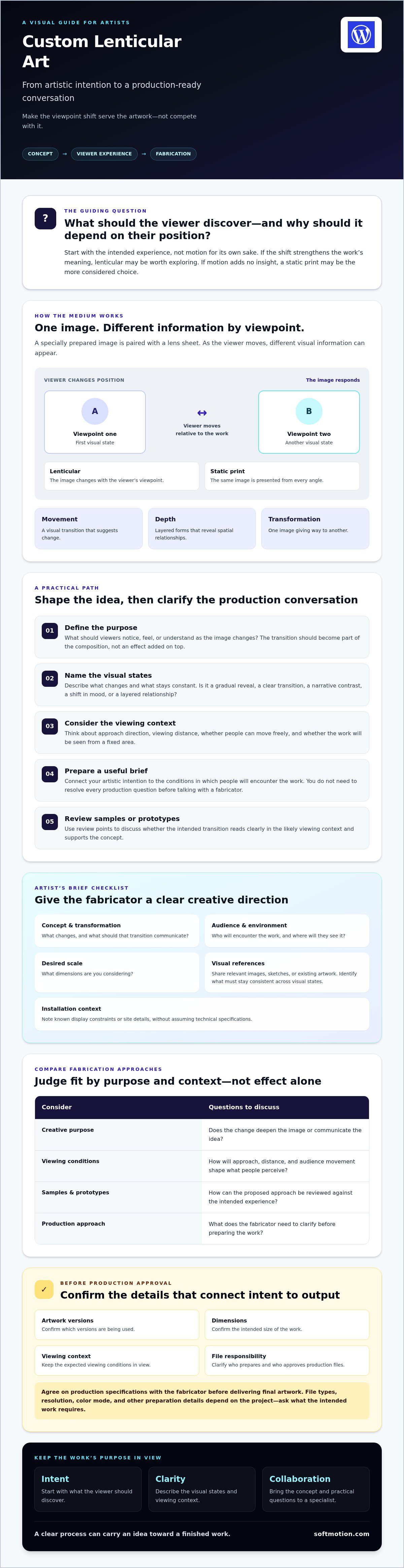
A lenticular image changes as the viewer moves. A specially prepared image is paired with a lens sheet, allowing different visual information to appear from different angles. The result can suggest movement, reveal depth, or transform one image into another. Lenticular printing offers a broader overview of the process and the visual effects it can produce.
In brief: Lenticular artwork changes with the viewer’s viewpoint; a static print presents the same image from every angle.
The shift is most compelling when it carries meaning. A portrait might gradually give way to another expression, a landscape could open into a second scene, or layered forms might reveal a different relationship as the viewer moves. In each case, the transition becomes part of the composition rather than an effect added on top.
For custom lenticular art for artists, the key question is not simply, “How can this move?” Ask, “What should the viewer discover, and why should that discovery depend on their position?” If the answer strengthens the work’s meaning, the medium may be worth exploring. If motion adds no insight, a static print may be the more considered choice.
Which artistic ideas translate well into lenticular imagery?
Look for ideas built around transformation, contrast, layered meaning, or distinct states. A work about memory might shift between a present-day image and a trace of the past. An abstract composition might reveal a second arrangement within the first. These are creative starting points, not guarantees. Suitability depends on the artwork, the intended effect, and the conditions in which people will see it.
Describe what should change and what should stay constant. Should a detail emerge gradually, or should the image make a clear transition? Should viewers notice a narrative contrast, a spatial relationship, or a change in mood? Clear answers help you and a fabrication partner assess whether the idea can become a legible visual sequence.
How does viewing position shape the experience?
The viewing path affects how people perceive the transition. An artwork approached head-on may create a different encounter from one viewed while walking past. Consider the direction people will approach from, their viewing distance, and whether they can move freely or will see the work from a fixed area. These details help determine whether a subtle reveal or a more pronounced change better serves the piece.
Think of the audience’s movement as part of the composition. A transition that reads clearly in one setting may be less apparent in another, so discuss the likely viewing context early. For broader fine-art context, explore the fine-art lenticular prints guide.
How Should Artists Develop and Prepare a Custom Lenticular Artwork?
Start with the experience, not the file format. Describe what you want viewers to notice, feel, or understand as the image changes. Then identify the visual states that create that experience. A portrait might shift from a composed expression to a more vulnerable one; an abstract work might reveal a second arrangement beneath the first. For a dimensional effect, discuss which elements should read as separate layers. These choices give a fabrication partner a clear creative direction before you get into production details.
What belongs in an artist’s lenticular project brief?
A useful brief connects the artistic idea to the conditions in which the work will be seen. Include:
- Concept and transformation: What changes, and what should the transition communicate?
- Audience and viewing environment: Who will encounter the work, and where?
- Desired scale: What dimensions are you considering?
- Visual references: Share relevant images, sketches, or existing artwork. Identify the elements that must stay consistent across visual states.
- Installation context: Note any known display constraints or site details, without assuming technical specifications.
Your brief doesn’t need to resolve every production question. It should make your intention clear and help the fabricator identify what needs clarification. With custom lenticular art for artists, that shared understanding supports a focused discussion about how to prepare the concept for fabrication.
Agree on production specifications with the fabricator before delivering final artwork, so file preparation matches the requirements of the intended work. Ask which file types, resolution, color mode, and other preparation details your project needs. Requirements can vary, so don’t rely on generic settings or assume files prepared for another print process will be suitable.
When should artists review samples or prototypes?
Consider a sample or prototype when you need to assess the visual experience before moving toward a larger work. Decide what you want to evaluate: whether the transition reads clearly, whether the visual states feel cohesive, or whether the overall impression matches your intent. A focused review is more useful than asking only, “Does it work?” A prototype can help test a direction, but it doesn’t replace confirming the requirements for the final project.
Guidance on custom lenticular prototypes offers another perspective on evaluating work before scaling, though each project has its own needs. To discuss your concept, intended viewing experience, and project requirements with a lenticular production specialist, bring your brief and reference materials to the conversation.
How Can Artists Compare Lenticular Effects and Fabrication Partners?
Compare effects by asking what each contributes to the artwork, how it will read in the intended setting, and what the production process requires. A flip can make a contrast immediate; a depth effect can give layered imagery spatial presence; an animation can unfold a sequence. None is automatically the best choice. The right option depends on the work’s purpose and the experience you want viewers to have.
Use this table to guide a conversation with potential fabrication partners. Treat each effect as a creative direction to explore, not a promise that every concept or specification will be feasible.
| Effect | Creative use | Questions to ask | Project-specific considerations |
|---|---|---|---|
| Flip | Reveal a clear change or contrast between visual states. | How can the transition read clearly without weakening either image? | Consider how distinct the states are and where viewers will encounter the work. |
| Depth | Give a composition layered presence or a sense of space. | Which elements need to separate, and what artwork preparation is required? | Discuss the source imagery and whether the intended viewing context supports the effect. |
| Animation | Unfold a sequence or create a sense of movement across viewpoints. | How many visual moments suit the idea, and how will the transition be reviewed? | Clarify the sequence, viewing path, and practical production requirements. |
Which questions reveal whether a fabricator fits the project?
Look for a partner who can discuss the artistic intention alongside the technical requirements. Ask about experience with fine-art commissions and whether samples, prototypes, or project coordination may suit your work. Then clarify how feedback and decisions are handled: What will you review, when is your approval needed, and who prepares or confirms the final files? Specific answers help you judge whether the collaboration fits your needs.
Before settling on an effect, ask the production partner to confirm which process and specifications are feasible for your artwork. A strong creative direction still needs to align with the source material, intended scale, and viewing conditions. With custom lenticular art for artists, this discussion can help preserve the idea while making production requirements clear early.
How should artists judge samples and portfolio examples?
Review examples for relevant effects and comparable contexts, not just visual appeal. A sample showing a transition can help you assess how it reads, but ask what it represents and what may differ in your final work, such as scale, artwork, or viewing environment. Use samples to guide decisions, not as a guarantee that a different project will look identical.
What Should Artists Confirm Before Approving Lenticular Production?
Before approving production, make sure the artistic intention and production plan still align. Confirm the effect, source artwork, dimensions, viewing context, and who is responsible for preparing and approving final files. Ask the fabricator to document requirements for your specific project rather than relying on assumptions about materials, technical specifications, pricing, or turnaround.
What project details should be settled before production?
Agree on the work’s purpose and visual priorities first. If one element must stay consistent while another changes, state that clearly. Then confirm which artwork versions are approved, what dimensions are under consideration, and where and how the piece will be displayed. Identify open decisions and name who has authority to approve them on the artist’s side and the production side.
Use this checklist as a final conversation guide:
- Artwork: Are the approved source files and versions clearly identified?
- Effect: Does everyone understand the intended visual transition or depth effect?
- Dimensions and context: Are the intended scale, viewing conditions, and known display constraints recorded?
- Responsibilities: Who prepares, checks, and approves the final files?
- Scope and reviews: What does any sample or prototype represent, and when will feedback or approval be needed?
- Installation assumptions: If installation is relevant, what site details or responsibilities need to be confirmed?
Ask the fabricator to put project-specific requirements, scope, review stages, and assumptions in writing. A shared record helps both parties spot unanswered questions before production begins.
How can artists protect creative intent during production?
Separate non-negotiable visual details from areas where adaptation is acceptable. You may need a particular expression, shape, or relationship between layers to remain intact, while allowing flexibility in how secondary elements are prepared. Share these priorities before review begins. Then use agreed review points to assess whether the developing work still serves the concept, not just whether a technical step is complete.
For larger pieces, scale can bring additional fabrication questions. Large format lenticular printing guidance can help frame those discussions, while the fabricator confirms what applies to your specific project.
Clear approvals support custom lenticular art for artists by keeping creative decisions visible throughout production. To discuss your project scope, viewing context, and production questions, contact Softmotion about fine-art lenticular prints.
How Can Artists Commission Custom Lenticular Art with Softmotion?
Once you’ve defined the visual intention and the production questions that matter, the next step is a focused conversation with a specialist. Softmotion works with artists on custom fine-art lenticular prints, connecting creative direction with production considerations. Founded in 1997, the company reports having completed more than 1,000 projects worldwide. Each commission has its own needs, so confirm the proposed process and scope for your work.
What can artists bring to an initial project conversation?
You don’t need to arrive with every technical decision made. Start with a concise brief that explains the concept, the change or depth you hope viewers will experience, and what should remain visually consistent. Add reference images or sketches, an approximate scale, and a description of where the work may be displayed. If the location or viewing conditions are undecided, mention that too.
Describe the experience before proposing a production solution. For example, explain whether viewers should notice a gradual reveal or a distinct shift between images. This gives the conversation a creative anchor. From there, you can discuss project needs with Softmotion, including custom design and production, whether samples may help assess a visual direction, and what project coordination could involve. Options depend on the particular work, so confirm what is appropriate for your project.
How can a specialist partner help carry an artwork forward?
A specialist partner can connect artistic goals to fabrication considerations, clarify which files or decisions are needed, and identify where a sample or prototype could inform the next step. This makes technical questions part of the creative dialogue instead of leaving them until the artwork is considered final. Ask how the proposed process fits your concept, which decisions you’ll need to make, and what requirements should be documented.
Keep the conversation collaborative and specific. Share what the piece must preserve, where flexibility is possible, and what remains unresolved. Softmotion can discuss a project from concept toward fabrication, but confirm scope, requirements, and any sample or project-coordination details directly. Don’t assume a fixed process, timeline, material, or outcome.
For artists considering custom lenticular art for artists, a clear first conversation can turn an ambitious visual idea into a practical discussion without diminishing its intent. If you’re ready to share a concept, intended viewing experience, and approximate project needs, explore a custom lenticular art project with Softmotion.
Bring Your Lenticular Concept into Focus
Successful custom lenticular art for artists starts with the viewing experience. Choose an effect that carries the work’s meaning, then shape the brief and production discussion around that intent. Clear artwork versions, viewing conditions, dimensions, and approval responsibilities help keep creative priorities visible as the project develops.
A specialist partner can connect those artistic decisions with fabrication considerations. Founded in 1997, Softmotion reports more than 1,000 completed projects worldwide. Its work with artists can include custom design and production, samples, and installation project management, with details confirmed for each project.
You don’t need every technical answer before you begin. Bring your concept, references, approximate scale, and a sense of how you want viewers to encounter the work. Discuss your custom lenticular art project with Softmotion and explore the questions that can guide it from idea toward fabrication.
Frequently Asked Questions
Is custom lenticular art suitable for every kind of artwork?
Suitability depends on the concept and whether a shift in perspective, depth, or visual state strengthens the work. A portrait with two meaningful expressions may benefit from a change, while a composition whose impact relies on stillness may not need one. Consider the specific image, intended effect, and display context. Before adapting finished artwork, discuss the viewer experience you want with a lenticular specialist.
How do artists prepare images for lenticular printing?
Image preparation depends on the intended effect and the project’s production requirements. Share source files and visual references early, then ask the fabricator to confirm the required file format, resolution, color setup, and any other specifications. Don’t assume files prepared for an ordinary print automatically meet lenticular production needs. Confirm requirements before finalizing or delivering artwork so the preparation supports the intended result.
Can an existing artwork be turned into a lenticular print?
An existing artwork may provide a starting point, but adaptation depends on its composition and the intended visual transition. You and the fabricator should identify which elements may change and which must stay consistent. Then discuss whether the source image is suitable as provided or whether additional imagery or design work may be needed. Not every existing work can be adapted without revision, so assess the specific piece before proceeding.
What should artists ask a lenticular art fabricator before commissioning?
Ask about relevant fine-art experience, sample or prototype options, file requirements, review stages, project scope, and coordination. Describe where and how the work will be viewed, then ask how its creative priorities will inform production decisions. Clarify who prepares and approves final files and which decisions remain open. Request written confirmation of project-specific details rather than relying on generic assumptions or unverified technical specifications.
Are samples useful before commissioning a larger lenticular artwork?
A sample can help you assess a proposed effect or visual direction before proceeding, depending on the project and what the sample represents. Before requesting one, agree with the fabricator on the questions it should answer, such as whether a transition reads as intended. Ask what may differ between the sample and a larger final work. Treat it as an evaluation aid, not a guarantee of an identical result.
How much does custom lenticular art cost?
Project scope and requirements shape the work involved, so request a proposal based on your concept. Discuss factors such as design needs, scale, sampling, fabrication, and any installation coordination relevant to the project. Share a concise brief and ask which assumptions and project elements the proposal includes. General price estimates may not reflect the needs or scope of your artwork.
How long does a custom lenticular art project take?
Timing depends on the project scope, development needs, review stages, production, and any installation coordination. After sharing your requirements, ask the fabricator for a schedule specific to your project rather than assuming a standard timeline. Discuss who needs to make decisions, whether files are ready, and how approvals will be handled. These details help clarify the sequence and identify factors that could affect the schedule.