
Custom Agamograph Production: From Concept to a Dynamic Visual Experience

What if an artwork changed not because it moved, but because your audience did? That shift in viewpoint is central to custom agamograph production: the visual experience is designed around how people approach, pass, and view the piece. A compelling result begins before fabrication, with the artwork, viewing path, and setting considered together.
If you’re unsure how an agamograph changes as viewers move, or how to turn an initial idea into a production-ready brief, you’re not alone. A traditional agamograph uses image strips arranged in a folded structure, while lenticular printing uses a lens sheet to reveal changing images or effects from different angles. Both approaches can transform a flat image into an experience that unfolds with the viewer, but the construction and design decisions differ.
This article explains how viewpoint shapes the design, how to choose an approach for your artwork and audience, and what project details help carry an idea through sampling, prototyping, production, and installation. Softmotion has delivered more than 1,000 projects worldwide since 1997, bringing creative and technical thinking together to develop visual projects for architectural, advertising, fine-art, tradeshow, and corporate environments.
Key Takeaways
- Design the image sequence around the viewpoints and movement you want the audience to experience.
- In custom agamograph production, a clear brief aligns the artwork, viewing path, site, and project goals before fabrication.
- Agamographs and lenticular prints can both reveal changing visuals, but their construction approaches differ.
- Use samples and prototypes to assess how the visual concept works before moving to full-scale production.
- Plan the installation context alongside the artwork so the finished piece feels purposeful in its environment.
What Is Custom Agamograph Production, and How Does the Image Change?
An agamograph is a viewpoint-dependent artwork that reveals different images as the viewer changes position. The effect is physical, not electronic: the artwork stays still while the audience supplies the movement. Put simply, an agamograph is a visual composition designed to change what it shows as a viewer’s perspective shifts.
The name is associated with Israeli artist Yaacov Agam, inventor of the Agamograph, whose work helped popularize art that unfolds through changing viewpoints. In custom agamograph production, the first design decisions are what the viewer should see and where they should see it from. Those choices guide the production method. The finished piece is the experience; design and fabrication are the careful work that make it possible.
How changing viewpoints reveal different images
Imagine two pictures arranged like alternating pages in a partly opened book. From one side, one picture comes forward; shift your position, and the other becomes more visible. Depending on the construction, image sections may be interleaved and presented across angled or shaped surfaces. The method can vary, but the principle is consistent: image placement must work with the angles from which people will encounter the artwork.
That makes the intended viewing path part of the composition. A piece viewed while someone walks past may reveal a gradual transition. A work approached from distinct positions may create a more noticeable change between images. Direction, distance, and pace all affect how the transition is perceived. Design for the actual setting, not just for a straight-on view of the artwork.
Where custom agamographs create visual impact
A changing image gives a static surface a new role: it invites people to move, pause, and look again. In an architectural setting, a viewpoint-dependent feature can respond to the path through a lobby or corridor. Advertising can use a shift in imagery to reveal another part of a message. In fine-art, tradeshow, or corporate environments, the transition can shape how visitors encounter a visual story or brand presence.
Each setting calls for a different relationship between the images and the audience’s movement. A tradeshow visitor may approach from several directions, while a fine-art viewer might spend time comparing two views. A corporate installation may need to read clearly from a common route through the space.
Before fabrication, make sure the artwork and viewing experience support each other. One image might introduce a subject, while another offers a complementary scene, detail, or message. A useful brief describes what changes, where viewers are likely to stand or walk, and what the transition should feel like. These decisions give the production team a clear foundation for developing the physical work.
How Custom Agamograph Production Moves from Concept to Fabrication
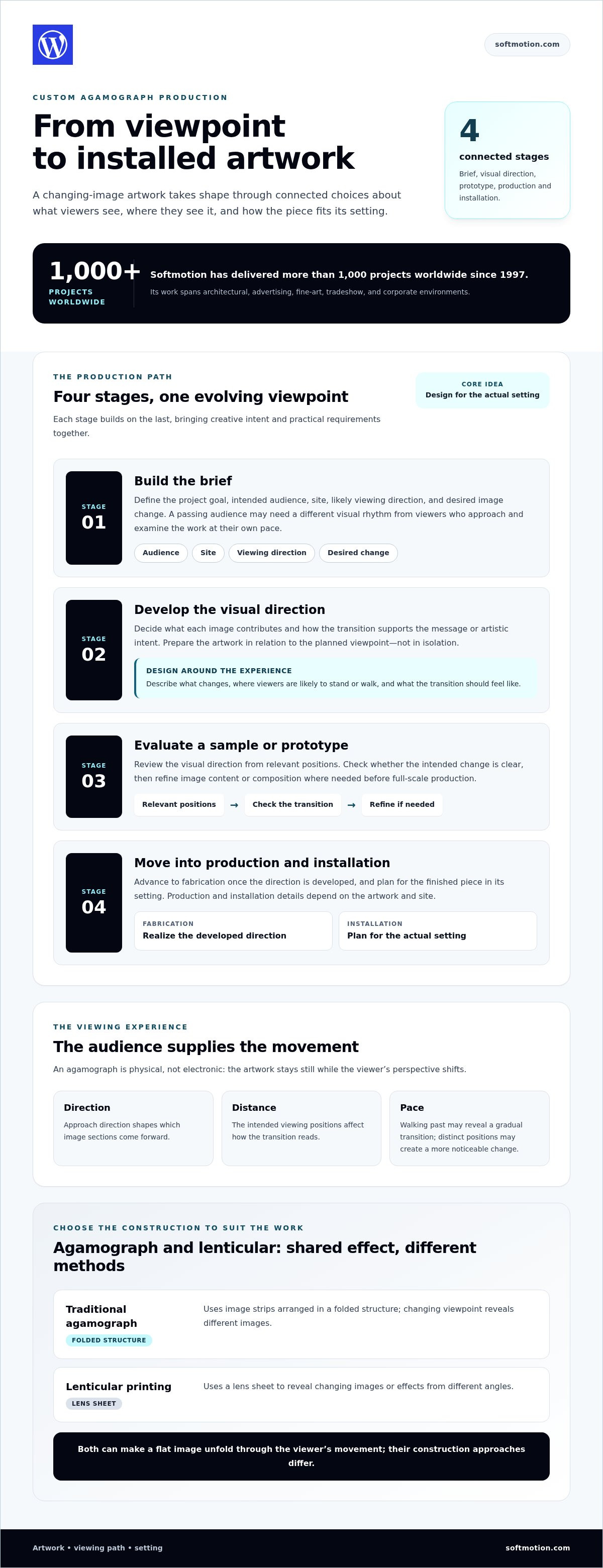
A successful piece takes shape through a series of connected decisions, not a single leap from artwork to fabrication. In custom agamograph production, image content and the way people will encounter it guide early design choices. The project brief sets the direction; design development, sampling, and prototyping help refine it before full production and installation.
The process moves from defining the audience and viewing experience to developing the artwork, evaluating samples, refining the design, fabricating the piece, and preparing it for installation. Each stage builds on the last, bringing creative intent and practical requirements together.
- Build the brief. Define the project goal, intended audience, site, likely viewing direction, and desired image change. A piece for a passing audience may need a different visual rhythm from one viewers approach and examine at their own pace.
- Develop the visual direction. Decide what each image contributes and how the transition supports the message or artistic intent. Prepare the artwork in relation to the planned viewpoint instead of designing it in isolation and adapting it later.
- Evaluate a sample or prototype. Review how the visual direction reads from relevant positions and whether the intended change is clear. Early evaluation can reveal where the image content or composition needs refinement.
- Move into production and installation. Once the direction is developed, advance through fabrication and plan for the finished piece’s setting. The production and installation details depend on the artwork and site.
Building the brief and designing the image transition
Start with the experience you want to create. Note who will see the artwork, where they’ll encounter it, which direction they’ll approach from, and what should change as their viewpoint shifts. Then distinguish the creative goal, such as revealing a second image or creating a visual conversation between two scenes, from technical details that need project-specific development. This helps preserve the idea while the team works out how to realize it.
Useful reference material can include proposed artwork, site photographs or plans, and a description of the audience’s likely route. The What is an Agamograph? resource offers a simple illustration of how changing viewpoints reveal different images. A custom project adds another consideration: the transition must work in its intended context.
Using samples and prototypes before full-scale production
A sample offers a practical way to assess the proposed image transition before moving to a larger production. Review it from the relevant viewpoints. Does the visual change match the concept? Is the relationship between the images understandable? Does the artwork communicate its intent as the perspective shifts? A prototype can help the team evaluate the direction and identify refinements before scaling up. Softmotion’s custom lenticular prototypes at scale illustrate how prototype development can inform larger visual projects.
Softmotion develops custom visual projects from early sampling and prototyping through production and installation. For examples of its work, explore Softmotion’s visual projects.
Agamograph vs. Lenticular Printing: What Changes and What Overlaps?
Agamographs and lenticular prints can both reveal different images as a viewer changes position, but the terms describe distinct approaches. The difference matters during design: the visual effect, viewing conditions, and scale of the finished work all influence which method is suitable. Neither is automatically the better choice.
In a conventional agamograph, image elements are arranged so that different views become visible from different angles. One familiar construction uses image strips across folded or angled surfaces, though custom work can take varied forms. Lenticular printing creates viewpoint-dependent imagery through a lenticular lens, a sheet with small lenses that directs different image information to the viewer at different angles. The intended effect and project requirements should guide the production method.
| Approach | Visual change | Design focus | Project fit |
|---|---|---|---|
| Agamograph | Different images or parts of an image come into view as perspective shifts. | How the image elements and viewing positions work together. | Projects where the artwork and viewer’s movement form a unified visual experience. |
| Lenticular print | A lens sheet reveals changing images or effects from different angles. | Preparing image information to work with the lenticular lens and viewing conditions. | Projects suited to a lens-based image transition, including some large-format applications. |
How an agamograph differs from a lenticular print
The simplest distinction is the production approach, not just the effect. A conventional agamograph is associated with images organized across a structure that presents different views as the audience moves. Lenticular printing uses a lens layer to reveal image information from changing angles. Both rely on viewpoint, but their design and fabrication requirements aren’t interchangeable. In custom agamograph production, let the intended effect guide the method, then develop the technical details around the fabrication plan.
When a project may benefit from a lenticular approach
A lenticular approach may suit a project when its image transition, viewing conditions, and intended scale work well with a lens-based format. For example, a large installation may need to communicate across a defined circulation path, while a print may be designed for a more contained viewing area. These are design considerations, not automatic rules: the image sequence and audience experience should lead the decision. Related information about large-format lenticular printing can help illustrate the considerations involved at architectural scale.
To compare options, describe the change viewers should perceive, the positions from which they’ll encounter it, and the planned setting. Then assess how each method supports that brief. Samples or prototypes can make the choice tangible before a project advances to full production, helping align the creative intent and production approach.
Planning a Custom Agamograph: Artwork, Viewing Path, and Site
A strong project brief connects the visual idea to the place where people will encounter it. In custom agamograph production, the artwork can’t be planned in isolation: its message, the audience’s movement, and the installation context all shape the experience. Start with the creative intention, then provide enough information about the site to develop project-specific requirements thoughtfully.
Preparing imagery and creative direction
Begin with the images or artwork concepts you want the piece to bring together. Describe what each view should communicate and how the transition should feel: surprising, gradual, playful, or contemplative. Clearly differentiated imagery can help viewers recognize a change, while related images can create a subtler visual connection. The right choice depends on the story, not a universal formula.
Share reference imagery and explain what matters most about it. References might convey mood, subject matter, color relationships, or the contrast between views. They don’t need to determine the production method. Keep the creative direction distinct from technical questions such as construction, materials, or mounting, which depend on the specific artwork and site.
Matching the viewing experience to the environment
Picture how people will encounter the work in its actual setting. Will they approach it directly, pass alongside it, or see it from several points across a room? A defined route can support a deliberate reveal; a more open space may call for a visual experience that makes sense from multiple positions. Scale matters too: what reads clearly at close range may feel different across a spacious lobby or tradeshow floor.
Use a concise brief to bring the main decisions together:
- Project goal: What should the artwork express or invite people to do?
- Audience: Who will see it, and how are they likely to move through the space?
- Visual direction: Which source images or concepts are under consideration, and what should change between views?
- Site context: Where will the piece be installed, and what nearby features or viewing positions may affect the experience?
- Project references: What images, sketches, plans, or examples help convey the intended result?
These details help separate creative choices from site-specific questions. Review mounting conditions and environmental requirements for the individual project instead of assuming they will match another installation. Providing site information early gives the production team a clearer basis for developing the work and assessing how the concept can translate into the space.
Bring the artwork and environment into the same conversation from the outset. See how Softmotion develops custom visual projects, from creative direction toward a considered installation.
How Softmotion Develops Custom Agamograph Projects
A successful project needs more than a striking image. It needs a clear relationship between the creative idea, the way viewers will encounter it, and the realities of producing and installing the finished work. Softmotion develops custom agamograph effects through a collaborative process that can include concept development, sampling, production, and on-site assembly.
Founded in 1997, Softmotion has delivered more than 1,000 projects worldwide for architects, advertisers, artists, and Fortune 500 corporations. Its work spans architectural, advertising, fine-art, tradeshow, and corporate environments, each with its own audience and setting. This experience helps bring the visual idea and its intended context into the same development process.
From early visual concept to project-ready direction
Early collaboration focuses on the intended image change and what the project should accomplish. The team considers the artwork, audience, and setting together, shaping a direction that connects visual intent with the planned viewing experience. A concept might reveal a contrasting image, extend an artistic narrative, or add a changing visual element to a larger environment. The right direction grows from the project itself.
Samples and prototypes make an idea easier to evaluate. They give the team and project partners a tangible way to assess how the imagery relates and whether the proposed transition supports the creative goal. Feedback at this stage can inform refinements before full production. This process lets each project’s needs guide the decisions rather than relying on a one-size-fits-all formula.
Coordinating production through installation
Production and installation planning need to remain connected once the direction is established. Choices made as the artwork is developed can affect how the finished piece is prepared for its intended setting, so carrying project context through these stages helps maintain continuity. Softmotion supports projects from sampling and prototyping through production and on-site assembly, connecting creative development with the practical work of bringing the piece into place.
Softmotion’s experience across more than 1,000 projects worldwide includes visual work for advertisers and artists as well as architectural and corporate installations. Each project still calls for its own development. The artwork, viewing conditions, scale, and site shape the path from initial idea to finished visual experience.
For a fine-art, advertising, tradeshow, architectural, or corporate setting, Softmotion can help develop an agamograph concept into a project-ready direction. Explore custom agamograph production with Softmotion and start shaping the visual experience around your project.
Shape the First Step of Your Visual Experience
A compelling project can begin with one focused question: what should a viewer notice first, and what should become visible as they move? The answer can guide the creative direction and help turn an early idea into a distinctive experience for a gallery, workplace, public interior, or brand environment.
As you consider custom agamograph production, think beyond the image itself. Picture the moment of discovery: where someone enters the space, when the artwork catches their attention, and what they carry away after seeing it change. A clear creative intention gives the project a meaningful starting point, while leaving room for the design to respond to its setting.
Softmotion can translate that intention into a considered visual project. Explore custom agamograph production with Softmotion and begin shaping an artwork that invites people to look, move, and see the space differently.
Frequently Asked Questions
Can a custom agamograph show more than two images?
Yes, a custom piece may be developed to present more than two visual states, depending on its design and fabrication method. Each additional view adds choices about what the audience sees and how the change should read, so consider whether every image contributes to the story. For example, a sequence might reveal connected stages of a process. Develop the intended effect and construction together.
Does an agamograph require a lenticular lens?
No, not every agamograph requires a lenticular lens. The term can describe viewpoint-dependent artwork made through different constructions, while lenticular printing specifically uses a lens sheet to reveal image content from changing angles. If you have a preferred format, note it in the brief. Otherwise, describe the visual experience you want so the design can be developed around the intended effect.
How close should viewers stand to an agamograph?
There isn’t one viewing distance that suits every agamograph. The appropriate position depends on the artwork’s scale, production method, and how viewers will approach it. For planning, describe the closest likely viewing point and any locations where people are expected to pause or pass by. A project sample or prototype can help assess the visual experience from those positions before the work is finalized.
Can custom agamograph artwork be created for an existing architectural site?
Yes. An existing site can inform the artwork’s dimensions, visual direction, and relationship to its surroundings. Useful starting material includes current photographs, available architectural plans, and notes about nearby features or common visitor routes. For example, a wall beside a building entrance may be seen at an angle by people arriving, rather than only from directly in front. When adapting artwork to complex physical spaces, utilizing 3D scanning and CAD design from specialists like FORMAQ Advanced Manufacturing can help map precise dimensions and develop custom structural mounts. Review site-specific mounting and environmental requirements as part of project development.
What artwork should I prepare for a custom agamograph project?
Gather the source images, sketches, or artwork concepts you’re considering, along with a short explanation of the relationship between them. If one view should feel like a reveal, or both should tell connected parts of a story, say so. You can also provide visual references that communicate mood or composition. The creative direction can be developed collaboratively, so the artwork does not have to be production-ready at the outset.
How long does custom agamograph production take?
Custom agamograph production timelines depend on the project’s scope and the decisions involved, so there isn’t a single schedule that applies to every piece. Concept development, review of samples or prototypes, production, and installation each contribute to the overall plan. A clear brief and timely feedback can help organize these stages. The schedule is shaped around the specific artwork and site requirements.
Can an agamograph be designed for a busy public space?
Yes. A busy setting can be part of the design brief. Consider whether people will encounter the artwork while walking, waiting, or moving through several routes, and identify the main sightlines. For instance, an installation near a lobby entrance may need to make sense to people who see it briefly as well as those who stop. Site review helps align the visual experience with circulation and project-specific installation needs.